
So, you're dreaming of a career in nursing but don't have the traditional A-Levels to get there? You're absolutely in the right place. An Access to Higher Education Diploma (Nursing) is a focused, one-year course designed specifically to bridge that gap and get you into a university nursing degree. It’s an incredibly popular and well-respected route, especially for adults changing careers or returning to education.
Your Launchpad into Healthcare
Think of an access to nursing course as your personal launchpad into the healthcare world. This qualification is built to make a nursing degree feel not just possible, but completely achievable, turning that ambition of yours into a solid, actionable plan. And it couldn't come at a better time. The demand for qualified nurses is sky-high, with some projections showing the NHS could face a shortfall of over 10,000 nurses by 2025. It’s a career with real impact and real demand.
This visual breaks down the simple, three-step journey from where you are now to where you want to be.
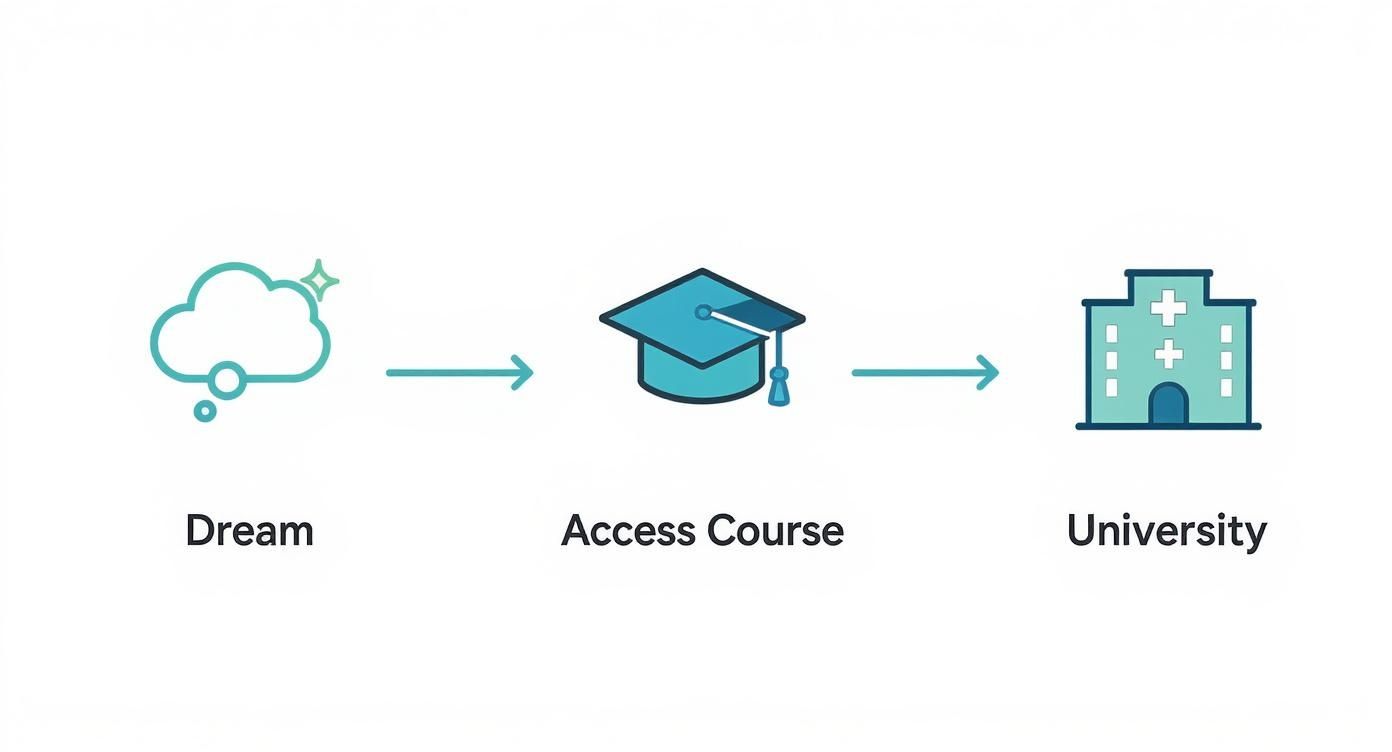
As you can see, the Access course is that essential middle step. It directly links your dream of becoming a nurse to the university degree you need to make it a reality.
What the Access to Nursing Course Involves
So, what exactly do you study on an Access to Nursing course? Let's pull back the curtain.
Think of this diploma as a bridge between where you are now and where you want to be—a fully-fledged nursing student. It’s designed to give you both the specific subject knowledge and the academic stamina needed to succeed in a demanding degree.
You’ll dive into core subjects like Human Biology, Psychology, and Sociology. These aren't just random topics; they are the fundamental building blocks for understanding patient care, health, and illness from every angle.
But the course goes deeper than just the 'what'. It focuses on the 'how'.
The real secret to the Access to Nursing course is that it teaches you how to learn like a university student. It’s not just about getting you through the door; it’s about making sure you thrive once you're inside, armed with top-notch research skills and a critical mindset.
So, while you're getting to grips with anatomy or the principles of social care, you're also mastering the art of writing essays, conducting research, and thinking critically. These are the skills that will set you apart.
Typical Modules in an Access to Nursing Course
To give you a clearer picture, most Access to HE (Nursing) Diplomas are built around a mix of core science subjects and units designed to sharpen your study skills.
Here’s a breakdown of what you can generally expect to cover and why each part is so important for your future career.
| Module Type | Example Subjects | How It Prepares You for Nursing |
|---|---|---|
| Core Sciences | Human Biology, Anatomy & Physiology, Health and Disease | Provides the essential scientific foundation to understand the human body, medical conditions, and treatments. |
| Social Sciences | Psychology, Sociology, Professional Healthcare Practice | Helps you understand the social and psychological factors affecting health and the ethical duties of a nurse. |
| Academic & Study Skills | Research Methods, Academic Writing, Critical Thinking, IT for Academic Study | Equips you with the practical skills needed to write assignments, analyse information, and succeed in higher education. |
As you can see, every module is carefully chosen to build a complete toolkit. You'll finish the course not just with knowledge, but with the confidence and practical skills to hit the ground running on day one of your nursing degree.
Meeting the Entry Requirements

Getting onto an Access to Nursing course isn’t just about ticking boxes with grades; it's about showing you have the heart and readiness for a career in care.
Most colleges will look for GCSEs in English and Maths at grade 4 (C) or higher. But if you don’t have these, don’t panic! There are other routes. Widely accepted alternatives, like Functional Skills Level 2 qualifications, can get you where you need to be. For a complete picture of what universities expect, take a look at our detailed guide on nursing degree entry requirements.
Beyond the paperwork, course providers want to see your passion. This is your chance to shine by highlighting any relevant work or volunteer experience. Showing you understand the core values of nursing and the NHS in your personal statement and interview can truly make all the difference.
Getting Your Application and Funding Sorted
Right, let's talk about the practical side of things: applying for your course and figuring out the finances. It might sound like a lot to handle, but honestly, it’s more straightforward than you might think.
The whole journey kicks off with finding the right provider for you. From there, you'll work on a personal statement that really tells your story and get ready for an interview where you can show just how committed you are to nursing.
Paying for Your Course
Now for the money side of things. The Advanced Learner Loan is a fantastic option for most people. It’s a government loan designed to cover your tuition fees, which removes one of the biggest hurdles straight away. This loan is what makes an access to nursing course a realistic goal for so many aspiring nurses.
If you want to get into the nitty-gritty, we've got a complete guide to Access to Higher Education funding that breaks it all down.
Here's the best part: the government will completely write off your Advanced Learner Loan once you finish a recognised nursing degree. That means your Access course could end up being completely free.
Securing Your University Place After the Course
Finishing your access to nursing course is a massive achievement, and it’s right to feel proud! But of course, that’s just the first major step. The next exciting challenge is applying to university.
So, how does it work? Your diploma translates directly into UCAS tariff points—the currency universities use for admissions. Most nursing degree programmes will have specific requirements, usually asking for a certain number of credits at Merit or Distinction level to show you're ready for the rigours of university study.
This qualification does more than just get your foot in the door. It also gives you the foundational knowledge to decide on a specialisation you’re passionate about, whether that's Adult, Child, or Mental Health nursing. This focused experience is invaluable when it comes to crafting a personal statement that truly stands out.
While interest in nursing careers can shift, the demand for dedicated, qualified nurses is always there. After a dip following the pandemic, recent data shows a promising recovery. There were 18,640 acceptances in 2023, proving that the need for fresh talent in the healthcare sector is as strong as ever. You can dig into the details by checking out the latest student nursing numbers from the NHS.
Ultimately, this diploma is a highly respected qualification that opens doors to degree programmes all over the UK, putting you on a clear path to the career you've been working towards.
Common Questions About the Access Course

One of the first things people ask is, just how intense is an access to nursing course? It’s a fair question. Let’s be honest, they are demanding, but they’re also built with real life in mind. These courses are specifically designed for adults who are often juggling work, family, and a hundred other things.
That's why you'll find flexible learning options. Many of our students successfully balance their studies with part-time jobs and family commitments, proving it’s absolutely achievable.
But what happens if things don't go perfectly, and you don't get the exact grades you need for university? First off, don't panic. It’s not the end of the road. A small setback doesn't have to derail your nursing dream.
You've got options. Systems like UCAS Clearing are there to give you a second chance at finding a spot. Plus, some students choose to retake a specific module to give their grades that extra boost. Your course provider will be there to offer guidance and help you figure out the best next steps to get you back on track towards a brilliant career in nursing.