
So, what exactly is an Access to Higher Education Diploma (Nursing)? Think of it as your dedicated fast-track route to a nursing degree, especially if you don't have the A-Levels universities usually ask for. It’s a purpose-built bridge to get you from where you are now to where you want to be, giving you the knowledge, study skills, and all-important UCAS points to get into university.
It's the key that unlocks your future in healthcare.
Your Bridge to a Nursing Career
It’s a common myth that without A-Levels, the door to a nursing degree is firmly shut. But that's exactly what the Access to Higher Education Diploma was created to challenge. This is a nationally recognised Level 3 qualification—the same level as three A-Levels—designed specifically for motivated adults who are ready to get back into education.
But this isn't just about ticking boxes for a university application. It’s a carefully structured programme that gets you genuinely ready for the demands of studying at degree level.
The course is a perfect fit for so many people, including:
- Career changers looking for a more rewarding and meaningful profession.
- Parents who are ready to chase their own ambitions now their children are older.
- Anyone who, for whatever reason, didn't follow the traditional school-to-A-Levels path.
The real purpose of access to nursing courses is to build you a solid foundation, making sure you don't just get into university—you thrive once you're there.
More Than Just Academic Knowledge
Yes, the curriculum will dive deep into essential subjects like human biology and psychology. But a huge part of the course is about developing the academic skills you'll need to succeed. You’ll learn how to research properly, write a compelling essay, and reference your sources correctly. These are the practical tools that build your confidence and are absolutely vital for higher education.
An Access to HE Diploma is your passport to a university nursing degree. It’s designed to provide the specific academic profile that universities look for from mature students, demonstrating your commitment and readiness for the rigours of a healthcare education.
How It Opens Doors to University
Universities all across the UK really value the Access to HE Diploma. They see it as a proven pathway that equips students with the maturity, discipline, and essential knowledge needed for a demanding degree like nursing.
When you finish the course, you’ll be awarded credits at Pass, Merit, and Distinction grades. These credits are then converted into UCAS Tariff points, which you'll use to meet the entry requirements for the nursing degrees you apply for. It’s this clear, structured progression that makes access to nursing courses one of the most reliable ways for adults to step into a brilliant career in nursing, helping to fill vital roles in the NHS and beyond.
Who Should Consider an Access to Nursing Course?
If you’ve got a burning ambition to become a nurse but feel like you missed the traditional boat, an Access to Nursing course could be your perfect fresh start. It’s a lifeline for people from all walks of life who share one powerful goal: to care for others.
This course is built for those whose journeys didn't involve A-Levels right after school. Maybe you're managing a busy retail store, armed with incredible people skills but craving a career with more soul. Or perhaps you've spent years raising a family, honing your patience and empathy, and are now ready to channel those skills into a new professional challenge.
Whatever your story, this course is designed to recognise your life experience and turn it into the academic key you need to unlock a nursing degree.
Could This Be the Right Path for You?
There's no single "type" of person who thrives on an Access to Nursing course. Our students bring a rich mix of backgrounds and life lessons to the table, but they often have a few things in common.
Does any of this sound familiar?
- You're a career changer: You feel stuck in your current job and are drawn to a role where you can genuinely make a difference in people's lives every single day.
- You’re a parent ready for a new chapter: With the kids a bit more independent, you're ready to invest in yourself and build a stable, rewarding career for the future.
- You missed out on A-Levels the first time around: Life happens. Maybe you went straight into work or took a different path, but that dream of becoming a nurse has never really gone away.
- You have hands-on caring experience: Perhaps you've been a carer for a family member or worked in a support role. That experience has ignited a passion you now want to turn into a profession.
Essentially, this course values your motivation and real-world experience just as much as any previous qualifications. It understands that qualities like resilience, communication, and empathy—often learned far from any classroom—are the true foundations of great nursing.
The Access to HE Diploma is specifically designed to welcome driven individuals back into education. It sees your personal journey and passion for care as your greatest assets, creating a clear pathway to turn them into the university qualification you need.
Why This Route Is So Important for the NHS
The need for dedicated, compassionate nurses has never been clearer. Recent figures show a tricky situation in nursing recruitment. While applications from 18-year-olds saw a welcome 9% increase in 2025, applications from mature students aged 35 and over actually fell by 9%. This is a real challenge for the NHS, especially as the Royal College of Nursing points out that nurses are, on average, starting their careers later in life. You can read more about the latest nursing application trends and see why access to nursing courses are so vital.
This is exactly where the Access to HE Diploma makes a huge impact. It provides a dedicated, supportive route for mature learners, making sure all that valuable life experience doesn't go to waste. By offering a flexible and focused path into nursing, it helps attract the very people our healthcare system needs most—resilient, empathetic, and committed individuals ready for a demanding but incredibly rewarding career.
Your decision isn't just a personal win; it's a step towards strengthening our national healthcare for years to come.
What You Will Learn on the Course

Thinking about what you'll actually learn on an Access to Nursing course? It's much more than a simple checklist of subjects. Think of it as building your complete nursing toolkit from scratch. Each module is a specific, essential tool you'll come to rely on throughout your university degree and your future career on the wards.
The whole curriculum is cleverly split into two areas that work hand-in-hand. You’ve got the core science subjects that give you the "what" and "why" behind patient care, and then you have the practical study skills that teach you "how" to actually succeed as a university student.
This dual-focus approach is what makes these courses so effective. You're not just learning facts; you're learning how to be a confident and capable student, ready for anything your degree throws at you. Let's break down what that really looks like.
Building Your Scientific Foundation
The science modules are the absolute bedrock of your nursing education. They give you the crucial biological and psychological insights needed to look after patients properly. Let's be honest, without this knowledge, clinical practice would just be guesswork.
And don't worry if it's been years since you last opened a science textbook. These modules are designed to be completely accessible, starting with the basics and building your understanding step by step. Every single concept is linked back to a real-world scenario you'd face in a healthcare setting.
Some of the key science-based modules you'll almost certainly cover include:
- Human Biology: This is where you get to grips with everything from the tiniest cells to the major organ systems that keep us going. Understanding how a healthy body works is the vital first step to figuring out what’s happening during an illness.
- Health and Wellbeing: This module zooms out from pure biology to look at the bigger picture. You'll explore the social and environmental factors that affect a person's health, helping you see patients as whole people, not just a list of symptoms.
- Psychology: In nursing, understanding the human mind is just as important as understanding the body. This unit dives into key psychological theories, helping you make sense of patient behaviour, mental health conditions, and the power of great communication.
An Access to Nursing course is brilliant at demystifying complex science. You won't just learn about the respiratory system in theory; you'll learn how that knowledge helps you care for a real patient having an asthma attack.
Mastering Essential University Skills
It's not all about science, though. A huge part of the course is dedicated to getting you ready for the academic side of university. A lot of adult learners feel a bit nervous about writing essays or preparing presentations, but the good news is that these skills are taught right from the start as part of your diploma.
This is a massive advantage of taking an Access to HE course. The course doesn't just assume you know how to study at degree level; it actively teaches you. You’ll learn how to research like a pro, structure a compelling argument, and reference your work perfectly—skills that are non-negotiable for getting a good degree.
Your assessments are designed to build these abilities gradually. Essays will challenge you to think critically and form your own conclusions, while practical reports will train you to record information clearly and accurately—just like the clinical notes you'll write every day as a qualified nurse.
By the time you finish, you won’t just have the knowledge you need for your nursing degree; you’ll have the academic confidence to truly shine.
Right, let's talk about what you'll need to get started. Taking that first step towards a new career can feel like a huge leap, but once you understand what's needed, the whole process feels much more manageable. The journey begins with the entry requirements – think of them as the essential foundation for a successful application, both for your Access course and your future nursing degree.
Most universities and course providers are looking for a solid baseline in your core academic skills. This isn't about being a genius; it’s about making sure you have the fundamental literacy and numeracy skills to handle the demands of studying at degree level and, eventually, clinical practice. After all, calculating drug dosages and writing clear, concise patient notes are non-negotiable skills for any registered nurse.
Because of this, the most common entry requirement you'll come across is a GCSE in English and Maths at grade C/4 or above. If you don't have these, please don't panic. So many students are in the same boat, and many complete Functional Skills qualifications alongside their Access course to tick that box.
Getting to Grips with the Application
Once you've got the basic requirements sorted, the next stage is the application itself. This is your chance to shine and show providers not just what you've done, but who you are as a person and why you're so committed to building a career in nursing.
The application for an Access to Nursing course is usually a straightforward online form, but the most important part of this whole process is your personal statement. This isn't just a formality to get through; it’s your story.
Your personal statement is the heart of your application. It’s where you connect your past experiences—whether from work, family, or volunteering—to the core values of nursing and show that you have the empathy, resilience, and dedication needed to succeed.
To make your application really stand out from the crowd, spend some time thinking about these key areas:
- Your Motivation: Why nursing? Be specific and genuine. Was it a personal experience with the healthcare system, a long-held admiration for the profession, or just a deep-seated desire to help people?
- Transferable Skills: You have more relevant skills than you think, I promise. Did your retail job teach you brilliant communication and how to handle difficult situations? Did raising a family teach you patience, organisation, and how to multitask under pressure?
- Understanding of the Role: Show them you've done your homework. Mentioning the core NHS values—like compassion and commitment—and explaining how you already embody them in your own life is a powerful way to do this.
Writing a Personal Statement That Gets Noticed
Your personal statement is your big opportunity to convince the admissions tutor that you are the right fit for their course. It’s a chance to really articulate your passion and prove you have the potential to be a fantastic future nurse.
Here’s a simple structure you can follow to get started:
- The Opening: Start with a strong, engaging opening that clearly states your ambition to become a nurse and why you're applying for this specific Access course.
- Show, Don't Tell: Use real-life examples to bring your skills to life. Instead of just saying, "I am a good communicator," describe a time when you used your communication skills to resolve a conflict or support someone in distress.
- Demonstrate Your Insight: Reflect on what nursing truly means to you. This shows a much deeper level of understanding beyond the surface-level idea of just "caring for people." For a more detailed breakdown, you can explore our guide on nursing degree entry requirements to see exactly what universities are looking for.
- The Conclusion: Finish up with a confident summary of your commitment and your readiness for the academic challenges ahead, leaving them in no doubt about your passion for a nursing career.
How to Fund Your Access to Nursing Course
Let’s tackle the big question on everyone’s mind: how do you pay for your course? It's often the first hurdle people think of, but the good news is there are clear, supportive funding routes available. Course fees shouldn't be the reason you put your nursing dream on hold.
Getting your head around the financial side of things right from the start brings real peace of mind and lets you focus on what really matters—your studies. For most students diving into an Access to Nursing course, the go-to option is the Advanced Learner Loan.
The Advanced Learner Loan Explained
Think of the Advanced Learner Loan as a helping hand from the government, created specifically for students aged 19 or over who are studying approved Level 3 qualifications, like your Access to HE Diploma.
It's not based on your income, and you won’t have to pay a single penny upfront. The loan covers your tuition fees entirely, and you only start paying it back once you’ve finished your course and are earning over the repayment threshold—which is currently £27,295 a year.
It works a lot like a university student loan. The repayments are designed to be manageable, set at just 9% of whatever you earn above that threshold. Better still, they’re taken straight from your salary, so you don't have to worry about managing the payments yourself.
The Best-Kept Secret for Aspiring Nurses
Now, for the really brilliant part—a unique benefit just for students on a nursing pathway.
If you take out an Advanced Learner Loan to fund your Access to HE Diploma and then go on to complete a university degree in Nursing (or another eligible healthcare subject), Student Finance England will completely write off your outstanding loan balance.
Yes, you read that right. It’s a genuine game-changer. This effectively means your Access to Nursing course could end up being completely free, as long as you successfully progress to and finish your degree. This incredible incentive is there to encourage more dedicated people like you to step into these vital healthcare professions.
For a complete breakdown of the financial support available, check out our in-depth guide to funding your Access to Higher Education course.
Other Funding and Financial Considerations
While the Advanced Learner Loan is the most popular route, some students prefer to pay for their studies themselves. Many providers, including us at Access Courses Online, offer flexible instalment plans to help spread the cost over a manageable period, often without charging any interest. This can be a great option if you’d rather not take out a loan.
It’s also smart to start thinking ahead to university life. Once you’re on your degree course, you may be eligible for the NHS Learning Support Fund, which can provide a non-repayable training grant of at least £5,000 per academic year.
And to help your budget stretch further while you're studying your Access course, don't forget to look into the various student discounts and deals available for everything from groceries to tech. Every little bit helps
Your Pathway to University and a Nursing Career
Finishing your Access to HE Diploma is a massive achievement, but it's really just the beginning. Think of it as the launchpad for your ultimate goal: securing a university place and starting a career as a registered nurse. This diploma is the key that unlocks that future, turning all your hard work into the UCAS Tariff points universities look for.
Every module you complete and each distinction grade you earn are like building blocks. They come together to create a strong academic profile that tells university admissions tutors you're ready for the demands of a nursing degree. This is exactly why it pays to research your target universities early on – knowing what they expect helps you set clear goals for yourself right from the start.
From Access Course to NHS Frontline
Choosing to become a nurse is more than just a personal career move. Right now, there's a significant national shortage of nurses, and the NHS is counting on dedicated people coming through pathways like access to nursing courses to secure its future. Your journey feeds directly into this national need, adding a real sense of purpose to your studies.
You're not just studying for yourself; you're taking a huge step towards becoming a vital part of the UK’s healthcare system. This diploma is your structured path to joining a profession that is truly the backbone of our communities.
A National Need for New Nurses
The demand for skilled nurses is undeniable, but getting enough new recruits into the system has its challenges. Between 2019 and 2025, the number of people in the UK applying for nursing courses changed dramatically. After hitting a high of 53,280 UK applicants in 2021, the numbers dropped to 37,170 in 2025 – the lowest they've been since 2019.
This drop is a real worry for the future of nurse recruitment and the government’s long-term health strategy. The Royal College of Nursing (RCN) has pointed to issues with the education model and the fact that nurse starting salaries are lower than many expect as potential reasons for the decline.
By choosing to pursue nursing via an Access course, you are directly helping to fill this gap, bringing your own unique life experience and passion to a profession that desperately needs it.
This chart shows how funding your Access to Nursing course can get you to your degree without leaving you with long-term debt.
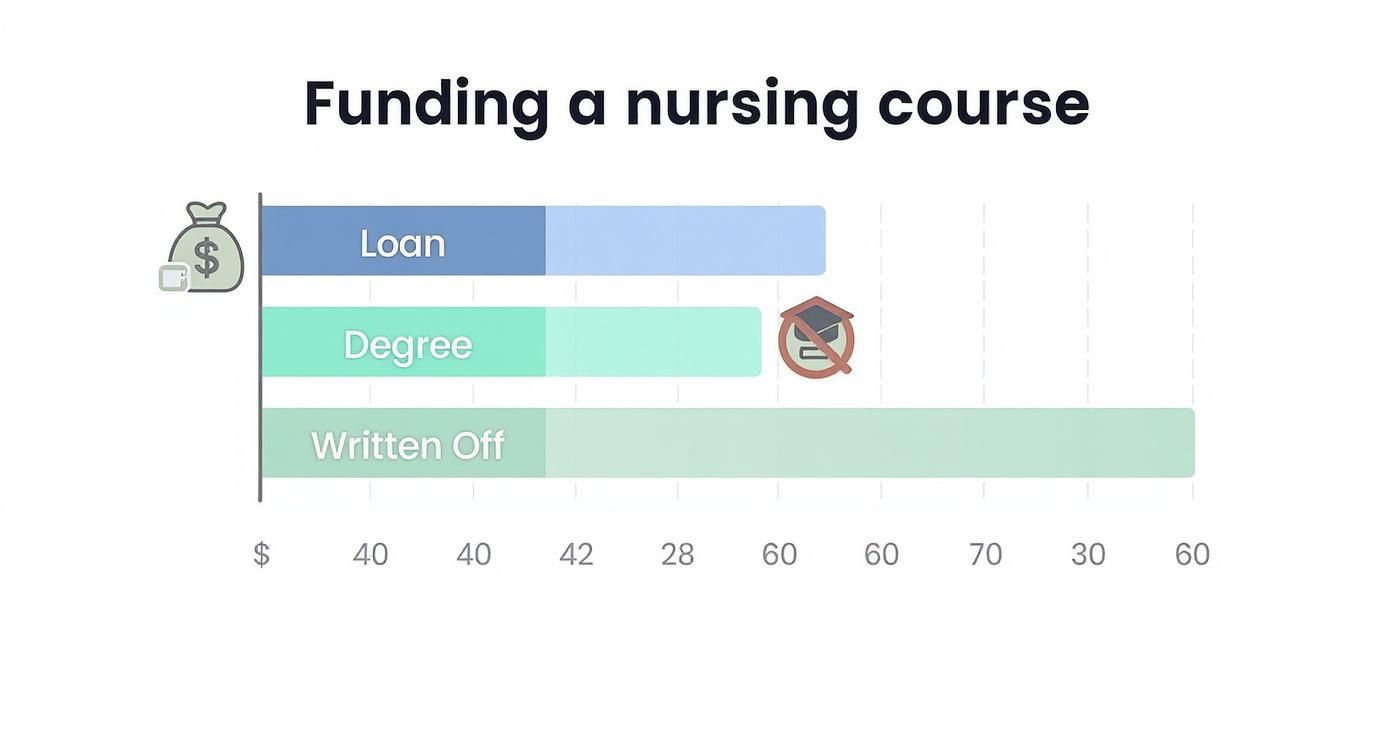
As you can see, the journey is straightforward: you take out an Advanced Learner Loan, complete your nursing degree, and then the loan is written off. Simple as that.
By choosing this pathway, you are making a commitment that benefits not only your future but the health of the nation. Universities and the NHS value the resilience and dedication that Access to HE students bring.
As you get started on your course, using the right tools can make all the difference. To keep your learning organised and your coursework on track, it's worth looking into effective lecture note-taking apps.
Ultimately, your Access to HE Diploma is so much more than just a qualification. It's proof of your determination and the first critical step on a deeply fulfilling journey. For a closer look at the whole process, from day one to your first day on the ward, check out our detailed guide on how to become a nurse.
Frequently Asked Questions
Thinking about a new career path naturally brings up a lot of questions. We get it. So, we’ve put together the most common queries we hear about access to nursing courses to give you clear, honest answers and help you move forward with confidence.
How Intense Is an Access to Nursing Course?
Let’s be honest, it’s a serious commitment. An Access to HE Diploma is a Level 3 qualification, which is the same level as three A-Levels, but you'll typically complete it in just nine months. So yes, the workload is demanding.
But here’s the thing: it’s specifically designed for adult learners. The course builds your knowledge step-by-step, and if you choose an online option, you get the flexibility to fit your studies around your life. It takes real dedication and good time management, but with focus and the support of your tutors, it's absolutely achievable.
Are These Courses Recognised by Universities?
Absolutely. This is probably one of the most important questions people ask. The Access to Higher Education Diploma is a nationally recognised qualification created precisely for adults who want to get into university without A-Levels. It’s widely accepted and respected by universities all over the UK for nursing and other healthcare degrees.
The Quality Assurance Agency for Higher Education (QAA) is the official body that regulates the diploma. This ensures every course meets the high academic standards universities demand, meaning your qualification carries real weight when you fill out that UCAS application.
What Happens If I Don't Have GCSEs in English and Maths?
This is a really common hurdle, so don't let it put you off. Most universities will ask for a grade C/4 or above in both GCSE English and Maths to get onto a nursing degree. If you don't have them, you're not out of the running.
The solution is to study for Functional Skills Level 2 qualifications. These are officially recognised as GCSE equivalents, and the best part is you can often study for them at the same time as your Access course. It’s a brilliant way to tick all the boxes and get everything you need in one go.
Is a Nursing Career Still a Good Choice?
Yes, now more than ever. The need for skilled, compassionate nurses is always high, and the role itself is incredibly rewarding. After a dip following the pandemic, student recruitment is thankfully on the rise again.
In 2025, a total of 18,640 students in England accepted a place on an undergraduate nursing degree, which was a 1% increase from the year before. The growth was especially strong among younger students, with a 6% jump in acceptances for those under 25. Plus, schemes like the NHS Graduate Guarantee are making it easier for newly qualified nurses to land jobs, showing real support for the profession's future. Learn more about the latest trends in student nursing numbers.
Can I Really Get a Job After Graduating?
The job prospects for nursing graduates are fantastic. Nursing is a profession with a national shortage, which means graduate employment rates are consistently high. The skills and hands-on knowledge you gain from your Access course and then your degree make you exactly who the NHS and private healthcare providers are looking for.
Completing an access to nursing course is the first step on a clear, well-trodden path to a stable, fulfilling, and vital career.
Ready to take that first step towards your nursing career? At Access Courses Online, we provide accredited, flexible online courses designed to fit around your life.
Start your journey with us today!