
Preparing for a nursing interview can be nerve-wracking, whether you are a recent graduate, a mature student returning to education, or a seasoned professional seeking a new challenge. Success isn't just about knowing your clinical skills; it's about effectively communicating your competence, compassion, and critical thinking under pressure. This comprehensive guide is designed to demystify the process by breaking down the most common nursing interview questions and answers you're likely to encounter.
We will move beyond generic advice and provide a strategic framework for crafting compelling responses. For each question, we'll delve into the interviewer's intent, helping you understand what they truly want to know. You'll find detailed, realistic sample answers structured using the STAR (Situation, Task, Action, Result) method, a proven technique for showcasing your experience with clarity and impact. Our analysis will offer actionable takeaways you can apply directly to your own preparation, ensuring you can articulate your unique value.
This guide also includes special considerations tailored for individuals pursuing nursing through non-traditional routes, such as an Access to HE Diploma, helping you leverage your life experience as a strength. We will cover everything from handling behavioural questions to discussing your long-term career goals. To ensure your message is always clear and well-received during your interview, it's beneficial to be aware of your speaking clarity, and even explore specialized resources like those offering accent reduction strategies tailored for nurses. Our goal is to equip you with the confidence and tools needed to make a memorable impression and secure that coveted nursing position in the NHS or private sector.
1. Tell Me About Yourself
This seemingly simple request is more than just an icebreaker; it’s a critical first impression. Hiring managers use this question to gauge your communication skills, confidence, and ability to connect your personal journey to the specific nursing role you're applying for. It sets the tone for the entire interview.
Your goal is to deliver a concise, compelling narrative that bridges your past experiences with your future aspirations as a nurse within their organisation.
How to Structure Your Answer
A proven method is the "Present-Past-Future" formula. This structure helps you stay on track and deliver a relevant, professional summary.
- Present: Start with your current situation. If you're a recent graduate from an Access to HE Diploma, mention it. If you're a student nurse, state your university and current placement.
- Past: Briefly touch on relevant experiences that led you here. This is perfect for career changers. Mention a previous role and a key transferable skill (e.g., communication, teamwork, problem-solving) that you developed.
- Future: Connect everything to the role you're interviewing for. Explain why you're excited about this specific opportunity and how your journey has prepared you for it.
Sample Answer & Strategic Breakdown
"I am a recently qualified Adult Nurse, having just completed my BSc (Hons) at the University of Manchester. My final placement was in the Acute Medical Unit at Manchester Royal Infirmary, where I solidified my clinical skills in a fast-paced environment, particularly in complex medication management and patient assessment.
"Before pursuing nursing, I worked for five years as a customer service team leader. That role taught me invaluable lessons in communication, empathy, and de-escalating difficult situations, which I found directly applicable when managing anxious patients and their families on the ward.
"I was drawn to this specific role on the surgical ward at your trust because of your reputation for excellent post-operative care and commitment to staff development. I am eager to apply my communication skills and clinical knowledge to contribute to your team and grow as a surgical nurse."
Why This Answer Works:
- Relevant & Concise: It gets straight to the point, starting with their current, relevant qualification.
- Highlights Transferable Skills: The mention of a past career is framed positively, directly linking customer service skills to patient care.
- Shows Enthusiasm & Research: It explicitly states why this role and this trust are appealing, showing genuine interest.
- Professional Tone: The language is confident and professional throughout.
2. Why Do You Want to Work in Nursing/This Healthcare Facility?
Interviewers ask this two-part question to understand your core motivations. They want to see that your desire to be a nurse is genuine and that your interest in their specific organisation is well-researched. This question separates candidates who want any nursing job from those who want this specific nursing job.
Your answer must demonstrate a strong alignment between your personal values, your professional goals, and the organisation's mission and culture. It's your chance to show you are a perfect fit for their team.
How to Structure Your Answer
A powerful approach is the "Passion-Research-Connection" model. This framework allows you to blend your personal drive with tangible evidence of your interest in the facility.
- Passion: Start with your fundamental reason for choosing nursing. What drives you? This could be a personal experience or a deep-seated value. If you're exploring this career path, you can find valuable insights on how to become a nurse in the UK.
- Research: Show you’ve done your homework. Mention something specific about the trust, hospital, or ward that impresses you. This could be their CQC rating, a recent award, a specialised patient programme, or their commitment to staff training.
- Connection: Bring it all together. Explain how your personal passion for nursing and their specific organisational strengths create a perfect match. Articulate how you see yourself contributing to and growing within their unique environment.
Sample Answer & Strategic Breakdown
"My passion for nursing stems from a desire to provide compassionate, evidence-based care during vulnerable moments in people's lives. I believe that every patient deserves not just clinical expertise, but also dignity and empathy, which is a value I have held throughout my training.
"I was particularly drawn to this Trust after reading about your 'Pathway to Excellence' accreditation and your dedicated dementia-friendly ward initiative. It’s clear that patient-centred care is at the core of your culture, not just a phrase on a website.
"I am eager to join an organisation that so clearly aligns with my own values. I want to contribute my skills to a team that is recognised for its high standards and to learn from the specialised dementia care training you offer. I am confident that this is the ideal environment for me to begin my nursing career and make a meaningful impact."
Why This Answer Works:
- Shows Genuine Motivation: It starts with a strong, value-driven statement about nursing, avoiding generic clichés.
- Demonstrates Research: Mentioning specific initiatives ('Pathway to Excellence', dementia-friendly ward) proves the candidate has gone beyond a superficial look at the organisation.
- Creates Value Alignment: It explicitly connects the candidate's personal values (empathy, dignity) with the Trust's demonstrated culture.
- Forward-Looking: The answer focuses on both contributing to the team and benefiting from the development opportunities, showing a commitment to long-term growth.
3. Describe a Challenging Patient Situation and How You Handled It
This is a classic behavioural question designed to move beyond theory and into practice. Interviewers want to see concrete evidence of your clinical reasoning, resilience, communication skills, and ability to remain professional under pressure. It's a chance to demonstrate your competence in real-world scenarios.
Your goal is to choose a compelling example that showcases your problem-solving skills and patient-centred approach, proving you can navigate the complexities inherent in nursing.
How to Structure Your Answer
The STAR method is the gold standard for answering behavioural questions like this. It provides a clear, logical framework to narrate your experience without rambling.
- Situation: Briefly set the scene. Who was the patient, what was the clinical context, and what was the specific challenge? (e.g., a confused patient refusing essential medication).
- Task: Describe your responsibility in that situation. What was the goal you needed to achieve? (e.g., to safely administer the medication while respecting patient autonomy).
- Action: Detail the specific steps you took to address the challenge. This is the most important part. Use "I" statements and focus on your actions, such as your communication techniques, clinical assessments, or collaboration with the team.
- Result: Explain the outcome of your actions. What happened? What did you learn from the experience, and how did it improve patient care or your own practice?
Sample Answer & Strategic Breakdown
"(Situation) During a placement on a busy geriatric ward, I was caring for an 82-year-old gentleman with dementia who became very agitated and verbally aggressive when I tried to administer his evening dose of antibiotics for a chest infection.
"(Task) My responsibility was to ensure he received this critical medication safely, while also de-escalating the situation to minimise his distress and maintain a calm ward environment.
"(Action) I first took a step back to give him space and spoke to him in a calm, reassuring tone, acknowledging his frustration. I checked his chart for any known triggers and saw none, so I asked his visiting daughter if this was common behaviour. She mentioned he often felt a loss of control. With this insight, I re-approached him, explained what the medication was for in simple terms, and offered him a choice: 'Would you prefer to take your tablet with some water now, or with a bit of yoghurt in five minutes?'
"(Result) By giving him a simple choice, I restored a sense of control for him. He calmed down immediately and agreed to take the medication with yoghurt. The situation was de-escalated without restraint, the patient received his treatment, and I learned a valuable lesson in patient-centred communication for individuals with cognitive impairments. I documented the successful technique in his care plan to help other staff."
Why This Answer Works:
- Follows the STAR Method: The answer is perfectly structured, making it easy to follow and understand.
- Demonstrates Key Skills: It showcases empathy, problem-solving, therapeutic communication, and collaboration (speaking with the family).
- Focuses on "I": The candidate clearly articulates their individual actions and critical thinking process.
- Shows Reflection: It ends by highlighting what was learned and how that learning was applied to improve future care for the patient.
4. How Do You Handle Stress and Prevent Burnout?
This question assesses your self-awareness, resilience, and proactive approach to well-being. Healthcare organisations are increasingly focused on staff welfare, knowing that nurses who manage stress effectively provide better patient care and are more likely to have a long, sustainable career. They want to see that you have healthy, practical coping mechanisms.
Your goal is to demonstrate that you are a resilient professional who understands the demands of the role and has concrete strategies to manage them, ensuring you can perform consistently and safely.
How to Structure Your Answer
A strong answer should demonstrate a multi-faceted approach, showing that you rely on more than one single method. Structure your response to cover these key areas:
- Acknowledge: Start by validating the question. Acknowledge that nursing is a demanding profession and that managing stress is a crucial professional skill.
- Individual Strategies: Detail specific, healthy activities you use to decompress outside of work. This could be physical (exercise, walking), creative (hobbies), or mindful (meditation, journaling).
- Professional & Team-Based Strategies: Explain how you manage stress at work. Mention professional strategies like debriefing with colleagues after a difficult shift, seeking support from a mentor, or practising clear communication to manage workload.
- Organisational Awareness: Show you would engage with workplace resources. Mentioning things like Employee Assistance Programmes (EAPs) or staff well-being initiatives shows you are proactive and understand the importance of organisational support.
Sample Answer & Strategic Breakdown
"I recognise that nursing is a high-pressure role, and I’ve developed several proactive strategies to manage stress. On a personal level, I find that regular physical activity is essential for my well-being, so I prioritise going for a run three times a week. I also maintain strong connections with friends and family outside of healthcare, which gives me a healthy perspective.
"At work, I believe in the power of teamwork and communication. After a challenging shift, I find it incredibly helpful to have a brief, constructive debrief with colleagues. It helps to process events and reinforces that we are a team. I also make a conscious effort to take my designated breaks to reset during the day.
"I am also aware of the importance of organisational support and would make full use of resources like the trust's Employee Assistance Programme if needed. I believe that by combining personal self-care with professional support systems, I can maintain my resilience and continue to provide safe, compassionate patient care."
Why This Answer Works:
- Balanced Approach: It covers personal, professional, and organisational strategies, showing a well-rounded and mature understanding of stress management.
- Specific & Actionable: Instead of just saying "I exercise," it specifies "I go for a run three times a week," which is more concrete and believable.
- Team-Oriented: The mention of debriefing with colleagues highlights teamwork and communication skills, which are highly valued in nursing.
- Shows Proactivity: It demonstrates foresight by mentioning the use of formal support systems like EAPs, showing the candidate is responsible and proactive about their mental health. To further understand how to maintain your well-being in a demanding profession, explore these effective nurse burnout prevention strategies.
5. What Are Your Strengths and Weaknesses?
This question is a cornerstone of competency-based interviews, designed to assess your self-awareness, honesty, and commitment to continuous professional development. Interviewers want to see that you can realistically evaluate your own abilities and that you are proactive about your growth.
Your goal is to present genuine strengths that are directly relevant to the nursing role and to frame a real weakness as an area for development, complete with a clear action plan.
How to Structure Your Answer
A balanced and strategic approach is key. Don't just list qualities; provide context and evidence for your strengths and demonstrate a proactive attitude towards your weakness.
- Strengths: Choose one or two key strengths that align with the job description. For each, use a mini-example to illustrate how you've applied it in a clinical or relevant setting. This makes your claim credible.
- Weakness: Select a genuine, but not critical, area for improvement. Acknowledge it honestly, then immediately pivot to explaining the concrete steps you are taking to address it. This turns a negative into a positive showcase of your professionalism.
Sample Answer & Strategic Breakdown
"One of my key strengths is my ability to build a strong rapport with patients quickly. During my placement on a busy geriatric ward, I made a point of spending a few extra minutes with each patient during my initial checks to learn something personal about them. This helped me to build trust, which was invaluable when I needed to explain complex care plans or encourage them to mobilise post-surgery.
"An area I have been actively working on is delegating tasks. Initially, I had a tendency to try and manage everything myself to ensure it was done to a high standard. However, I soon realised this wasn't efficient or supportive of my colleagues. To improve, I completed a short online module on effective delegation and started consciously entrusting tasks to healthcare assistants, providing clear instructions and trusting in their capabilities. This has greatly improved our team's workflow and my own time management."
Why This Answer Works:
- Relevant & Specific: The strength (patient rapport) is a core nursing skill, backed by a concrete example from a geriatric ward.
- Demonstrates Proactivity: The weakness is presented as a learning journey. It shows self-awareness and a clear, actionable plan for improvement (completing a module, consciously practising).
- Avoids Clichés: It avoids generic answers like "I'm a perfectionist." The weakness chosen is realistic for a new or developing nurse and shows an understanding of team dynamics.
- Positive Framing: The answer concludes on a positive note, highlighting the improved workflow and personal growth resulting from addressing the weakness.
6. How Do You Stay Current With Nursing Practice and Evidence-Based Care?
Healthcare is constantly evolving, driven by new research, technology, and patient care standards. Interviewers ask this question to gauge your commitment to lifelong learning and your dedication to providing the safest, most effective care possible. They want to see that you are a proactive professional, not a passive one.
Your answer should demonstrate a clear, multi-faceted strategy for staying informed. It’s not enough to say you read articles; you need to show how you actively seek out, evaluate, and apply new knowledge to your clinical practice.
How to Structure Your Answer
A strong answer should detail specific activities and link them to improved patient outcomes. Focus on a few key areas rather than listing everything you've ever done.
- Formal Learning: Begin with formal methods like continuing professional development (CPD), certifications, or relevant courses. Mention specific organisations or publications.
- Practical Application: Connect your learning to your work. Give a brief example of how a piece of new evidence changed your practice or contributed to a quality improvement initiative on your ward.
- Professional Engagement: Mention your involvement with professional bodies (like the RCN or NMC), attending conferences, or engaging in peer discussions like journal clubs.
Sample Answer & Strategic Breakdown
"I am committed to lifelong learning and use a combination of methods to stay current. I regularly read publications from the Royal College of Nursing and the British Journal of Nursing to keep abreast of national guidelines and emerging research in my specialty.
"For example, I recently completed a CPD module on advanced wound care which highlighted new evidence for a particular type of dressing. I discussed this with my ward sister and, following our unit's protocol, we trialled the new dressing on a patient with a chronic wound, which led to a noticeable improvement in healing time.
"I also believe in learning from my peers, so I actively participate in our ward's monthly journal club. This allows us to critically appraise new studies together and discuss how we can integrate evidence-based changes into our daily practice to enhance patient safety and outcomes."
Why This Answer Works:
- Specific & Credible: It names respected professional bodies and journals (RCN, British Journal of Nursing), adding weight and credibility.
- Shows Initiative: The candidate didn't just learn something; they took action by discussing it with a senior colleague and applying it in practice.
- Demonstrates Impact: It provides a concrete example of how their learning directly led to a positive patient outcome, proving the value of their efforts.
- Collaborative Spirit: Mentioning the journal club shows they are a team player who values collaborative learning and continuous improvement.
This approach effectively answers one of the most important nursing interview questions and answers by proving you are a dedicated and reflective practitioner. For more on the importance of continuous development, you can explore why upskilling is key to advancing your career.
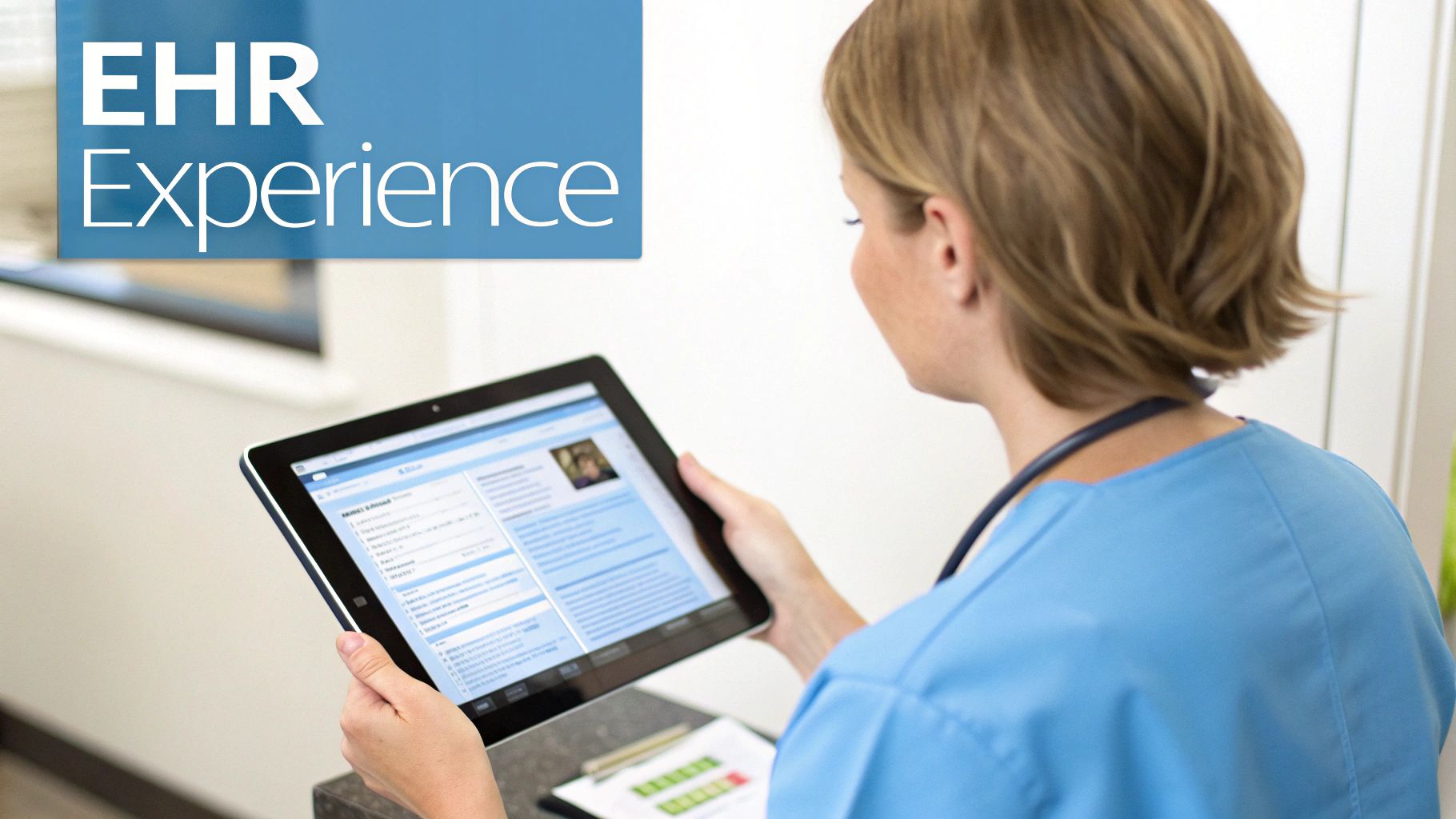
7. Describe Your Experience with Electronic Health Records (EHR) and Medical Technology
In today's healthcare environment, digital proficiency is non-negotiable. This question assesses your technical competence, adaptability, and understanding of how technology underpins patient safety and efficiency. Hiring managers want to see that you can integrate seamlessly into their digitally-driven workflows.
Your goal is to demonstrate not just familiarity with specific systems, but also a broader understanding of how these tools improve patient care, streamline documentation, and support clinical decision-making.
How to Structure Your Answer
A strong answer should specify your experience, highlight your proficiency, and show your enthusiasm for learning.
- Specify Systems: Name the specific EHR systems you have used (e.g., Epic, Cerner, System C). Being specific shows direct, hands-on experience.
- Describe Proficiency: Go beyond just naming the system. Mention key functions you are comfortable with, such as clinical documentation, medication administration records (MAR), patient observations, and care planning.
- Emphasise Adaptability & Safety: Connect your skills back to patient outcomes. Explain how you use technology to ensure safety and express your willingness to quickly learn the new systems used by the trust. The increasing role of digital skills in healthcare is undeniable.
Sample Answer & Strategic Breakdown
"During my placements, I gained extensive hands-on experience with the System C CareFlow EHR. I am highly proficient in managing patient records, charting observations and assessments, and using the electronic medication administration system to ensure safe and accurate delivery of care. I particularly found the integrated alert system valuable for flagging potential patient safety issues, like allergies or deteriorating NEWS2 scores.
"I understand that every trust customises its systems, and I am a very quick learner. At my previous placement, I quickly became the go-to person on my shift for troubleshooting minor system queries for my peers.
"I am confident in my ability to quickly become proficient with your specific EHR and am eager to leverage technology to contribute to the high standards of patient safety and care on this ward. I see technology as a crucial tool for enhancing clinical practice, not just an administrative task."
Why This Answer Works:
- Specific & Confident: It names a specific, widely used UK system (System C) and confidently lists core nursing functions performed within it.
- Highlights Safety Focus: The answer cleverly links EHR use directly to patient safety by mentioning allergy alerts and NEWS2 scores, a key priority for any NHS trust.
- Shows Proactive Adaptability: It acknowledges that systems differ and frames this as a positive, showcasing a quick-learning attitude and even peer support skills.
- Positive Mindset: It concludes by framing technology as a positive tool for improving patient care, which is exactly what a modern, forward-thinking trust wants to hear.
8. Tell Me About a Time You Collaborated With a Multidisciplinary Team to Solve a Patient Problem
Modern healthcare is a team sport. No single professional has all the answers, and this question probes your ability to be an effective team player. Hiring managers want to see if you can communicate effectively, respect the expertise of others, and contribute to a coordinated effort focused on patient-centred care.
Your objective is to narrate a specific situation where you worked with professionals from different disciplines. The key is to show how this collaboration directly led to a better outcome for the patient, highlighting your role as a facilitator and active participant.
How to Structure Your Answer
The STAR method (Situation, Task, Action, Result) is perfect for this question. It provides a clear, logical framework to tell a compelling and complete story of your collaborative skills.
- Situation: Briefly set the scene. Describe the patient's condition and the specific challenge that required a multidisciplinary approach. For example, a patient with complex needs preparing for discharge.
- Task: Clearly state your specific goal or responsibility within the team. What was the objective? It could be to create a safe discharge plan or to resolve a medication conflict.
- Action: Detail the specific steps you took to facilitate collaboration. Describe who you worked with (e.g., physiotherapist, social worker, doctor) and what each person contributed. Emphasise your communication and teamwork.
- Result: Conclude by explaining the positive outcome. How did the team's collaboration benefit the patient? Use specific results, such as "the patient was discharged safely with all necessary support," or "their pain was better managed."
Sample Answer & Strategic Breakdown
"During my placement on a geriatric rehabilitation ward, I was caring for an 82-year-old gentleman recovering from a hip fracture. He was medically fit for discharge, but his mobility was still limited, and he lived alone. The (S) Situation was complex; a premature discharge could lead to a fall and readmission.
"My (T) Task as his named student nurse was to help coordinate a safe and sustainable discharge plan that addressed his medical, physical, and social needs.
"For the (A) Action, I initiated a multidisciplinary team meeting. I liaised with the physiotherapist to understand his mobility limitations and equipment needs. I spoke with the ward doctor about his pain management regimen, and I contacted the social worker to discuss arranging a care package and a home safety assessment. I acted as the central point of communication, ensuring everyone was aware of the patient's progress and the different aspects of the plan.
"As a (R) Result, we developed a comprehensive plan. The physiotherapist arranged for a walking frame, the social worker secured twice-daily carer visits, and we adjusted his medication timings to optimise pain relief during his most active periods. He was discharged home safely a few days later, and at his follow-up appointment, he was reported to be coping well and regaining his independence."
Why This Answer Works:
- Demonstrates Proactivity: The candidate didn't just participate; they "initiated a meeting," showing leadership potential.
- Clearly Defines Roles: It specifies who was involved (physiotherapist, doctor, social worker) and their unique contributions, showing an understanding of the team structure.
- Patient-Centred Focus: The entire narrative revolves around the patient's safety and well-being, which is the ultimate goal.
- Highlights Communication: The answer explicitly mentions acting as a "central point of communication," a critical nursing skill.
Nursing Interview Q&A: 8-Point Comparison
| Question | 🔄 Implementation complexity | ⚡ Speed / Efficiency | ⭐ Expected effectiveness / quality | 📊 Expected outcomes / impact | 💡 Ideal use case / Tip |
|---|---|---|---|---|---|
| Tell Me About Yourself | Low — open-ended, minimal setup | Moderate — ~2–4 min | ⭐⭐⭐ — shows communication & priorities | Surface-level fit, candidate narrative cue | Prepare a 2–3 minute nursing-focused story |
| Why Do You Want to Work in Nursing / This Facility? | Low–Medium — requires candidate research | Moderate — ~2–3 min | ⭐⭐⭐⭐ — strong indicator when specific | Predicts cultural fit, motivation, retention | Reference facility mission, programs, genuine reasons |
| Describe a Challenging Patient Situation (STAR) | Medium — behavioral probing required | Longer — ~4–6 min | ⭐⭐⭐⭐ — reveals judgment, problem-solving | Concrete evidence of clinical competence & teamwork | Use STAR; focus on your actions and measurable result |
| How Do You Handle Stress and Prevent Burnout? | Low — reflective, wellness-focused | Short–Moderate — ~2–4 min | ⭐⭐⭐ — indicates resilience & self-awareness | Signals sustainability, risk of turnover | Cite specific, practiced coping strategies and supports |
| What Are Your Strengths and Weaknesses? | Low — requires honest framing | Short — ~1–3 min | ⭐⭐⭐ — shows self-awareness and growth mindset | Identifies training needs and role fit | Choose relevant strengths; present weaknesses you’re improving |
| How Do You Stay Current With Nursing Practice? | Medium — probes professional development habits | Short–Moderate — ~2–4 min | ⭐⭐⭐⭐ — strong predictor of continuing competence | Indicates likely adoption of best practices & QI involvement | Mention journals, certifications, recent applied changes |
| Describe Your Experience with EHR and Medical Technology | Medium — technical details vary by system | Short — ~1–3 min | ⭐⭐⭐ — demonstrates technical readiness | Reveals onboarding speed and documentation quality | Specify systems (Epic, Cerner, etc.) and modules used |
| Time You Collaborated With a Multidisciplinary Team | Medium — needs role clarity and outcomes | Moderate — ~3–5 min | ⭐⭐⭐⭐ — shows teamwork, leadership, influence | Demonstrates interprofessional communication and patient outcomes | Identify team roles, your facilitation, and quantifiable impact |
Your Final Pre-Interview Checklist and Key Takeaways
You've navigated the landscape of common nursing interview questions and answers, from behavioural deep dives to questions about your core motivations. Now, it's time to consolidate that knowledge into a powerful, confident performance. A successful nursing interview isn't just about reciting perfect answers; it's about showcasing the competent, compassionate, and resilient professional you are.
Remember, every question is an opportunity. It's a chance to connect your personal experiences, whether from previous healthcare roles or the dedicated study you undertook in your Access to HE Diploma, to the specific needs of the facility and the values of the nursing profession. Your unique journey is your greatest asset.
Distilling Your Strategy: The Core Principles
As you finalise your preparation, focus on these overarching principles that we have explored. They are the foundation upon which strong, memorable answers are built.
- Authenticity Over Perfection: Hiring managers are looking for a genuine person, not a robot. Your passion for patient care, your self-awareness about your weaknesses, and your authentic enthusiasm are what will make you stand out.
- The STAR Method is Your Framework: For every behavioural question, the STAR method (Situation, Task, Action, Result) provides a clear, concise, and compelling structure. It prevents rambling and ensures you deliver a story with a powerful conclusion.
- Research is Non-Negotiable: Demonstrating that you have researched the hospital, its values (like the 6 Cs of Nursing), its recent achievements, and the specific patient population it serves shows genuine interest and initiative. This is a critical differentiator.
- Connect to the "Why": Beyond the what and the how, always link back to the why. Why was that patient interaction meaningful? Why does evidence-based practice matter to you? This reveals your underlying values and commitment to nursing.
Final Actionable Checklist
Use this checklist in the final days and hours before your interview to ensure you are fully prepared and confident. Go through each point methodically.
- Re-read Your CV and Personal Statement: Be prepared to discuss anything you have written. Your interviewers will have these documents in front of them.
- Prepare 3-5 STAR Method Stories: Have versatile examples ready that showcase key competencies: teamwork, handling conflict, managing stress, patient advocacy, and problem-solving. One strong story can often be adapted for multiple questions.
- Formulate Your Questions: Prepare at least three thoughtful questions to ask the interviewers about the role, the team, or the unit's culture. This demonstrates your engagement and critical thinking.
- Conduct a Mock Interview: Practise answering questions aloud with a friend, family member, or mentor. This helps you refine your timing, tone, and delivery, especially for virtual interviews.
-
Plan Your Logistics (Virtual or In-Person):
- For Virtual: Test your technology (camera, microphone, internet connection), choose a professional and distraction-free background, and ensure your lighting is good.
- For In-Person: Plan your route, allow extra time for travel, and prepare your professional attire the day before.
- Review Key Clinical and Professional Knowledge: Briefly refresh your memory on the NMC Code of Conduct, the principles of evidence-based practice, and any clinical skills relevant to the role.
Mastering these nursing interview questions and answers is the final step in translating your hard-earned qualifications into a tangible career. You have put in the work, whether through traditional education or a flexible online course, to get to this point. Now is the time to let that dedication shine through. Walk into that room (or log into that call) with the self-assurance that you have not only the knowledge but also the strategic communication skills to succeed. Good luck!
If you're at the beginning of your journey and need the foundational qualifications to apply for a nursing degree, an Access to Higher Education Diploma is your direct pathway. At Access Courses Online, we provide flexible, accredited online courses designed to fit around your life, empowering you to take the first critical step towards your healthcare career. Discover how our Access Courses Online can help you build the knowledge and confidence to succeed, from your first assignment to your final university interview.