

You may be looking at a course page right now with two tabs open. One for the course you want, and one for your bank account.
That's a familiar place to start. Plenty of adults know exactly why they want to return to study. They want nursing instead of another year in a job that drains them. They want to move into computing, social science, business, or a health profession. They want a route into university that feels realistic. The problem usually isn't motivation. It's cost, and the fear of getting the funding decision wrong.
That's why it helps to stop asking, “Can I afford to do this?” and start asking, “Which adult learner grant, bursary, or support scheme fits my situation?”
You're far from alone in making this shift. Nearly half of adults in the UK, 49%, have participated in learning within the last three years, which was reported as an all-time high in adult education participation in FE Week's coverage of the 2023 participation report. Adults are returning to education in large numbers because retraining, career change, and second chances matter.
A good funding plan doesn't start with filling in forms at random. It starts with knowing what counts as a grant, what support sits outside tuition, and what to ask your provider before you commit. That's where money, time, and stress are saved.
Your Dream Career is Closer Than You Think
A lot of adults carry the same private thought for years: “I could do more if I could just get back into education.”
You might have left school without the qualifications you needed. You might have started a career that once made sense but doesn't fit your life now. Or you may already know the next step, such as an Access course leading to university, but keep putting it off because funding feels murky.
The cost worry is real, but it isn't the whole story
When adults hesitate, they often assume the only way forward is to pay everything themselves. That's where people get stuck. They see the tuition fee and stop there, without checking whether they qualify for funded learning, grant support, or extra help with practical costs.
The more useful question is this: what support could reduce the cost of returning?
That shift matters because adult funding rarely comes in one neat package. Some learners get their course funded. Others combine a grant with targeted support for day-to-day costs. Others use a loan or payment plan only after they've checked the free options first.
Practical rule: Start with support that doesn't need repaying. Only look at borrowing once you know what grant help is available.
Returning to education is normal now
There's also something reassuring about the wider picture. Adult learning isn't unusual or niche. As noted earlier, 49% of adults in the UK have taken part in learning within the last three years, showing that returning to study is part of mainstream adult life, not a risky exception.
That matters emotionally as much as financially. If you've been out of education for years, it's easy to think everyone else has a head start. They don't. Adult classrooms and online courses are full of people building a second chance, a new profession, or a route to university they missed the first time.
What this means for you
If you're considering an Access course, don't treat funding as an afterthought. Treat it as part of your course choice.
A strong plan usually includes:
- A clear goal: Know what degree or career you're working towards.
- A funding first approach: Check grant eligibility before you think about paying privately.
- A full-cost view: Tuition matters, but so do travel, childcare, equipment, and time.
- Early conversations: Funding questions are easier to solve before enrolment than after it.
An adult learner grant can be the difference between “one day” and “this year”. The key is understanding what that term means, because not every type of support works the same way.
What Exactly Is an Adult Learner Grant
An adult learner grant is money or funded support that helps pay for your education and doesn't need to be repaid. That's the point people most want clarified, and it's the one that makes grants so valuable.
A simple way to think about it is this. A grant is like educational support that covers a cost for you. A loan is borrowing that cost and dealing with repayment later. Both can help. They're just not the same thing.
Grant versus loan in plain language
If you've been overwhelmed by funding jargon, strip it back to the basics:
| Type of support | What it does | Do you repay it? |
|---|---|---|
| Grant | Covers some or all eligible education costs | No |
| Loan | Lets you borrow towards study costs | Yes, under the loan rules |
That distinction matters because many adults assume all education funding creates debt. It doesn't.
The grant that matters most for many adult learners
For a lot of adults in England, the most important example is this: learners aged 19+ studying their first full Level 3 qualification can be eligible for a fully funded Adult Education Budget grant, so the course is free and there is no repayment as outlined by NCFE.
That's the sort of support that can make an Access route feel possible again.
If you're unsure whether your course sits at the right level, ask the provider directly. “Is this eligible for full funding as a first Level 3?” is a smart question, and it usually gets you to the right conversation fast.
Why people get confused
There are three common reasons adult learners mix funding types up:
- The names are technical: Adult Skills Fund, Adult Education Budget, bursary, discretionary support, loan. They can blur together.
- Tuition and living costs are separate: A free course doesn't always mean every associated cost disappears.
- Eligibility is personal: Your age, previous qualifications, employment situation, and course choice can all affect what you can access.
A grant pays differently from a loan, and support for tuition is different from support for day-to-day study costs.
A useful way to think about your search
Don't search for “money for adults going back to study” and hope for the best. Search in layers.
Start with:
- Course funding for the qualification itself.
- Supplementary support for costs around the course.
- Fallback options only if the free routes don't apply.
That order keeps you from borrowing too early. It also makes the rest of the funding environment much easier to understand.
Mapping the UK Adult Funding Landscape
Most adults don't need a longer list of funding names. They need a map.
The easiest way to make sense of the UK's financial aid environment is to sort support into the main places it comes from. Once you do that, you stop treating funding like a mystery and start treating it like a search process.
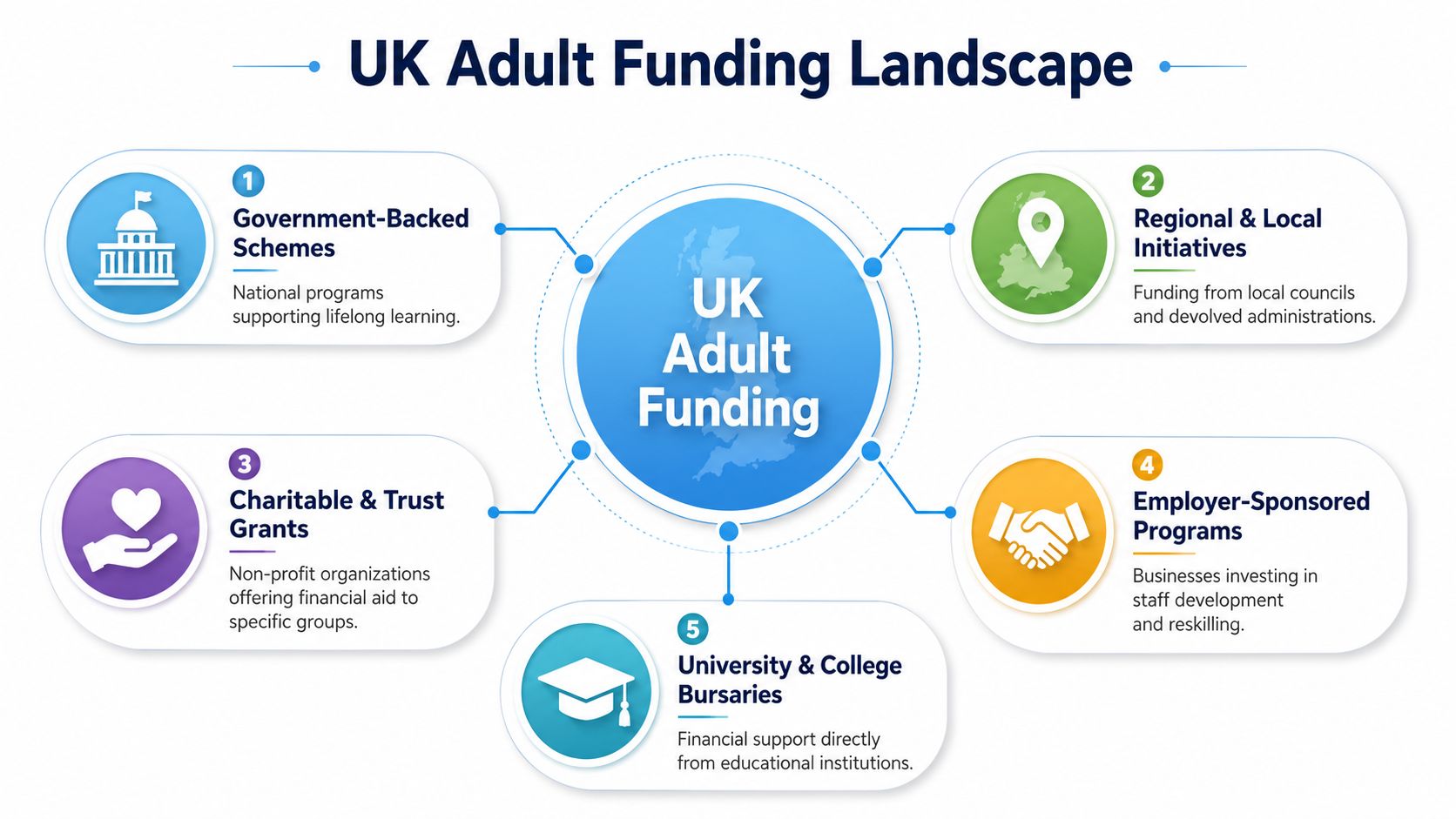
Government backed schemes
Many begin their search with government-backed support, and rightly so. Government backed support often covers tuition for eligible adult learners, especially where the course level and your previous qualifications fit the rules.
These schemes are usually the most structured. They have clearer eligibility criteria, recognised course lists, and provider processes already in place. If your Access route connects to a recognised Level 3 entitlement, this is often your strongest first stop.
Regional and local initiatives
Your local area can matter more than you think. Some adult education funding is influenced by local authorities, devolved systems, or regional priorities.
That means two learners with similar goals can see different options depending on where they live and which provider they use. If you're looking locally, ask specific questions rather than broad ones. Try asking whether there is any regional adult skills support attached to your postcode or learning provider.
If childcare is one of your biggest concerns, it also helps to understand the wider family budget picture. A plain-English guide to understanding UK childcare costs can help you estimate what support you may need to ask about alongside course funding.
Charitable and trust grants
This category is often overlooked because it takes more searching and the awards can be narrower in scope. But for some adults, especially those with a specific personal circumstance, charitable funding can be worth the effort.
These grants may focus on hardship, caring responsibilities, disability, community ties, or a particular career path. They're less universal, but they can fill gaps that mainstream tuition funding doesn't cover.
Employer sponsored programmes
If you're already employed, don't ignore internal support. Some employers will contribute to study where the course supports development, progression, or retraining.
Even if they won't cover everything, they may help with fees, time off, equipment, or flexible working. A short email to HR or your manager can uncover more than many people expect.
University and college bursaries
Providers themselves can be part of the solution. Colleges and universities sometimes offer bursaries, hardship support, or signposting to additional funds.
One example of targeted support beyond tuition is the Adult Dependants' Grant, which is a non-repayable support for full-time students with a financially dependent adult, with a maximum award of £3,545 for the 2025 to 2026 academic year as described in this adult education funding explainer.
For a broader look at different routes learners often combine, this guide on funding for courses is a useful place to compare the main support types before you apply.
The strongest funding plan usually comes from stacking the right sources, not waiting for one perfect scheme to solve everything.
The Ultimate Eligibility Checklist for Funding
Eligibility is where adults often lose confidence. The rules can sound technical, and many people assume a small uncertainty means they won't qualify.
It doesn't. It usually means you need a checklist.
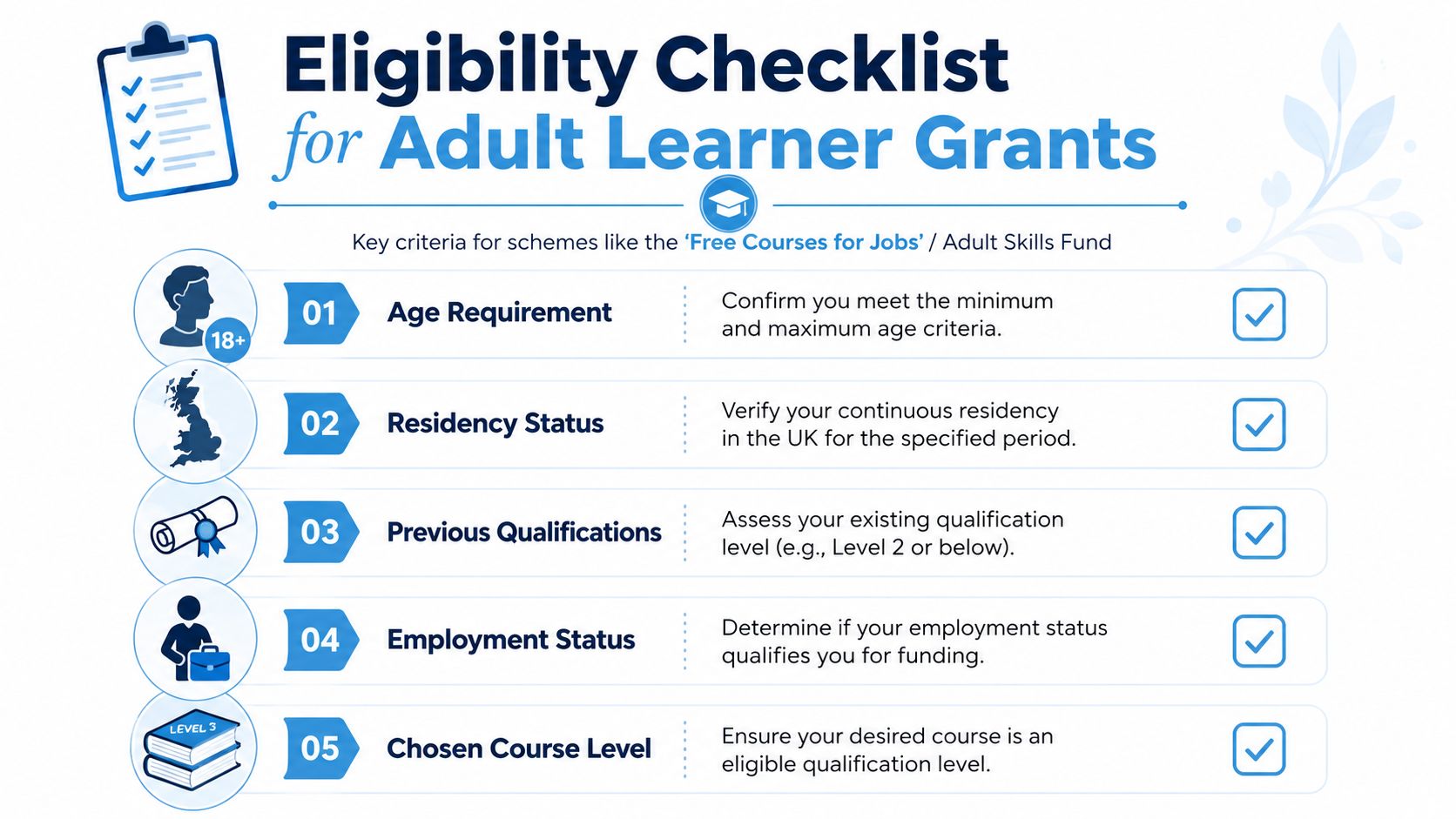
The first questions to answer
For many adult learners aiming at an Access route or another Level 3 pathway, the most useful starting points are these:
- Your age: Are you 19 or over at the point the course begins?
- Your qualification history: Is this your first full Level 3 qualification?
- Your course level: Is the course itself eligible under the funding scheme your provider uses?
- Your residency position: Do you meet the provider's residency rules for funded study?
- Your current circumstances: Are you employed, on a lower income, or unemployed in a way that may affect support?
These aren't trick questions. They're screening questions. Your answers tell you which conversation to have next.
Where many adult learners misread the rules
The biggest source of confusion is previous study. People often think, “I did some qualifications years ago, so I probably won't get anything.” That may or may not be true. The important detail is whether you already hold the level of qualification that affects the grant you're checking.
Another point people miss is that course labels can hide funding relevance. A course name may sound similar to another, but only certain qualifications count in a particular funding stream. That's why provider confirmation matters.
A practical self-check
Use this as a working checklist before you speak to admissions or a funding adviser:
| Check | What you need to know |
|---|---|
| Age | Whether the scheme applies to adults from age 19 |
| Course level | Whether your chosen course is classed at the funded level |
| Previous qualifications | Whether you already hold the same level or higher |
| Residency | Whether you meet the provider's funding rules |
| Extra support needs | Whether costs like childcare or travel may need separate help |
Your eligibility may be split across different funds
One important point. You might be eligible for one kind of support and not another.
For example, a learner might qualify for funded tuition but still need separate help with study costs. Another might not qualify for a tuition grant but could still be considered for bursary style support or a different payment route. Funding rarely works in an all-or-nothing way.
That's one reason mature students often benefit from reading up on the wider finance picture, not just one grant. If you want a fuller overview of how funding options can work later on in your journey, this guide to student finance for mature students is a helpful companion.
If your answer is “maybe”, that's not a rejection. It's a sign to verify the detail with the provider rather than ruling yourself out.
What to gather before you ask
You'll usually get better answers if you have these details ready:
- Proof of identity: So the provider can check basic enrolment requirements.
- Address and residency information: Needed for funding checks.
- Your qualification history: Even rough details help at the first stage.
- Your employment situation: This can affect what support is available.
- Your intended progression: If you know the degree or career you want, say so.
Adults often think they need every document before making contact. You don't. You just need enough information to ask the right first question.
How to Secure Your Grant Step by Step
Once you know the funding overview and your likely eligibility, the next job is action. This part is much more manageable when you break it into small steps and do them in the right order.

Choose the course before you chase the money
It sounds obvious, but many adults search for grants before they've pinned down the exact course. Funding decisions depend on the qualification, level, provider, and your circumstances. You need a specific course in mind before anyone can tell you much that's reliable.
Write down:
- the course title
- the level
- the provider
- your intended next step after the course
That turns a vague funding query into a practical one.
Ask the provider the right questions first
This is the step people skip, and it often costs them time.
Before you fill in external forms, ask the provider:
- whether the course can be fully funded
- which grant route applies
- what evidence they'll need
- whether there is additional support for costs outside tuition
If you want a quick primer on the kinds of support you may be discussing, this overview of a grant for education can help you arrive better prepared for that conversation.
Gather documents in one folder
A simple admin habit makes this much easier. Create one digital folder and one paper folder if you prefer hard copies.
Include:
- ID documents
- proof of address
- evidence of previous qualifications
- employment or benefit information if relevant
- notes from calls or emails with the provider
When funding teams ask for something, you'll be able to respond quickly instead of hunting through old emails.
Don't forget the hidden costs
Often, many adult learners miss support they could have had. Tuition is only one part of the total cost of returning to study.
Adult learners in England have a statutory right to be considered for Discretionary Learner Support for costs such as childcare, travel, and equipment, but they must proactively ask their college or provider about applying according to GOV.UK guidance on grants and bursaries for adult learners.
That phrase matters: proactively ask.
Ask this directly: “Can I be considered for Discretionary Learner Support for childcare, travel, or equipment?”
Many learners never ask, because they assume the provider will mention it automatically. Sometimes they do. Sometimes they don't. Bring it up yourself.
A short video can also help if you prefer seeing the process discussed rather than only reading about it.
Follow up like a project manager
Treat your application like a small project with dates and checkpoints.
- Send the initial enquiry
- Confirm the funding route
- Submit the required evidence
- Ask about supplementary support
- Check whether anything is missing
- Keep copies of every reply
This approach is especially useful if you're balancing work and family responsibilities. You don't need to do everything in one sitting. You just need to keep the process moving.
Smarter Funding Alternatives and Your Next Steps
Not getting a full grant doesn't mean your plan has failed. It means you move to the next sensible option.
That matters more now because public funding for adult education has tightened over time. The Institute for Fiscal Studies reports a £2 billion real-terms reduction since 2003 to 2004, with spending falling from an inflation-adjusted peak of £6.3 billion to about £4.3 billion in 2023 to 2024, which helps explain why many adults now need a mixed funding strategy rather than a single source of support in the IFS overview of adult education and skills spending.
A grant is best, but it isn't your only route
If grant funding doesn't fully apply, adults often look at two practical alternatives:
- Advanced Learner Loan: A structured borrowing option for eligible study.
- Provider payment plans: Useful when you want to spread costs in a controlled way.
The right choice depends on your situation. Some learners value the lower immediate pressure of a loan. Others prefer the certainty of staged payments and no borrowing beyond the course cost.
Grant versus loan at a glance
| Feature | Adult Learner Grant | Advanced Learner Loan |
|---|---|---|
| Repayment | No repayment | Repayment applies under the loan rules |
| Best for | Learners who meet funding criteria | Learners who need a fallback when grants don't apply |
| Financial feel | Reduces or removes upfront tuition cost | Spreads cost through borrowing |
| Main question to ask | “Am I eligible?” | “Is this borrowing manageable for me?” |
Use alternatives strategically
A fallback option works best when you choose it deliberately, not in panic.
For example, if tuition funding isn't available, you can still reduce pressure by checking whether any other study costs can be supported separately, then deciding whether a loan or instalment route covers the remainder more comfortably. Looking at your wider monthly budget can help here. If you need a practical way to get organised before committing, this guide on how to automate your personal finances is useful for building a clearer payment plan around study.
Your next move should be simple
Don't try to solve every funding question in one evening. Start with the shortest path to clarity.
Do these three things next:
- Pick the exact course you want
- Ask whether you qualify for funded tuition
- Ask separately about childcare, travel, and equipment support
That sequence prevents one of the most common mistakes adults make. They focus only on the headline course fee and miss support that could make study workable in practice.
The adult learner grant system can seem scattered at first, but it becomes much easier once you treat it as a roadmap. Check the free routes first. Ask direct questions. Gather evidence early. Keep a backup plan ready. That's how adults move from “I'd love to do this” to “I've started.”
If you're ready to explore your options, Access Courses Online can help you check suitable Access to HE Diploma routes, understand possible funding options, and find a study plan that fits around work and family life. A quick conversation with their team can help you turn a vague idea into a practical next step.