

You may be working full time, caring for family, and wondering whether a science career is still realistic without the A-levels you needed at school. Perhaps you've searched for biomedical science degrees and found demanding entry requirements, then discovered that an Access route could give you another way in. The opportunity is real, but the route is more demanding and more specific than many course pages suggest.
A biomedical science access course can help you prepare for university, but enrolling is only the first decision. You also need to match the course content to your target degree, understand how online practical work is assessed, check your GCSE foundation, and make sure the workload fits your life. A careful plan now can prevent an expensive qualification from failing to meet one university's subject or grade conditions later.
Understanding the Biomedical Science Access Course
Consider a learner who has spent several years in an administrative role and now wants to move into laboratory-based healthcare work. They may have strong motivation and relevant life experience, but no traditional science A-levels. An Access to Higher Education Diploma can provide the academic bridge between that starting point and a university biomedical science degree.
The qualification is a nationally recognised Level 3 programme in the UK, regulated by the Quality Assurance Agency for Higher Education and designed for adults returning to education. It develops subject knowledge alongside the study habits universities expect, including academic writing, evidence handling, scientific reasoning and structured assessment. The route is therefore different from a short introductory course or an informal preparation programme. It is a regulated qualification with progression value.
A useful explanation of the route is available in this guide to what an Access to HE Diploma involves. The important distinction is that an Access course isn't just a collection of interesting biology topics. You'll be assessed against formal learning outcomes, submit work to deadlines, and build a transcript that universities can examine when considering your application.
What the qualification can lead to
A science-focused diploma may support progression into degrees such as:
- Biomedical science: Study of human biology, disease processes, laboratory science and related disciplines.
- Biochemistry: Focus on chemical processes within living systems.
- Pharmacology: Examination of medicines, drug action and biological effects.
- Related life-science subjects: Other degrees may be possible, provided the course content and grades satisfy the university's conditions.
One official science specification describes the diploma as carrying 60 credits and involving 450 to 600 guided learning hours. It also identifies progression into Biomedical Sciences, Biochemistry, Pharmacology and related life-science areas. Those figures come from the official Access to HE science course specification.
That recognition matters for adults who didn't follow the standard school route. You aren't asking a university to overlook missing A-levels. You're applying with a qualification specifically designed to demonstrate readiness for higher education. However, recognition doesn't mean every university accepts every Access diploma in the same way. Your eventual success depends on choosing a course whose subject units and grades fit the degree you want.
Practical rule: Choose the university degree first, then select the Access course. Don't choose a course in isolation and hope it will fit later.
Syllabus Structure and Academic Weight
The academic weight of an Access diploma is easy to underestimate because the word “access” can sound like a preliminary step. In reality, the qualification has a defined structure, formal assessment and university progression value. One Medical Biosciences specification describes a Level 3 diploma worth 60 credits, with 450 to 600 guided learning hours, and says it is comparable for UCAS tariff purposes to three A-levels. These details are set out in the Medical Biosciences Access course information.
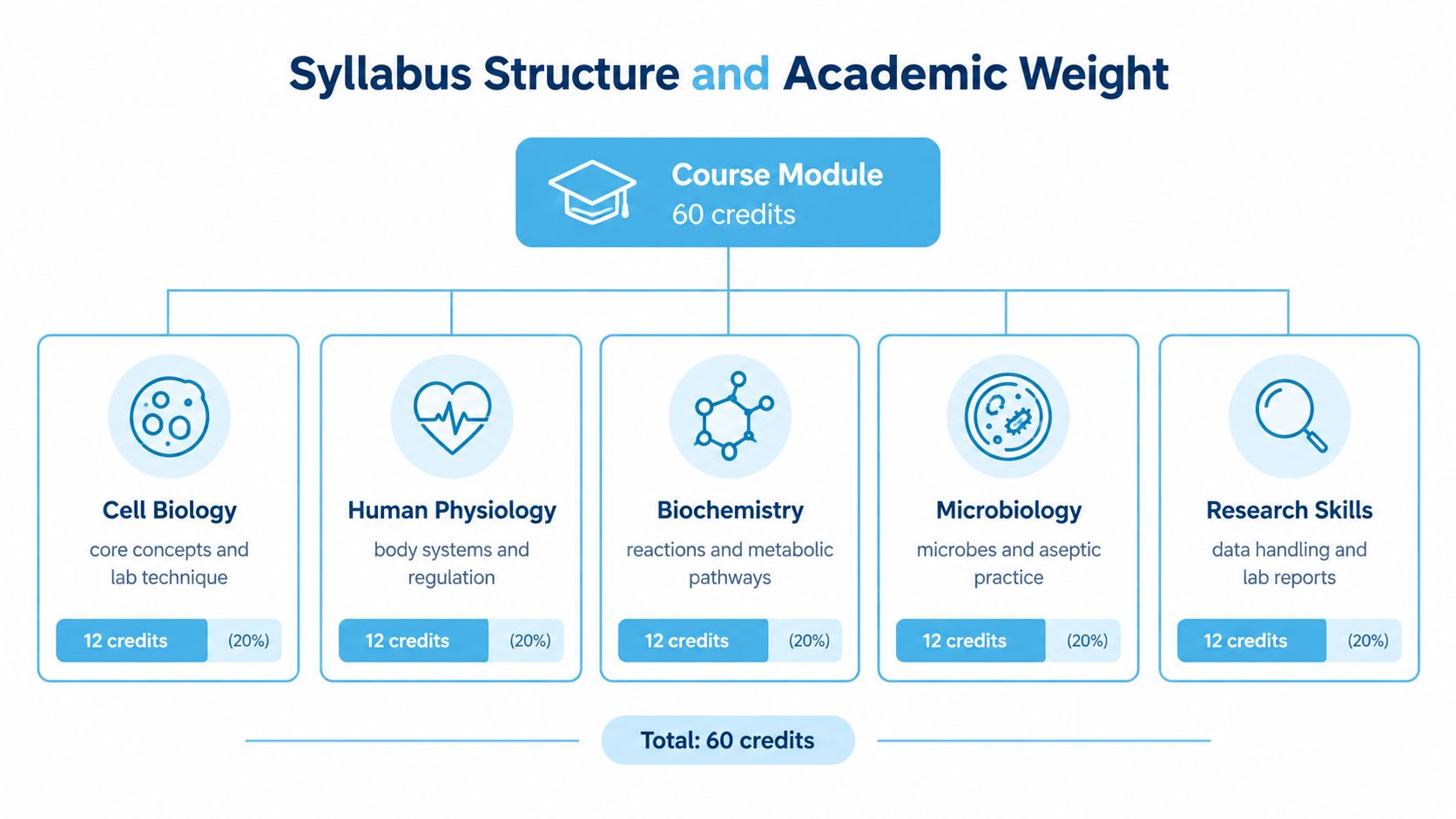
The 60-credit framework gives you a useful way to judge the size of the commitment. Credits are allocated to units, and those units may be graded or ungraded depending on the provider and awarding organisation. Graded units usually contribute directly to the academic profile universities review, while ungraded units can support skills such as study practice, preparation or personal development. You should ask the provider which units are graded and how the final transcript presents them.
What guided learning hours mean
Guided learning hours aren't the same as the total time you'll spend studying. They refer to structured learning supported by a tutor or course team. Your overall workload can also include reading, watching recorded lessons, preparing assignments, revising scientific terminology, analysing data and correcting work after feedback.
That distinction is particularly important for adults with jobs or caring responsibilities. A course may be delivered online and still demand regular, uninterrupted study. Flexibility usually changes where and when you study. It doesn't remove the need to understand complex material, complete assessments or meet deadlines.
How assessment builds academic readiness
Expect assignments that test more than recall. A science learner may need to explain a biological process, interpret a table of results, compare evidence, produce a referenced report or evaluate the limitations of an investigation. These tasks build habits that transfer to university laboratory reports and scientific essays.
A sensible course comparison should therefore examine:
- Credit distribution: Ask how many credits belong to Biology, Chemistry, Physics, Mathematics and research or study skills.
- Assessment method: Check whether units use essays, examinations, practical reports, presentations, portfolios or data analysis.
- Grading structure: Find out which units receive graded outcomes and how grades are calculated.
- Progression documentation: Request the full module list and ask whether the awarding organisation and target universities recognise it.
The comparison with three A-levels describes progression value, not identical teaching. An Access diploma may organise learning differently and may suit adults who need a concentrated route back into education. You still need to show that you can work at Level 3, manage scientific concepts and produce consistent assessed work.
Navigating Online Labs and Study Workloads
A biomedical science access course can be fully online and still ask for practical thinking. The platform may change, but the academic task stays the same: you must observe, record, interpret, and explain. Providers often use virtual laboratory simulations, tutor-led demonstrations, structured practical activities, data interpretation, and written reports. Some courses also expect you to work with household materials or analyse supplied experimental results. Ask for a sample practical brief before you enrol, because the test is how the course turns online activity into assessed science work.

Test the practical model before you commit
A virtual simulation can let you change variables, repeat a procedure, and practise reading results. It does not recreate every feature of a physical laboratory. You may have less chance to handle specialist equipment, practise sterile technique under supervision, or receive immediate correction while carrying out a procedure.
That difference matters for adult learners who need to know what they are paying for with time as much as money. The most useful question is not whether the course is “online”, but what it counts as practical evidence. Ask whether you will submit observations, calculations, screenshots, videos, data tables, or written evaluations. Find out whether a tutor checks technique through a recording, whether any work takes place at a partner centre, or whether assessment focuses mainly on interpretation. Confirm which equipment you need, since some courses ask for a microscope, protective items, or measuring tools, while others only require a computer and standard household materials. If an experiment produces unexpected results, ask how the course handles that situation and whether you can safely complete the activity at home.
For wider context on scientific preparation, you may find this Ace Med Boards pre med guide useful. It is not a substitute for the specification of your chosen Access course, but it can help you see how scientific foundations and practical reasoning support later study.
Plan the workload around your actual week
Access science courses usually include guided learning, then add independent study on top. That second layer often catches adult learners off guard. Reading, revision, assignment planning, and redrafting take real time, just as lab notes do in a classroom setting. One provider states that learners should commit to at least one extra day each week for independent study, as explained in its biomedical science Access course information.
Treat that extra day like a fixed appointment. Before you enrol, map your normal week and locate the hours when you can work without interruption. If your only free time is late at night after work and family duties, ask how quickly tutors reply and whether live sessions are required.
The online format described in this guide to studying Access science online may offer flexibility, but flexibility only helps if you protect the time. A workable plan includes a quiet space, reliable internet access, time for practical preparation, and spare room for assignments that take longer than expected. A course can feel manageable on paper and still become difficult if your week has no protected study block.
University Entry Requirements and Progression
The most expensive mistake is choosing an Access diploma before checking the entry page for your preferred biomedical science degree. Universities can ask for the same overall qualification while setting very different conditions for grades, subject credits and module content. A generic “science” label may not be enough if the degree requires specific Biology and Chemistry units.
The following examples show why you need to compare the details rather than rely on a general statement that Access courses are accepted.
| University | Overall Grade Requirement | Specific Module Requirements |
|---|---|---|
| King's College London | An Access to HE Diploma with 60 credits, including 45 Level 3 credits overall, with 36 at Distinction and 9 at Merit | At least 15 Level 3 Biology credits at Distinction and 15 Level 3 Chemistry credits at Distinction |
| Brunel University of London | 128 tariff points from an Access to HE Diploma, with 45 Level 3 credits in a related subject | Biology and Chemistry units passed at Distinction |
These requirements are published on the King's College London biomedical science entry requirements page. The same source material identifies the Brunel requirements, but you should still check Brunel's own current course page before applying because universities can revise their conditions.
Build a module-matching checklist
Take the entry page for each target university and copy its requirements into a comparison document. Then ask a course adviser to confirm each point in writing.
- Subject title: Does the Access course include Biology and Chemistry, or does it use broader unit names?
- Credit level: Are the required credits taught and assessed at Level 3?
- Grade target: Can the course provide the Distinction or Merit profile your university requests?
- Module quantity: Does the syllabus contain enough credits in each required subject?
- Application timing: Will your predicted grades and final transcript be available when the university needs them?
A university may accept an Access route into biomedical science while still rejecting an applicant whose module mix doesn't match. NHS careers guidance also presents Access study as one accepted route into biomedical science at Level 6, not as a replacement for checking each institution's requirements. That distinction matters if your long-term aim is an NHS laboratory career.
You can also use practical detail to judge whether a provider understands laboratory education. For example, reviewing university laboratory equipment options can help you recognise the difference between a course that explains laboratory environments clearly and one that uses “practical” as a vague marketing term. The provider still needs to tell you how its own assessments work.
Funding Options and Hidden Prerequisites
An offer from an Access provider does not settle the practical questions. Before enrolling, you need to know how the course will fit your budget, whether its entry conditions match your qualifications, and whether the resulting diploma supports your intended university application. For an adult learner balancing employment or family responsibilities, a funding decision can affect the entire study plan.
Course fees vary by college and programme. Some colleges list tuition costs of around £3,384 per year at some colleges, as shown in the Weston College biomedical science course information. Check the provider's current fee schedule rather than applying one college's figure to every course. Ask which costs are included, such as assessment, registration, practical materials and tutor support. A lower headline fee may still require you to budget for items the provider excludes.
Funding needs an eligibility check
An Advanced Learner Loan may be available to eligible adult learners, but eligibility depends on the course, the learner and the progression arrangements. Confirm the provider's guidance and the awarding organisation's status before treating the loan as part of your plan. Ask what happens if you withdraw, defer or change direction, and whether any costs become your responsibility.
The guide to Access to Higher Education funding provides questions to raise about loans and payment arrangements. Record the answers in writing. This matters when your university progression plan depends on completing the diploma, because a funding condition may affect the route you can take after graduation.
Audit your GCSE foundation
Access grades are only one part of the admissions picture. Universities and colleges may expect applicants to hold specific qualifications before they consider the diploma. Independent course information indicates that science progression may require GCSE English, Maths and Science at grade 4/C, although individual providers can set different conditions. Check whether Functional Skills satisfy the Access provider, then ask whether your target university accepts them for the degree.
Use this audit before you enrol:
- Find your certificates: Confirm the exact subject names and grades instead of relying on memory.
- Separate provider and university rules: Admission to the Access course does not guarantee that a university will accept your qualification profile.
- Check science subjects carefully: Biology, Chemistry and general science may be treated differently.
- Plan missing qualifications early: Ask whether GCSE equivalents or Functional Skills can be studied alongside the diploma without creating an unmanageable workload.
Admissions safeguard: Ask the university admissions team to confirm your proposed Access subject combination before you pay a course fee.
The hidden barrier is often administrative alignment. You may be ready for Level 3 study yet still need to resolve a missing GCSE, an unsuitable module or a funding condition before your application can progress.ose
Study Strategies for the Adult Learner
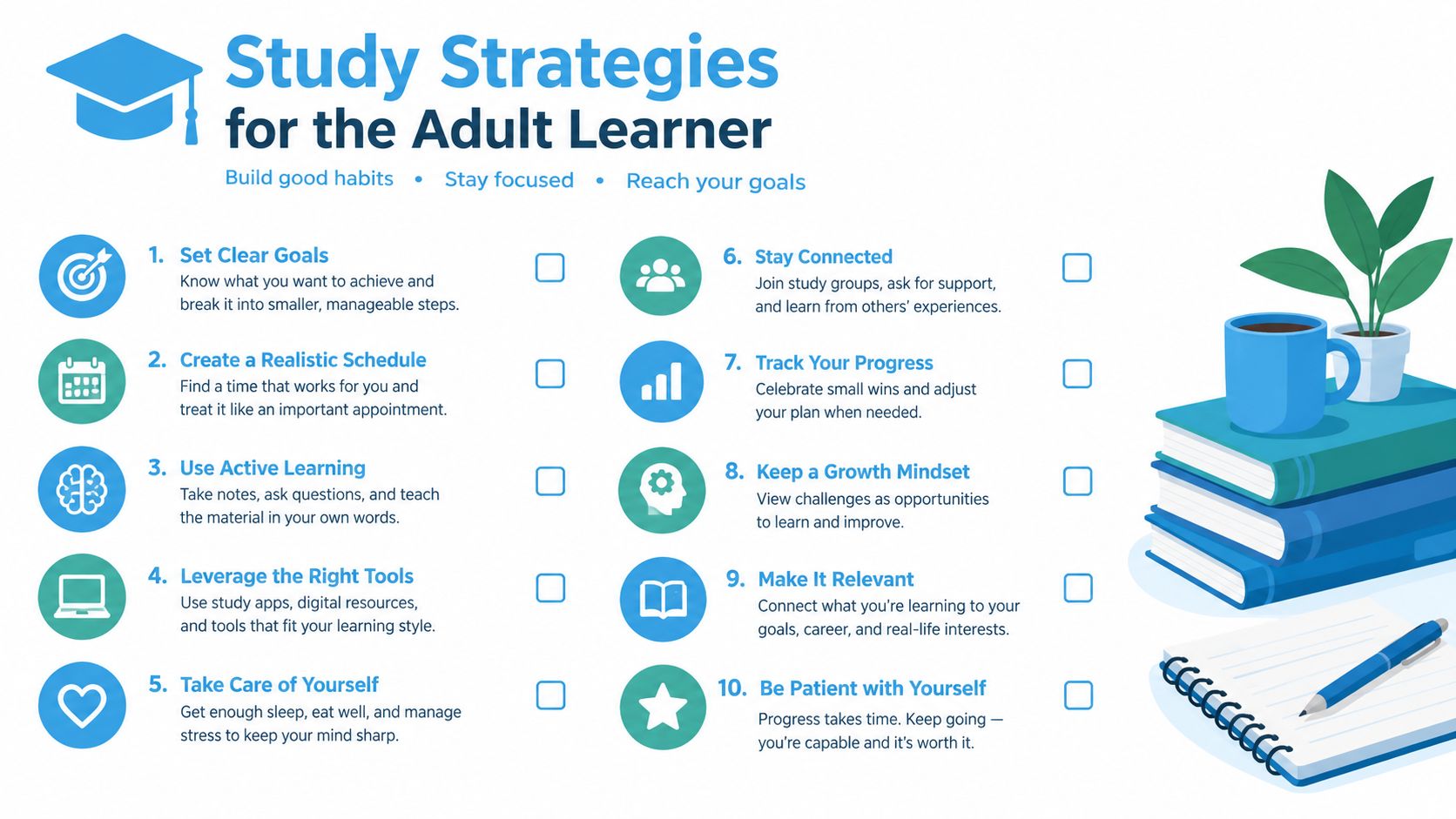
Adult learners often bring strong organisation, professional experience and a clear reason for changing direction. They may also have limited time, rusty academic habits and competing responsibilities. Your strategy should therefore reduce avoidable decisions, not depend on studying whenever a spare moment appears.
Start with a weekly study appointment that you protect like paid work. Divide it into different activities rather than spending every session passively reading. One session might cover scientific vocabulary, another could focus on assignment planning, and a later block could be used for data analysis or referencing.
Use a system that protects attention
A practical routine could look like this:
- Begin with the assessment brief: Identify the command words, evidence required and submission date before you start researching.
- Keep a science glossary: Record unfamiliar terms in your own words, then revisit them during short revision sessions.
- Read actively: Write one sentence explaining the purpose of each source instead of highlighting entire pages.
- Draft in layers: Create an outline, add evidence, explain the science, then edit for clarity and accurate referencing.
- Review feedback: Turn tutor comments into a checklist for the next assignment rather than treating feedback as a final judgement.
- Use peer contact: Compare interpretations and study methods, but write and reference your own work.
- Protect recovery time: A sustainable plan includes sleep, meals and breaks, because exhaustion makes complex science harder to process.
For practical ideas on managing concentration while combining employment and study, explore these work and study focus techniques. The useful principle is simple: reduce distractions before you begin, and decide what the session will produce.
Treat university research as part of your coursework
Don't wait until the final application stage to investigate degrees. Keep a document containing each university's subject requirements, grade profile, GCSE conditions, application deadlines and admissions contact. Update it whenever a course page changes, and take it to your Access adviser so you can test your plan against the actual diploma modules.
If academic writing feels unfamiliar, ask tutors for a model structure without copying its language. A strong scientific assignment normally makes a clear claim, supports it with appropriate evidence, explains the biological reasoning and acknowledges limits. Referencing is not decoration. It shows where information came from and helps you distinguish your analysis from published evidence.
The following video may provide another starting point for thinking about study habits and preparation:
A biomedical science access course can be a credible route into university, but it rewards preparation before enrolment. Check the module match, confirm the GCSE position, understand the online practical model, and protect independent study time. Access Courses Online offers online Access to Higher Education Diploma courses, tutor guidance and funding information for adults planning progression to university. Visit Access Courses Online to review the available science pathway and speak with an adviser about whether its modules fit your target biomedical science degree.