
Thinking about making a career change at 40 in the UK? Let’s cut to the chase: yes, it’s not just possible, it’s a brilliant idea. Far from being too late, this stage of life gives you a powerful mix of real-world experience, self-awareness, and often a bit more stability. It’s the perfect launchpad for a smart, strategic move towards a career that genuinely fulfils you.
Why A Career Change At 40 Is A Strategic Move

The thought of starting over at 40 can feel pretty intimidating. It’s easy to get bogged down by that old "mid-life crisis" cliché. But the reality for thousands of people across the UK is far more positive and empowering. This isn't about running away from a job you hate; it's about purposefully walking towards a future you'll love.
The reasons for wanting a change are deeply personal, but you’d be surprised how many of us share the same motivations. Many professionals hit a point where the job they fell into years ago just doesn't fit with their values or where they see their life going anymore.
The Real Drivers Behind The Change
Think about it. By your forties, you’ve probably got two decades of work under your belt. You know what makes you tick, what drains your energy, and where your real strengths lie. This isn’t some flight of fancy – it’s a calculated decision built on years of experience.
So, what’s really pushing people to make the leap?
- A better work-life balance: The hustle culture wears thin. The desire for a job that allows time for family, health, and hobbies often moves from a "nice-to-have" to a top priority.
- Finding meaningful work: Many of us want our work to mean something more. We want to feel like we're making a tangible, positive impact, whether that’s in healthcare, teaching, or the charity sector.
- Future-proofing your skills: The world of work is changing fast. Retraining in high-demand fields like tech or healthcare isn't just about a new job; it's a savvy move to secure your career for the long haul.
- Escaping burnout: Let's be honest, some industries can really take their toll. A fresh start in a new field is often exactly what’s needed for better mental and physical well-being.
A career change in your forties isn't about starting from square one. It’s about leveraging the incredible wealth of experience you already have and redirecting it towards something that genuinely excites you for the decades ahead.
This is your chance to take the reins. You’re not just building a career anymore; you're designing a life. All those skills you've picked up along the way – project management, dealing with tricky clients, solving complex problems, leading a team – are incredibly valuable and transferable. The trick is learning how to frame them for a new audience. For a more detailed look at this process, we recommend checking out this strategic guide to changing careers after 40.
Employers are increasingly waking up to the value of maturity, resilience, and emotional intelligence that people in their mid-career bring to the table. This journey embraces the idea that your professional life is long, and it’s never too late to learn something new. Lifelong learning is the cornerstone of a successful career change, and as you'll see in this guide, it’s becoming the new standard for professional growth in the UK.
Start by Assessing Your Skills and Motivations
Thinking about a career change at 40 in the UK is a huge step, and the real work starts long before you even glance at a job advert. This first phase is all about looking inwards – taking a deep, honest look at what you truly want and the skills you already have.
Skipping this part is like setting off on a road trip without a map. You’ll get somewhere, sure, but it probably won’t be where you actually wanted to go.
It’s about more than just asking, "what next?". You need to pick apart your current job to figure out exactly what isn’t working for you anymore. This clarity is crucial. It stops you from just running away from one job and stumbling into another one that leaves you feeling just as unfulfilled.
If you’re feeling this way, you're not alone. Research from the University of Surrey found that job satisfaction for professional workers often follows a U-shaped curve, hitting its lowest point in our 40s. This isn’t just a vague feeling; it’s a well-documented pattern that often sparks a much-needed career rethink. You can read the full research about this mid-career dip to see the data behind it.
Create Your Career Fulfilment Scorecard
Let's get practical and move beyond that general feeling of being unhappy. A great way to start is by creating what I call a 'Career Fulfilment Scorecard'. It’s a simple but incredibly powerful tool for figuring out what really matters to you at work.
Jot down the key things you want from a job and then score your current role on each one, from 1 to 10. This turns that abstract feeling into something tangible you can actually work with.
- Autonomy and Flexibility: How much control do you have over your work and your schedule?
- Creative Freedom: Do you get a chance to be innovative or try out new ideas?
- Sense of Impact: Can you see the results of your hard work? Does it feel meaningful?
- Work-Life Integration: Does your job support your life outside of the office, or does it completely drain you?
- Learning and Growth: Are you still developing new skills and tackling interesting challenges?
- Financial Reward: Does your pay packet reflect your contribution and support your lifestyle?
Seeing low scores in certain areas gives you a clear direction. For example, if 'Autonomy' gets a 2 but 'Financial Reward' is an 8, you know that your next move should prioritise roles with more independence, even if the salary is similar.
Uncover Your Hidden Transferable Skills
After two decades in the working world, you've built up a huge bank of skills that are valuable well beyond your current industry. The trick is to identify them and then reframe them for a completely new context. It’s time for a transferable skills audit.
Instead of thinking about your job title, think about the actions you perform every day. Years spent managing a chaotic retail floor isn't just "retail management." It's expert-level stakeholder management, conflict resolution, real-time problem-solving, and inventory logistics – all skills that are highly sought after in a corporate project management role.
Your experience is your greatest asset. The key isn't to erase your past but to translate it. Frame your history as a unique advantage that a younger candidate simply cannot offer.
To get your audit started, think about these categories:
- Communication Skills: Have you presented to senior managers, written persuasive reports, or mediated disagreements within a team?
- Leadership and Management: Have you mentored junior staff, managed a budget, or led a project from start to finish?
- Problem-Solving Skills: Think of a time you fixed a complex operational issue or navigated a tricky client crisis. What steps did you take?
- Technical Skills: What software, systems, or specific methods are you a dab hand at?
If you feel you need a bit of outside help to get some clarity, exploring something like career coaching can be a brilliant way to pinpoint the right path for you.
This deep dive into what motivates you and what you're already good at builds a solid foundation for your entire career change. With this self-knowledge, every decision that follows—from choosing a course to writing your CV—becomes more focused, intentional, and much more effective. When you're ready to explore what comes next, check out our detailed guide on how to find the career that’s right for you.
Finding Your New Path: Education and Training Routes in the UK
Once you've got a better sense of where you're heading, it's time to figure out how to get there. Let's be honest, making a successful career change at 40 in the UK usually means learning some new skills. The good news? The days of thinking a full-time, three-year degree is your only option are long gone.
Today's training landscape is brilliant for adult learners. It's packed with flexible, practical options designed to fit around the realities of work and family life. Whether you've got a few months or a couple of years to spare, there's a route that will work for you. The trick is to pick the one that truly matches your new career goals, budget, and how quickly you want to make the move.
This little flowchart is a great way to check in with yourself and see if the classic signs for a career change are flashing.
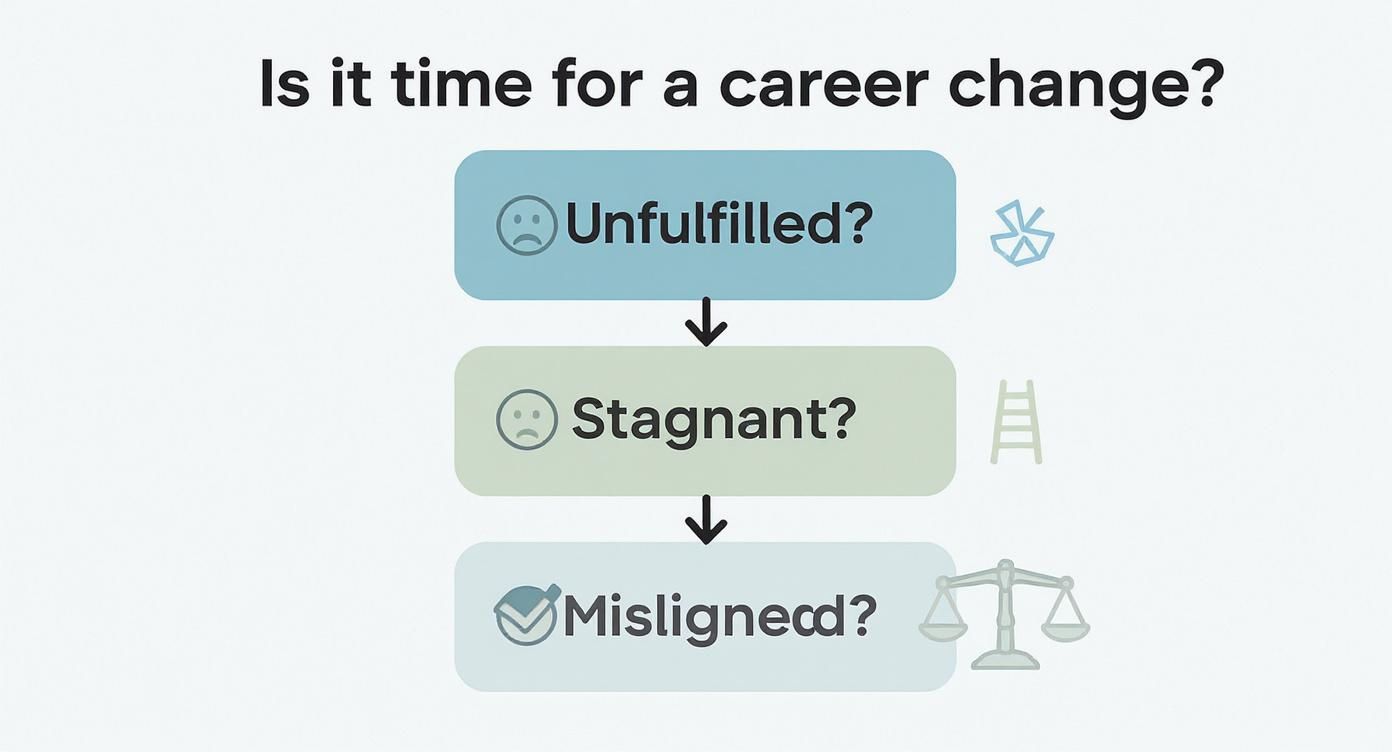
It quickly helps you see if you're feeling unfulfilled, stuck in a rut, or just not aligned with your values anymore – all massive drivers for finding a new path.
University, But Not as You Know It
For a lot of professional careers—especially in healthcare, science, or social work—a university degree is still a must-have. But getting there as a mature student is now much more straightforward than you might think.
The Access to Higher Education (HE) Diploma is a real game-changer here. This is a Level 3 qualification specifically created for adults who want to get to university but don't have the typical A-Levels. Universities all over the UK recognise them, and you can often get one done in just a year of full-time study, or even more flexibly online over two years.
If this sounds like it could be for you, it's well worth understanding what an Access to Higher Education course entails to make sure it fits your plans. These diplomas are laser-focused on specific subjects, so an Access to HE Diploma in Nursing, for instance, gives you the exact skills and knowledge you'll need to hit the ground running on a nursing degree.
Earn While You Learn with an Apprenticeship
Forget the old stereotype—apprenticeships aren't just for teenagers anymore. Degree apprenticeships, in particular, are a fantastic way for career changers to get qualified. You can earn a full bachelor's or even a master's degree while you work.
Here’s the deal:
- You work in a full-time job, spending about 80% of your week gaining practical experience and 20% studying with a university.
- Your employer pays you a salary and covers every penny of your tuition fees.
- You finish with a degree, years of hands-on experience in your new field, and absolutely no student debt.
It's a model that sectors like tech, engineering, and business have really embraced. Getting a spot can be competitive, but it’s an incredible opportunity to switch careers without the financial headache of full-time study.
Don't overlook apprenticeships. They're a highly respected and incredibly practical way into a new profession, giving you that perfect blend of theory and real-world experience that employers are crying out for.
Need a Quicker Transition? Look at Accelerated Routes
If your main goal is to get into a new job as fast as possible, there are plenty of options that can get you ready in months, not years. These are perfect for fields where practical, hands-on skills are valued more than a traditional degree.
Comparing Reskilling Routes for UK Career Changers
Choosing the right training path is a big decision. This table breaks down the main options to help you see which one might be the best fit for your goals, timeline, and budget.
| Training Route | Typical Duration | Average Cost (UK) | Best For | Example Qualification |
|---|---|---|---|---|
| Degree Apprenticeship | 3-5 Years | £0 (Funded by employer) | Earning a salary while gaining a full degree and experience. | BSc (Hons) Digital & Technology Solutions |
| Access to HE Diploma | 9 months - 2 Years | £3,000 - £6,000 | Adults without A-Levels needing a fast-track to university. | Access to HE Diploma (Nursing) |
| Intensive Bootcamp | 3-6 Months | £5,000 - £12,000 | A very fast, practical transition into a tech-focused role. | Full-Stack Web Development Certificate |
| Professional Certification | 1-12 Months | £500 - £3,000 | Adding a specific, industry-recognised skill to your CV. | CIPD Level 5 Diploma in People Management |
Ultimately, the best choice depends entirely on where you want to go. A bootcamp is perfect for getting into coding quickly, whereas an Access to HE Diploma is the key that unlocks a university degree in a field like nursing or social work.
Intensive Bootcamps
You’ll find these mostly in the tech world. They offer deep-dive training in things like software development, data science, or cybersecurity. They are incredibly fast-paced and practical, and the good ones have great connections with employers. Just be prepared for a significant upfront investment in both time and money.
Professional Certifications
These are shorter, more affordable qualifications that prove you know your stuff in a specific area. They're recognised by employers and can really make your CV stand out.
- Marketing: A Chartered Institute of Marketing (CIM) qualification can be your ticket into a marketing role.
- Project Management: Certifications like PRINCE2 or AgilePM are seen as essential for many project management jobs.
- Human Resources: A qualification from the Chartered Institute of Personnel and Development (CIPD) is the gold standard in HR.
Getting a certification like this shows an employer you have the up-to-date, specific knowledge they need, right from day one. It's a powerful way to add real credibility to the transferable skills you already have.
How to Fund Your Career Transition
Right, let's talk about the elephant in the room: money. For most people thinking about a career change at 40 in the UK, the financial side of things is often the biggest hurdle. How on earth can you afford to retrain when you’ve got a mortgage, family commitments, and bills piling up?
The good news is, you don’t have to fund this journey entirely on your own. There are several financial support systems designed specifically to help adult learners get the qualifications they need. Getting your head around these options is the first step to making your career change a reality.
It’s a step many are taking, and salary is a huge motivator. Recent stats show a big jump in mid-career moves, with 38% of UK professionals saying money is the main reason they’re looking for something new. Discover more insights about UK career change statistics. This makes finding the right funding route more crucial than ever.
Getting to Grips with the Advanced Learner Loan
One of the best tools out there for adult learners in England is the Advanced Learner Loan. This isn’t just for school leavers; it's designed for people just like you.
Think of it like a student loan, but for approved further education courses at Levels 3, 4, 5, or 6. This covers qualifications like Access to Higher Education Diplomas, which are a massively popular route into university for career changers.
Here’s the lowdown:
- Who can apply? You need to be 19 or older on the first day of your course and be a UK resident. Your household income isn’t a factor, and there’s no credit check involved.
- Paying it back: You only start making repayments once you’ve finished your course and are earning over the threshold (which is currently £27,295 a year). The repayments are set at 9% of whatever you earn above that amount, so they’re designed to be manageable.
- The university bonus: Here’s a brilliant perk. If you take out an Advanced Learner Loan to fund an Access to HE Diploma and then go on to complete a university degree, Student Finance England will write off your loan balance completely. It's a fantastic incentive to keep going.
The Advanced Learner Loan is all about removing the upfront cost of training. It lets you invest in your future without the immediate financial stress, unlocking the door to a new career.
Exploring Other Ways to Fund Your Studies
While the loan is a brilliant option, it’s not the only one. It’s always worth a bit of digging to see if you can find funding that you don’t have to pay back. These options are often tied to specific courses, industries, or your personal circumstances.
Here’s where else you could look for support:
- Grants and Bursaries: Loads of universities and colleges have specific funds set aside for mature students or those heading into in-demand fields like healthcare or social work. Have a good look around the ‘fees and funding’ section on the websites of any institutions you’re interested in.
- Employer Sponsorship: If your career change is a step up within your current company or a related industry, don’t be shy about asking for sponsorship. Put together a solid business case showing how your new skills will benefit them. You might be surprised—they could agree to cover some or all of your training costs.
- Charitable Trusts: There are countless smaller trusts and charities that offer educational grants. They often have very specific criteria, but using a tool like the Turn2us grants search can help you sift through them and find a potential match.
Smart Budgeting for Your Transition
Getting your course fees covered is one piece of the puzzle. The other is managing your day-to-day finances while you’re studying. A temporary dip in your income is a real possibility, so setting up a realistic budget is key for your peace of mind.
Start by tracking your spending for a month to get a clear picture of where your money is actually going. Look for areas where you can make some temporary cutbacks. This isn’t about depriving yourself forever; it’s about making short-term adjustments to hit a massive long-term goal. Think of it as a strategic financial plan for your future self, making sure your career change is as smooth as possible.
Putting Your Plan into Action

You’ve done the hard graft of figuring out your next move and getting the right training under your belt. Now for the exciting bit: making it happen. This is where all that soul-searching and studying pays off, helping you build a compelling story for employers.
Executing a successful career change at 40 in the UK isn’t just about applying for jobs; it’s about confidently showing that this move is a deliberate, valuable step forward.
Remember, you’re not starting from scratch. You bring two decades of professional maturity, resilience, and real-world problem-solving skills to the table. The trick is to weave this experience into every part of your application process, from your CV to your interview answers.
Crafting a CV That Tells Your Story
Think of your CV less as a historical document and more as a marketing brochure for your new career. For a career changer, its sole purpose is to bridge the gap between where you’ve been and where you’re going. You need to make it instantly clear why you’re a fantastic fit, even without a traditional background in the role.
The personal statement at the top is your prime real estate. It has to grab a recruiter’s attention in seconds and frame your career change in a really positive light.
Here are a couple of examples of how to do it right:
- For a move into project management: "A highly organised and results-driven professional with 15 years of experience in retail operations management, now leveraging a PRINCE2 certification to transition into a dedicated project management role. Proven ability to lead cross-functional teams, manage budgets exceeding £500k, and deliver complex projects on schedule."
- For a move into healthcare support: "A compassionate and empathetic former customer service manager seeking to apply extensive client relations and problem-solving skills to a healthcare support setting. Recently completed an Access to HE Diploma in Health and Social Care, demonstrating a strong commitment to patient-centred care and a thorough understanding of clinical environments."
Notice how both examples immediately tackle the career change head-on? They highlight transferable skills and shout about new qualifications.
Networking with Purpose, Not Just Volume
Networking can feel a bit daunting, but it’s genuinely one of the best ways to get your foot in the door of a new industry. Forget about aimlessly adding hundreds of strangers on LinkedIn. The real magic is in building genuine connections through what are known as informational interviews.
An informational interview is just a chat with someone who’s already working in the field you want to join. It’s not a job interview; it’s a chance for you to gather priceless insights and advice.
- Identify People: Use LinkedIn to find people in roles that you find interesting. Look for fellow career changers or people who studied the same course you did.
- Reach Out Politely: Send a short, friendly message explaining your situation. Let them know you admire their career path and would be grateful for 15 minutes of their time to ask a few questions about their experience.
- Prepare Thoughtful Questions: Don't ask things you could easily Google. Ask about the day-to-day challenges, the skills they rely on most, and what advice they’d give someone just starting out.
This approach builds real rapport and gives you insider knowledge you can’t get anywhere else. Plus, it often puts you on the radar for jobs that haven't even been advertised yet.
Mastering the Interview and Your Narrative
When you land that interview, you can bet you’ll be asked the big question: "So, why the change?" This is your moment to shine, not to get defensive. Your answer needs to be a positive, forward-looking story.
Your career change is a story of deliberate growth, not an escape. Explain what drew you towards this new field, highlighting how your past experiences have uniquely prepared you for its challenges.
You’re not alone in this. Recent surveys show that around a third of UK workers between 45 and 54 are actively planning a career change. For many, like the 40% who cite it as their main driver, the goal is better pay and prospects. You can read more about these career change statistics to see just how common this is.
A brilliant way to structure your answer is the "Past, Present, Future" model:
- Past: Briefly touch on your previous career and a key skill you mastered. (e.g., "In my 15 years in sales, I became an expert at building client relationships and understanding their needs.")
- Present: Connect that skill to your new path and mention your recent training. (e.g., "I realised I wanted to apply that skill in a more analytical way, which is why I pursued a certification in data analytics.")
- Future: Show your enthusiasm for the role and the value you’ll bring. (e.g., "I'm excited to bring my communication skills and new technical abilities to this role to help your team turn data into actionable insights.")
This approach turns a potential question mark into your greatest strength. It shows the interviewer they’re meeting a thoughtful, motivated, and highly capable person who is ready to add value from day one.
Common Questions About Changing Careers at 40
Thinking about a career change at 40 in the UK is a huge step. It’s exciting, but it’s bound to bring up a few worries. That’s completely normal – in fact, it shows you’re taking it seriously.
Let's tackle some of the most common questions head-on. Think of this as a quick chat to quieten those nagging doubts and get you focused on what’s ahead.
Will Employers See My Age as a Disadvantage?
This is the big one, isn't it? It’s so easy to worry that you'll be overlooked for younger candidates. But it’s time to flip that thought on its head.
An employer isn't just looking for someone who can tick a few technical boxes. They’re hiring a person who can solve problems, handle pressure, and be a reliable member of the team. Your age isn't a weakness; it's your superpower.
You've got two decades of real-world experience. You’ve navigated difficult clients, dealt with tricky office politics, and seen projects through from wobbly start to successful finish. Younger candidates simply haven't had the time to build that kind of resilience and professional maturity.
Your age is a mark of reliability and wisdom. Make sure your CV and interview stories highlight the seasoned perspective you bring. You’re not a risk; you’re a safe pair of hands.
Can I Afford to Take a Pay Cut?
The thought of a drop in salary, even a temporary one, can feel like a complete roadblock. While a pay cut is possible when you start in a new field, it’s rarely as drastic or as permanent as you might fear. The key is to plan for it.
Before you do anything else, sit down and create a proper budget for your transition period. Look up average salaries in your new industry – and don't just look at entry-level roles. With your background, you won't be starting at the very bottom.
- Entering at a higher level: Your experience in things like project management or dealing with customers could mean you land a mid-level role straight away, softening any financial blow.
- Negotiating power: You have far more clout to negotiate a better starting salary than a recent graduate. Don't be afraid to use it.
- Think long-term: Your new career might have a much higher ceiling for earnings. A small dip now could be a brilliant investment in your future.
How Do I Explain a Career Gap for Retraining?
Taking time out to study can feel like a big red flag on your CV, but only if you let it be. The trick is to own it. Never try to hide it or hope no one notices.
Instead, frame it as a period of focused, deliberate growth.
On your CV, don’t leave a blank. Add a section called something like "Professional Development & Reskilling." This is where you detail your Access to HE Diploma and list the key skills you learned.
Suddenly, a "gap" becomes a massive positive. It shows you have:
- Ambition: You’re driven and invested in your own development.
- Commitment: You’ve shown real dedication to your new path.
- A solid plan: This was a thought-out, strategic move, not a last-minute decision.
By presenting it this way, you’re telling employers that you’re a motivated, forward-thinking candidate who has spent time getting the exact skills they’re looking for.
At Access Courses Online, we understand that changing careers is about so much more than a new job title—it’s about building a life you love. Our flexible, online Access to HE Diplomas are designed to fit around you, giving you the perfect stepping stone to university and the career you’ve always wanted. Discover your path today at https://accesscoursesonline.com.