
You're working, caring for family, and trying to decide whether retraining is realistic. Your current job may be dependable, yet you can feel that you've stopped moving forward. University seems appealing, but traditional entry requirements, study costs, and the fear of starting again can make the route look closed.
That's where well-designed career development pathways matter. They turn a broad ambition, such as moving into nursing, computing, teaching, or management, into a connected sequence of decisions. The important question isn't just where you can start. It's whether each step gives you the eligibility, knowledge, confidence, and evidence needed for the next one.
What Career Development Pathways Really Mean
A career development pathway is a planned route from your current position to a specific future role. It may include preparatory study, a recognised qualification, work experience, professional registration, and further development. The pathway doesn't have to be linear, and it doesn't need to look like the route taken by a school-leaver.
Think of it as a bridge rather than a ladder. A ladder usually suggests that everyone climbs the same rungs in the same order. Adult learners often need a bridge with several entrances, a few changes of direction, and space to pause when work or family responsibilities demand it.
Suppose you work in administration but want to become a healthcare professional. Your current role may have given you communication, organisation, record-keeping, and customer-service skills. Those strengths are useful, but they may not satisfy university entry requirements for a health degree. A suitable pathway identifies the missing academic preparation, supplies it through an appropriate qualification, and connects that qualification to a realistic university application.
The four jobs a pathway must do
A useful pathway provides more than a certificate. It should answer four practical questions:
- Where can I enter? This may be through existing qualifications, workplace experience, Functional Skills, or an adult-access course.
- What must I learn? The route should identify the subject knowledge and study skills your target role requires.
- What will I leave with? Look for a qualification or other evidence that the next institution or employer recognises.
- What happens next? A course is only part of the route. You need to know whether it leads to university, an apprenticeship, professional employment, or another defined step.
The distinction matters because participation alone isn't progression. You can complete a short course and still have no clear route into the role you want. Strong pathways connect one decision to the next and make the handover visible.
For broader career planning, a careers page can help you explore how your interests, skills, and professional aims fit together. It's also useful to understand what lifelong learning means, particularly if your route will involve several stages rather than one return to education.
Practical rule: Don't ask only, “What course can I take?” Ask, “What does this course qualify me to do next?”
How Pathway Models Work in Practice
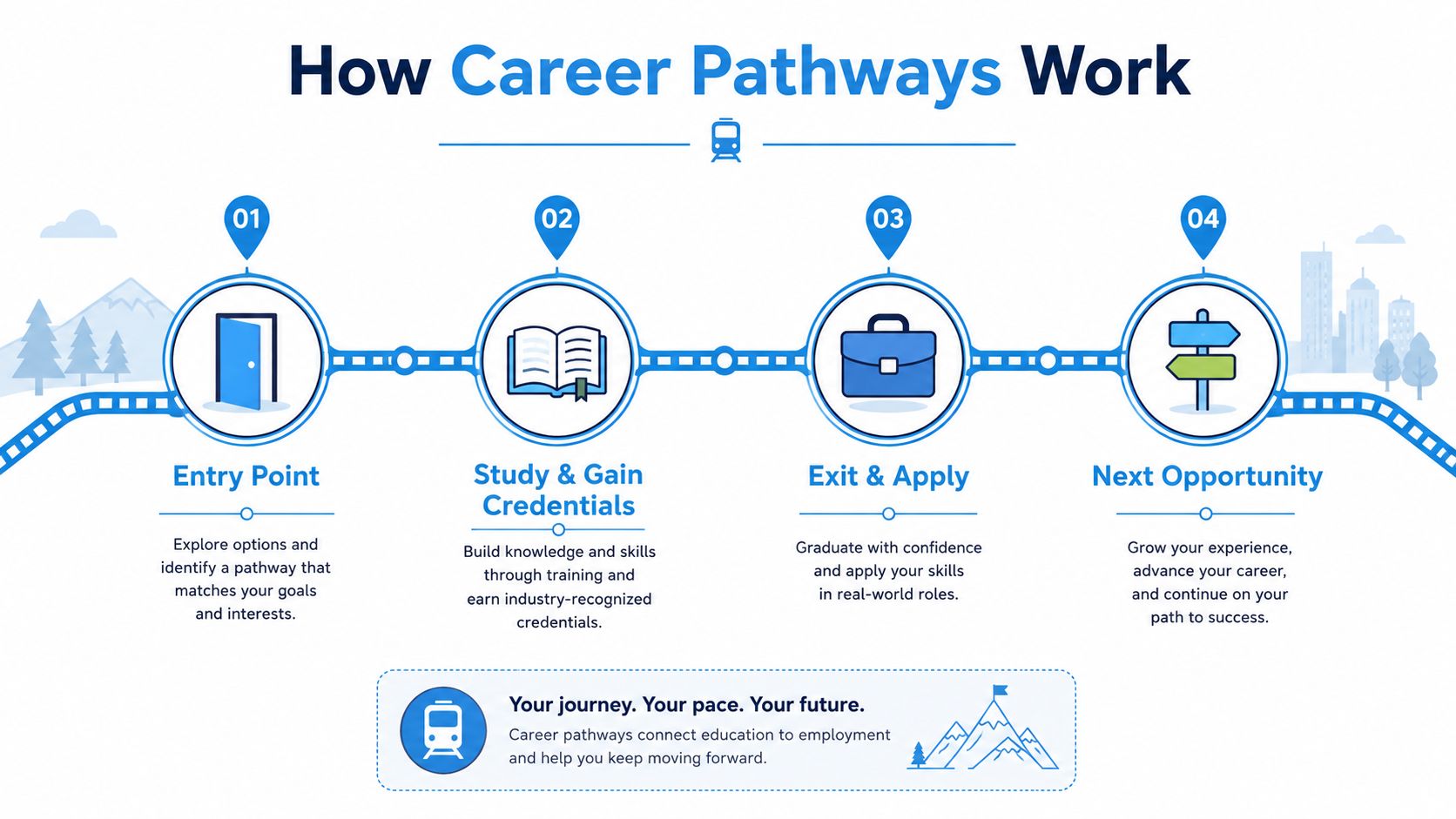
Picture a train line. You begin at a station that represents your current qualifications and experience. You then travel through study, assessment, and application before arriving at a new opportunity. Some passengers take an express route. Others change lines, collect additional tickets, or pause at a station while their circumstances change.
That's a better picture of career development pathways than a single staircase. The route has entry points, learning stops, exit points, and connections to future destinations.
Direct routes and modular routes
A direct route has a clear academic destination. A learner without the usual school-leaving qualifications might complete an Access to Higher Education Diploma and then apply for a degree. Someone following a conventional school route might take A-Levels before applying to university.
A modular route is more like changing trains. You might complete Functional Skills in English or maths, add a short technical course, gain experience with an employer, and then progress to a higher-level qualification. Short courses can be useful when they fill a specific gap, but they don't automatically provide university entry.
The order matters. If your target degree requires evidence of academic writing and subject preparation, a course that only introduces general workplace skills may not be the right first stop. Conversely, if an employer wants a practical digital skill immediately, a short course could be the sensible starting point while you investigate longer-term study.
What an exit point really means
Every station should have a defined exit:
- Academic exit: you meet the entry requirements for a degree or higher-level course.
- Employment exit: you can apply for roles that recognise the qualification or experience.
- Professional exit: you move towards a regulated occupation or registration route.
- Planning exit: you gain enough information to choose the next stage with confidence.
In 2021-22, 43,420 learners registered for an Access to HE Diploma, while 23,290 students entered higher education using one. Earlier progression analysis found that 62% of Access students progressed to degree-level study within four years, including 47% within one year and another 15% within two to four years. These figures are reported in the Access to HE key statistics.
The lesson isn't that every learner should take the same route. It's that a pathway becomes meaningful when its exit is clear. Before enrolling, identify the next institution, employer, or professional requirement that will recognise what you're about to complete.
Comparing the Main UK Pathway Options
Adults often compare routes as if one qualification must be universally superior. In practice, the right choice depends on your destination, current qualifications, available time, financial position, and need for flexibility.
| Route | Typical Duration | Flexibility | Best For |
|---|---|---|---|
| Access to HE Diploma | Usually structured around an academic year, with part-time options available from some providers | Often available through full-time, part-time, blended, or online study | Adults without traditional qualifications who want to progress to university |
| A-Levels | Usually studied as a multi-subject programme over an extended period | Timetables vary by college and provider | Learners who need specific subjects or a conventional academic route |
| Apprenticeship | Varies by occupation and level | Built around an employer's workplace and training pattern | People who have, or can secure, employer support while earning and training |
| Short skills bootcamp | Short and intensive, with duration depending on the programme | Often designed for rapid, focused learning | Adults needing a targeted skill for an immediate employment goal |
| Direct HE entry | Depends on the degree or higher-level course | University arrangements vary | Applicants who already meet the institution's entry requirements |
Access to HE Diplomas
An Access to HE Diploma is usually the most directly aligned option when you're an adult without A-Levels or equivalent qualifications and your destination is university. It combines subject preparation with academic skills, which can make it a practical bridge into degrees such as nursing, midwifery, science, social science, business, or computing.
Check the specific university requirements before choosing a Diploma. Some degrees ask for particular units, grades, GCSEs, Functional Skills, work experience, or other evidence.
A-Levels
A-Levels remain a strong option when a university or profession specifically requires named subjects. They can also suit learners who want a broad academic foundation. For an adult returning after a long break, however, the timetable, subject combination, and assessment style may be less compatible with employment and family life.
You can explore alternatives in this guide to A-Level alternatives, then compare the result with the entry requirements for your chosen degree.
Apprenticeships and bootcamps
Apprenticeships combine paid employment with structured training, making them attractive when you can secure an appropriate employer. They're less flexible than purely online study because your working pattern and learning schedule depend on the organisation.
If you're exploring routes that don't require a degree, this guide to finding apprenticeships without a degree may help you understand how to search and what employers typically ask for. Bootcamps can be faster, but their value depends on the exact skill, employer recognition, and whether the programme connects to a next qualification or job.
Real Stories of Adults Mapping a New Route
A pathway becomes easier to understand when you see how it fits around ordinary life. The examples below are representative planning scenarios, not individual testimonials. Each shows the same principle: the route must fit the person's target role and available capacity.

Returning after raising a family
A parent who has spent years caring for children may have strong organisation, communication, and problem-solving skills but lack recent formal qualifications. The first task isn't choosing a degree. It's identifying a destination that feels meaningful and checking its entry requirements.
An Access to HE Diploma can provide an academic re-entry point. The learner might choose part-time or online study, reserve fixed weekly blocks for assignments, and speak with universities before enrolling so the Diploma subject matches the intended degree. The route becomes manageable when study is treated as a scheduled responsibility, not something squeezed into leftover time.
In 2024, learners aged 30 and over represented 25% of Access to HE acceptances, and the 35+ age band was the largest single group, according to parliamentary data on mature Access learners. Mature learners aren't unusual passengers on this train. They're a central part of the route.
From healthcare assistant to nursing
A healthcare assistant already understands patient contact, teamwork, confidentiality, and the demands of care work. Those experiences can support a nursing application, but they don't replace the academic and professional requirements of a nursing degree.
The learner might use an Access to HE Diploma in a health-related subject, confirm the required GCSE or equivalent evidence, and compare university modules, placement expectations, and admissions criteria. The important conversion step is checking that the preparation leads to an application the university can assess, rather than assuming relevant employment alone will be enough.
Watch the video below for another perspective on planning adult study and progression.
From warehouse work to computing
A warehouse operative may already have practical experience with systems, stock data, troubleshooting, and process improvement. If the target is computing, the learner should distinguish between a short coding introduction and a qualification designed to support university entry.
An Access route can supply structured academic preparation before a Computer Science or related degree. A short course may still be useful alongside it, particularly for building a portfolio or testing whether the subject feels right. The best choice depends on whether the immediate need is exploration, employment, or formal progression.
Planning Your Own Pathway Step by Step
Start with the role, not the course. Many stalled plans begin with an interesting qualification that doesn't connect to a realistic destination.
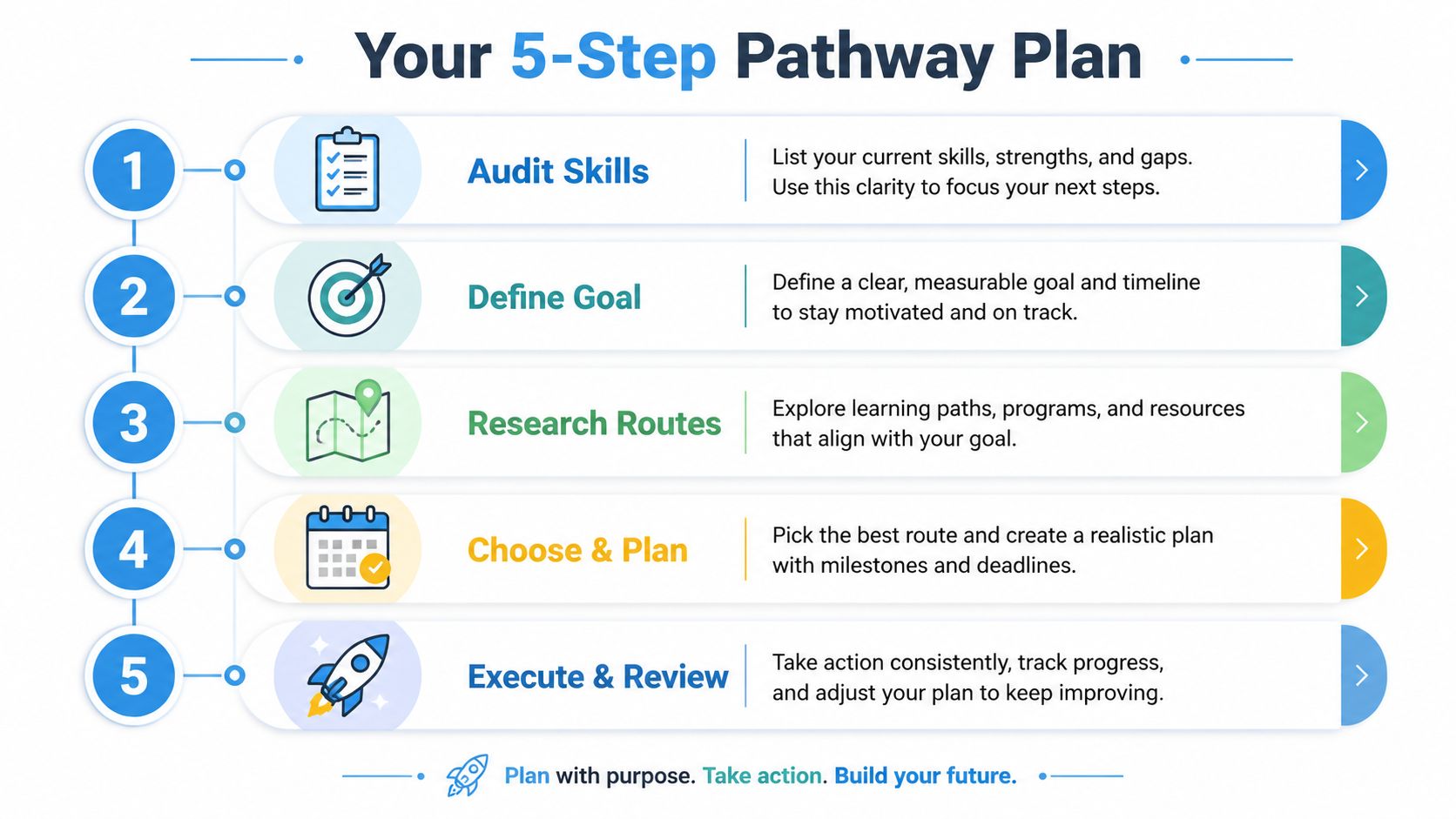
1. Audit your starting point
Write down your qualifications, workplace experience, digital skills, English and maths confidence, caring responsibilities, and available study hours. Include evidence that doesn't appear on a certificate, such as supervising colleagues, handling sensitive information, using software, or supporting customers.
Use this prompt: What can I already prove, and what might an admissions team still need to see?
2. Define the target role
Choose a role specific enough to research. “I want a better career” is a reasonable feeling, but it isn't yet a planning target. “I want to apply for a nursing degree” or “I want to move into an entry-level computing role” gives you something concrete to investigate.
Ask:
- What does a normal working day involve?
- Which qualifications or registrations appear in current vacancies?
- Does the role require a degree, an apprenticeship, or practical experience?
- What would make this change worthwhile for my household?
Skills England's annual report and Sectoral Skills Needs Assessments map pathways from courses to occupations. The same source reports that demand for key occupations is projected to grow by nearly 25% over the next decade. Treat that as a reason to investigate alignment, not as a promise that any course will produce employment.
3. Reverse-engineer the qualification chain
Work backwards from the role. If it requires a degree, identify suitable degrees. Then check their entry requirements. Only after that should you choose an Access Diploma, A-Level combination, apprenticeship, or short course.
Create a simple chain:
Target role → degree or occupational qualification → entry requirements → preparation route → current starting point.
For career exploration and decision-making, you could also review these free career change tools. Use tools to generate questions, then verify every important requirement with the university, employer, or awarding body.
4. Choose the route and build it into your calendar
Compare course content, assessment, study mode, tutor support, start dates, and progression advice. Ask providers how learners submit work, receive feedback, and contact tutors.
Then put study into your existing week. Don't write “study when I can”. Choose repeatable windows and identify a backup slot for difficult weeks.
5. Check outcomes and review regularly
For a university route, look beyond the qualification title. Check whether the degree leads towards the role and whether graduates commonly move into work or further study. Graduate Outcomes data for 2023/24 recorded 87% of UK graduates in work or further study, 71.9% of working graduates in professional-level employment, and a £30,000 median salary for full-time employed first-degree graduates, as reported by Universities UK's graduate employment analysis.
Put your draft on one page. If you can't explain the next step after each stage, the route needs more research.
Funding, Flexibility, and Other Practical Realities
A pathway can be academically suitable and still fail if it doesn't fit your budget, work pattern, or home life. Treat these constraints as design information, not personal shortcomings.
Government-funded further education included 1,830,650 adult learners aged 19 and over in 2023/24, including 280,210 learners at level 4 or above, which represented a 5.9% rise on the previous year, according to the published analysis of England's further education and skills system. Adult study is part of the mainstream education system, but you still need to check the precise funding rules for your course and circumstances.
Price the whole route
Ask the provider about course fees, payment schedules, study materials, assessment arrangements, and any additional requirements. An Advanced Learner Loan may be available for an eligible Access to HE Diploma. Some providers also offer interest-free payment plans, while employers may contribute where the study supports workforce development.
Read the terms carefully. Funding eligibility, repayment arrangements, and support differ according to the course and learner. This practical guide to funding for courses can help you prepare questions before speaking with a provider.
Choose flexibility with care
Online study can remove travel and make it easier to work around shifts or childcare. It still requires reliable planning, regular communication, and a quiet enough place to concentrate. Blended learning may suit you better if you benefit from scheduled classroom contact.
An Access Diploma isn't a shortcut. It's an academic route with deadlines, research, written work, and subject expectations. The advantage is that the content can be designed for adults returning to study, rather than assuming recent school experience.
A flexible course should change where and when you study, not remove the standards you need to meet.
Finally, check recognition and regulation. Confirm the awarding body, the qualification's status, and whether your preferred universities accept it for the degree you want. Ask for written confirmation where requirements are specific, especially for healthcare and other professionally regulated routes.
Your Next Seven Days
You don't need to solve your entire working life this week. You need to create enough evidence to make the next decision responsibly.
- Choose two possible destinations. Write down the roles or degrees that interest you, then note the entry requirements beside each one.
- Shortlist two relevant Access subjects or alternative routes. Compare them against your target requirements, not just their titles.
- Request two university prospectuses or admissions conversations. Ask whether the proposed qualification is accepted and whether any extra requirements apply.
- Check funding eligibility. Contact the provider about an Advanced Learner Loan, payment options, and the full cost of study.
- Draft a real weekly timetable. Include work, travel, family responsibilities, study blocks, and one recovery period.
- Book a taster session or advice call with a regulated provider. Use the conversation to test your assumptions and identify missing documents.
- Tell one trusted person what you're planning. Accountability makes the plan easier to protect when the first busy week arrives.
The next move isn't to wait until you feel completely ready. It's to verify one requirement, book one conversation, and turn a vague ambition into a route you can inspect.
Access Courses Online offers accredited online Access to Higher Education Diploma courses for adults preparing for university in subjects including Nursing, Midwifery, Health Professions, Computer Science, Science, Social Science, and Business and Management. Visit Access Courses Online to compare relevant pathways, review flexible study options, and request guidance on your next step.