

The fundamental difference really boils down to this: Computer Science is the theoretical foundation—it’s the science behind computation, algorithms, and data. On the other hand, Software Engineering is the applied discipline, focused on the practicalities of designing, building, and maintaining robust, real-world software systems.
One discipline explores what's possible, while the other engineers what's practical.
Defining Computer Science vs Software Engineering
To make the right choice between these two fields, you first have to get to grips with their core philosophies. Think of it like the difference between an architect who dreams up a groundbreaking skyscraper (the computer scientist) and the civil engineer who makes sure it can be built safely, on budget, and to last for decades (the software engineer).
Both roles are absolutely essential, but their focus and the methods they use are worlds apart.

Core Focus Theory vs Application
Computer Science dives deep into the 'why' of computing. It's a scientific and academic field with deep roots in mathematics, exploring everything from the efficiency of algorithms to the absolute limits of artificial intelligence. It’s all about the abstract models of computation and the general principles that make everything tick.
Software Engineering, however, is all about the 'how'. It takes those theoretical principles established by computer science and applies them through a systematic process to create software that actually works for people. This field is defined by project management, quality assurance, team collaboration, and the entire software development lifecycle.
The simplest way to frame the debate on computer science vs software engineering is theory versus practice. Computer science is about understanding computational principles, whereas software engineering is about applying those principles to build reliable products for users.
At a Glance Comparing Computer Science and Software Engineering
This table breaks down the core differences to give you a clear, side-by-side view of each discipline. Getting these distinctions straight is the first step in figuring out which path best aligns with your own interests and career goals.
| Dimension | Computer Science | Software Engineering |
|---|---|---|
| Core Focus | The theory and science of computation, data, and algorithms. | The practical application of engineering principles to software development. |
| Primary Goal | To innovate, discover new computational possibilities, and solve abstract problems. | To design, build, test, and maintain reliable and scalable software systems. |
| Key Questions | "What is the most efficient way to solve this problem?" and "What is computationally possible?" | "How can we build a robust system that meets user needs on time and within budget?" |
| Typical Output | Research papers, new algorithms, theoretical models, or proof-of-concept technologies. | Functional software applications, operating systems, and enterprise-level platforms. |
As you can see, while they are closely related and often overlap, their starting points and end goals are quite different. One is driven by discovery and optimisation, the other by delivery and reliability.
Comparing UK University Degree Programmes
Choosing between computer science and software engineering isn't just about what job you want later; it’s about the kind of university experience you’re signing up for. Both degrees open doors to brilliant careers in tech, but the path you'll walk through a UK university is surprisingly different for each, from the modules you’ll tackle to how you'll be graded.
The core difference really comes down to educational philosophy. A computer science degree is built to give you a deep, theoretical grasp of computation itself—the why behind the code. On the other hand, a software engineering degree is all about equipping you with the structured, systematic processes needed to build reliable, massive software systems in a professional setting.

Core Curriculum and Typical Modules
If you pick a Computer Science (BSc) programme, expect your first year to be packed with foundational mathematics like discrete maths and linear algebra, alongside your first taste of programming. As you get further in, the course dives right into the abstract, theoretical heart of computing.
You'll likely find modules covering:
- Theory of Computation: Exploring what computers can and, more importantly, cannot fundamentally do.
- Algorithm Design and Analysis: Learning how to create efficient algorithms and prove how effective they are.
- Artificial Intelligence Fundamentals: Getting to grips with the core ideas behind machine learning and intelligent systems.
- Computer Architecture: Peeling back the layers to see how processors and memory actually work.
In contrast, a Software Engineering (BEng) degree throws you straight into the practical world of the software development lifecycle. You'll still learn the programming fundamentals, but the focus very quickly shifts to actually building things.
Expect your timetable to be filled with modules focused on professional practice:
- Software Project Management: Mastering methodologies like Agile and Scrum to manage development teams and deliver projects on time.
- Systems Architecture and Design: Planning the high-level blueprint for complex software applications.
- Software Testing and Quality Assurance: Making sure software is reliable, secure, and as bug-free as possible.
- User Interface (UI) and User Experience (UX) Design: Focusing on how to create software that people find intuitive and enjoyable to use.
Getting your head around these curriculum differences is vital. You can dig deeper into the specific computer science degree requirements to see exactly what universities are looking for.
Assessment Methods and Learning Styles
The way you're assessed is a direct reflection of what each degree values. Computer science courses often lean on traditional, theory-heavy exams to test your understanding of complex mathematical and logical concepts. You'll spend a lot of time solving abstract problems and writing proofs.
Software engineering, however, is almost entirely portfolio-driven. Your grades will come from project-based assignments, often requiring you to work in a team to design, build, and present a real, working piece of software. Your final mark depends on your ability to collaborate, hit deadlines, and produce a polished, professional product.
A computer science student proves they understand an algorithm through a written exam. A software engineering student proves their understanding by implementing that algorithm in a team project that serves a real user need.
The Growing Influence of AI Specialisations
This academic landscape isn't static, either. The explosion of artificial intelligence is shaking up course structures and what students are choosing to study. Recent UCAS data for 2025 applications shows a clear trend: AI-focused computing degrees saw a 15% surge in UK applications.
Interestingly, this boom in specialised AI courses has led to a surprising 10% drop in applications for the broader computer science and software engineering degrees, which marks a change after five straight years of growth. You can read more about these trends in a report from BCS, The Chartered Institute for IT.
This tells us that while the foundational degrees are still essential, students are increasingly attracted to specialised routes that offer a more direct line into cutting-edge fields. As a result, many universities are now weaving AI and machine learning modules into both degrees, blurring the lines and creating hybrid specialisations. When you're comparing programmes, make sure to check out the elective modules and specialisation tracks available in the final years to ensure they match up with where you want to go in your career.
Career Paths And Salary Expectations In The UK
Understanding the textbooks is one thing, but seeing how a degree translates into a real-world career and a monthly payslip is where the decision really starts to matter. Both Computer Science and Software Engineering degrees swing open the doors to some seriously exciting and well-paid jobs in the UK tech scene.
That said, they often point you down quite different paths, reflecting that core split between theory and application. The degree you choose will genuinely shape your professional journey right from your very first job.
A Computer Science degree is often a launchpad into roles that are all about pushing the boundaries of what technology can do. Graduates are snapped up by research and development labs, universities, and specialised tech companies where a deep, theoretical understanding isn't just a "nice-to-have"—it's essential. Think innovation, discovery, and creating what comes next.
On the other hand, a Software Engineering degree is a direct pipeline into the engine room of the digital world. The skills you gain are in ridiculously high demand across every industry you can think of, from banking and healthcare to retail and gaming. These are the people who build, maintain, and scale the digital tools we rely on every single day.
Exploring Typical Job Roles
The day-to-day of a graduate from these two fields can look completely different. A computer scientist might spend their week developing a new machine learning model, while a software engineer is busy figuring out how to build that model into an app that millions of people can use without it crashing.
Common Computer Science Career Paths:
- Data Scientist: Dives into huge, messy datasets to spot trends and find insights that help a business make smarter decisions. This demands a solid grasp of statistics, algorithms, and machine learning.
- AI/ML Engineer: Specialises in designing and building artificial intelligence models. They work on the cool stuff, like natural language processing, computer vision, or systems that predict future trends.
- Research Scientist (Computing): Works in either university or corporate R&D labs to invent new computing technologies, publish their findings, and tackle fundamental problems in the field.
Common Software Engineering Career Paths:
- Full-Stack Developer: A versatile builder who creates both the parts of a website you see (front-end) and the server-side logic that makes it all work (back-end). They need a broad skill set across different programming languages and frameworks.
- DevOps Engineer: Acts as the bridge between writing code and making sure it runs smoothly for users. They focus on automating the process of building, testing, and releasing software quickly and reliably.
- Mobile App Developer: Focuses entirely on creating applications for smartphones and tablets, working within the specific ecosystems of iOS or Android.
To put it simply: a computer scientist might invent a new, hyper-efficient algorithm for compressing data. The software engineer is the one who then takes that algorithm and builds it into a cloud storage service, making sure it's stable and fast for millions of users.
UK Salary and Job Market Realities
When it comes to your bank balance, both fields are fantastic choices, but there are some subtle differences in the job market that are worth knowing.
Here's a snapshot of the UK market in 2025. On average, software engineers are earning around £54,976, just nudging ahead of computer scientists at £54,656. It’s not a huge gap, but it points to a consistent premium for hands-on, application-focused skills, which are massively in demand. Just look at the job postings: there are a staggering 12,726 unique monthly ads for software engineers, far more than for pure computer science research roles.
This isn't surprising. Businesses everywhere need skilled professionals to build and maintain their digital products. The growing demand for digital skills is a constant, and it benefits graduates from both degrees. Once you know which direction you're heading, the next step is finding the right opportunities. This guide on where to find tech jobs is a great place to kickstart your search.
UK Salary and Job Role Comparison
To give you a clearer picture, here’s a breakdown of what you might expect in terms of roles and salary at different stages of your career. Keep in mind that these figures can change based on the specific company, your location within the UK, and the industry you're in.
| Aspect | Computer Science | Software Engineering |
|---|---|---|
| Typical Starting Salary (UK) | £30,000 - £45,000 | £32,000 - £48,000 |
| Mid-Career Average (5+ years) | £50,000 - £75,000 | £55,000 - £80,000 |
| Senior/Lead Potential (10+ years) | £75,000 - £110,000+ | £80,000 - £120,000+ |
| Key Industries | AI/ML, Cybersecurity, Academia, FinTech R&D | E-commerce, SaaS, Mobile Tech, HealthTech |
| Top UK Hubs | London, Cambridge, Oxford | London, Manchester, Bristol, Edinburgh |
Ultimately, both paths lead to secure, well-compensated, and future-proof careers. The slight edge for Software Engineering in starting salaries and job volume reflects the immediate, practical needs of the market, while Computer Science roles often involve longer-term, foundational work that can lead to incredible breakthroughs.
How to Choose the Right Path for You
Okay, let's move beyond the facts and figures. Making this decision is personal, and it's about matching a career path to your personality, how you like to work, and what you want in the long run. The difference between computer science and software engineering isn't just about what you study; it reflects two entirely different ways of thinking about and solving problems.
To make it clearer, let's think about two types of people. See which one sounds more like you.
Are You a Theorist or an Architect?
Do you get a buzz from abstract puzzles and understanding the deep-down principles of how things work? If you love digging into maths, logic, and theoretical models to see what's even possible with computers, you might be 'The Theorist'.
- You thrive on: Asking "why?" and "what if?".
- You enjoy: Crafting and analysing algorithms, pushing the boundaries of AI, and getting to the bottom of complex systems.
- Your motivation is: Discovery and making things work better at a fundamental level.
This mindset is a perfect match for Computer Science, a field dedicated to exploring the very foundations of computation.
On the other hand, do you get real satisfaction from building solid, useful things that people can actually use? If you love the process of designing, building, and refining a product that solves a real-world problem, you're probably 'The Architect'.
- You thrive on: Answering the question, "how do we build this so it's reliable and doesn't fall over?".
- You enjoy: Working with a team, managing projects from start to finish, and using proven processes to create software that lasts.
- Your motivation is: Seeing a project through to completion and making a real-world impact.
This practical, results-focused approach is the heart and soul of Software Engineering, which is all about the disciplined art of creating functional software.
This decision tree gives you a visual way to see which path your natural instincts might be pointing you towards.
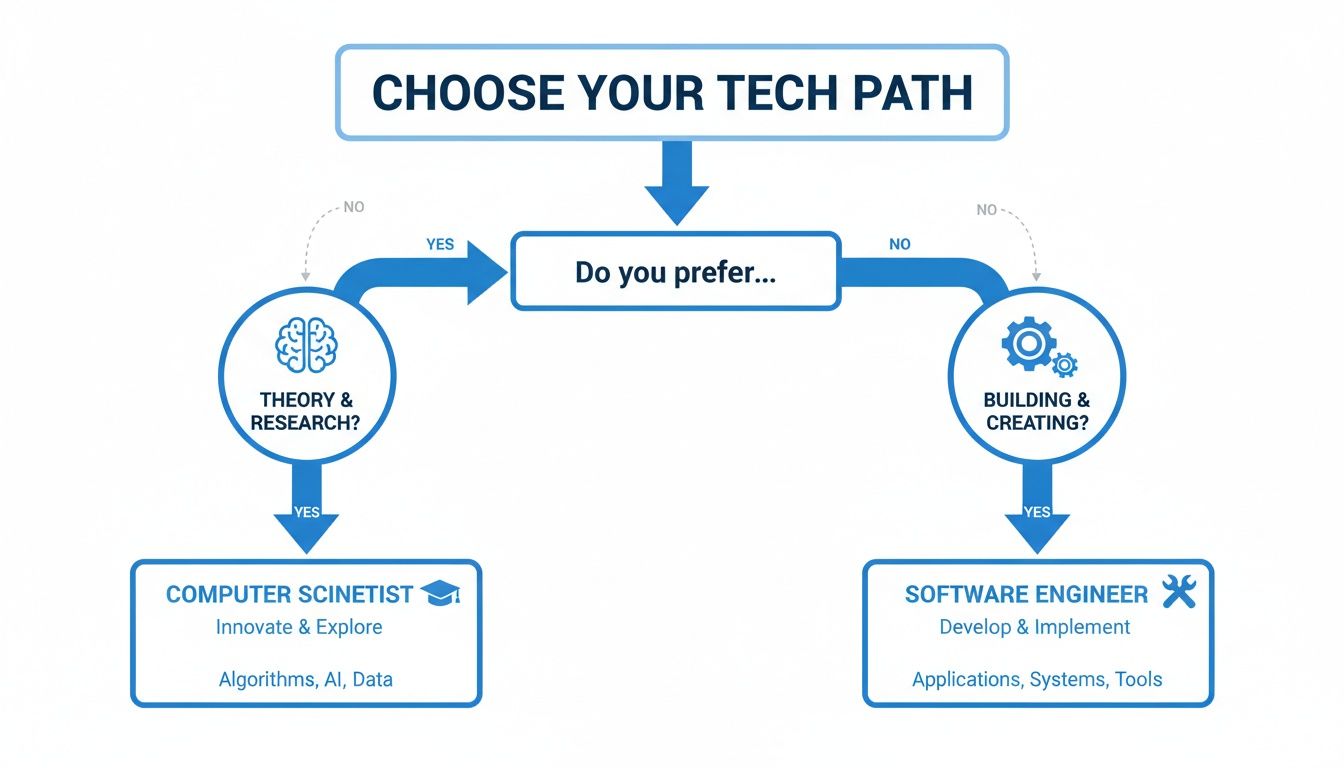
As you can see, the journey splits depending on whether you lean more towards abstract problem-solving or practical, hands-on building.
Guidance for Career Changers and Mature Learners
If you're coming back to education or switching careers, your past experience is a massive plus, not a drawback. Don't just focus on what you need to learn; think about the skills you already have and how they fit into this debate.
For instance, if you've been a project manager in a totally different industry, you're already brilliant with timelines, budgets, and getting a team to work together. These skills are a direct fit for software engineering, especially in roles like project management or Scrum master. Likewise, someone from a logistics or finance background probably has sharp analytical skills, which are gold dust in the data-heavy world of computer science.
Think of it this way: choose computer science to invent the future of computing; choose software engineering to build it. This simple idea really cuts through the noise and gets to the core of the choice.
Your professional maturity, communication skills, and understanding of how workplaces function can give you a real edge over younger graduates in either field. The trick is to figure out which path lets you play to your existing strengths while you get up to speed on the technical side.
For anyone just starting to dip their toes into the tech world, getting a broader picture of how to get started can be a huge help. This practical roadmap for starting an IT career is a great place to start.
Ultimately, this choice is all about you. Neither path is better than the other—they're just different. By taking a moment to think about whether you're driven more by theoretical discovery or by the practical craft of building, you can choose the degree and career that will truly click. Your journey in tech is your own, and picking the right starting line is the first step to a future you'll love.
Exploring University Entry and Alternative Pathways
Choosing your degree is one thing, but figuring out how to get there is the next big hurdle. Whether you've set your sights on a Computer Science or a Software Engineering degree, you need a clear picture of the entry requirements. But it's just as important to know that A-Levels aren't the only way into a tech career.
For most UK universities, the traditional route means having specific A-Level qualifications. A solid grade in Maths is almost always non-negotiable for both degrees, as it builds the logical foundation you’ll rely on every single day. Many of the top programmes also like to see at least one science subject, like Physics or even Computer Science, to show you’ve got a knack for analytical thinking.

Beyond Traditional A-Levels
But what if you don’t have those specific A-Levels? It’s a situation many people find themselves in, especially mature students, career changers, or anyone whose school days didn't point them directly towards tech. The good news is the UK higher education system has excellent alternative pathways designed to bridge that exact gap.
One of the most powerful and widely accepted options is the Access to Higher Education (HE) Diploma. These are Level 3 qualifications, right on par with A-Levels, created specifically to get students ready for the demands of university study. They're a perfect fit for adults returning to education.
An Access to HE Diploma does more than just teach you the subject. It’s designed to rebuild your academic confidence and arm you with essential university skills like research, proper referencing, and critical thinking. You’ll be ready to hit the ground running from day one of your degree.
How Access Courses Pave the Way to Tech Careers
If you’re aiming for a tech career, a specialised diploma is your best bet. An Access to HE Diploma in Computing, for instance, is the ideal launchpad for either a Computer Science or Software Engineering degree because the curriculum is built to cover all the essential foundations.
Key modules you'll likely cover include:
- Introduction to Programming: Getting you comfortable with the core principles of coding.
- Mathematics for Computing: Covering the specific maths concepts universities want to see.
- Computer Systems and Architecture: Giving you a solid understanding of how hardware and software work together.
This focused approach means you’ll arrive at university with the knowledge not just to keep up, but to thrive. The flexibility of online study also allows you to fit learning around work or family, making that career change feel much more achievable. You can find out more about how Access Courses prepare you for a future in Computer Science and see if this path is right for you.
Ultimately, these routes prove that not having the "right" A-Levels from years ago isn't a dead end. With the right preparation, the door to a degree in Computer Science or Software Engineering is wide open, no matter what your educational background looks like.
Frequently Asked Questions
Even after comparing the degrees and career paths, you might still have a few questions lingering. That's completely normal. Making this decision is a big step, so let's tackle some of the most common queries we hear to help you get that final bit of clarity.
Can a Computer Science Degree Lead to a Software Engineering Job?
Yes, absolutely. In fact, it's one of the most well-trodden paths into the industry. A Computer Science degree arms you with a deep understanding of algorithms, data structures, and the theories behind computation—the very foundations that top tech companies build on. The vast majority of CS graduates walk straight into software engineering roles.
To make that transition as smooth as possible, you’ll want to pair your academic knowledge with some hands-on experience. Think about:
- Building a portfolio of your own coding projects.
- Contributing to open-source software on platforms like GitHub.
- Securing an internship to get a taste of real-world development cycles.
When you combine that solid theoretical grounding with proven practical skills, you become a very attractive candidate for almost any software development job.
Which Is Better for a Career in AI or Machine Learning?
This is a great question, as both fields are critical to the world of AI, but they serve different purposes. It’s best to think of them as partners.
Computer Science is all about inventing and truly understanding the core algorithms and complex mathematical models that make AI tick. If you want to be the person creating the next generation of machine learning theories, this is your discipline.
Software Engineering, on the other hand, is about taking those brilliant AI models and building them into reliable, scalable applications that people can actually use. It solves the practical puzzles of deployment, maintenance, and making sure the system performs under pressure. The most in-demand AI professionals often have a strong footing in both, usually starting with a computer science foundation and then honing their software engineering craft.
How Difficult Is It to Switch Careers Between the Two?
Switching between these two fields is not only possible but incredibly common. The tech world is all about continuous learning, and because there’s so much overlap between the two disciplines, moving from one to the other often feels like a natural career progression.
The skills are highly transferable. A software engineer can deepen their theoretical knowledge through further study to move into research, while a computer scientist can build a project portfolio to transition into a hands-on development role. Your initial degree choice doesn't lock you in forever.
For instance, a software engineer might take some specialised courses in algorithm optimisation to pivot towards a more research-focused role. In the other direction, a computer scientist could master a few popular development frameworks and learn about the software lifecycle to become a senior developer or a systems architect. The real key is staying curious and committing to your professional growth.
Ready to take the first step towards your new tech career, even without traditional A-Levels? At Access Courses Online, we provide accredited online Access to HE Diplomas that prepare you for university success. Find the right course to start your journey today.