

You've got a deadline, a blank page, and a nagging feeling that your CV alone isn't enough. Maybe you're applying for a healthcare course, maybe you're changing careers, or maybe you're returning to education after a gap and wondering how to explain it all without sounding apologetic. That's exactly where covering letter help earns its keep, because a good letter doesn't repeat your CV, it connects the dots for the person reading it.
In the UK, a covering letter still matters in modern applications, especially where employers or admissions teams want to understand motivation, commitment, and fit. Resume.io's summary of Jobscan data says 35.4% of job seekers consistently send a cover letter with every application, and 42.5% send one for some applications, while 65% of start-ups request cover letters compared with 55% of medium-sized companies and 48% of giant tech corporations source. For adults applying through Access to HE routes, healthcare entry, or a career change, that means the letter often carries the story your CV can't.
A strong covering letter does three jobs well. It explains why you're applying, it shows you can write clearly, and it fills the gaps between your experience and the role or course. If you're also polishing professional messages for applications, the practical advice in how to write professional business emails is a useful companion, because the same habits, clarity, structure, and polite precision, carry straight into a covering letter.
What a Covering Letter Is Really For
A lot of people treat the covering letter as a polite extra, something to attach if there's time. That's a mistake. In real admissions and hiring settings, it's often the only place where you can explain a non-linear path, such as working for years before starting an Access to HE Diploma, returning after caring duties, or moving from retail into Nursing.
The letter tells the story behind the CV
Your CV lists what you've done. The covering letter explains why it matters. It's where you show that previous experience, even if it isn't identical, still taught you something relevant, maybe communication, teamworking, empathy, organisation, or calmness under pressure.
That matters most for applicants who don't follow the usual graduate scheme route. If you're applying to university, a healthcare programme, or a new profession, the reader wants to understand your motivation and whether you've thought through the step you're taking. A covering letter gives that context without forcing you to cram your whole life into a form.
Practical rule: if a sentence could sit in your CV unchanged, it probably doesn't belong in the covering letter.
The letter shows your writing style and judgement
Admissions tutors and hiring managers notice tone quickly. A tidy, focused letter tells them you can follow instructions, organise ideas, and communicate with care. Oxford University Careers Service recommends a business-letter structure, a letter of no more than one side of A4, and addressing it to a named individual where possible Oxford University Careers Service.
That's useful because the letter isn't meant to be long. It's meant to be sharp. Think of it as a short professional explanation, not a life history. If you want a second viewpoint on structured application writing, CV writing tips can help you see how the same clarity shows up across application documents.
The rest of the work is practical
Once you understand the purpose, the rest gets simpler. The strongest letters are built from structure, specific examples, and a closing that asks for the next step without sounding needy. That's the pattern to keep in mind as you write.
The Structure That Works Every Time
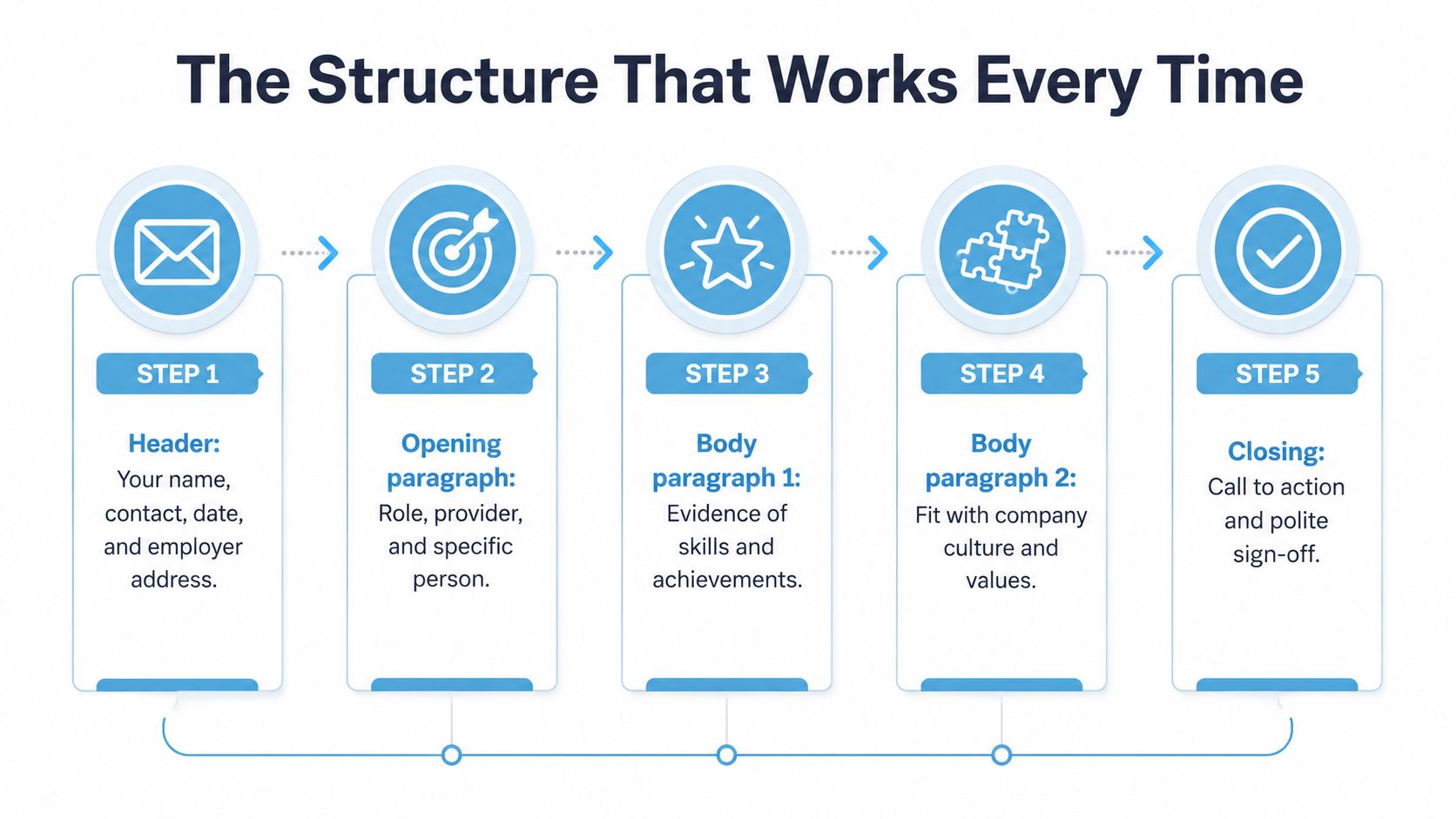
A covering letter reads best when it follows a clean, familiar shape. Oxford University Careers Service recommends a business-letter structure and keeping it to no more than one side of A4 Oxford University Careers Service, which makes the letter easier to read and harder to overdo. That doesn't mean it has to feel stiff, it just means every part has a job.
Start with the basics
Put your name, contact details, date, and the employer or provider's details at the top. If you know the person's name, use it. Oxford's guidance says addressing it to a named individual where possible is the right move Oxford University Careers Service.
A simple opening line can be as direct as, “Dear Ms Ahmed,” followed by, “I am writing to apply for the Access to HE Diploma in Nursing.” That's enough. The reader doesn't need a dramatic introduction, they need to know what this letter is for.
Give the body a clear purpose
The middle paragraphs should do the work. One paragraph can explain motivation, and another can show evidence, such as previous study, work, volunteering, or life experience that proves you're ready. Prospects advises applicants to rewrite the letter for each application, use keywords from the job advert, and include real examples to evidence claims Prospects.
A useful sentence looks like this, “My experience supporting customers in a busy pharmacy taught me how to stay calm, accurate, and organised, which is why I'm now applying for Midwifery.” That links past to future without sounding inflated.
Close with a straightforward next step
Your final paragraph should thank the reader and ask for an interview, a place, or a chance to discuss the application further. Keep it calm and professional, not desperate. A line such as, “I'd welcome the opportunity to discuss my application further and hope to hear from you soon,” does the job neatly.
If you want a practical model for how formal application writing works in recruitment contexts, the best recruitment email templates for 2026 are worth a look because they show the same habits of clarity, purpose, and polite action. For layout, many applicants also find that a sensible business-letter style mirrors the structure they already use in professional communication, which makes the letter feel less daunting.
Keep it short, keep it targeted, and make every paragraph earn its place.
Tailoring Your Letter for University and Healthcare Applications
The same covering letter shape can work for very different applications, but the details have to change. A letter for an Access to HE Diploma, a Nursing course, or a career change into Midwifery is not written in the same way as a general job application. Prospects is clear that you should rewrite each letter for each application, use the language of the advert or course page, and support what you say with real examples Prospects.
Match the route you're actually taking
An adult learner applying for a degree often needs to explain readiness, not just enthusiasm. An Access to HE applicant might need to show how family responsibilities, work experience, or previous study have prepared them for a return to education. A healthcare applicant may need to show commitment to patient care, resilience, and reliability.
A simple comparison helps:
| Situation | What to emphasise | What to avoid |
|---|---|---|
| Access to HE applicant | Readiness for study, motivation, evidence of persistence | Over-explaining old setbacks |
| Healthcare applicant | Care, communication, calmness, responsibility | Vague claims like “I'm passionate” |
| Career-change applicant | Transferable skills, clear reason for the move | Pretending previous work never happened |
That table isn't about sounding polished for its own sake. It's about giving the reader the information they need first, in the form they can use quickly.
Use specific examples for the sector
For a Nursing or Midwifery application, a line about teamwork is stronger when it comes with context. “Working in a care home taught me to communicate clearly with residents, families, and colleagues during busy shifts” tells a reader far more than “I work well with people.” The same applies to university courses, where you might say, “Completing assignments on time while working part-time showed me I can manage deadlines and study routines.”
A career-changer can do the same thing. If you're moving from retail into Health Professions, for example, you could point to customer care, accuracy with records, or staying composed during difficult conversations. The skill doesn't need to come from the same sector, it needs to be relevant.
Keep the focus on the destination
If you're unsure whether your experience sounds connected enough, use this rule. Name the course or role, name the provider or employer, then connect one piece of experience directly to one requirement. That keeps the letter grounded and stops it drifting into biography. For help shaping a more reflective application tone alongside your covering letter, what makes a good personal statement is a useful companion read.
A line like, “I am applying for the Access to HE Diploma in Business because I'm ready to build the academic skills needed for university study,” does exactly what it should. It is specific, grounded, and easy to follow.
Phrasing That Sounds Confident Without Sounding Arrogant
Most applicants don't need more ideas, they need better sentences. The difference between flat and strong often comes down to phrasing. You want to sound sure of yourself, but not inflated, and the easiest way to do that is to lead with evidence rather than adjectives.
Open without sounding formulaic
You don't need to begin with “I am writing to apply” every time. Try a more direct opening that shows purpose and fit straight away. “I'm applying for the Access to HE Diploma in Health Professions because I'm ready to build a career in care” feels more human and more focused.
For a university application, you could write, “I am applying for the Computer Science degree because I've developed a strong interest in problem-solving and want to turn that into formal study.” That says what matters without overblown language.
Explain gaps and changes plainly
If there's a gap in education or employment, name it briefly and move on. “After several years away from formal study, I'm now ready to return with stronger focus and a clear goal” is better than a long apology. If you've been caring for children, working shifts, or recovering your confidence, you don't need to overshare, you just need to show readiness.
For a career change, keep the reason honest. “My time in retail showed me that I want a role with more direct impact on people's wellbeing, which is why I'm now applying for Midwifery” is clear and sensible. It shows reflection without sounding rehearsed.
Useful wording: say what you've done, then say what it prepared you for. That's stronger than saying you're “passionate”, “hard-working”, or “highly motivated” on their own.
Close with confidence
Your ending should ask for the next step cleanly. “I would welcome the opportunity to discuss my application further” works well for jobs and courses alike. If you're writing to a university team, “I'd be grateful for the chance to discuss my suitability for the course” keeps the tone respectful and steady.
A few more adaptable lines help when you're stuck:
- Transferable skills: “This role helped me build organisation, teamwork, and communication skills that I can bring to your course.”
- Motivation: “I'm applying now because I'm ready to take the next step towards a career in healthcare.”
- Evidence of readiness: “Balancing work and study has taught me how to plan, prioritise, and follow through.”
- Polite ask: “I'd be glad to provide any further information if needed.”
Those lines aren't magic. They work because they're specific, calm, and easy to trust.
Common Mistakes and How to Fix Them
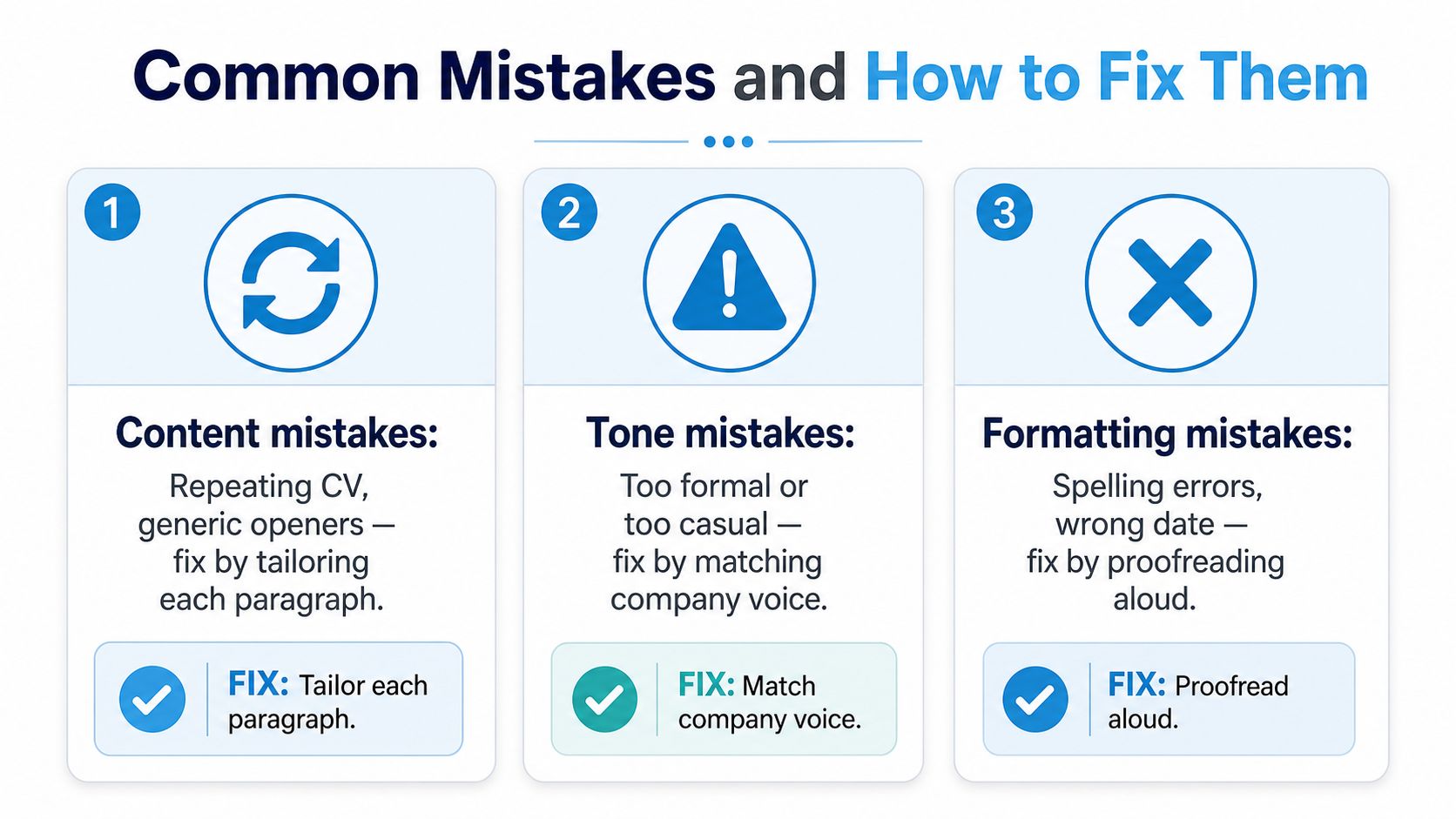
The most damaging covering letter problems are usually small. A tired reader doesn't need perfection, but they do need clarity. If you fix the repeated patterns below, your letter will already look more credible than most.
Content mistakes that waste space
Repeating the CV is the first trap. A weak version says, “I worked in retail for three years and developed customer service skills,” which the CV already shows. A stronger version says, “Working in retail taught me how to stay calm under pressure, which I now want to bring into healthcare study.”
Generic openers are another common slip. “Please find attached my application” tells the reader almost nothing. “I'm applying for the Access to HE Diploma in Science because I'm ready to return to study with a clear academic goal” does much more useful work.
Unsupported claims cause problems too. Saying “I'm a natural leader” means little unless you show the reader where that showed up. Replace that with one concrete example, even a short one, and the sentence starts to carry weight.
Structure mistakes that make the letter harder to read
Oversized letters feel heavy. Oxford University Careers Service advises keeping a covering letter to no more than one side of A4 Oxford University Careers Service, and that limit is there for a reason. It forces focus.
Missing names are another avoidable issue. If the advert gives a contact person, use it. If it doesn't, take a little time to find the right person rather than leaving the letter floating. A named addressee makes the letter feel more deliberate.
Poor paragraph order can also blur your point. Put the role or course first, then the motivation, then the evidence, then the close. Don't bury the main reason for applying halfway down the page.
Tone mistakes that sound off
Some letters sound too formal, with phrases that feel copied from another era. Others go the opposite way and sound chatty, as if the reader is a friend. The sweet spot is professional but plain.
A weak sentence might read, “I am most desirous of obtaining this esteemed opportunity.” A better version is, “I'd welcome the chance to study with you and build the skills needed for the next stage of my career.” That sounds natural and respectful.
Evidence convinces. Adjectives don't.
Final Checklist and Where to Go Next
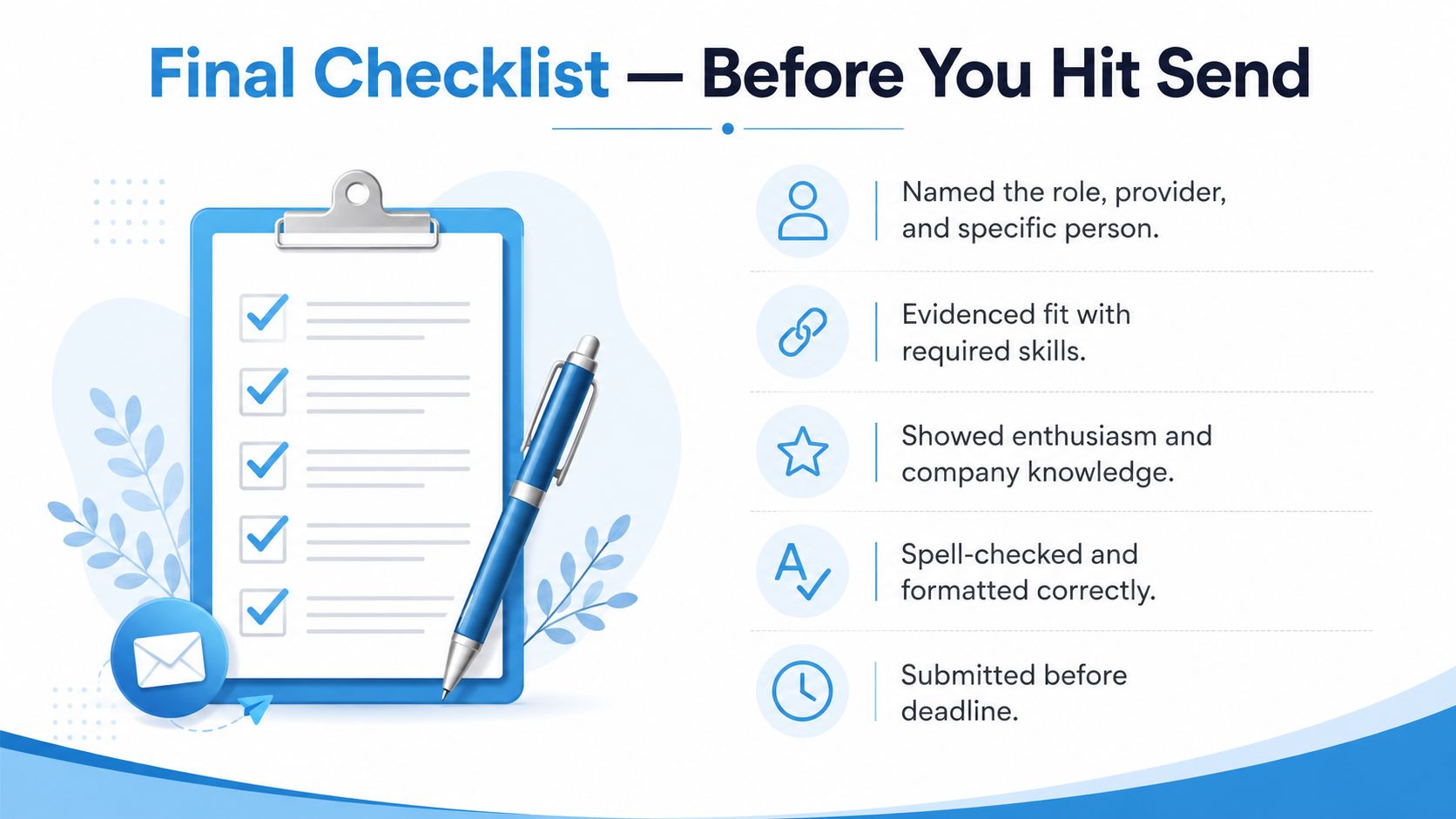
Before you send anything, run your letter through a simple final check. The strongest applications usually aren't the flashiest, they're the ones that are clear, tidy, and obviously written for the right place.
Use this quick send-off check
- Named the role, provider, and person: Check the course, job title, and recipient are correct.
- Shown fit with real examples: Make sure each claim has a concrete example behind it.
- Kept it concise: If it runs over one side of A4, trim the least useful lines.
- Proofread carefully: Read it aloud, because your ear catches awkward phrasing your eyes skip.
- Saved it properly: Export as a PDF and give it a sensible filename before sending.
If you're using an AI writing assistant to help draft a first pass, it's still worth checking the final version line by line. The guidance in Voice Control Pro's AI writing tips is helpful here because it reinforces the idea that tools should support your voice, not replace it.
For applicants who are also preparing for the next stage, how to prepare for university interview pairs naturally with a strong covering letter, since both depend on clear motivation and grounded examples. That combination matters when you're explaining a route into university or a healthcare career.
If you're building that route through an Access to HE Diploma, Access Courses Online offers accredited online study, flexible learning that fits around work and family, tutor support, and personalised advice to help you move towards university with confidence. Visit Access Courses Online to explore your options and get practical support for the next step.