
A good personal statement is your professional pitch wrapped in a personal story. It goes far beyond a simple list of your qualifications. It’s your chance to reveal the 'why' behind your ambition, showing your passion, suitability, and readiness for a specific university course through a compelling, authentic narrative.
Understanding Your Personal Statement
Think of your personal statement as the trailer for a film—your film. A good trailer doesn't just list the actors and show a few random scenes. It sets a tone, introduces the main character (you!), hints at the journey they've been on, and builds real excitement for what's to come. Its job is to convince the audience—in this case, the admissions tutor—that this is a story worth investing in.
This really is the perfect analogy. Your statement needs to achieve three key things: it must be a compelling pitch, a genuine story, and a solid bridge connecting your past to your future. It's your one chance to speak directly to the admissions team, showing them the person behind the grades and the application form. A truly great personal statement communicates your unique value in a way that connects with the university's own culture and academic standards.
The Three Core Components
To build this narrative effectively, you need to focus on three distinct but interconnected elements. Each part plays a vital role in constructing a persuasive and memorable account of who you are and why you belong on their course.
- Your Pitch: This is your hook. It’s the confident, forward-looking part of your statement where you make it clear why you are an excellent candidate for this specific course. It should be direct, engaging, and show genuine motivation from the get-go.
- Your Story: This is the heart of your statement. Here, you provide the evidence to back up your pitch by sharing relevant experiences, skills, and moments of insight. This isn't just about listing what you did, but exploring what you learned from it and how it shaped you.
- Your Bridge: This is the crucial link that connects your past experiences and current ambitions to your future at their university. You must explicitly show how this course is the logical next step for you and how you’ll contribute to their academic community.
This diagram helps visualise how these three elements—the pitch, the story, and the bridge—form the essential structure of a powerful personal statement.
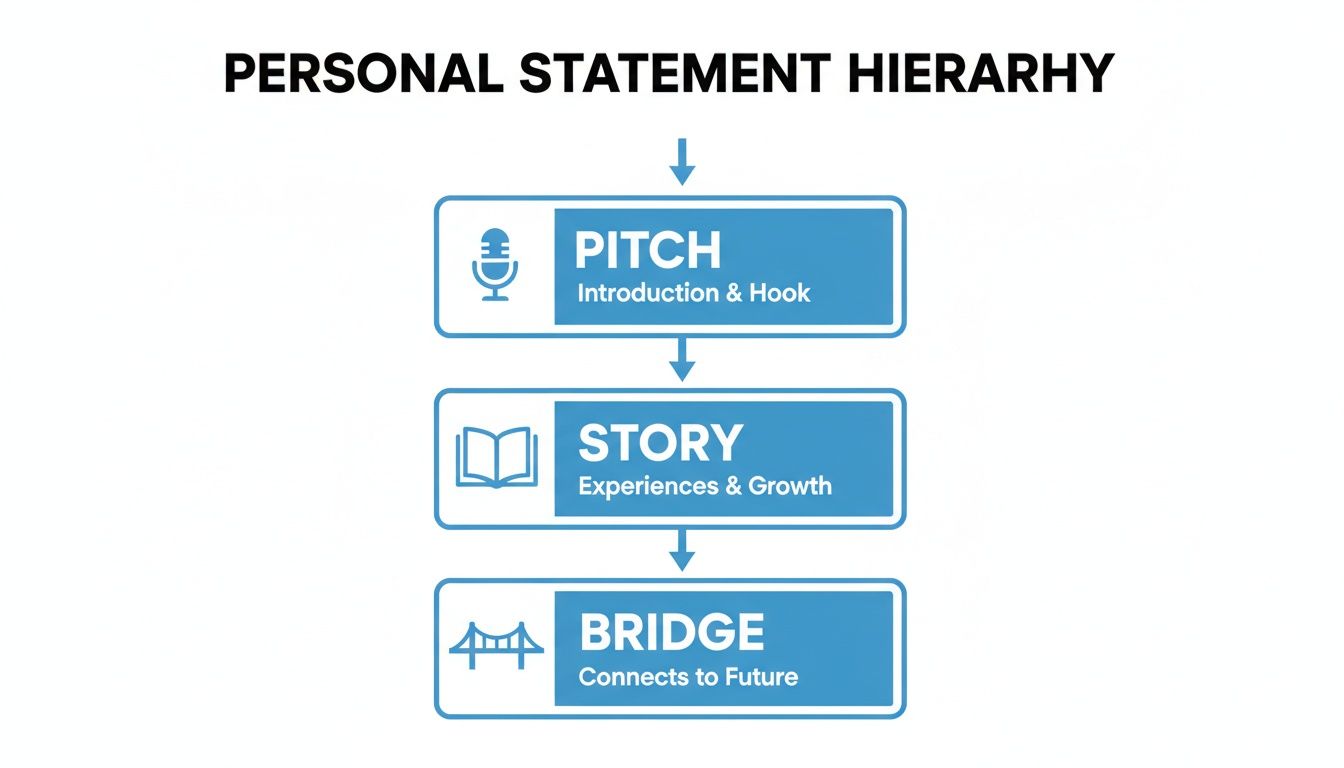
As you can see, these components work together to build a completely convincing case for your admission.
The most memorable essays don’t try to sound “admissions-worthy” or try to prove something. Instead, the great ones sound like you—whoever that might be. The best statements emerge from honest introspection and help the reader understand your unique journey.
Ultimately, what makes a good personal statement is authenticity. Admissions tutors read thousands of applications; they can spot insincerity or generic templates a mile off. Your goal is to give them a clear, genuine, and engaging insight into your character, motivations, and potential.
Why Your Statement Is Your Most Powerful Application Tool

Think of your UCAS application like a puzzle. Your grades and qualifications are crucial pieces, but they don't show the full picture. The personal statement is where everything comes together, giving life and personality to your application. It's the single best tool you have to speak directly to an admissions tutor, showing them who you are, what drives you, and why you’re a fantastic fit for their course.
This is especially true for competitive courses or if you're returning to education after a break. Tutors are looking for qualities that numbers on a certificate just can't reveal – things like your motivation, resilience, and a real passion for your subject. Your statement is your chance to connect the dots of your journey and show them you’re ready for the challenges of university.
Moving Beyond Grades
For many students, particularly those studying an Access to HE Diploma, the personal statement is a complete game-changer. It’s a platform to weave your work, family, or voluntary experience into a compelling story that links directly to the demands of a degree.
It’s your chance to answer the big questions the admissions team will be asking:
- Why this specific course, and why here?
- What practical skills have you picked up that will help you hit the ground running?
- How have your life experiences shaped your ambitions?
A brilliant statement can level the playing field, proving that your non-traditional path has given you a maturity and focus that other applicants might lack. This narrative is often the deciding factor that makes your application stand out from hundreds of others.
The Deciding Factor For Diverse Applicants
Universities are keen to build a diverse student body, and your statement is how they find promising candidates from all walks of life. Figures from the Quality Assurance Agency (QAA) show just how vital Access to HE courses are. In 2021-22, 29% of Access students came from ethnic minority backgrounds and 26% had a declared disability, proving the rich pool of talent these courses attract.
For these applicants, the personal statement is essential for providing context that grades alone can't offer. Tutors rely on it to gauge your commitment, especially when your background is less conventional. For adult learners and career changers – the very people we support at Access Courses Online – a statement that translates life experience into academic potential is incredibly powerful.
Your personal statement isn’t about impressing someone in an office—it’s about inviting them into your story. When written with honesty and care, it can show the values, motivations, and dreams that GPAs can’t capture.
Learning how to write a cover letter that gets you hired follows a similar principle: you’re tailoring your story and highlighting your best qualities to make a strong impression. By understanding what makes a great personal statement, you’re investing in the most persuasive part of your application. For more help, check out our guide on top tips for applying to UCAS.
Structuring Your Story for Maximum Impact
A brilliant personal statement isn’t just a random list of your accomplishments; it's a story you’re telling. Think of it like a good film – it needs a compelling beginning, an engaging middle, and a memorable end to take the admissions tutor on a journey. By the time they finish reading, they should be completely convinced of your potential.
Let’s break down how to build that narrative, piece by piece. The classic three-act structure is your best friend here. Your intro is the hook, the main body is where you build your case with evidence and action, and the conclusion is the powerful finale that leaves a lasting impression. Sticking to this blueprint makes your statement logical, persuasive, and incredibly easy to follow.
Crafting an Unforgettable Introduction
Your opening paragraph is your one big chance to grab the reader’s attention. The goal is to be memorable, but not for the wrong reasons. Tutors have read the phrase "From a young age, I have always been passionate about..." thousands of times, so it’s best to avoid clichés like that altogether.
Instead, jump right in with something specific and engaging. It could be a short anecdote about the moment you realised this was the subject for you, or a powerful statement that cuts straight to the heart of why you're applying. The key is to be authentic and direct – show them your motivation from the very first sentence.
Building a Persuasive Main Body
This is where the real work happens. The main body is the heart of your statement, making up around 70-80% of the word count. This is your space to connect your experiences, skills, and academic interests into one cohesive argument. It’s not about just listing what you’ve done; it’s about explaining why it matters.
The golden rule here is to 'show, don't tell'. Don’t just claim you’re a great team player; describe a specific time where your teamwork helped achieve something tangible. This approach breathes life into your experiences and gives the tutor solid proof of your abilities.
To keep this section organised, a simple structure can work wonders. The STAR technique is a popular and really effective way to do this:
- Situation: Briefly set the scene. Where were you and what was the context?
- Task: What was the goal you needed to achieve or the problem you had to solve?
- Action: What specific things did you do to tackle the task?
- Result: What was the outcome? And, most importantly, what did you learn from it?
Using this framework for a couple of your most important experiences helps keep your paragraphs focused and powerful. It forces you to go beyond just describing events and really reflect on how they’ve prepared you for university.
Your personal statement isn’t just a record of events; it's a reflection on their meaning. The best statements help the reader understand not just what you've done, but how those experiences have shaped who you are and who you want to become.
Writing a Powerful and Lasting Conclusion
Your conclusion is your final chance to leave a strong, positive impression. It should be concise and confident, summing up your key points without just repeating them word-for-word. This is where you bring your story to a satisfying close.
Reaffirm your excitement for the course and the specific university. Mentioning a particular module, a piece of research, or a lecturer whose work interests you is a great way to show you’ve done your homework. It proves you have a genuine interest and can see yourself thriving in their academic community.
End on a forward-looking note. Finish by clearly stating your future goals and explaining how this course is the vital next step on your journey to achieving them. A strong ending ties everything together, reinforcing your suitability and leaving the admissions tutor with a clear sense of your purpose and determination.
Tailoring Your Statement to Your Chosen Course

Sending out a generic personal statement is a massive missed opportunity. While the basic flow might stay the same, the heart of the content has to be laser-focused on the specific course you’re applying for.
Think of it this way: you’d never send the same CV to apply for a chef role and an accountant role, right? Your personal statement demands that same level of customisation.
Admissions tutors aren't just looking for a good student. They're looking for a promising future nurse, an innovative future software developer, or an insightful future business leader. A truly great personal statement proves you get the unique demands of your chosen profession and have already started to live those values.
This means doing your homework. Dig into the course modules, get a feel for the university's ethos, and understand the professional standards of the industry you’re aiming for. Your mission is to draw clear, undeniable lines between your experiences and their specific requirements.
Writing for a Nursing or Healthcare Course
For any healthcare degree, especially something like Nursing or Midwifery, your statement needs to practically radiate empathy and resilience. Tutors are hunting for evidence that you understand and embody the core values of the NHS Constitution, often called the '6 Cs'.
These values are the absolute bedrock of patient care in the UK. A powerful statement will bring these qualities to life through real examples:
- Care: Describe a time you provided support or comfort, showing your natural instinct to look after others.
- Compassion: Go a step further than just care. Explain how you truly understood and empathised with someone’s situation.
- Competence: Detail any relevant training or work experience. Even skills learned from parenting show you can handle serious responsibility.
- Communication: Give an example of when you had to listen carefully or explain something clearly, especially if it was a difficult situation.
- Courage: Talk about a time you stood up for what was right or handled a tough moment with integrity.
- Commitment: Show your dedication through volunteering, relevant reading, or completing an Access to HE in Health course.
When you share a story about comforting a distressed patient during your time as a healthcare assistant, you aren’t just listing experience. You are actively demonstrating compassion and communication, bringing the core values of nursing to life for the admissions tutor.
Generic claims like "I am a caring person" just fall flat. Instead, describe an action that proves you are. This evidence-based approach is what makes a personal statement for healthcare truly stand out.
Showcasing Your Skills for Computer Science
Applying for a Computer Science degree? The focus shifts completely. While being a team player is great, tutors are really looking for your logical thinking, problem-solving skills, and a genuine passion for tech that goes beyond your coursework.
Your statement should be full of your projects and intellectual curiosity. Don't just say you enjoy coding. Talk about that small game you tried to build, the website you designed for a friend, or how you taught yourself Python just to automate a boring task. These examples scream initiative and a real drive to understand how things tick.
Here’s what to zero in on:
- Problem-Solving: Describe a complex problem you tackled—it doesn't even have to be a coding one—and walk the tutor through your logical steps to find a solution.
- Personal Projects: Mention any coding projects, even the unfinished ones! Explain what you were trying to do and what you learned when you hit a wall.
- Mathematical Aptitude: Connect your interest in technology to your logical or mathematical brain. Explain why you get a kick out of subjects that demand precision and analytical thought.
This approach proves you aren't just interested in using technology, but in creating it. That distinction is everything for a successful application.
Articulating Transferable Skills for Business or a Career Change
If you're changing careers and applying for a Business or Management course, your statement is the bridge between your past and your future. You have to show the admissions tutor how your previous career—no matter how different it seems—has perfectly prepared you for the world of business.
Your work history isn't a drawback; it's your unique selling point.
The key is to translate your experiences into the language of business. A retail manager has deep experience in logistics and customer relations. A stay-at-home parent develops incredible project management and budgeting skills. It's all about how you frame it. For a closer look at a specific field, our detailed guide on writing a psychology personal statement example offers more insights into connecting past experiences to a new academic path.
Highlight these transferable skills with solid examples:
- Leadership: When did you guide a team or take full ownership of a project?
- Financial Acumen: Have you managed budgets, handled accounts, or been responsible for hitting financial targets?
- Communication & Negotiation: Describe a time you had to persuade a client, mediate a dispute, or present an idea effectively.
By proving you already have a strong foundation of professional skills, you show that you are a mature, low-risk candidate who is ready to build on that experience in an academic setting.
Common Mistakes and How to Avoid Them
You’ve poured your heart and soul into crafting your story. The last thing you want is for a small, avoidable slip-up to let you down. Think of this section as your final pre-flight check, making sure everything is polished, professional, and ready to impress.
Getting your personal statement right is as much about avoiding common pitfalls as it is about showcasing your strengths. Admissions tutors read thousands of these, and they can spot the same old mistakes a mile off. Let's walk through a simple checklist to make sure your hard work shines through.
The Dos: Making Your Statement Stronger
First, let's focus on the positive habits that can take your writing from good to great. These are the small but powerful choices that add real weight and credibility to your application, making it far more memorable.
-
Do Be Yourself: Write in your own voice. Tutors want to get a sense of who you are, not who you think they want you to be. Trying to sound overly academic or using a thesaurus for every other word can come across as insincere. Honesty and authenticity are always more powerful.
-
Do Use Numbers to Show Impact: Numbers bring your achievements to life. Instead of saying you “helped at a busy veterinary clinic,” you could say you “assisted with the care of over 20 animals per day.” It makes your experience tangible and gives the reader a much clearer picture of what you've done.
-
Do Connect the Dots for Them: Don’t assume the admissions tutor will automatically see the link between your skills and their course. Spell it out! Explain how your weekend job managing stock taught you the organisational skills needed for a logistics degree.
The best statements emerge from honest introspection. You’re not proving your worth—you’re helping the reader understand your journey. It's this genuine reflection that separates a good statement from a truly great one.
The Don'ts: Traps to Avoid at All Costs
Just as important as knowing what to include is knowing what to leave out. These common traps can instantly weaken your personal statement, distracting from your potential and making you blend into the crowd.
Think of these as red flags for admissions tutors. Avoiding them shows you’re a thoughtful and serious applicant who has taken the time to understand what's required.
-
Don't Use Famous Quotes: Starting with a quote from Einstein or Maya Angelou is one of the most common clichés. Tutors want to hear your voice and your thoughts, not someone else's. That precious character count is for your story, not theirs.
-
Don't Make Empty Claims: Avoid vague statements like, “I am a passionate and dedicated student.” Anyone can say that. You need to provide evidence. Show your passion through a story about a project you loved; don’t just state it as a fact.
-
Don't Just List Things: Your personal statement isn’t a CV. Simply listing your part-time jobs or voluntary roles without any reflection is a huge missed opportunity. The magic is in the why. What did you learn? How did that experience change you? Why does it make you a perfect fit for their course?
We've put together a quick checklist to help you review your own statement. Running through these simple dos and don'ts can help you spot any areas for improvement before you hit submit.
Quick Guide to Personal Statement Success
| Do | Don't |
|---|---|
| Write in your natural voice and show your personality. | Use clichés or famous quotes that don't add value. |
| Show, don't just tell. Back up your claims with evidence. | Make vague statements like "I'm a hard worker." |
| Quantify your achievements with numbers and specifics. | Simply list your experiences like a CV. |
| Explain why you want to study the course with genuine reasons. | Try to be funny. Humour is subjective and can fall flat. |
| Link your skills and experiences directly to the course. | Exaggerate or lie about your achievements. |
| Proofread meticulously for spelling and grammar errors. | Forget to check the character and line limits. |
By keeping these points in mind, you can feel confident that your personal statement is a clear, compelling, and authentic reflection of who you are. This final check helps ensure your application makes the best possible impression and stands out for all the right reasons.
Polishing Your Final Draft Before You Submit
You’ve poured your heart, experience, and ambitions onto the page. But getting your story down is only half the battle. The final editing and proofreading stage is what turns a good personal statement into a great one. This is your chance to sharpen your message and make sure every word counts.
Think of yourself as a sculptor. Your first draft is the raw block of marble—it has potential, but the real masterpiece is revealed through careful, precise chipping and polishing. This isn't just about fixing typos; it's about making your writing stronger, clearer, and much more impactful.
A Step-by-Step Polishing Process
Don't just give your document a quick once-over and hit submit. A methodical approach will help you catch the kind of errors your brain automatically corrects when you read silently. It’s always a good idea to step away for at least a day between writing and editing to see your work with fresh eyes.
-
Read It Aloud: This is the single most effective trick in the book. Reading your statement out loud forces you to slow down. You'll hear the awkward phrasing, clunky sentences, and repetitive words that your eyes might have missed. If you stumble over a sentence, it needs a rewrite.
-
Cut Ruthlessly: Your personal statement has a strict character limit, so every single word has to earn its place on the page. Go through each sentence and ask yourself: "Does this add real value?" Get rid of unnecessary words, delete redundant phrases, and combine short, choppy sentences to improve the flow.
-
Check for Consistency: Make sure your tone and message are consistent from start to finish. Does the confident pitch in your introduction match the evidence you provide later on? A consistent narrative is what makes a personal statement feel authentic and persuasive.
-
Use Digital Tools Wisely: Spelling and grammar checkers are a good first line of defence for catching basic mistakes, but don’t rely on them blindly. They often miss context and can sometimes even make the wrong suggestions. Use them as a safety net, not as a substitute for your own careful proofreading.
Gaining a Fresh Perspective
Once you’ve done all you can on your own, the most valuable next step is to get a fresh pair of eyes on your draft. You’re simply too close to your own writing to spot every little issue.
Your personal statement isn’t just a record of events; it's a reflection on their meaning. Getting feedback ensures that the meaning you intend is the one your reader receives, making your story resonate on a deeper level.
Ask a trusted friend, family member, or tutor to read your statement. But don’t just ask them if it’s "good." Ask specific, probing questions:
- What three adjectives would you use to describe me after reading this?
- Was any part confusing or unclear?
- What do you think is my strongest point?
Their feedback can reveal blind spots you never knew you had and help confirm that your personality is truly shining through. As you refine your work, considering these external strategies to improve academic writing can also add a layer of professionalism and clarity.
This final polish ensures your application is confident, clear, and ready to impress. If you're applying after completing an Access to HE Diploma, you can find more guidance in our article on how to apply to university after an Access course.
Frequently Asked Personal Statement Questions

Even with the best plan in the world, it’s completely normal to have a few nagging questions pop up as you get writing. This final section is all about tackling those common queries we hear time and time again, especially from adult learners heading back into education. Think of it as a final confidence boost.
Let's clear up those last few hurdles. They might feel like big blockers right now, but with a bit of straightforward advice, you'll see they’re easy enough to overcome.
How Do I Start Writing with a Blank Page?
Staring at a blank page is probably the most intimidating part of this whole thing. The secret? Don’t try to write the perfect, polished introduction first. That comes later. Instead, start with what you know.
Just start by getting your thoughts down on paper. Brainstorm a simple list of your experiences. Jot down things like:
- The key skills you’ve picked up from work, volunteering, or just life in general.
- Those specific moments that really sparked your interest in this subject.
- The reasons you’ve landed on this particular course.
Forget about flow or fancy sentences for now. The goal is to create a pile of raw material – the clay you'll eventually shape into a brilliant story. You can always loop back and write the introduction at the very end, once you know exactly what you’re introducing.
Can I Use the Same Statement for Different Universities?
This is a great question. You can only submit one personal statement through UCAS for up to five choices, so you can’t write a different one for each. That doesn't mean a generic, one-size-fits-all approach is the way to go, though.
If your chosen courses are very similar – for instance, five different Nursing BSc programmes – a single, highly focused statement is perfect. You’re golden.
But what if you're applying for slightly different subjects, like Business Management at one uni and Marketing at another? Your mission is to find the common ground. Focus on the skills and motivations that link them, like your communication abilities, strategic thinking, or commercial awareness. Whatever you do, don't mention a specific university by name.
How Much About Hobbies Is Too Much?
Hobbies can be a fantastic way to let your personality shine through, but they absolutely must be relevant. You have very limited space, and every single sentence needs to earn its place by strengthening your application. Always ask yourself: does this hobby show off a skill that will help me succeed on this course?
Talking about your role as captain of the local netball team is great – it shows leadership and commitment. Describing your love for binge-watching box sets probably isn't, unless you’re applying for a Film Studies degree. It's all about connecting your interests back to the course.
Think quality over quantity. One or two well-explained examples that highlight relevant traits are far more powerful than a long list of your weekend activities. Focus on what your hobbies reveal about your character, your resilience, or how you manage your time. That’s what an admissions tutor really wants to see.
Feeling ready to take that next step towards your degree? At Access Courses Online, we specialise in helping adult learners get the qualifications they need to thrive at university. Our flexible, accredited Access to HE Diplomas are your direct route to a brand new career.
Explore our courses and start your journey today at accesscoursesonline.com