

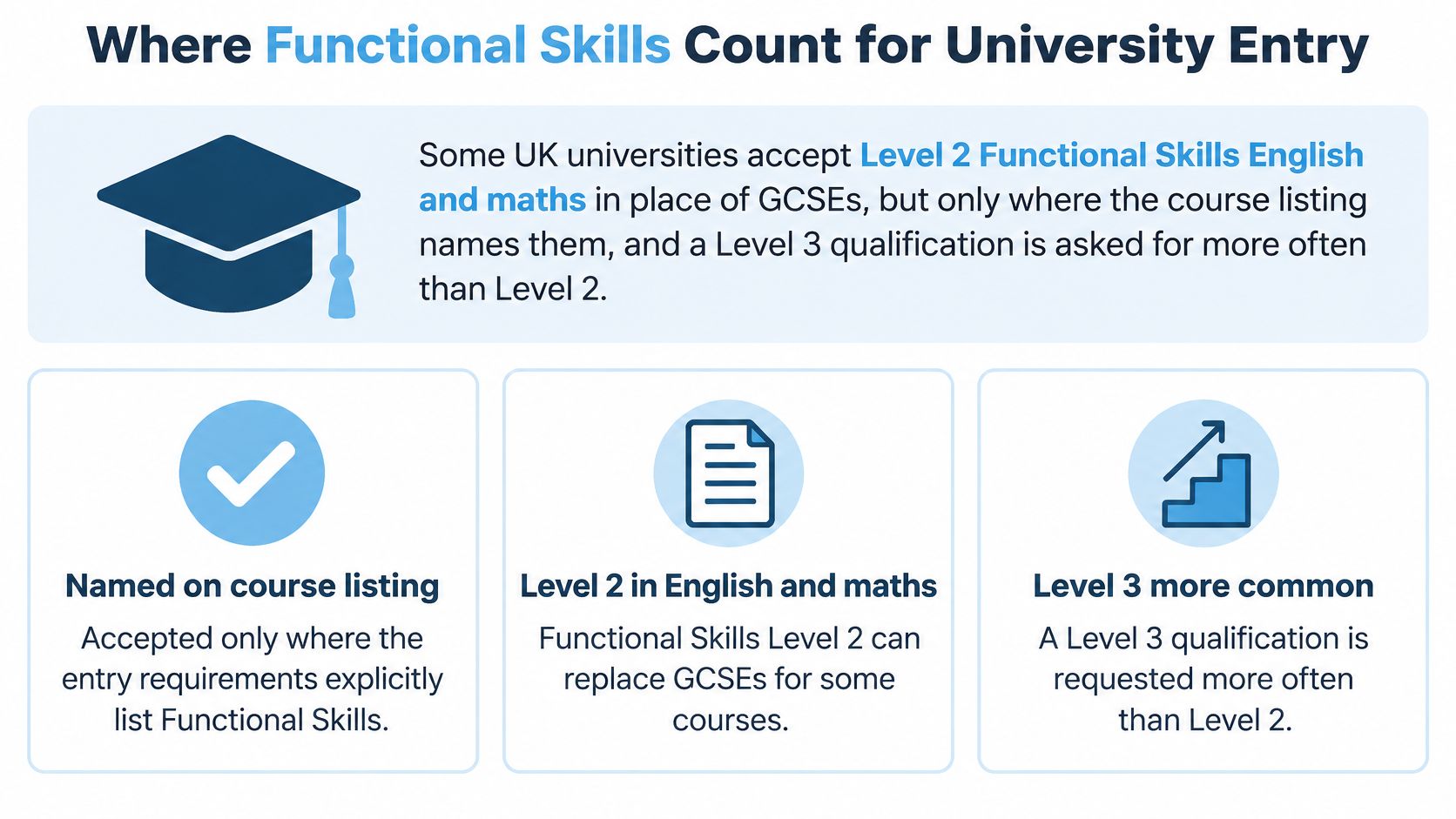
Some UK universities accept Level 2 Functional Skills English and maths in place of GCSEs, but only where the course listing names them, and a Level 3 qualification such as an Access to HE Diploma, A levels or T Levels still usually forms the offer.
The advice you'll meet most often comes in two flavours. One says universities accept Functional Skills now, so stop worrying about GCSEs. The other says universities only want GCSEs, so Functional Skills are pointless. Both are wrong in the same way. They answer a question that admissions tutors never ask.
An entry requirement isn't one demand. It's usually two, sitting side by side in the same paragraph, and they do different jobs. Until you know which one you're trying to satisfy, no yes or no answer will help you.
Where Functional Skills Count for University Entry
Confusion starts with the word requirement. A course listing can ask for a GCSE-equivalent condition in English or maths and, separately, a main academic entry profile at Level 3. Functional Skills Level 2 can sometimes meet the first. It cannot meet the second, and most guides blur the two into a single question about whether the qualification "counts".
The Department for Education treats Functional Skills as a foundation for progression into further study or employment, and its higher-education guidance sends applicants back to the individual university and course requirements. The qualifications are nationally regulated, but they create no automatic right of entry to a degree, as the government collection on Functional Skills qualification requirements sets out. One institution will name Level 2 Functional Skills English as acceptable for a given course. Another will insist on a GCSE grade, often because a professional or regulatory body expects one.
The qualification hasn't changed between those two listings. The wording has.
| Requirement | Can Level 2 Functional Skills meet it? | What else you usually need |
|---|---|---|
| GCSE English at grade 4/C | Often, if the course lists it | A Level 3 qualification for the main offer |
| GCSE maths at grade 4/C | Often, if the course lists it | A Level 3 qualification for the main offer |
| Main Level 3 academic entry | No | A levels, T Levels or an Access to HE Diploma |
| UCAS Tariff points | Only when embedded in a composite Level 3 qualification | Standalone Functional Skills earn no points |
| Regulated routes such as nursing or midwifery | Check the exact course listing | Subject, placement, health and interview checks |
That last row catches people out. Professional courses can accept Functional Skills for the literacy and numeracy line while adding a set of conditions that have nothing to do with either qualification.
Before you read a single listing in detail, get clear on the three questions you'll be asking every university. They're short, and they stop you wasting a cycle on the wrong course.
- Does Level 2 Functional Skills replace GCSE English or maths on this course? Ask about English and maths separately, because a department may accept one and not the other.
- Does this degree carry higher subject requirements? A science foundation year and a BSc in the same subject can word the same condition differently.
- Which Level 3 qualification forms the main basis of the offer? This is the question that decides whether you need an Access to HE Diploma, A levels, a T Level or something else entirely.
Answer those three and you know whether Functional Skills are doing real work in your application or just sitting in a folder. If you're returning to study after years away, the writing side of a degree can feel like a bigger obstacle than the entry wording, and the guide to academic writing and presentations from Englify walks through essays, referencing and presentation structure in plain language.
Reading a Listing and Confirming the Current Rule
The same Level 2 certificate can satisfy one admissions tutor and fail another, because the deciding text is written course by course rather than nationally. Universities set their own entry requirements, and a course page may name particular qualifications, subjects, grades or equivalent awards. Nothing forces two departments in the same building to agree.
Three patterns cover almost every listing you'll open.
Three patterns you'll meet in listings
The explicit equivalence. Some listings name Functional Skills outright. UCAS course listings include a science-related degree that accepts Level 2 Functional Skills in literacy and numeracy, and a biotechnology course that accepts Level 2 Functional Skills or equivalent Level 2 awards alongside GCSE maths, English and science, as this UCAS course listing illustrates. A social work listing takes the same approach with GCSE English and maths, then adds substantial relevant work or voluntary experience as a separate condition that no qualification can satisfy for you.
The silence. The page asks for "GCSE grade 4" and stops. Silence isn't a refusal, but it isn't permission either. Treating a blank as a yes is how applicants end up with a rejection in March that a single email in September would have prevented.
The stricter named condition. Nursing, midwifery, social work and laboratory science courses frequently add subject rules, placement hours, interviews, health assessment or a DBS check on top of the academic line.
Why the version on your certificate matters
Scale first, because this pathway is larger than most applicants assume. Ofqual recorded 326,060 Functional Skills qualification certificates across the 2024 to 2025 academic year, including 105,690 Level 2 certificates, down from 114,435 in 2023 to 2024, a fall of about 7.6%, according to its annual qualifications market report. The same report puts the overall fall in Functional Skills certification at 2.7% year on year and notes that Digital Functional Skills qualifications have replaced ICT Functional Skills for new learners, initially at Entry Level and Level 1.
That replacement matters more than it looks. A listing written with ICT Functional Skills in mind isn't automatically satisfied by a Digital certificate, and a course that names Level 2 doesn't extend down to Entry Level or Level 1 by implication.
A four-step reading routine
Work through these in order, and bookmark the page you read them on.
- Check the level. If the listing names Level 2, an Entry Level or Level 1 certificate doesn't meet it, however recent your result.
- Check the subject. English and maths are separate conditions in most listings and are treated separately far more often than applicants expect.
- Check the version. Confirm whether the course recognises Digital Functional Skills, and whether it still references ICT.
- Check the completion date and grade. Some listings specify a grade or a pass, and some set a recency rule for qualifications taken years ago.
Then email the admissions team and ask for written confirmation that quotes the course code and your exact qualification. Keep that reply. Policies get rewritten between application cycles, and the email is what you'll point to if the wording changes under you.
Worth knowing: a reply that says "Functional Skills are accepted" without naming the level and subject has told you almost nothing. Ask again with the specifics.
Functional Skills Compared With GCSEs and Access Diplomas
Four qualifications get mixed up in these conversations, and each one does a different job. Once you can place them side by side, the decisions get easier.
GCSE English and maths at grade 4/C is the condition Functional Skills Level 2 most often stands in for. It's the standard pre-16 benchmark, and plenty of courses still ask for the GCSE itself, particularly in maths.
Functional Skills Level 2 is built as applied English and maths for everyday and workplace contexts. That practical design is why employers value it and why some admissions teams accept it as a GCSE equivalent, while its applied focus is also why it doesn't slot into the main Level 3 academic space.
The Access to Higher Education Diploma is a Level 3 qualification, equivalent to A levels and accepted by many universities. It's assessed through coursework rather than a final exam, which suits adults returning to study after a long break.
A levels remain the standard academic profile most degree offers are built around.
| Qualification | Usually meets a GCSE English or maths condition? | Usually forms the main Level 3 entry? | UCAS Tariff points | Assessment style |
|---|---|---|---|---|
| GCSE English or maths, grade 4/C | Yes | No | Not applicable | Exams |
| Functional Skills Level 2 | Often, where the course lists it | No | Only when embedded in a composite Level 3 qualification | Applied assessment |
| Access to HE Diploma | No, it is a Level 3 route | Yes, accepted by many universities | No fixed points | Coursework, no final exams |
| A level | No, it is a Level 3 route | Yes | Yes | Exams |
Two rows surprise people. The first is the tariff line. UCAS notes that Functional Skills attract UCAS Tariff points only when embedded within a composite Level 3 qualification, not when taken as standalone awards, which is set out in the UCAS guidance on entry requirements. So a Level 2 certificate won't add points to your profile.
The second is the Access route. Students can be accepted onto an Access to HE course without any GCSEs, though some universities still require GCSE English and maths or equivalent as a condition of the degree offer. That's precisely the gap Functional Skills Level 2 can close, and it's why the two qualifications are often taken together rather than as alternatives. If you want the full breakdown, there's a closer comparison of Functional Skills versus GCSEs worth reading before you commit.
Match the route to the barrier. A GCSE-only obstacle points one way. A missing Level 3 qualification points another, and no Level 2 certificate will fix it.
When Universities Ask for More Evidence
The trigger readers hit first is experience. A social work or nursing-related course can accept your Level 2 English and maths without argument and still ask what you've done with your working life. That isn't a technicality designed to catch you out. It's the department testing suitability for a role that involves vulnerable people.
Other triggers appear just as often, and each one asks for a specific piece of evidence rather than a general statement.
- A Level 3 profile the course still needs. Evidence: completed Diploma units, predicted grades from your tutor, and a reference that speaks to your ability to work at Level 3.
- Subject preparation. Technical and science degrees want to see relevant study. Evidence: a portfolio of the units you've covered, with the assignments that show laboratory or data work.
- Relevant paid or voluntary experience. Evidence: a dated list of hours, the setting, and a named supervisor who'd confirm it.
- An interview. Evidence: practice with someone who'll ask the awkward questions, not just the friendly ones.
- Professional checks. Health assessment, placement availability and a DBS check sit outside the academic decision and take time to arrange.
No qualification guarantees admission. Universities decide based on the diploma you've studied, your results, your English-language ability and any additional course requirements, which is why two applicants with identical certificates can get different answers.
Rule of thumb: if the listing mentions experience, placement or interview, assume the offer is conditional on evidence beyond the qualification itself.
We can review published entry requirements with you and contact admissions teams on your behalf, but the university makes the final decision. Plan for that: gather the evidence before you need it, and you'll be answering a question rather than scrambling for one.
Strengthening a Borderline Application
Sheffield Hallam University's published minimum entry requirements for 2026 show how the two jobs sit in one policy. The document lists Functional Skills English Level 2 and Functional Skills Maths Level 2 as acceptable literacy and numeracy evidence, separately requires a Level 3 qualification such as an Access to Higher Education Diploma, T Level or other Level 3 qualification for degree entry, and indicates that relevant employment, caring, volunteering or private study may sometimes be assessed where an applicant doesn't meet the standard minimums, as the 2026 university minimum entry requirements policy sets out.
That third element is the one generic advice misses. If you're an adult with a decade of paid work, caring responsibilities or sustained volunteering, you may have a route that a school-leaver applying with the same grades doesn't.
Turning that experience into evidence takes four steps.
- Map each piece of experience to a named condition. If the listing asks for relevant work or voluntary experience, list the hours, the setting and what you were responsible for. Don't describe your personality; describe the role.
- Link it to the subject in your personal statement. An admissions tutor reading a social work application wants to see what your care experience taught you about safeguarding, not a diary of what happened each week.
- Check the statement against the exact course wording. Every claim you make should answer something the listing asks for, in the same vocabulary it uses.
- Proofread, then confirm references are in place. One named referee who can speak to the relevant experience is worth more than three who barely know you.
There's more on building that evidence in this guide to the benefits of work experience before you apply.
We help students with university applications, including discussing course choices, proofreading personal statements and providing references, and that support is often where a borderline application gets its margin.
The test to apply to your own draft: could the admissions team point to one specific line that satisfies the stated condition? If they'd have to infer it, rewrite it.
Choosing Your Route Into University
Pick the route that matches the barrier in front of you, not the one that sounds most impressive.
Resit GCSE English or maths when the barrier is a GCSE condition and the course lists GCSEs only, with no equivalent named. It's slower, and it's the only thing that works in that situation.
Take Functional Skills Level 2 in English and maths when the listing names it as an accepted equivalent and you have no GCSEs. It's the fastest way to clear a threshold condition, and it doesn't pretend to be a Level 3 qualification.
Enrol on an Access to HE Diploma when you need a Level 3 academic profile and have no A levels. No GCSEs or A Levels are required to enrol on Access to HE Diploma courses, though some universities still ask for GCSE English and maths or equivalent, which is where the Level 2 certificates come back into play.
Contextual admissions is worth knowing about at this stage. Universities may consider your background, circumstances and experience alongside your grades, so an application that explains the path you took and ties it to the subject can land differently from one that leaves a gap unexplained.
We offer NCFE Functional Skills qualifications in English, Maths and Digital skills, and the Functional Skills Bundle covering English and Maths at Level 1 or Level 2 costs £1,095.00, which suits applicants who need both conditions cleared before an Access course begins. If you're still deciding whether a degree is realistic without A levels, this explanation of getting into university without A levels covers the routes in more detail.
Then work in this order.
- Write down the exact listing wording for each course on your shortlist, copied rather than paraphrased.
- Choose the route that fits the barrier you've identified, not the one you've already started.
- Email admissions for written confirmation that names your qualification, level and subject against the course code.
- Enrol once the answer is in writing. Not before.
That sequence takes a fortnight and saves a year.
If you're weighing Functional Skills against a full Access to Higher Education Diploma, we can talk through which route the universities on your shortlist recognise for your subject. Our advisers help adults without traditional qualifications map the requirements, choose between English and maths qualifications at Level 1 or Level 2, and build an application that answers each condition in writing. Visit Access Courses Online to see the courses, payment plans and start dates, and get the admissions question settled before you commit to a route.