

You may be sitting at your kitchen table after a full day at work, searching for a career that feels more meaningful without knowing whether you can afford to start again. Perhaps you've looked at nursery jobs and wondered whether your existing experience counts, whether you need GCSEs, or whether retraining means leaving your current job. Those are sensible questions. Becoming an early years practitioner is a practical career change, but the route depends on your qualifications, your responsibilities outside work, and the setting you want to join.
The role is much more than supervising play. Practitioners support development, protect children, work with families, notice changes in behaviour, and follow statutory standards. England's early years workforce remains substantial. The 2025 Childcare and Early Years Provider Survey estimated 53,600 providers and 353,700 paid staff in England, with 1,620,800 registered childcare places. The figures also show that workforce capacity isn't evenly distributed, which makes qualified, dependable practitioners important to everyday childcare delivery.
A Day in the Life of an Early Years Practitioner
At 7:45am, the room is quiet but not still. You open the door, check that the environment is safe, receive a quick handover from the previous shift, and prepare sensory toys for a small-group activity. Before the first child arrives, you've already considered who may need extra reassurance, which resources need setting out, and whether yesterday's observation suggests a useful next step.
The morning begins with greetings, coats, bags, breakfast routines, and parents sharing small but important details. One child slept badly. Another has a new word they've been practising at home. A toddler is upset because their familiar key person isn't in the room. You respond warmly, but you're also observing communication, independence, movement, and emotional regulation.

Care, play, and learning happen together
A nappy change is a care task, but it's also a chance to build trust, language, and independence. During a phonics circle, you might sing, model sounds, notice who joins in, and adapt the activity for children who need a different form of support. Outside, a garden session can involve balancing, mark-making in mud, turn-taking, problem-solving, and conversations about living things.
The practitioner's records grow from these ordinary moments. You may jot down what a child said, photograph a construction project according to setting policy, or discuss a pattern with a room leader. Documentation shouldn't sit apart from practice. It helps you decide what to offer next and gives families a clearer picture of their child's development.
The physical and emotional reality
You'll bend, lift, kneel, clean, carry equipment, and move quickly between children. You may spend several minutes helping a two-year-old calm down after dropping their cup, while another child needs help with a coat and a colleague needs information about a safeguarding concern. Patience matters because children don't regulate their emotions on an adult timetable.
Collection time brings more gentle conversations. You might explain a child's new interest in counting, mention that they tried a new food, or pass on a concern that needs a longer discussion. People who thrive in this work usually enjoy variety, stay calm during messy moments, communicate clearly, and take genuine satisfaction from small developmental wins.
What the Role Actually Involves
A child arrives upset, a parent has a question, and two colleagues need information at the same time. An early years practitioner must respond safely while still supporting learning and relationships. The Early Years Foundation Stage statutory framework, usually called the EYFS, sets the legal structure for work with children from birth to age five. It covers learning, development, care, safeguarding, and welfare. The EYFS group and school-based framework also sets qualification and ratio requirements, so it affects daily duties, records, and staffing decisions.
Turning the EYFS into daily practice
The seven areas of learning guide what you notice and offer. The prime areas are communication and language, physical development, and personal, social and emotional development. The specific areas are literacy, mathematics, understanding the world, and expressive arts and design.
These areas overlap in ordinary play. A pretend shop can involve conversation, counting, mark-making, social negotiation, and problem-solving. Your task is to observe what a child can already do, then provide a suitable next opportunity. Children do not need identical activities or identical levels of support.
Core responsibilities include:
- Safeguarding: Recognise concerns, follow reporting procedures, maintain professional boundaries, and share information appropriately.
- Inclusive practice: Adapt activities and communication for children with special educational needs and disabilities, working with colleagues and relevant professionals.
- Positive behaviour guidance: Help children name feelings, understand boundaries, repair relationships, and develop self-regulation.
- Health and welfare: Follow hygiene, safety, sleep, food, medication, and care procedures set by the framework and your employer.
- Partnership with families: Share observations respectfully and listen to parents, carers, and other professionals.
- Reflective practice: Review what worked, what did not, and how your actions affected a child's experience.
Job titles vary. You may see nursery practitioner, nursery nurse, teaching assistant, or room-based practitioner. A room leader generally takes on planning and team coordination, while a teaching assistant may work mainly in a school. Check whether the qualification is recognised as full and relevant for the post and staffing ratios. A real vacancy can show how duties are described in practice through careers at Happy Tree Academy.
Adults retraining mid-career often meet these expectations through a staged route. An Access diploma or Functional Skills can support progression towards a relevant early years qualification, while work experience shows how the framework operates beyond coursework. Each step connects study with supervised practice, rather than treating qualification as a shortcut around the responsibilities of the role.
Understanding the Qualification Levels You Need
A career changer might begin with a Level 1 introduction, study for Level 2 while gaining supervised experience, then progress to Level 3 as responsibilities grow. The levels work like rungs on a ladder, but the job you can do depends on the exact qualification and the setting's requirements.
Level 2 usually provides a foundation for assistant-level practice. Level 3 commonly supports more independent work and may allow you to count in staffing ratios when the award is approved, full, and relevant. Level 6 can lead towards teaching, leadership, or specialist work. It is not a universal entry requirement for private and voluntary early years settings.
The Department for Education's early years qualifications list shows which UK awards count as full and relevant. The 2025 early years qualification requirements and standards document explains the tiered structure and how qualifications relate to ratio decisions.
Early Years Qualification Levels at a Glance
| Level | Typical Qualification | What It Allows in a Setting | Typical Part-Time Duration | English & Maths Requirement |
|---|---|---|---|---|
| Level 1 | Introductory childcare or education award | Helps you explore the sector and prepare for further study | Varies by provider | Provider requirements vary |
| Level 2 | Early Years Practitioner qualification or apprenticeship | Provides the foundation for assistant-level practice, subject to the qualification being full and relevant | The Early Years Practitioner apprenticeship typically lasts 12 months, according to Skills England | Check the provider's entry rules |
| Level 3 | Early Years Educator qualification | Commonly supports unsupervised practice in ratios when the qualification is approved and full and relevant | Varies by provider and delivery model | GCSE-equivalent English and maths or accepted alternatives may be required |
| Level 4 | Higher-level early years or childcare study | Can deepen specialist or supervisory knowledge, depending on the qualification | Varies by provider | Provider requirements vary |
| Level 5 | Advanced early years leadership or foundation-level study | May support leadership or progression, depending on the exact award and setting | Varies by provider | Provider requirements vary |
| Level 6 | Degree-level early years qualification, QTS, EYTS, or EYPS | Can support teacher, leadership, and specialist progression; some Level 6 awards count in ratios | Varies by provider | Degree or programme entry requirements apply |
The table is a guide, not an automatic job entitlement. A course with “childcare” in its title may not meet statutory ratio rules. Ask the provider whether the award appears on the DfE list and whether it is full and relevant to your intended post.
For example, a Level 2 learner might support play, care routines, and activities under supervision. At Level 3, a practitioner may take greater responsibility for planning and children's learning. This practical understanding should include child development for neurodivergent families, while recognising that background reading does not replace an approved qualification.
Adults retraining mid-career may need to fit study around work, family, or an existing qualification gap. An Access diploma or Functional Skills can support progression, but the route still includes supervised practice and checks on entry requirements. If you are comparing flexible study, read about online childcare courses at Level 3, then confirm the course's status with the provider and potential employers.
Routes Into the Role and How to Compare Them
There isn't one ideal route for every adult learner. A school leaver with no caring responsibilities may choose an apprenticeship, while a parent returning to education may need a course that can be studied around school runs. Someone already volunteering in a nursery may need to fill a specific qualification gap rather than begin from the beginning.
| Route | Typical Length | Cost / Funding | Flexibility | Outcome |
|---|---|---|---|---|
| Level 2 apprenticeship | The Early Years Practitioner standard has a typical duration of 12 months, according to Skills England | Funding arrangements depend on the employer and apprenticeship rules | Combines paid work with structured learning | Level 2 foundation qualification |
| Level 3 apprenticeship | Varies by standard and prior learning | Employer and apprenticeship funding may apply | Strong workplace focus, with study built into employment | Level 3 qualification where the standard and award meet requirements |
| Direct college-based Level 2 or Level 3 course | Varies by provider and attendance pattern | Fees and funding depend on eligibility | College timetables may be less flexible than online study | Recognised qualification, subject to approval |
| Access to HE Diploma | Varies by provider and learner pace | Funding eligibility depends on personal circumstances and provider arrangements | Often suited to adults balancing work and family | Preparation for higher education, rather than an automatic ratio qualification |
| Functional Skills English and maths | Varies according to starting level and assessment plan | May be funded in some circumstances | Often available online or through local providers | Can support entry requirements where accepted |
| EYE pathway or recognition of prior experience | Depends on existing experience and evidence | Assessment and funding arrangements vary | Useful for people already working in early years | May provide a route to recognised status where eligibility is met |
Consider a 24-year-old working in retail. A Level 3 apprenticeship could provide paid employment and regular workplace experience, but the learner would need an employer willing to support the standard and allow time for study. The route may be less convenient if shifts change frequently, yet it connects learning directly to real children and routines.
A 40-year-old parent might prefer an Access to HE Diploma if the longer-term aim is a degree in early years education or teaching. That choice can make sense when evening attendance is difficult, but an Access diploma should be understood as a progression qualification, not automatically the same as a full and relevant Level 3 early years award.
Decision test: Choose the route that gives you the qualification your target setting requires, in a format your actual week can sustain.
Someone already volunteering in a nursery may be closer than they think. Their experience can help with applications and workplace confidence, while Functional Skills may address missing English or maths requirements. The provider or employer must still confirm what evidence and qualification the role requires. Prior experience can strengthen a pathway, but it doesn't automatically replace an approved award.
How to Start or Retrain While You Work
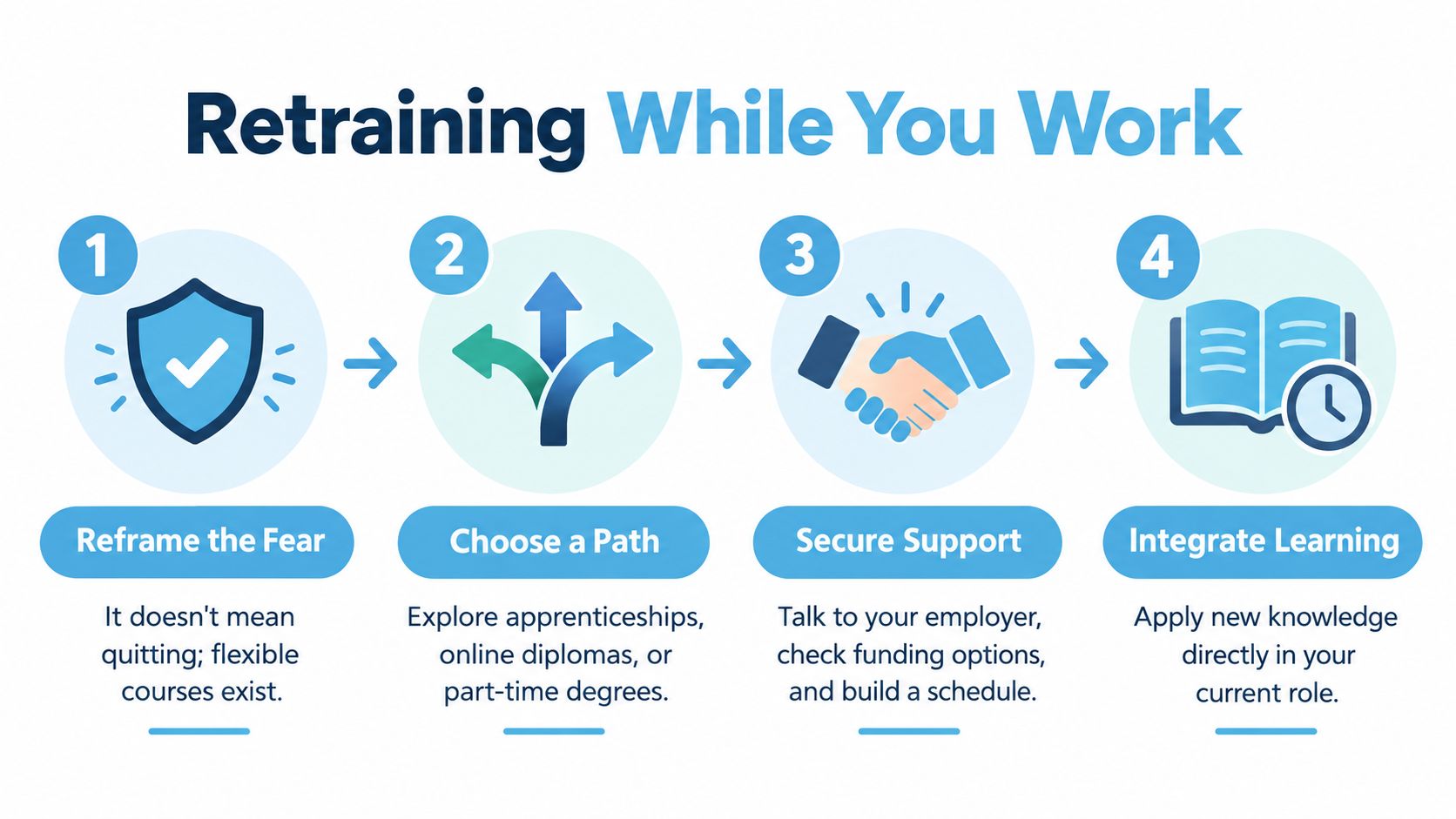
Retraining doesn't always mean resigning. Many adults begin by testing the idea through volunteering, a setting visit, a part-time course, or a conversation with a local nursery. The sensible aim is to reduce uncertainty before making an irreversible decision.
Start with an honest audit
Write down every qualification you hold, including GCSEs, Functional Skills, previous childcare awards, first aid training, and relevant work experience. Don't assume an old certificate is accepted, and don't assume that lacking a GCSE means the route is closed. Ask a college, apprenticeship provider, or careers adviser to check your position.
Next, arrange an initial careers conversation. Take your qualification certificates and explain your working pattern, childcare arrangements, travel limits, and target role. A provider can then distinguish between a Level 2 starting point, a Level 3 route, Functional Skills preparation, or an Access diploma aimed at higher education.
Build study around real constraints
Online and blended learning can fit around shifts, but flexibility still requires planning. You'll need protected time for reading, written work, assessments, placement activity, and conversations with tutors. Ask about employer-release time, placement expectations, live sessions, deadlines, and what happens if caring responsibilities interrupt your study.
You can also read practical guidance on studying while working full-time, then test the plan against your own rota rather than an ideal week.
Use this sequence:
- Confirm the target: Decide whether you want assistant-level work, Level 3 practice, teaching, or leadership.
- Check the qualification: Ask whether the proposed award is full and relevant for EYFS ratios.
- Secure the setting: Find out whether placement hours or employed practice are required.
- Agree support: Tell your employer early if you'll need a stable shift, study leave, or a placement day.
- Protect recovery time: Early years work is physical and emotionally demanding, so don't schedule every available hour as study time.
Deadlines can slip. Placements can take longer to arrange than expected. A current employer may need notice before changing your hours. Plan for these practical delays instead of treating them as personal failure.
A realistic example might begin with an enquiry and qualification audit, followed by Functional Skills preparation if needed, a supported application, and workplace learning. Depending on the route and prior learning, an adult could work towards a qualified practitioner role over 12 to 18 months, but the exact timeline belongs to the provider, employer, and qualification.
Salary Expectations and Where the Career Can Lead
Pay deserves a direct conversation before you commit. The verified information available here describes the size and structure of the workforce, but it doesn't provide reliable salary figures for each setting, so exact amounts shouldn't be presented as universal facts. Nursery pay varies by region, employer type, responsibility, contracted hours, and whether the setting follows a recognised pay scale.
| Role | Nursery (private) | Pre-school / voluntary | Maintained sector |
|---|---|---|---|
| Level 2 practitioner | Employer-set rate, often linked to entry-level duties | Employer-set rate, sometimes influenced by charitable funding | May follow local authority arrangements where applicable |
| Level 3 practitioner | Employer-set rate, with variation for experience and room responsibility | May vary with funding and organisational policy | More likely to connect to formal local authority or school pay structures |
| Room leader | Usually higher than practitioner roles, depending on setting size and duties | Depends on the organisation and leadership responsibility | May align with school or local authority structures |
| Deputy or manager | Varies significantly with accountability, qualifications, and setting size | Varies significantly by provider | Can follow established leadership or local authority arrangements |
The important distinction is between a qualification and a guaranteed salary. Level 3 can make you more useful operationally because it may support ratio deployment and greater responsibility, but the employer still sets the offer. Ask about contracted hours, paid planning time, overtime, holiday arrangements, progression reviews, and any London or regional weighting before accepting a post.
Progression is broader than one nursery ladder
A practitioner may progress to room leader, deputy, nursery manager, or area manager. Others move into childminding, school-based teaching assistant work, SEND support, training, curriculum roles, or inspection-related careers. Level 6 study can open further teaching and leadership options, particularly for people aiming towards QTS, EYTS, or another degree-level route.
Some adults discover that their strongest skills sit in a related caring profession. If that sounds like you, comparing early years with career options in health and social care can help you decide whether your preferred work involves group-based development, individual care, clinical support, or leadership.
Pay in early years is a valid concern, not a lack of commitment. Look at the whole offer and the progression structure, then decide whether the work, hours, and future options fit your life.
Common Myths Worth Leaving Behind
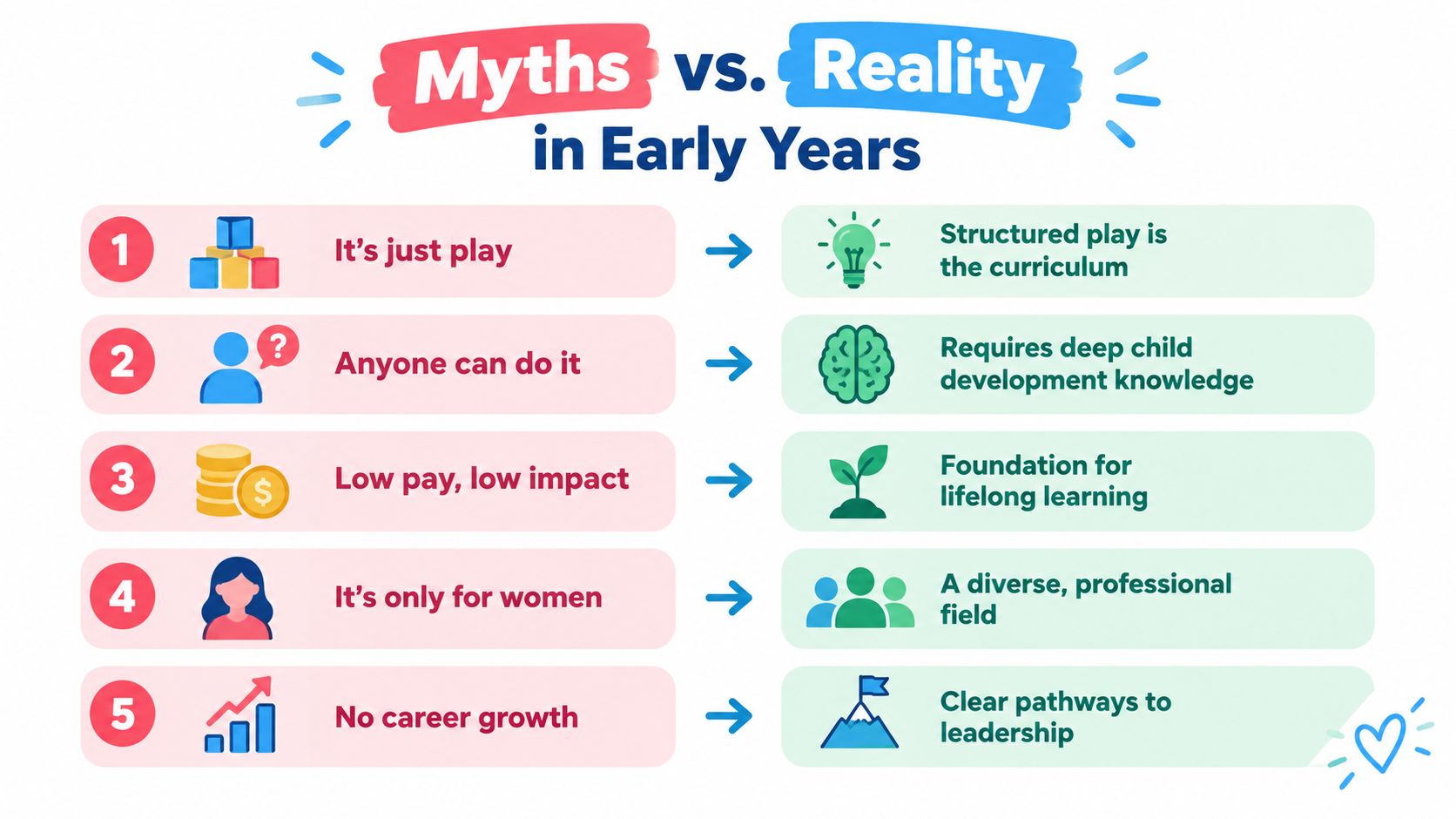
Myth one, it's unskilled because children play. Purposeful play is planned learning. Practitioners select resources, extend language, support social development, observe progress, and adapt the environment. Joining a game may involve assessing communication, turn-taking, movement, or problem-solving while keeping the child engaged.
Myth two, warmth is all you need. Warm relationships help children feel secure, alongside safeguarding awareness, health and safety knowledge, SEND support, accurate records, and professional communication. The role combines care with judgement, observation, and teamwork.
Myth three, qualifications are just a rubber stamp. An approved qualification shows competence across several areas of practice. It can also affect whether an employer may count you in statutory ratios, so the certificate changes what you can do in a setting. For an adult retraining, that distinction matters. An Access diploma may prepare you for higher education, while Functional Skills can strengthen English or maths before or alongside a vocational route. They are steps in a route, not interchangeable labels.
Myth four, early years work has no financial or professional future. Pay varies and needs careful checking, but room leadership, management, specialist support, teaching, and further study can create progression. Ask an employer to explain the opportunities in that setting rather than assuming every nursery offers the same path.
Myth five, the work is only for women. Children benefit from seeing different adults in caring and educational roles. Men are welcome in early years practice, and fair recruitment can widen the role models children encounter.
Your Next Steps Into Early Years Practice
Start with the setting, not the course title. Decide whether you're drawn to a private nursery, pre-school, childminding, a maintained nursery, or school-based early years work. Each environment can involve different hours, responsibilities, progression opportunities, and qualification expectations.
Then choose the level that matches your destination:
- Level 2: A sensible foundation if you're new to early years and need structured workplace learning.
- Level 3: The usual focus if you want more independent practice and a qualification that may count in ratios when it is approved and full and relevant.
- Access to HE: A route for adults planning higher education, especially when a degree or teaching pathway is the longer-term goal.
- Functional Skills: A practical option when English or maths requirements need strengthening before or alongside another course.
Contact local colleges, apprenticeship providers, and nurseries this week. Ask whether you can visit a setting, what qualification they accept, whether funding may be available, and what study or placement hours are expected. Before applying for a job, read the setting's current Ofsted report and prepare questions about supervision, training, planning time, and progression.
Functional Skills may take several months, while a Level 3 route can take 12 to 18 months depending on the programme and your circumstances. Adult retraining is achievable when you treat it as a planned transition rather than a leap into the unknown.
Choose one action today. Send an enquiry, request a setting visit, or gather your certificates for a qualification check. That small step will give you information you can use.
Access Courses Online offers flexible online Access to Higher Education Diplomas, including an early years education option, alongside support for adults returning to study or changing careers. Visit Access Courses Online to explore suitable courses, funding guidance, and a study route that can fit around work and family commitments.