
Thinking about your next move after serving in the Armed Forces? The Ministry of Defence (MOD) has a powerful tool designed to help you do just that. It's called the Enhanced Learning Credits Scheme (ELCS), and it funds courses that can give you a real leg-up as you transition to civilian life.
These aren't just any courses. They're nationally recognised qualifications at Level 3 or higher, aimed at helping service members and leavers build on their military experience and thrive in new careers.
What Exactly is the Enhanced Learning Credits Scheme?
Think of Enhanced Learning Credits (ELC) as a dedicated training fund the MOD has set aside just for you. It's an investment in your future, designed to support your personal and professional growth as you prepare for what comes next. The whole programme is managed by the Enhanced Learning Credits Administration Service (ELCAS), which ensures the funds go towards approved, high-quality courses from trusted providers.
This scheme is a brilliant bridge between your military skills and the civilian job market. It recognises that while you've gained incredible experience, you might need formal qualifications to get your foot in the door of a new industry. This funding opens up pathways that are often essential for moving up the ladder or making a complete career change.
To give you a clearer picture, here’s a quick breakdown of how the scheme works.
Enhanced Learning Credits Scheme at a Glance
This table provides a quick summary of the key components of the ELC scheme, helping you grasp the essential details immediately.
| Component | Description |
|---|---|
| Purpose | To fund personal and professional development for UK Armed Forces personnel and service leavers. |
| Focus | Nationally recognised qualifications at Level 3 or above (A-Level equivalent or higher). |
| Administration | Managed by the Enhanced Learning Credits Administration Service (ELCAS). |
| Eligibility | Available to eligible service members during and after their service. |
| Key Benefit | Provides a structured, funded pathway to higher education and professional careers. |
Essentially, the ELC scheme is your launchpad for building a successful civilian life on the foundations of your military service.
What Kind of Courses Are Covered?
The ELC scheme is all about higher-level learning, meaning it supports qualifications that give you substantial new skills and knowledge. To qualify for funding, a course must be:
- A nationally recognised qualification.
- At Level 3 (the same level as an A-Level) or above on the Regulated Qualifications Framework (RQF).
- Offered by an ELCAS-approved learning provider.
This ensures your ELC funding is put towards qualifications with genuine, real-world value, such as an Access to Higher Education (HE) Diploma – a qualification that serves as a direct route into university.
Your Pathway to a New Career
For many service leavers, an Access to HE Diploma is one of the most powerful enhanced learning credits courses out there. It provides the exact qualifications you need to apply for a degree in fields like nursing, business, social work, or engineering. This makes the ELC scheme a vital tool for resettlement, turning career aspirations into achievable goals.
The official ELCAS website is your go-to resource for checking which providers and courses are approved.

This platform lets you verify that both the training provider and the specific qualification you're interested in are eligible for ELC funding.
The real purpose of the ELC scheme is to give service personnel real, tangible opportunities for advancement. By funding qualifications like the Access to HE Diploma, it offers a structured and credible route into higher education and professional careers that might otherwise have felt out of reach.
You can think of the financial support from ELCs as a specialised grant for your education. If you're looking to understand more about financial aid for personal development, exploring the different types of grants for individuals can provide a broader perspective.
Ultimately, this scheme empowers you to take control of your future, building upon your military service with qualifications that civilian employers truly recognise and value.
Confirming Your Eligibility for ELC Funding
Figuring out if you qualify for Enhanced Learning Credits (ELC) funding can feel a bit daunting at first, but it’s actually pretty straightforward once you break it down. The scheme is designed to reward your service by investing in your future, so your eligibility is tied directly to your time in the Armed Forces.
Think of it as a loyalty scheme for your professional development. The longer you serve, the more educational funding you unlock. This approach ensures that those who’ve dedicated significant time to the military get the biggest boost when transitioning to civilian life or upskilling while still serving.
The Core Requirement: Your Length of Service
The number one factor that determines your eligibility is your length of qualifying service. The ELC scheme works on a tiered system, meaning your service time directly impacts the amount of funding you can claim each year. It’s a fair and progressive setup.
There are two main funding levels to get your head around:
- Lower Tier Funding: To get access to this level, you’ll generally need to have completed at least four years of eligible service after your initial training. This tier usually gives you up to £1,000 for each claim you make.
- Higher Tier Funding: If you’ve completed eight years or more of eligible service, you can access the higher level of funding. This tier gives you a bigger pot to work with, offering up to £2,000 per claim.
It's really important to check your official service record to confirm exactly how much qualifying service you've racked up. This is what will define which tier you fall into and how much cash you can get for your chosen course.
Your service is a direct investment in your future learning potential. The ELC scheme recognises this by creating a clear pathway where your dedication unlocks significant financial support for high-value qualifications.
This tiered system lets you map out your educational journey. Whether you're eyeing up one high-value course or planning to spread your claims over a few years, knowing your funding level is the essential first step. For more ideas on how this can be used, particularly for getting university-ready, you can explore different options for funding for Access courses.
Timeframes for Service Leavers
One of the most crucial parts of ELC eligibility is the deadline for making a claim after you've left the military. You don’t have forever to use this benefit, so planning ahead is absolutely key.
For most people leaving the service, you have up to five years from your discharge date to use your ELC funds. This used to be ten years, but recent changes have shortened the window, which means you need to be a bit more on the ball.
This five-year period is a hard deadline. It’s vital to get your chosen course and provider approved—and your Claim Authorisation Note (CAN) submitted—well within this timeframe. Leaving it to the last minute is a surefire way to risk missing out on this fantastic entitlement.
Special Considerations for Different Service Types
While the main rules about service length apply to most people, there are some specific nuances for different groups within the Armed Forces. It's worth knowing where you fit.
- Reservists: If you’re a Mobilised Reservist, you may also be eligible for ELCs, but the criteria can be a little different. Your eligibility often depends on how long you were mobilised for and other specific factors. The best bet is to check the official ELCAS guidelines or chat with your unit's education staff for the exact details.
- Medical Discharge: Personnel who are medically discharged often have different eligibility rules. In many cases, the minimum service period can be waived, giving you access to ELC funding sooner to help you resettle into a new career.
No matter what your situation is, the definitive place to confirm your eligibility is always the ELCAS website and your service's education officer. They can give you a personalised assessment based on your complete service history, so you have the right information before you start looking for courses. Ticking this box early will give you the confidence to plan your next career move without any guesswork.
How to Find ELC Approved Courses and Providers
Alright, so you’ve confirmed you're eligible for ELC funding. Brilliant! The next big step is finding the right course and a provider you can trust. This part is about more than just picking a subject you're passionate about; it’s about making sure both the course and the institution are officially recognised by the Enhanced Learning Credits Administration Service (ELCAS).
Think of it this way: your funding is locked until you find a provider with the right key. Getting that official approval is absolutely critical, so let’s walk through how to do it.
Your Go-To Source: The Official ELCAS Website
Your first and only stop for verified information should be the official ELCAS website. It’s the definitive directory for every single provider authorised to accept ELC funding. If a provider isn't on that list, they aren't eligible, no matter what their own website might claim. Don’t get caught out!
Using the ELCAS Provider Search
Head over to the provider search function on the Enhanced Learning Credits website. The tool is pretty straightforward and lets you search by name, location, or even a keyword related to your subject of interest. This is your single source of truth for all approved enhanced learning credits courses.
To make your search effective, it helps to have a few details handy:
- The name of a learning provider you’re considering.
- A specific course title if you already have one in mind.
- The general subject you want to study, like healthcare or business.
This will help you quickly build a shortlist of potential providers who are already officially part of the ELC scheme.
How to Check a Provider's ELCAS Number
Every single approved learning provider is given a unique ELCAS number. It’s their official stamp of approval from the scheme. When you find a provider on the ELCAS portal, this number will be listed right next to their name.
For instance, Access Courses Online is an approved provider, and our ELCAS number is 10232. Finding this number on the official search portal is your proof that we’re a legitimate partner for your ELC-funded studies.
Here’s a look at what the provider search results page on the ELCAS website looks like.
As you can see, the layout is clear and simple. It shows the provider's name, their ELCAS ID, and their location, making it easy to verify everything in one place.
What Makes a Course ELC-Approved?
Here’s a crucial point: just because a provider is approved, it doesn't automatically mean all of their courses are eligible. ELC funding is specifically for higher-level learning. To qualify, a course must be a nationally recognised qualification at Level 3 or above on the Regulated Qualifications Framework (RQF).
An approved provider is the first checkpoint, but an approved course is the destination. Always verify both. A Level 3 qualification like an Access to HE Diploma is a perfect example of an eligible course that opens doors to university.
An Access to Higher Education Diploma, for example, is a Level 3 qualification designed as a direct pathway to university. This makes it a fantastic and popular choice for using your ELC funding. To get a better feel for these qualifications, check out our guide on Access to HE courses online. It breaks down how these diplomas work and the career paths they can help you unlock.
Beyond the official stamps of approval, you'll also want to find an institution that’s a good fit for you. For some general guidance on choosing an online course provider, think about things like tutor support, student reviews, and flexible study options. This ensures your chosen course is not just funded, but also delivers the top-quality education you deserve.
Using Your ELC for an Access to HE Diploma
Turning your Enhanced Learning Credits (ELC) into a university place is an achievable goal, and the process is probably more straightforward than you think. Let's walk through it together, using a real-world example: applying for an Access to Higher Education Diploma. This guide will map out every step, from picking your course right through to finalising your payment.
The idea here is to take the mystery out of the paperwork and admin side of using your ELC funding. By following these steps, you'll feel confident managing the process smoothly, leaving you free to focus on what really matters—your education and your future.
Step 1: Select Your Course and Get a Quote
First things first, you need to choose an ELC-approved qualification that lines up with your career ambitions. Let's say you've got your sights set on studying Nursing at university. In that case, the perfect launchpad would be an Access to HE Diploma in Nursing. Once you've found an approved provider, like Access Courses Online (our ELCAS No. is 10232), you just need to get in touch.
The provider will send you an official course quote. This document is vital because it breaks down the total cost of the qualification, which you'll need for your ELC claim form. Just make sure the quote clearly states the course title and the provider's ELCAS number.
Step 2: Complete Your ELC Claim Form
With your quote in hand, it's time to tackle the ELC claim form. You can usually download this from the ELCAS website or find it through your service's education portal. The form will ask for details about you, the course you've chosen, and your learning provider.
Accuracy is absolutely key here. Take a few extra minutes to double-check that all the information is correct, especially the course cost and provider details you've taken from your quote. Simple mistakes can cause delays, so it’s time well spent.
Step 3: Secure Authorisation from Education Staff
Once your form is filled out, the next step is to submit it to your Education Staff or Single Service Representative for authorisation. They are responsible for checking your eligibility and making sure your chosen course meets all the scheme's requirements for enhanced learning credits courses.
This is a really important checkpoint in the process. Your Education Staff will review your service record and the course details before signing off on your claim. Their approval is what officially gives your funding request the green light.
This simple visual breaks down the core process of finding and choosing ELC-eligible courses.
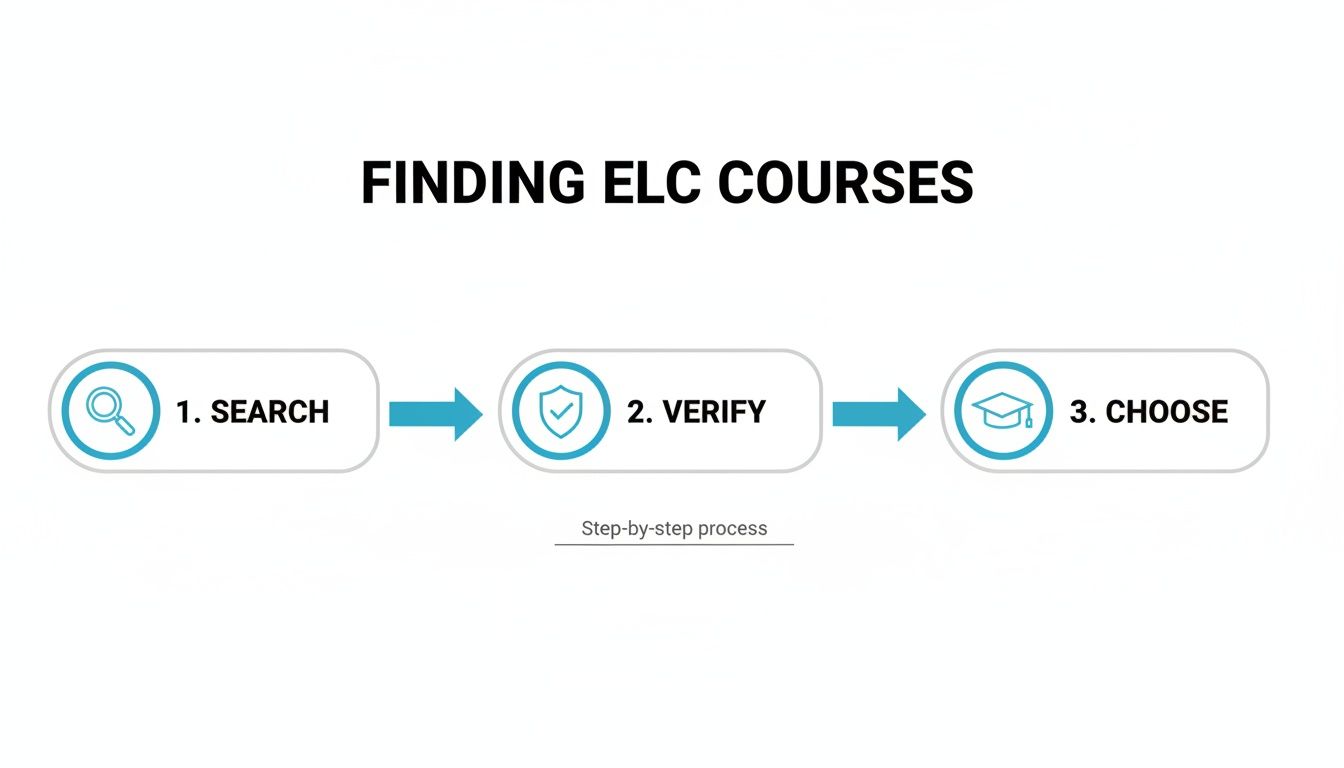
This workflow really highlights the importance of being methodical—start with a broad search, verify the provider is legit, and then make your final choice.
Step 4: Receive and Submit Your CAN
After your claim gets the thumbs-up, ELCAS will issue a Claim Authorisation Note (CAN). You can think of the CAN as your voucher for the course. It’s the official confirmation that the MOD is committed to paying its share of your fees. You’ll get a copy, and your learning provider will be notified too.
Your job now is to send your copy of the CAN straight to your chosen provider. It’s the final piece of the puzzle they need to formally enrol you and lock in your place. Don't hang about with this step, as the CAN does have an expiry date.
The Claim Authorisation Note (CAN) is your golden ticket. It transforms your approved ELC claim into a confirmed place on your chosen course. Submitting it to your provider promptly is the final administrative hurdle before your learning journey begins.
If you're thinking about this path, it’s worth getting to know the qualification itself. You can learn more about what an Access to HE Diploma involves and how it gets you ready for university-level study.
Step 5: Manage Your Personal Contribution
The ELC scheme is a partnership, which means you're required to pay a personal contribution of at least 20% of the total course fee. This payment shows your own commitment to your personal development. You'll pay this amount directly to the learning provider.
For example, if your Access to HE Diploma costs £2,500 and you use a higher tier ELC claim of £2,000, your personal contribution would be £500.
Most providers, including us here at Access Courses Online, offer flexible payment options to make this more manageable. You can often spread the cost over several months, so it’s always worth discussing payment plans with your provider when you enrol. Once your contribution is sorted and your CAN is submitted, you’re officially ready to start your studies and take that exciting next step towards your new career.
The Career Impact of an ELC-Funded Diploma
Cashing in your Enhanced Learning Credits for something like an Access to HE Diploma is a whole lot more than just a simple purchase. Think of it as investing your hard-earned benefits into a launchpad for your next chapter. It's a strategic move that can completely reshape your professional life after the Armed Forces, opening doors you might have thought were closed for good.
This isn’t just about getting another certificate to hang on the wall. It’s about building a solid bridge from your military experience to a civilian career in booming sectors like healthcare, tech, or business. An Access to HE Diploma, paid for with your ELC, becomes a powerful tool that gives you a recognised and respected pathway straight into university and onto the professional ladder.
Proving the Pathway Works
One of the biggest questions we hear from service leavers is whether this route really gets you ready for the demands of university. The answer is a resounding yes. The evidence shows that students who get into higher education with an Access to HE Diploma do just as well as those who took the traditional A-Level route. That’s a crucial point—it proves this qualification isn’t a shortcut, but a genuinely robust and effective preparation for degree-level work.
This equal footing in performance really speaks to the quality and intensity of enhanced learning credits courses like the Access to HE Diploma. Recent stats from the Quality Assurance Agency for Higher Education (QAA) back this up, showing that degree results are broadly the same. For example, 25% of students who started university with an Access to HE Diploma earned a first-class degree, right alongside the 26% of students who had other Level 3 qualifications. You can dig into more of the data by reading the full QAA report about Access to HE Diploma success rates.
An Access to HE Diploma isn’t just about getting into university; it’s about giving you the academic skills and confidence to thrive once you’re there. The data confirms it’s a pathway that delivers real results.
From Service to a Fulfilling New Career
Just imagine it: moving from a career in the forces to becoming a registered nurse, a computer scientist, or a business manager. That's the real, tangible outcome that an ELC-funded diploma can make happen. By investing your credits this way, you’re taking a decisive step towards a fulfilling professional life—one that’s built on the foundations you already have but is aimed at brand-new horizons.
This pathway is designed to set you up for success, giving you:
- Targeted Knowledge: You'll study modules directly related to your chosen degree, making sure you walk into university on day one feeling fully prepared.
- Academic Skills: The course is brilliant at teaching the essentials, like how to write a proper essay, conduct research, and think critically.
- A Clear Trajectory: It turns a vague ambition into a concrete plan, with clear steps from the moment you enrol to when you hit 'submit' on your university application.
Ultimately, your Enhanced Learning Credits are an opportunity to redefine what comes next. Using them to fund an Access to HE Diploma is one of the most direct and proven ways to nail your long-term career goals, turning your transition into a story of genuine growth and success.
Strategic Planning to Maximize Your ELC
Getting the most out of your Enhanced Learning Credits isn't just about picking a course that looks good. It's about playing the long game. Think of your ELC pot less like a one-off grant and more like a dedicated fund for your future, an investment in your career that you can draw from over several years.
With the ability to make up to three separate claims, you have the flexibility to plan a real learning journey. This forward-thinking approach is key, especially when you consider how the scheme is set up. You get a set amount each financial year—usually £1,000 for the lower tier and £2,000 for the higher tier—so your goal should be to make every single claim count.
Stacking Qualifications Over Time
One of the smartest ways to use your ELC is to "stack" your qualifications. Instead of using it all on a single, standalone course, think about how different courses could build on one another to create a powerful skillset.
For instance, you could use your first claim on a foundational course like an Access to HE Diploma. This gets you the qualifications you need to get into university. Later, you can use your next claims for more specialised professional certificates that complement the degree you've earned. It’s a methodical way to build an impressive CV that really stands out to employers.
This is a popular route for a reason. Adult learners are a huge part of the UK's higher education scene. In fact, government statistics showed that 68% of adults aged 19-64 had at least a Level 3 qualification by the end of 2024, proving just how vital these courses are. You can check out the latest official figures yourself on the UK education and training statistics on GOV.UK.
Maximising your ELC is about thinking ahead. Treat each claim as a building block for your future, creating a career path that is both ambitious and completely achievable.
Managing Costs and Contributions
So, what happens if the course you’ve got your eye on costs more than your annual ELC allowance? It’s a common scenario, as many high-value enhanced learning credits courses, such as a comprehensive diploma, can easily exceed the yearly limit.
Don't worry, you've got a few solid options:
- Top it up with savings: Use your ELC to cover the majority of the cost and simply pay the rest out of your own pocket.
- Look for other funding: You might be eligible for other grants or bursaries that can be used alongside your ELC.
- Use a provider payment plan: Many learning providers, including us at Access Courses Online, offer flexible, interest-free payment plans. This can cover your 20% personal contribution and any leftover balance, making the cost much easier to manage.
Frequently Asked Questions About ELC Courses
It's completely normal to have a few lingering questions when you're sorting out the finer details of a funding scheme. To make sure you can move forward with total confidence, we've put together some clear, straightforward answers to the most common queries we hear about using Enhanced Learning Credits.
Think of this as your final checklist. We'll cover the practical specifics, from crucial deadlines to how different ways of studying fit into the ELC scheme, so you have everything you need before you start your application.
How Long Do I Have to Use My ELC After Leaving?
This is one of the most important details to get right, so listen up. For most people leaving the service, you have up to five years from your official discharge date to put in your final ELC claim.
That window used to be a bit longer, but recent changes mean you need to be on the ball with your planning. It’s a really good idea to get the process started well before that deadline hits. If you leave it to the last minute, you could risk your application timing out, and nobody wants to miss out on this fantastic entitlement. Plan ahead and make sure your Claim Authorisation Note (CAN) gets submitted in good time.
Can I Use ELC Funding for Online or Distance Learning?
Yes, you absolutely can! The ELC scheme was designed with modern learning in mind, which means it fully supports online and distance learning courses. This flexibility is a massive plus for service leavers who might be juggling a new job, family life, or other commitments while they study.
As long as the provider and the specific qualification are approved by ELCAS, it doesn’t matter how the course is delivered. This means you can study high-value enhanced learning credits courses, like an Access to HE Diploma, from anywhere you like, without ever needing to step foot on a physical campus.
The ELC scheme is all about flexible learning. Your funding depends on the provider being ELCAS-approved and the course being at the right level – not whether you're studying online or in a classroom.
This modern approach means your resettlement education can fit around your life, not the other way around.
How Does Paying My 20% Contribution Work?
Your personal contribution is a standard part of the ELC funding deal. You’re required to pay a minimum of 20% of the total course fee yourself, directly to your learning provider. This is a separate payment from the funds ELCAS sends on your behalf.
Here’s a simple breakdown of how it usually goes:
- Get Your Invoice: Once your place on the course is confirmed, the provider will send you an invoice. It’ll clearly show the total cost, the amount your ELC claim covers, and the remaining balance you need to pay.
- Sort Out Payment: You’ll then pay your share directly to the provider.
- Ask About Payment Plans: Many providers get that paying this amount in one go isn't always easy. They often offer flexible, interest-free payment plans that let you spread the cost over a few months, which can make things much more manageable.
Always have a chat with your provider about their payment options when you enrol. It's the best way to make sure you can budget properly and focus on your studies without any financial stress.
Ready to take that next step towards your new career? At Access Courses Online, we specialise in ELCAS-approved Access to HE Diplomas that offer a direct pathway to university. Find out how we can help you use your funding to smash your goals by visiting https://accesscoursesonline.com.