
Returning to education or needing to upskill can feel daunting, particularly when maths stands in the way. Many adults in the UK assume that gaining the qualifications for university entry or a career change requires expensive tuition. The reality is that a wealth of high-quality, free online maths courses are readily available, offering a structured and cost-effective pathway to achieving your goals.
This guide is designed to help you navigate these resources efficiently. Whether you are building everyday number confidence for a new job, refreshing your GCSE-level skills for an Access to HE Diploma, or preparing for the mathematical demands of a degree in healthcare or computer science, the right resource is here. We have analysed the 12 best platforms to help you find the perfect fit for your specific learning needs.
This is not just a list; it is a comprehensive breakdown of what each platform offers. For every course provider, you will find:
- A clear assessment of who it is best for.
- An honest look at the pros and cons based on real learner experiences.
- Guidance on how its content maps to UK qualifications like Functional Skills and Access to HE requirements.
- Practical advice on how to structure your study and what to do next.
We cut through the noise to provide a clear, practical roadmap. Each entry includes screenshots and direct links, so you can start learning immediately. Our goal is to help you identify the most suitable free online maths courses to build a solid foundation for your academic or professional future, without spending a penny. Let’s find the right course for you.
1. OpenLearn (The Open University)
OpenLearn, The Open University's free learning platform, is an excellent starting point for UK-based adults returning to education. It offers a vast library of free online maths courses, ranging from foundational numeracy in "Everyday maths" to more advanced, degree-level tasters. This makes it an ideal resource for building confidence before committing to a formal qualification like an Access to HE Diploma.
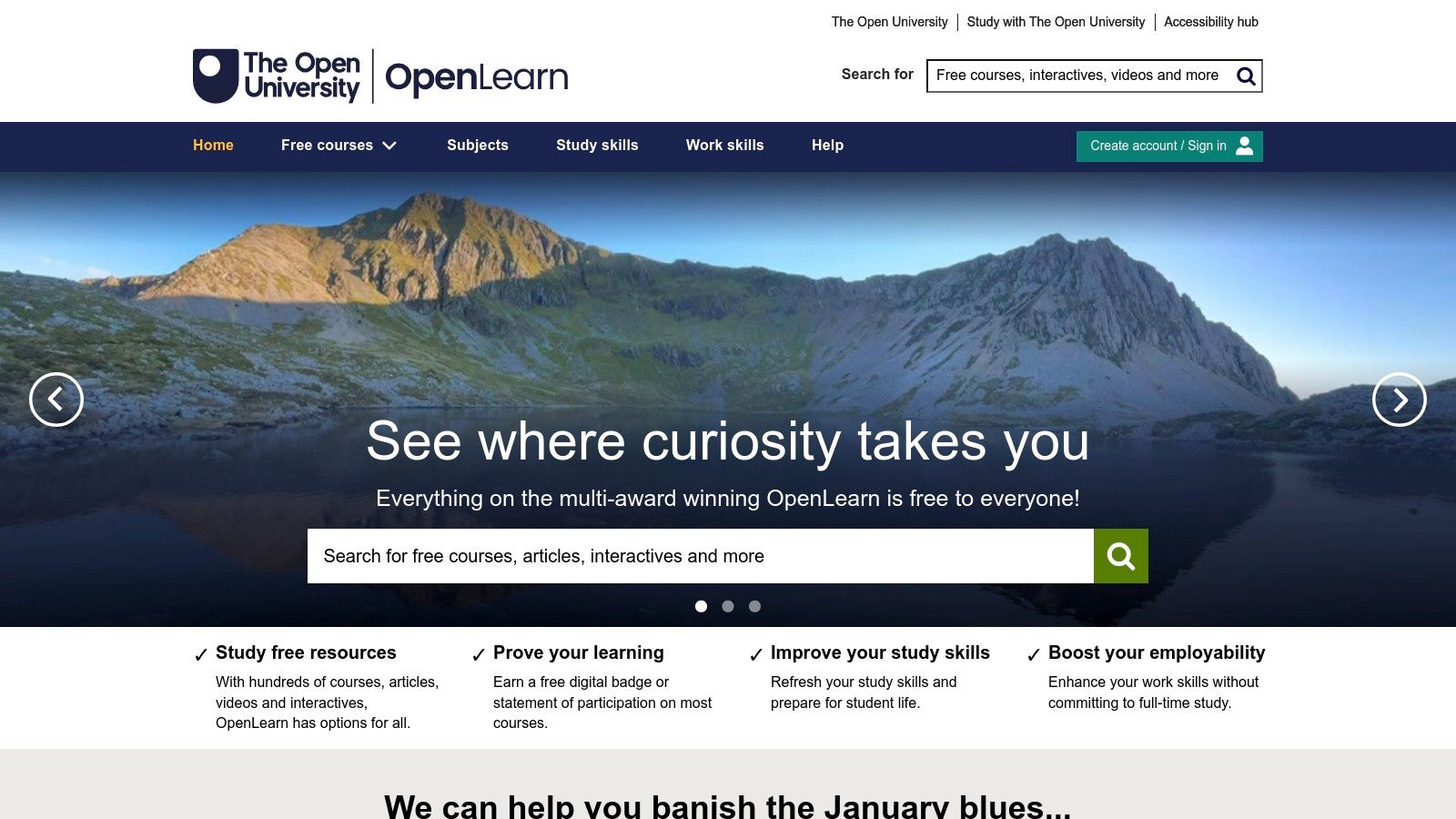
The platform stands out due to its direct link with a respected UK university, ensuring high-quality, well-structured content. The self-paced nature of the courses offers incredible flexibility, a key benefit of this modern approach to learning, and a concept explored further in discussions about why online learning is the future of education.
Key Features and Use Cases
- Best For: Adult learners needing a flexible, no-cost way to refresh maths skills or prepare for formal study. It’s particularly useful for those targeting an Access to HE Diploma but wanting to bridge knowledge gaps first.
- Course Structure: Each course provides clear time estimates (from 2 to 24 hours) and is broken down into manageable weekly sections. Many courses award a free Statement of Participation upon completion.
- Badged Courses: Select courses offer a free digital badge, which can be a valuable addition to a CV or LinkedIn profile to demonstrate continuing professional development (CPD).
Practical Considerations
While the content is of university quality, it's important to note that OpenLearn does not offer one-to-one tutor support. The certificates are statements of participation, not formal, regulated qualifications. For effective use, start with a lower-level course to gauge your current ability before moving on to more advanced topics.
- Pros: Trusted provider, no fixed start dates, badged courses evidence learning, excellent bridge to higher education.
- Cons: No dedicated tutor support, certificates are not formal qualifications.
- Website: https://www.open.edu/openlearn
2. FutureLearn
FutureLearn is a prominent UK-based MOOC (Massive Open Online Course) platform featuring a diverse collection of free online maths courses. It partners with respected UK universities and specialist organisations like MEI and the sigma Network, offering short, accessible courses ideal for bite-sized learning. Its model allows learners to sample a wide range of materials to find the perfect fit before considering a paid upgrade.
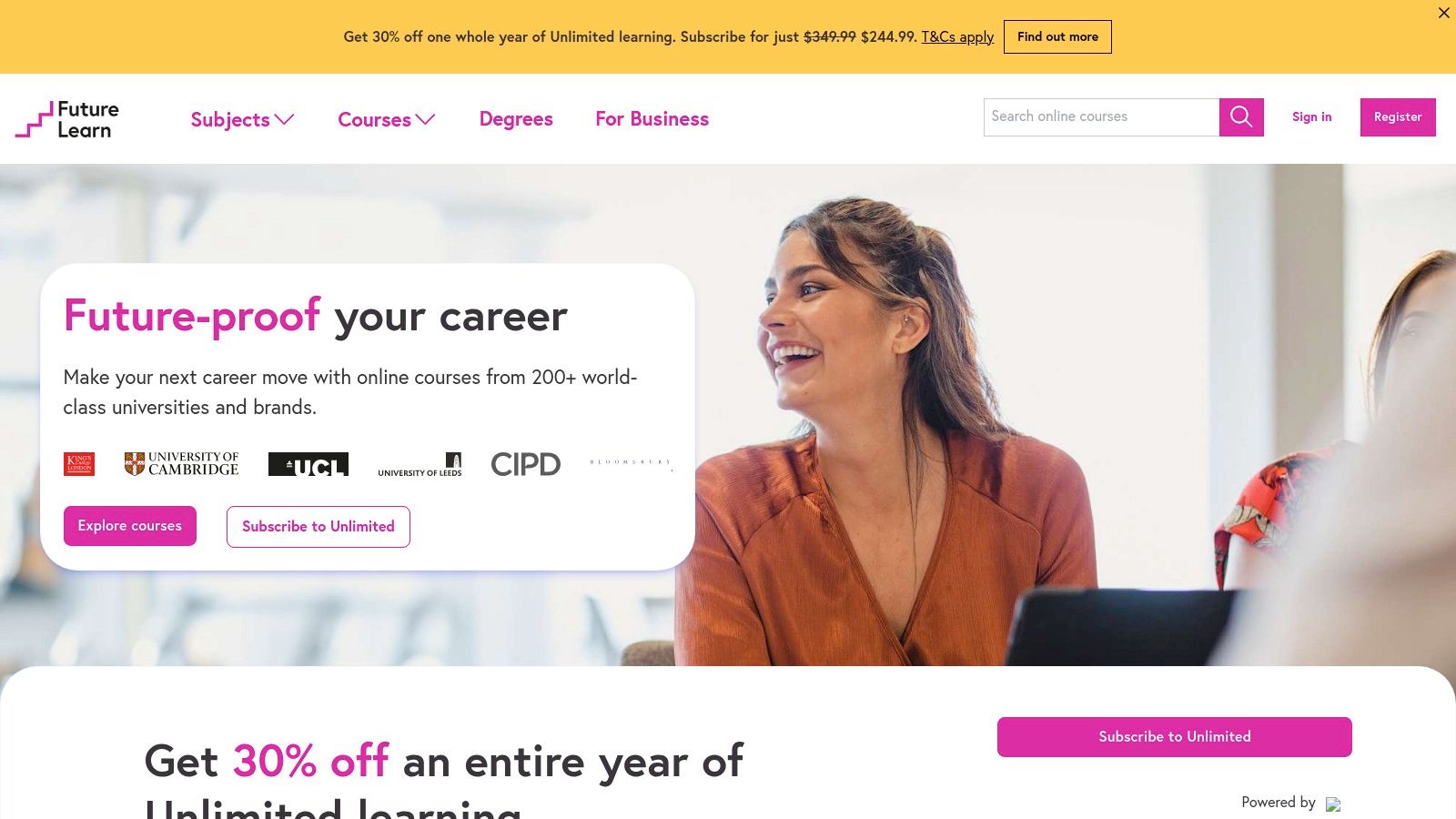
The platform stands out for its high-quality partnerships and its 'try before you buy' approach. The free 'Limited access' tier grants you entry to course materials for its duration plus 14 days, which is excellent for exploring a specific topic without financial commitment. This is particularly useful for adult learners wanting to test their aptitude for a subject before enrolling in a more formal course like an Access to HE Diploma.
Key Features and Use Cases
- Best For: Learners who want to explore specific maths topics from various UK universities and charities. It's great for dipping into different subjects to gauge interest and difficulty.
- Course Structure: Courses are typically run over several weeks with a recommended weekly study time. The platform is mobile-friendly and includes community discussion forums to engage with peers.
- Limited Access Model: The free tier provides access to the course videos, articles, and peer discussions for a limited time. Upgrading to a paid tier or subscription unlocks extended access, assessments, and certificates.
Practical Considerations
The primary limitation of the free model is the time-restricted access; if a course runs for four weeks, your access will expire shortly after. Furthermore, official certificates of achievement and graded assessments are locked behind the paywall. To use it effectively, be ready to complete the course within its scheduled run to maximise the free content.
- Pros: Strong UK university partner network, easy to sample multiple courses for free, community learning elements.
- Cons: Free access is time-limited, certificates and formal assessments require payment, some courses run on fixed schedules.
- Website: https://www.futurelearn.com
3. Khan Academy
Khan Academy is a non-profit organisation offering a vast and completely free library of educational resources. Its comprehensive K-12 to early-college maths curriculum makes it an exceptional tool for anyone looking to rebuild their mathematical foundations from the ground up. With structured pathways through arithmetic, algebra, calculus, and statistics, it’s one of the best free online maths courses available for structured, self-guided learning.
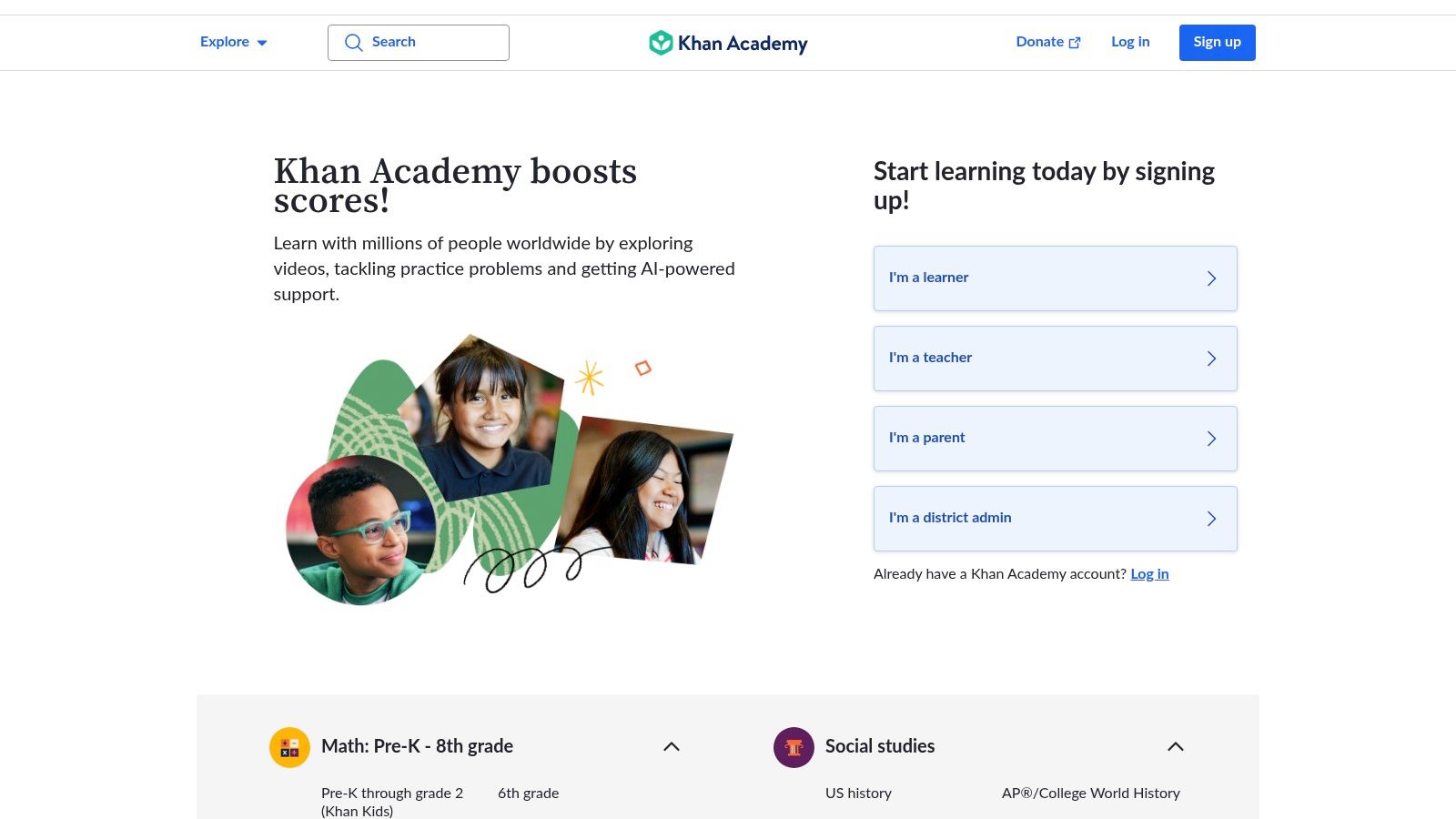
The platform’s strength lies in its "mastery learning" approach. Users progress by demonstrating understanding through practice exercises, quizzes, and unit tests that provide instant feedback. This active learning method is highly effective for building genuine confidence and ensuring you have truly grasped a concept before moving on, making it a powerful supplement for Access to HE Diploma preparation.
Key Features and Use Cases
- Best For: Learners who need to systematically fill knowledge gaps, from basic numeracy to A-Level equivalent topics. Its practice-heavy format is ideal for solidifying skills required for an Access to HE Diploma in Science or Computing.
- Course Structure: Content is organised into clear missions and courses (e.g., "Algebra 1", "Pre-calculus"). Each unit contains a mix of instructional videos, articles, and extensive practice exercises with immediate, step-by-step solutions.
- Mastery System: The platform tracks your progress, encouraging you to achieve proficiency in each skill. This personalised learning path ensures you focus on areas where you need the most help.
Practical Considerations
While Khan Academy’s content is world-class, it is not aligned with specific UK qualifications like GCSEs. However, the mathematical principles covered are universal and map very well to their curricula. The platform does not offer formal certificates of completion, so its value lies in skill acquisition rather than credentialing. For best results, use its "Get ready courses" to identify and fix foundational weaknesses.
- Pros: Comprehensive curriculum, powerful practice engine, 100% free with no adverts, excellent for building skills from scratch.
- Cons: No formal certificates, content is not framed around specific UK qualifications.
- Website: https://www.khanacademy.org
4. edX
edX is a global online learning platform founded by Harvard and MIT, offering a vast array of university-level courses. For learners seeking free online maths courses, it provides an excellent opportunity to engage with high-calibre material from world-leading institutions, covering everything from foundational algebra and calculus to advanced statistics and discrete mathematics.
The platform operates on a "freemium" model where most individual courses can be audited for free. This gives you temporary access to all lecture videos, readings, and non-graded practice assignments. This makes edX a superb resource for those wanting a taster of university-level mathematics or needing to refresh specific advanced topics before embarking on a rigorous programme like a science-based Access to HE Diploma.
Key Features and Use Cases
- Best For: Self-motivated learners wanting to experience maths courses from top-tier universities without financial commitment. It is ideal for pre-university students wanting to get ahead or professionals needing to understand complex mathematical concepts for fields like data science or engineering.
- Course Structure: Courses are instructor-led and run on specific schedules. The free audit track provides time-limited access to course materials, typically for the duration of the course run.
- Verified Certificates: While auditing is free, learners can pay to upgrade to the verified track. This usually unlocks graded assessments and provides a shareable certificate upon successful completion, which can be useful for career progression.
Practical Considerations
The main limitation of the free audit track is its time-sensitive nature; you lose access when the course period ends. Furthermore, crucial components for proving your knowledge, such as graded exams and the final certificate, are behind a paywall. To use it effectively, enrol just before you have a dedicated block of time to work through the materials.
- Pros: Access to content from prestigious universities, clear pathway to gain a verified certificate, covers highly advanced topics.
- Cons: Free access is time-limited, graded assessments and certificates require payment, less flexibility than self-paced platforms.
- Website: https://www.edx.org
5. MIT OpenCourseWare (OCW)
For highly motivated learners aiming for university-level understanding, MIT OpenCourseWare (OCW) provides unparalleled access to world-class academic materials. This platform offers a complete archive of course content from the Massachusetts Institute of Technology, making it one of the most comprehensive sources for free online maths courses available. It's an exceptional resource for those needing to grasp complex topics like calculus, linear algebra, and discrete mathematics before tackling a demanding degree.
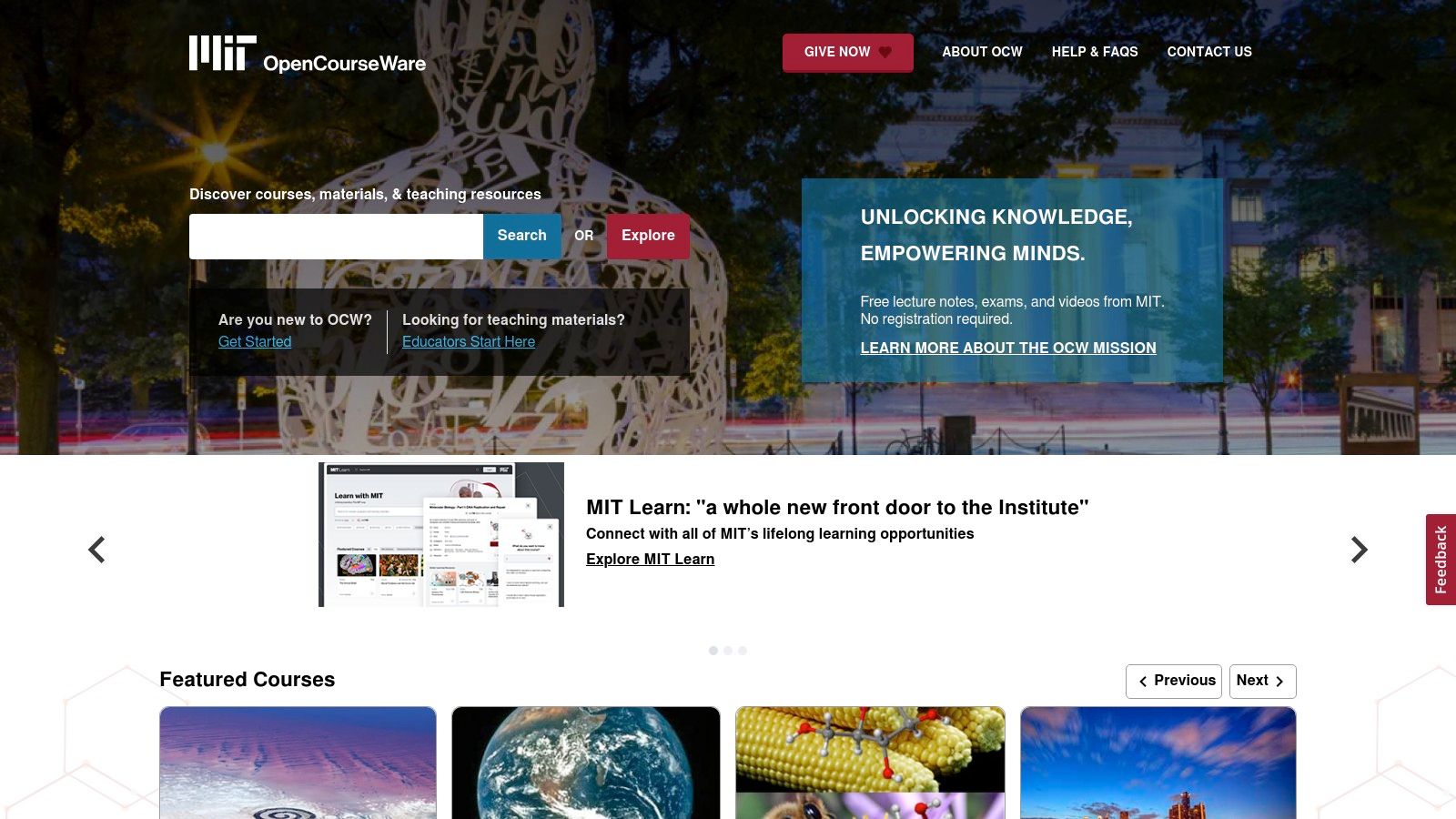
What makes OCW stand out is its commitment to open access; no sign-up is required to view lecture notes, watch video recordings, or attempt problem sets and past exams. The depth and academic rigour are unmatched in the free-to-access space, offering a genuine insight into the curriculum of a world-leading university. This resource is perfect for a learner who is self-disciplined and ready to engage with challenging, high-level material independently.
Key Features and Use Cases
- Best For: Self-directed learners, particularly those preparing for STEM degrees (like Computer Science or Engineering) who need a deep, foundational understanding of advanced mathematics.
- Course Structure: Content is organised into full course archives. Users can access syllabuses, video lectures, detailed notes, problem sets with solutions, and final exams, allowing them to simulate a full university course at their own pace.
- Downloadable Resources: A significant advantage is the ability to download most materials for offline study, offering incredible flexibility for learning without a constant internet connection.
Practical Considerations
The greatest strength of OCW is also its main challenge: the lack of a structured learning environment. There is no instructor interaction, peer support, or formal certification. Learners must be highly motivated and capable of structuring their own study plan and assessing their own progress. The material is demanding and assumes a solid pre-existing mathematical foundation for many of its courses.
- Pros: Entirely free access to MIT-level content, deep and rigorous materials, downloadable for offline study.
- Cons: Requires significant self-discipline, no tutor support or community, does not offer any certificates.
- Website: https://ocw.mit.edu
6. Alison
Alison provides a huge catalogue of free online maths courses, positioning itself as a major platform for free learning and skills development. Its "freemium" model allows anyone to access course materials without charge, making it a highly accessible option for learners wanting to test different topics, from foundational adult numeracy to more specialised areas like algebra or mathematics for trades.
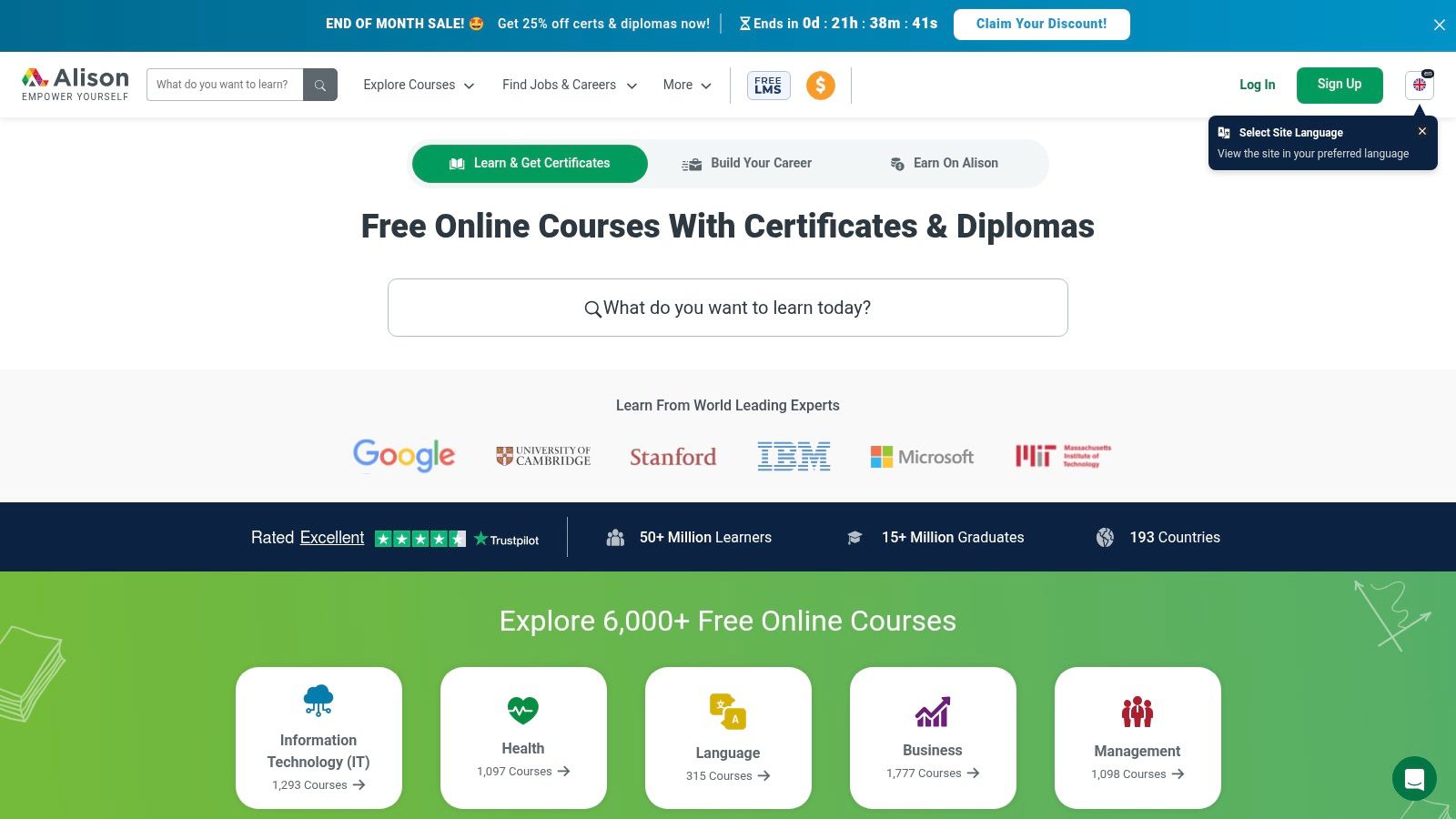
The platform is particularly useful for short, focused learning bursts. If you need to quickly refresh a specific concept before tackling a larger Access to HE module, Alison's bite-sized courses can be ideal. Many courses are CPD-accredited, offering a way to demonstrate continuous learning to employers, though it’s important to note the certificates themselves are a paid extra.
Key Features and Use Cases
- Best For: Individuals looking for quick, no-cost refreshers on specific maths topics or professionals needing to demonstrate CPD without committing to a long-term course.
- Course Structure: Courses are typically video-based with short modules and quizzes to test understanding. A learner dashboard helps track progress across multiple courses.
- Free Learning Model: The core value is that all learning content is free. Users only pay if they wish to remove ads or purchase a digital or physical certificate upon completion.
Practical Considerations
While the breadth of choice is a major advantage, the quality can be inconsistent as courses are created by various third-party publishers. The primary drawback is the cost associated with certification; the "free" aspect applies strictly to the learning experience itself. For effective use, focus on courses with high ratings and clear learning outcomes to find the most valuable content.
- Pros: Completely free to learn, many short and practical courses, good for targeted skill-building and quick refreshers.
- Cons: Certificates and diplomas require payment, course quality and depth can vary significantly.
- Website: https://alison.com
7. Saylor Academy
Saylor Academy is a non-profit organisation that provides free online maths courses designed at a university-level, making it a powerful resource for learners aiming for higher education. It offers self-paced courses in subjects like College Algebra, Calculus I, and Statistics, presenting a clear pathway to more advanced mathematical concepts often required for science, engineering, and business degrees.
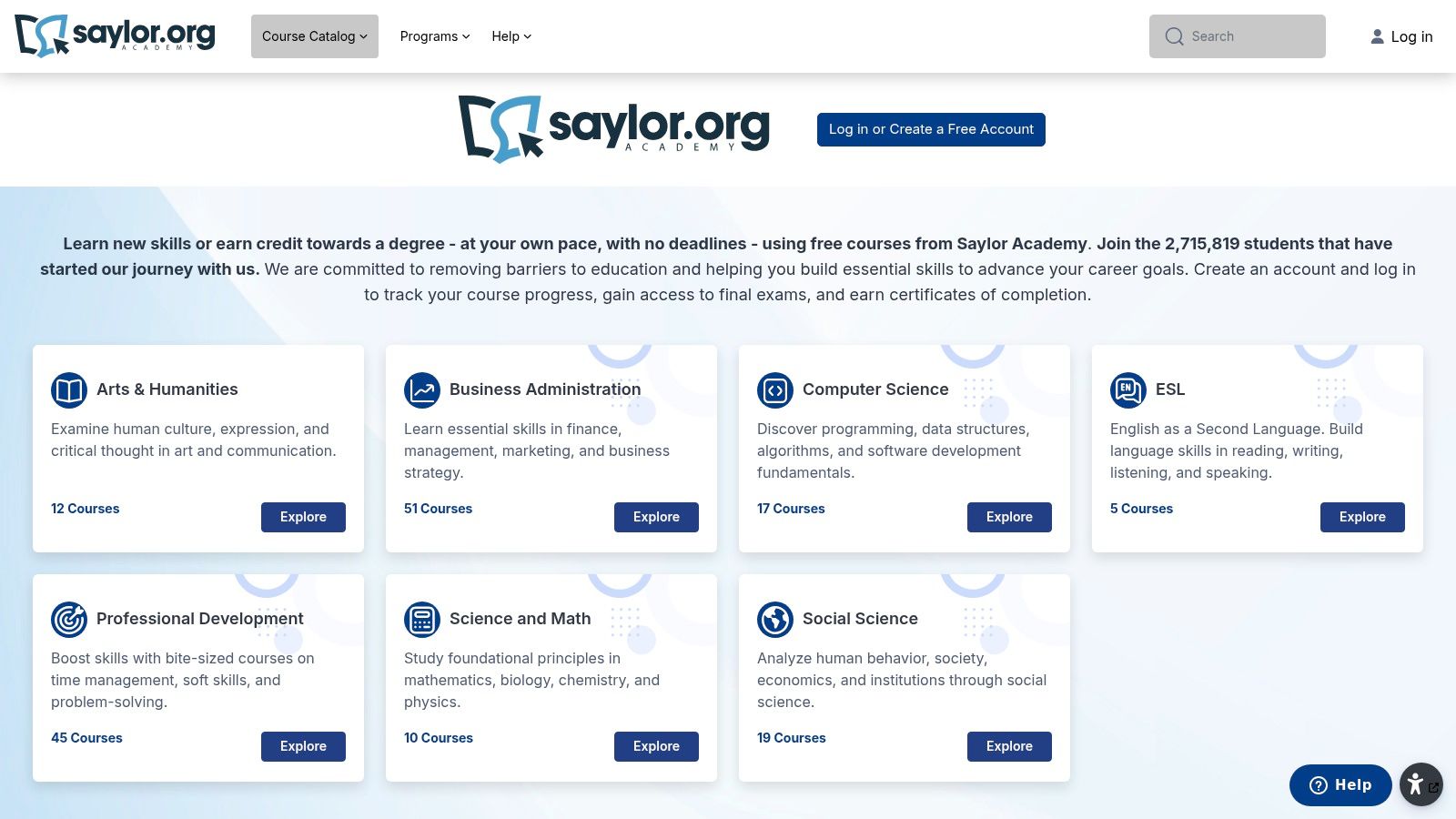
The platform’s mission is to make education accessible, and its structure reflects this by offering the entire learning experience, from materials to final exams, at no cost. This makes it an excellent option for prospective Access to HE students who want to test their readiness for university-level maths without any financial commitment. The availability of free certificates of completion provides a tangible way to document learning.
Key Features and Use Cases
- Best For: Self-motivated learners who need to grasp university-level maths topics like calculus or statistics before starting a degree. It is ideal for those who want a structured, text-based course that mirrors a traditional syllabus.
- Course Structure: Courses are organised into units with estimated study times, reading materials, and practice exercises. Learning is assessed via a final exam, and passing it earns a free certificate.
- Credit Recommendation: Some courses have been recommended for credit by the American Council on Education (ACE), which, although US-centric, demonstrates the high academic standard of the content.
Practical Considerations
The learning experience at Saylor Academy is entirely self-directed, with no instructor interaction or tutor support, requiring significant discipline. While the course selection is high-quality, it is more limited than larger MOOC platforms, focusing on core university subjects. The platform is best used as a preparatory tool to build foundational knowledge for formal, accredited UK qualifications.
- Pros: Entire course experience is free including certificates, good bridge to higher-education maths, structured university-style syllabus.
- Cons: Limited number of maths courses, no instructor or tutor interaction, credit recommendations are US-based.
- Website: https://learn.saylor.org
8. BBC Bitesize
BBC Bitesize is a cornerstone of UK education and an invaluable resource for anyone needing to revise school-level mathematics. While not a structured course provider in the traditional sense, its extensive library of free online maths courses material, including guides, videos, and quizzes, makes it an essential tool for targeted revision, particularly for those preparing for GCSE-level qualifications or needing a refresher before tackling an Access to HE Diploma.
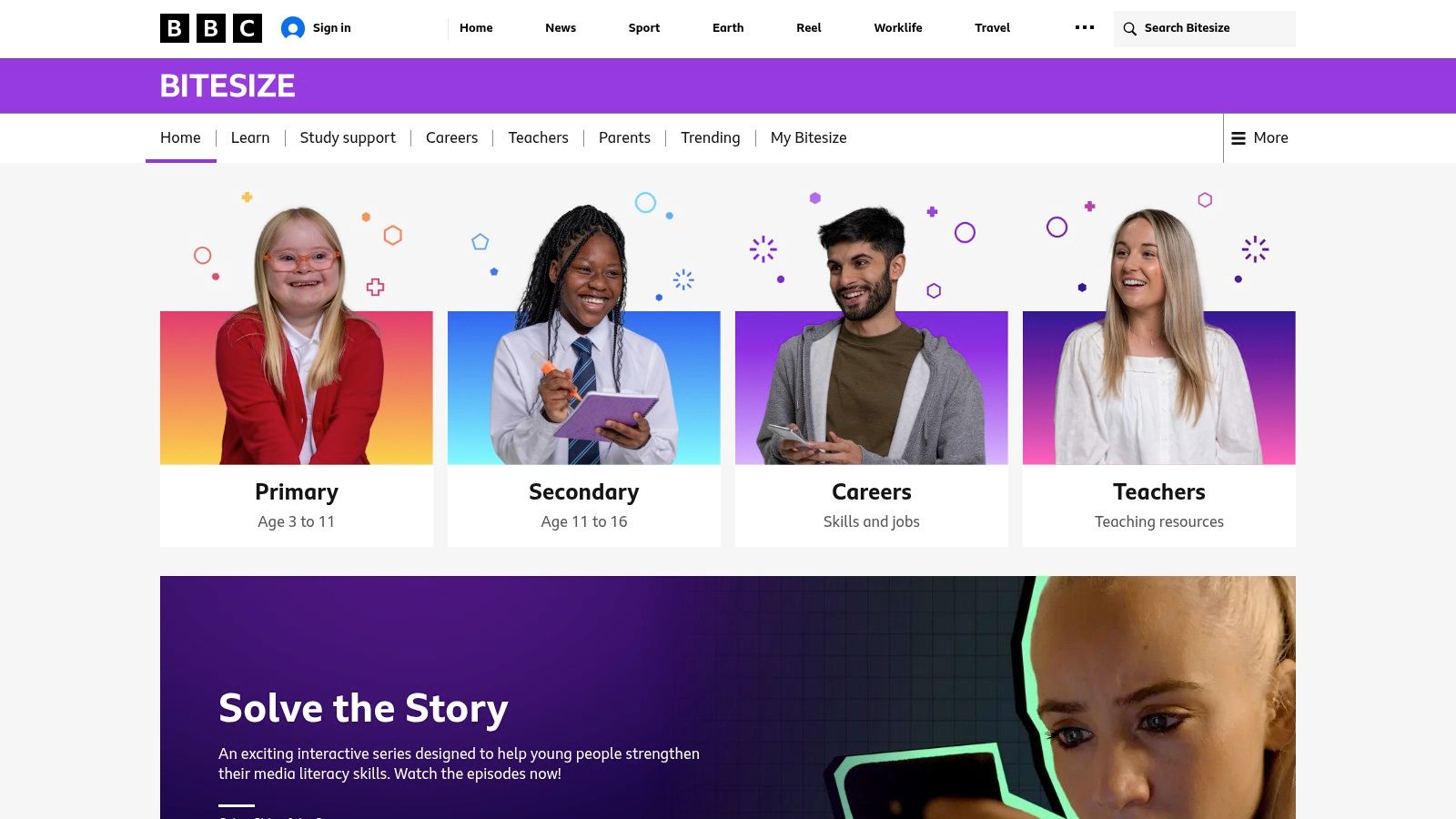
The platform’s strength lies in its direct alignment with the UK national curricula, offering specific content for England, Northern Ireland, Scotland, and Wales. Its approachable, "bitesize" format breaks down complex topics into digestible chunks, making it exceptionally user-friendly and perfect for quick study sessions on any device without requiring any sign-up.
Key Features and Use Cases
- Best For: Learners needing to quickly revise specific GCSE maths topics, build confidence with foundational concepts, or supplement formal study with curriculum-aligned practice.
- Course Structure: Content is organised by topic rather than as a linear course. Users can select specific areas like algebra or geometry and work through explainers, watch videos, and test their knowledge with interactive quizzes.
- Curriculum-Specific: Material is tailored to the exam boards and curriculum of each UK nation, ensuring revision is relevant and targeted.
Practical Considerations
BBC Bitesize is a supplementary resource, not a formal course platform. It does not offer certificates or tutor support, and its content is limited to the pre-university level. It is most effective when used to plug specific knowledge gaps or for focused revision alongside a more structured learning programme.
- Pros: Trusted UK resource, approachable content, ideal for GCSE revision and school-level recap, no sign-up required.
- Cons: Not a formal 'course' with certificates, limited depth beyond GCSE level.
- Website: https://www.bbc.co.uk/bitesize
9. National Numeracy Challenge (UK)
The National Numeracy Challenge is a free, confidential tool designed to help UK adults build confidence with everyday numbers. It's an ideal starting point if you experience maths anxiety or want to improve practical numeracy skills for life and work. This resource is less about academic theory and more about applying maths to real-world scenarios like budgeting and understanding data.
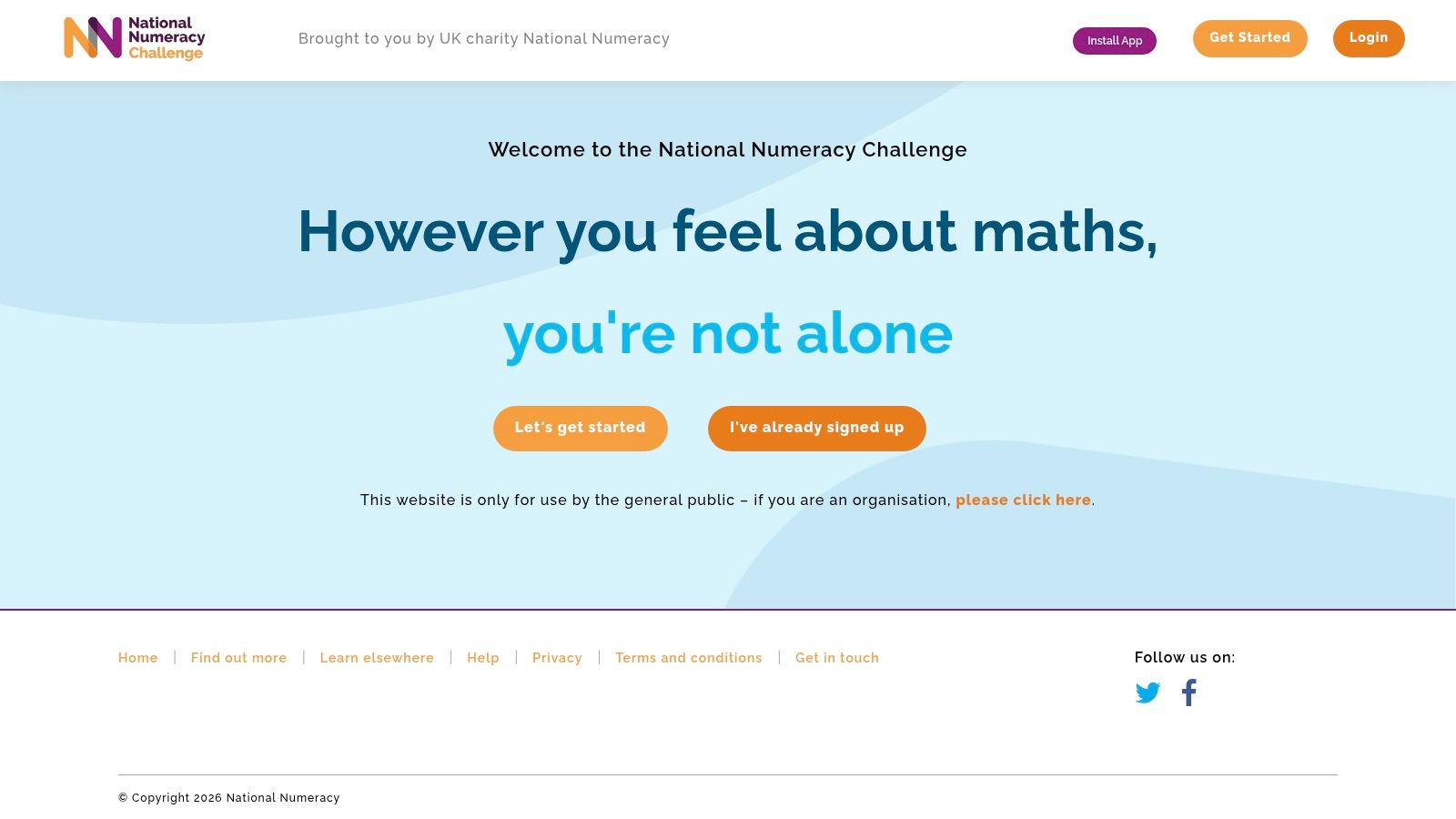
This platform stands out for its supportive, non-judgemental approach. It starts with a quick skills check that diagnoses your current level and generates a personalised learning plan. This targeted approach ensures you focus on the areas where you need the most practice, making it an effective stepping stone towards more formal qualifications, such as those discussed in guides to GCSE Maths for adults.
Key Features and Use Cases
- Best For: Adults who want to overcome a fear of maths and improve their number confidence in a supportive environment. It is also excellent preparation before starting a Functional Skills qualification.
- Course Structure: The journey begins with a quick check-up quiz. Based on your results, the platform provides tailored, bite-sized learning resources, activities, and videos to help you improve. Progress is tracked as you work towards the "Essentials of Numeracy".
- Practical Focus: All content is geared towards practical application, covering topics like managing money, interpreting measurements, and understanding percentages in everyday contexts.
Practical Considerations
The Challenge is a confidence-builder and skills-checker, not a formal course. It does not lead to a regulated qualification and is focused entirely on foundational, practical numeracy rather than the advanced algebra or geometry found in GCSE or A-Level curricula. For best results, use it consistently to build a solid foundation before tackling formal study.
- Pros: Specifically designed for UK adults, supportive and confidence-building tone, excellent preparation for Functional Skills.
- Cons: Does not provide a formal qualification, focuses only on foundational numeracy, not advanced maths.
- Website: https://www.nationalnumeracy.org.uk/challenge
10. Multiply (UK government-funded free adult numeracy)
Multiply is a UK government-funded initiative aimed at helping adults improve their numeracy skills. It offers free online maths courses for anyone aged 19 and over who does not already have a GCSE in maths at grade C (or the new grade 4). The programme is delivered through local councils and providers, focusing on practical, everyday maths for work and life.
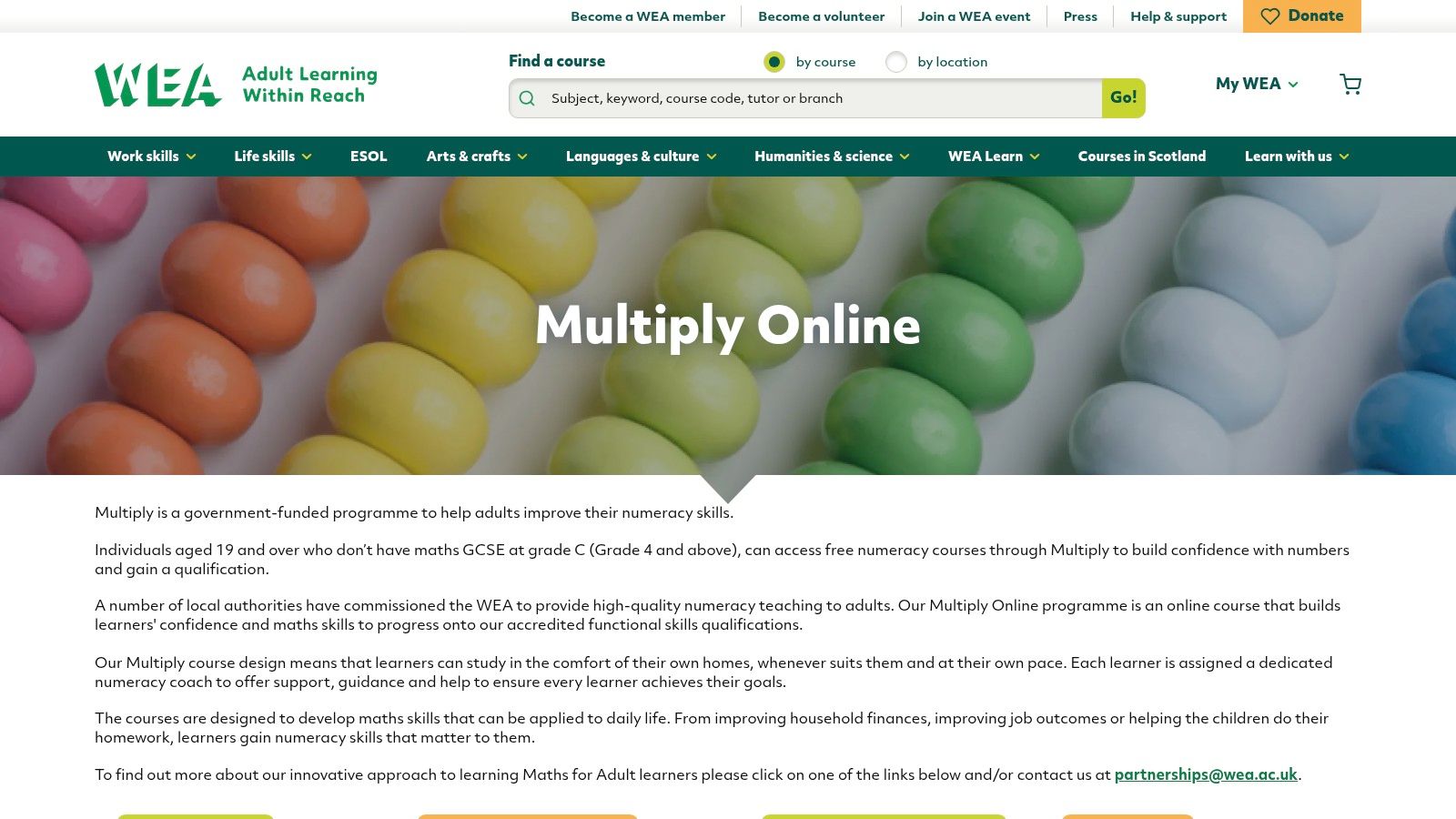
The programme stands out because it is 100% funded for eligible learners and is designed as a direct pathway to formal qualifications. Many of the courses are specifically structured to prepare learners for qualifications like Functional Skills Level 2 maths, a key requirement for many Access to HE Diplomas and university courses. This makes it a highly valuable, structured, and goal-oriented option.
Key Features and Use Cases
- Best For: UK-based adults (19+) without a maths GCSE C/4 who need a structured, free course to gain a foundational qualification for career progression or entry into higher education.
- Course Structure: Delivery varies by local provider but often includes flexible online, in-person, or blended options. The curriculum is focused on practical application and building confidence.
- Progression Routes: Courses are designed to lead directly into formal qualifications, such as Functional Skills or GCSE maths, bridging a critical gap for many aspiring students.
Practical Considerations
The primary limitation is eligibility; the funding is strictly for adults who meet the specific criteria of age and prior qualification level. The sign-up process and course availability differ significantly across local authorities, so you will need to search for the provider in your area.
- Pros: Completely free for eligible learners, clear pathways to formal qualifications, flexible scheduling with online options.
- Cons: Strict eligibility restrictions, enrollment processes and course quality can vary by local area.
- Website: https://www.wea.org.uk/multiply-online
11. mathcentre (UK university maths support)
mathcentre is a fantastic resource hub created by a consortium of UK universities, specifically designed to support post-16, Further Education (FE), and Higher Education (HE) students. It's not a single course, but a curated library of free online maths courses and materials, making it a powerful tool for targeted revision. For anyone preparing for an Access to HE Diploma or needing to brush up on specific A-Level topics before starting university, this site is invaluable.
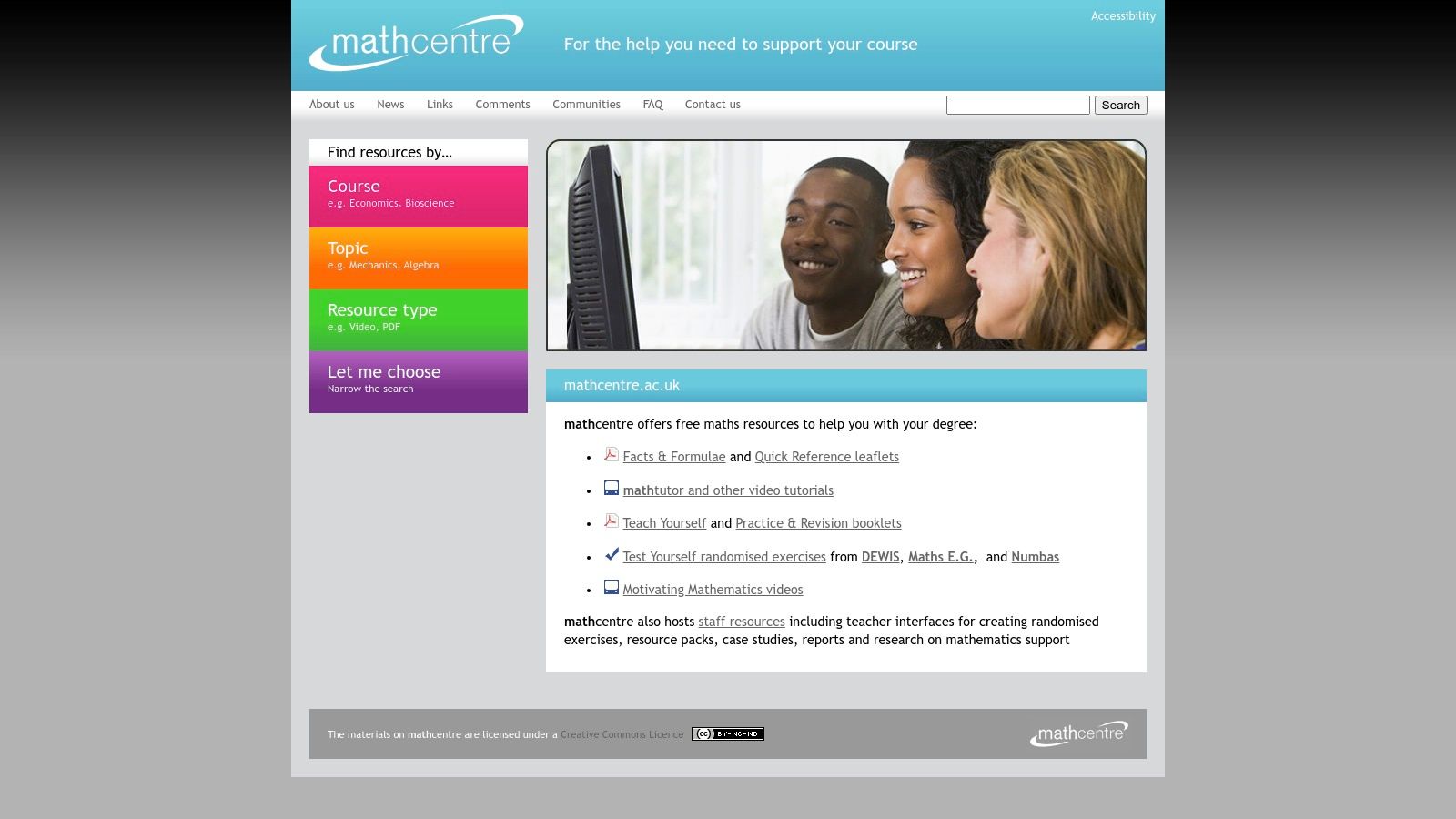
The platform's strength lies in its academic rigour and topic-specific approach. Rather than a linear programme, learners can dive directly into video tutorials, 'Teach Yourself' booklets, and printable formula sheets for topics from algebra to mechanics. This pick-and-mix style is ideal for efficiently plugging knowledge gaps identified during Access to HE studies.
Key Features and Use Cases
- Best For: Access to HE students and university applicants needing to strengthen specific, prerequisite maths topics. It's perfect for self-directed learners who know what they need to revise.
- Course Structure: The site is a repository of resources, not a structured course. Content is organised by topic, featuring downloadable PDFs, video lessons, and online exercises powered by systems like Numbas for interactive practice.
- Creative Commons Licence: Most materials are licensed under Creative Commons, allowing for easy download, printing, and use in personal study without restriction, which is a significant practical benefit.
Practical Considerations
The key drawback is the lack of a guided learning path; users must be proactive in finding the materials they need. The interface is functional and academic rather than slick and modern, prioritising content over user experience. To use it effectively, identify weak areas in your knowledge first, then use mathcentre's search or topic lists to find relevant revision packs.
- Pros: High-quality, trusted UK academic resources, excellent for targeted pre-university revision, completely free with no registration.
- Cons: Not a guided 'course', learners must self-select materials, the interface feels dated.
- Website: https://www.mathcentre.ac.uk
12. Udemy (free maths courses category)
Udemy is a vast online learning marketplace known for its paid courses, but it also hosts a substantial collection of free online maths courses. These are typically short, video-based tutorials created by independent instructors, covering everything from basic arithmetic and GCSE revision to introductions to algebra and calculus. This makes it an excellent resource for quickly plugging a specific knowledge gap or getting a taster of a topic without any financial commitment.
The platform’s strength lies in its sheer variety and the ability to sample different teaching styles rapidly. While paid courses often have more depth, the free offerings are perfect for targeted revision. Lifetime access to enrolled free courses (as long as they remain on the platform) is a significant benefit, allowing you to revisit concepts whenever needed.
Key Features and Use Cases
- Best For: Learners who need to refresh a very specific maths topic quickly, such as factorising quadratics or understanding percentages, before tackling a larger course.
- Course Structure: Content is primarily video-based, broken into short lectures. Many courses include a Q&A section where you can see questions from other students, though direct instructor interaction on free courses is often limited.
- Filtering System: Udemy’s powerful search and filtering tools make it easy to isolate free courses. You can sort by rating and read reviews to gauge the quality before enrolling.
Practical Considerations
The quality of content can vary significantly between instructors, as it is an open marketplace. It is crucial to check reviews and instructor credentials. Courses are not always aligned with the UK curriculum, so they are best used for understanding concepts rather than direct exam preparation. Certificates of completion are basic and not formal qualifications.
- Pros: Huge variety of topics, lifetime access to enrolled courses, user reviews help identify quality content.
- Cons: Quality and depth are inconsistent, not necessarily UK-curriculum aligned, certificates are not formal qualifications.
- Website: https://www.udemy.com
12-Provider Comparison: Free Online Math Courses
| Provider | Core features ✨ | Quality ★ & USP 🏆 | Price / Value 💰 | Target audience 👥 |
|---|---|---|---|---|
| OpenLearn (The Open University) | ✨ Free self‑paced courses, badges, Statements of Participation | ★★★★ Trusted OU content; good bridge to Access | 💰 Free; statements (not formal quals) | 👥 Adults returning to study; Access prep |
| FutureLearn | ✨ Short UK uni courses, community discussions, mobile | ★★★★ Strong UK university partners; social learning | 💰 Free limited access; paid upgrade for certs | 👥 Learners wanting UK‑context tasters |
| Khan Academy | ✨ Mastery paths, instant feedback, practice engine | ★★★★★ Comprehensive practice; excellent foundations 🏆 | 💰 Completely free; long‑term access | 👥 Learners rebuilding basics; pre‑Access |
| edX | ✨ University‑level courses, free audit, paid verified certs | ★★★★ High‑quality uni content; advanced refreshers | 💰 Free audit; paid verified certificates | 👥 Higher‑level refreshers & tasters |
| MIT OpenCourseWare (OCW) | ✨ Full course archives: lectures, notes, problem sets | ★★★★★ Rigorous top‑tier materials for deep study 🏆 | 💰 Free; no certificates or tutor support | 👥 Self‑directed intermediate/advanced learners |
| Alison | ✨ Free CPD‑flagged modules, learner dashboard, quizzes | ★★★ Practical short modules for quick refreshers | 💰 Free learning; certificates/diplomas paid | 👥 Those seeking targeted, short courses |
| Saylor Academy | ✨ Self‑paced college‑style courses with final exams | ★★★★ Complete course experience; free completion certs | 💰 Free; some ACE credit recommendations | 👥 College‑style learners prepping for HE |
| BBC Bitesize | ✨ Topic explainers, videos & quizzes aligned to UK exams | ★★★★ Trusted, approachable GCSE‑level content | 💰 Free; no formal certificates | 👥 GCSE students & adults needing school‑level recap |
| National Numeracy Challenge (UK) | ✨ Quick skills check + tailored learning plan | ★★★★ Supportive UK‑focused assessment tool | 💰 Free; personalised learning plan | 👥 Adults improving everyday numeracy; Functional Skills prep |
| Multiply (UK govt‑funded) | ✨ Funded adult numeracy courses (online/blended) | ★★★★ Clear progression to Functional Skills/GCSE | 💰 100% funded if eligible | 👥 UK adults 19+ without GCSE C/4 |
| mathcentre (sigma Network) | ✨ Topic‑organised resources, printable packs, Numbas | ★★★★ High‑quality UK academic support resources | 💰 Free; resource‑based (no certs) | 👥 Post‑16 / FE / HE students & Access candidates |
| Udemy (free maths category) | ✨ Marketplace micro‑courses, video tutorials, reviews | ★★–★★★ Quality varies by instructor; many options | 💰 Many free; paid items & platform certificates | 👥 Quick tasters and topic‑specific refreshers |
Building Your Future: From Free Courses to University Success
You now have a comprehensive map of the best free online maths courses available, each offering a unique pathway to mathematical proficiency. From the structured, university-level introductions on OpenLearn and edX to the granular, skill-based practice on Khan Academy and BBC Bitesize, the resources are vast and empowering. The key takeaway is not just that these tools exist, but that they can be strategically combined to create a personalised learning plan that fits your specific goals, whether that’s passing a GCSE equivalency test, preparing for a degree in computer science, or simply building the confidence to manage numbers in your daily life.
The journey from foundational numeracy to university-level mathematics is no longer gated by expensive tuition fees or rigid timetables. You can start today, using a platform like National Numeracy or Multiply to assess your baseline, then transition to more formal courses on FutureLearn or Saylor Academy to fill specific knowledge gaps identified for your chosen Access to HE Diploma.
Turning Knowledge into Opportunity
The true power of these free online maths courses lies in their ability to act as a launchpad. Completing them doesn't just improve your mathematical ability; it cultivates critical thinking, analytical reasoning, and resilience. These are not just academic buzzwords; they are tangible assets for your future. Beyond academic growth, these free maths courses can significantly enhance your practical abilities. For instance, learning how to effectively demonstrate problem-solving skills on your CV can be a game-changer when applying for jobs or further education.
By working through these modules, you are actively building a portfolio of evidence that shows your commitment, self-discipline, and readiness for the rigours of higher education. This preliminary study is your proving ground, allowing you to test your aptitude and solidify your ambitions before committing to a formal qualification.
Your Actionable Next Steps
To make the most of this guide, it's time to move from reading to doing. Here is a clear, actionable plan to get started:
- Define Your Goal: What is your primary objective? Is it to gain the maths skills for a Nursing diploma, prepare for a Business degree, or simply refresh your A-Level knowledge? Be specific.
- Assess Your Starting Point: Use a tool like the National Numeracy Challenge to get an honest, confidential assessment of your current skills. This removes the guesswork and helps you start at the right level.
- Select Your Primary Resource: Based on your goal, choose one core platform to anchor your learning. For a structured, academic approach, OpenLearn is excellent. For flexible, self-paced practice, Khan Academy is unmatched.
- Supplement Strategically: Use other resources to support your main platform. If you’re struggling with a specific calculus concept in your edX course, find a detailed tutorial on mathcentre or a short video on Udemy to clarify it.
- Set a Schedule and Stick to It: Treat this like any other serious commitment. Block out dedicated study time in your calendar, even if it’s just a few hours a week. Consistency is far more important than intensity.
- Aim for a Recognised Qualification: The ultimate goal of this preparatory work is to qualify for the next stage. Use these free courses to build the foundation needed to confidently enrol in and succeed on an Access to Higher Education Diploma, your direct pathway to a university degree.
By following this structured approach, you transform a collection of free resources into a powerful engine for personal and professional advancement. You are not just learning maths; you are actively designing your future, one equation at a time. The path to higher education and a new career is open, and you have already taken the first, most important step.
Now that you've used these free resources to build your foundational skills and confidence, you're perfectly positioned to take the next step. At Access Courses Online, we provide accredited Access to Higher Education Diplomas that are recognised by universities across the UK and designed for flexible online study. Let us help you turn your preparation into a university place and a rewarding new career.