

Struggling to get that essential English qualification? If you need a GCSE Grade 4 (what used to be a C) for university or a new job, but the thought of going back to Shakespeare and poetry analysis fills you with dread, there’s a much more practical solution.
Functional Skills English Level 2 is designed specifically for adults. It cuts out the literary deep dives and focuses squarely on the reading, writing, and communication skills you actually use day-to-day.
Your Communication Passport to New Opportunities

It’s best to think of this qualification not as a typical English course, but as your official ‘communication passport’. It proves to employers and universities that you have the skills needed to understand information, write clearly, and communicate effectively in the real world.
The whole point of Functional Skills English Level 2 is to give you a credential that confirms your ability to handle professional and academic tasks with confidence. It’s your ticket to moving forward.
What Does This Qualification Actually Involve?
This course is laser-focused on certifying your real-world English abilities. It’s perfect for anyone needing a GCSE-equivalent to unlock their next step, whether that's an apprenticeship, a promotion, or a place at university. The course is built around three core pillars:
- Reading: You’ll learn to confidently get to grips with different types of texts, from detailed reports and articles to everyday instructions you’d find in any workplace.
- Writing: This is all about crafting clear, professional documents. Think emails, letters, articles, and reports, all with the correct spelling, punctuation, and grammar.
- Speaking and Listening: You’ll build confidence in contributing to discussions, giving short presentations, and really listening to what others are saying.
This practical approach is exactly why it's become such a popular and respected alternative to GCSE English for adults. It proves you have the skills that employers and universities are actually looking for, without the extra academic theory.
Why Was It Created?
Simple. The qualification was developed to fill a major gap for adults who didn't get a Grade C/4 in their school GCSEs but now find they need it to get ahead. It recognises that adults need a faster, more relevant way to prove their English skills.
You can find out more about how a Functional Skills Level 2 qualification can open doors for you in our detailed guide.
By concentrating on practical application, the course ensures that everything you learn is immediately useful. It acts as a powerful launchpad, opening up pathways that might have seemed closed before, from Access to HE Diplomas to new career opportunities.
Breaking Down the Three Core Exam Components
To get your head around the Functional Skills English Level 2 exam, you need a clear picture of what you’ll actually be doing on the day. It’s not one single, daunting test. Instead, it’s split into three distinct parts, each designed to check a different aspect of your practical English skills.
Think of it like learning to cook a new dish. You’ve got the reading part (following the recipe), the writing part (creating your own shopping list and notes), and the speaking part (explaining to someone how you made it). Each skill is crucial, and mastering them all proves you’re a competent communicator, ready for whatever your career or further education throws at you.
The Reading Exam: A Test of Real-World Understanding
First up is the Reading exam. This isn't about dissecting old poems or classic novels. It's all about how well you understand and interpret the kind of written information you come across every single day.
You'll be given a few different documents and asked questions to see if you can pull out the important details, figure out the writer's intention, and even spot a bit of bias. The whole point is to show you can confidently handle various styles of writing.
- Can you follow instructions? Think step-by-step guides or workplace safety notices.
- Can you identify the purpose? Is an article trying to inform you, persuade you to buy something, or just entertain you?
- Can you spot a one-sided argument? Could you tell if a news story or an opinion piece is pushing a particular agenda?
For instance, you might get an email from your boss and a promotional leaflet. Your job could be to compare the formal, straight-to-the-point tone of the email with the persuasive, colourful language of the leaflet. It’s all about proving you’re a sharp, critical reader in any real-world setting.
The Writing Exam: Crafting Clear and Purposeful Communication
Next, we have the Writing exam. This section is purely about your ability to produce clear, well-structured, and accurate written work for practical situations. You’ll be asked to create documents that serve a specific purpose for a particular audience.
The tasks are designed to feel like real-world scenarios, so the skills you’re practising are genuinely useful from day one. You won't be writing abstract essays – you'll be creating functional pieces of writing.
The golden rule here is clarity and purpose. Your writing needs to be fit for the job it’s meant to do, whether that’s formally requesting information, persuading a colleague, or informing a customer.
Some common tasks you might face include:
- Writing a formal letter of complaint or a job application.
- Crafting a balanced article that explores different viewpoints on a topic.
- Composing a professional and easy-to-understand email to your team.
Nailing this part of the Functional Skills English Level 2 exam shows that you can get your ideas across effectively in writing, using the right spelling, punctuation, and grammar so your message lands exactly as you intended.
The Speaking, Listening, and Communicating Exam
The final piece of the puzzle is the Speaking, Listening, and Communicating (SLC) component. For a lot of people, this is the most nerve-wracking part, but it’s really just a structured way to see how you handle professional conversations. It’s not a public speaking competition; it’s a test of your ability to actively participate in a discussion.
To help you get a sense of what's involved, we've put together a simple table that breaks down each assessment.
Functional Skills English Level 2 Assessment Breakdown
The table below summarises the skills and tasks you'll encounter across the three assessments.
| Component | What You Will Be Assessed On | Example Tasks |
|---|---|---|
| Reading | Your ability to understand, interpret, and evaluate different types of texts. | Comparing information in two documents, identifying the main points of an article, explaining how language is used to persuade. |
| Writing | Your ability to produce clear, accurate, and well-structured documents for a specific audience and purpose. | Writing a formal email, drafting a letter of application, creating a blog post or an article. |
| Speaking, Listening & Communicating | Your ability to contribute effectively to discussions and deliver a clear presentation. | Participating in a group discussion on a set topic, giving a short, prepared presentation to a small audience. |
As you can see, each part tests a practical skill that is immediately useful in both work and study.
This assessment usually involves two main activities: a group discussion and a short presentation. In the discussion, an assessor will watch how well you listen to others, add your own ideas, and respond to different points of view. For the presentation, you’ll deliver a brief talk on a straightforward topic, with the focus on structure and clarity.
This part of the qualification proves you’re not just a passive sponge for information but an active and confident communicator. The great news is that the standards for these exams are very consistent. In fact, pass rates have been remarkably stable over the last few years. Data from Ofqual shows that between late 2021 and late 2024, the pass rate for English Level 2 Writing was 85.1% and Reading was 84.1%, with a combined pass rate of 80.0%.
You can explore more about these consistent pass rates yourself. This stability shows that with the right preparation, passing is a very achievable goal.
Comparing Functional Skills English to a GCSE
It’s one of the first questions we hear from learners: “Is a Functional Skills qualification really as good as a GCSE?”
The answer is a straightforward and confident yes. A Functional Skills English Level 2 qualification is officially recognised by employers, colleges, and universities right across the UK. It’s seen as equivalent to a GCSE Grade 4, which you might remember as the old Grade C.
The real difference isn’t in its value but in its focus. Imagine it like this: a GCSE is like studying a detailed world atlas. It covers history, geography, and complex theories—all valuable, but not all of it is needed for your immediate journey. Functional Skills, on the other hand, is like having a powerful GPS on your phone. It doesn't tell you about historical trade routes, but it gets you exactly where you need to go, right now.
Different Paths to the Same Destination
Both qualifications are designed to get you to your goal, whether that’s a spot at university or a promotion at work. They just take very different routes. A GCSE in English often asks you to analyse classic literature, explore the historical context of a text, and write creatively.
By contrast, Functional Skills English Level 2 cuts away the academic theory to focus purely on the practical skills that matter in the real world. It’s built for adults who need to confidently read a report from their boss, write a professional email to a client, or contribute clearly in a team meeting.
For many adult learners, this practical approach is a massive advantage. Every single thing you learn is directly useful for your career or future studies, which makes the whole process feel more relevant and engaging.
The way they are assessed also highlights this difference. GCSEs usually come down to a couple of high-stakes final exams covering a massive curriculum. Functional Skills breaks it down into three manageable parts: Reading, Writing, and Speaking & Listening. Each one tests a specific, real-world skill, which can feel much less daunting.
This diagram shows how the core skills are broken down for the exam.
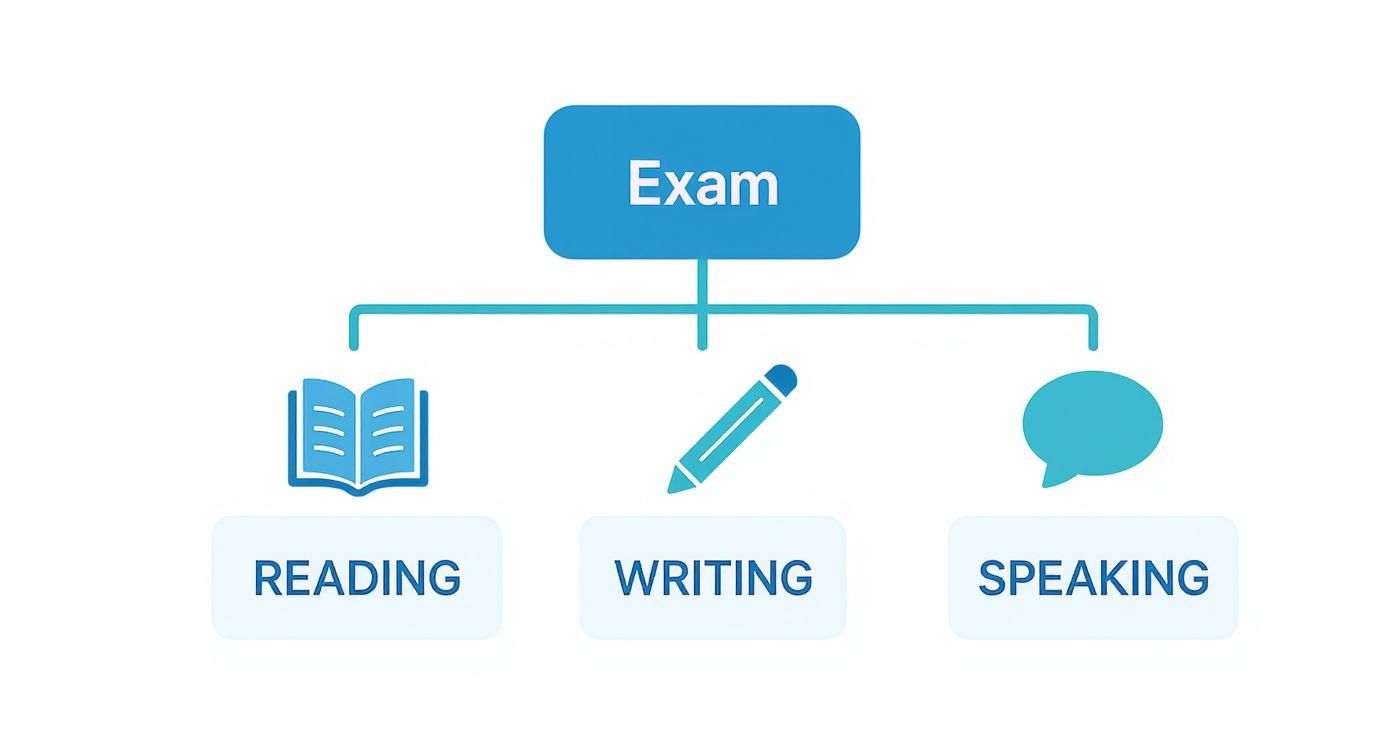
As you can see, the three parts are assessed separately, reinforcing that you’re being tested on distinct, practical communication skills.
A Head-to-Head Comparison
So, which path is right for you? It all comes down to your personal goals and circumstances. To make it clearer, let’s put them side-by-side.
Functional Skills English Level 2 vs GCSE English Language
| Feature | Functional Skills English Level 2 | GCSE English Language |
|---|---|---|
| Primary Focus | Practical, real-world communication skills for work and daily life. | Academic study, including literary analysis and creative writing. |
| Equivalence | Recognised as equivalent to a GCSE Grade 4 (formerly Grade C). | The national standard qualification for school-leavers. |
| Target Learner | Primarily adults who need a qualification for work or university access. | Typically taken by 14-16 year-olds in a traditional school setting. |
| Assessment | Three separate assessments: Reading, Writing, and Speaking & Listening. | Usually two final exam papers covering a very broad curriculum. |
| Content | Tasks like writing formal emails, reading workplace reports, and taking part in discussions. | Involves analysing fiction and non-fiction texts, poetry, and creative writing. |
| Study Time | Can be completed flexibly online in just a few months. | Typically requires a full academic year of structured classroom lessons. |
At the end of the day, both qualifications are highly respected. But if you're an adult learner who needs a fast, relevant, and practical way to get that Grade 4 equivalent, Functional Skills English Level 2 is almost always the smarter choice. It’s designed to fit around your life and give you the exact skills you need to move forward.
Unlocking Your Path to University and Career Growth

Earning your Functional Skills English Level 2 qualification is about so much more than just passing another exam. Think of it as the key that unlocks doors you might have thought were permanently closed. This single certificate is your direct route to higher education and better job prospects, finally putting your biggest ambitions within reach.
For thousands of adults returning to education, this qualification is the essential first step onto the most trusted path to university: an Access to Higher Education (HE) Diploma. These diplomas are tailor-made for people who don't have traditional A-Levels but are ready to pursue a degree.
Your Direct Pathway to University
Almost every university in the UK recognises and accepts Access to HE Diplomas for entry onto their degree programmes. But these diplomas have their own entry requirements, and one of the most common is a GCSE Grade 4 (or C) in English, or a recognised equivalent. This is exactly where Functional Skills English Level 2 comes into play.
By passing this one qualification, you tick that essential box, clearing the way for you to enrol on your chosen Access to HE Diploma and start the journey towards earning a degree.
Think of it as the foundational piece of the puzzle. Without it, the path to university can feel blocked. With it, you unlock a clear and structured route to achieving your dream of getting a degree.
Once you’ve got your Functional Skills English Level 2 certificate and completed your Access to HE Diploma, a whole new world of degree courses opens up. Some of the most popular and rewarding career paths begin with this exact journey:
- Nursing and Midwifery: Strong communication is non-negotiable in these competitive healthcare degrees. This qualification formally proves you have what it takes.
- Social Work: A career in social work hinges on your ability to write clear, concise reports and communicate with empathy—both are core functional skills.
- Business and Management: From drafting business plans to communicating with stakeholders, this qualification provides the bedrock skills for any business degree.
- Teaching: Before you can train to become a teacher, you have to demonstrate a high standard of English. This is a critical first step on that path.
Gaining a Competitive Edge in the Job Market
The value of this qualification doesn't stop at university applications. In today's competitive job market, employers aren't just looking for experience; they want proof of practical communication skills. Having Functional Skills English Level 2 on your CV sends a clear signal that you can write professional emails, follow complex instructions, and contribute effectively to team discussions.
It gives you a real advantage when you’re applying for a new job, going for a promotion, or trying to secure a place on an apprenticeship scheme. In fact, many employers now list a Level 2 English qualification as an essential requirement, meaning it can be the difference between your application being seen or being dismissed at the first hurdle.
Ultimately, this qualification proves you are a competent, reliable communicator who is ready to meet the demands of a professional environment. It isn't just a piece of paper—it’s concrete proof of your abilities, drawing a direct line from passing an exam to building the future you truly want.
Finding the Right Study Option for You
Once you’ve set your sights on achieving your Functional Skills English Level 2, the next big question is: how are you going to study for it? For some, the traditional route of enrolling at a local college with its fixed timetables and term dates works perfectly.
But let's be realistic. For most adults juggling jobs, family, and everything else life throws at them, that rigid structure can feel like an impossible hurdle.
Thankfully, there’s a much more flexible way. Online learning has become a game-changer, offering courses specifically designed for busy adults who need their studies to fit around their lives, not the other way around.
The Power of Flexible Online Learning
The biggest win with online study is the freedom it gives you. Forget rushing to evening classes after a long day. You can access all your course materials whenever and wherever you want – whether that’s during your lunch break, after the kids are in bed, or on a quiet Sunday morning.
This self-paced approach means you’re in complete control. You can spend extra time on the topics you find tricky and breeze through the bits you already know, all without the pressure of keeping up with a class. The best online providers, like us, also offer dedicated one-to-one tutor support, so you get personalised guidance right when you need it. Digging into different online course platforms for UK institutions can help you see just how much support is out there.
Choosing a study method that adapts to your life, rather than forcing your life to adapt to it, is often the key to success. For adult learners, this flexibility can be the single most important factor in completing the qualification.
The world of adult education is always shifting. Recent government figures show that in the last academic year, 188,680 adults enrolled in Level 2 English courses, a change from the 209,750 learners the year before. You can read more about these further education trends yourself, but it highlights why finding a supportive and adaptable provider has never been more crucial.
Understanding the Costs and Funding
Okay, let's talk money. Budgeting is a vital part of your plan, so it helps to know exactly what you’re paying for. The price of a Functional Skills English Level 2 course can vary, but it usually breaks down into a few key areas.
- Course Fees: This is the main cost, covering all your learning materials, online resources, and that all-important tutor support.
- Exam Fees: Often, the cost to sit the three exams (Reading, Writing, and SLC) is a separate charge. You can typically expect an individual exam to cost between £100 and £200.
- Resit Fees: It's always a good idea to check the policy on resits. Some providers might include one attempt in the price, while others will charge for any extra attempts needed.
It's also well worth investigating funding options, especially for adult learners in the UK. Depending on your personal circumstances and what qualifications you already have, you might be eligible for government funding to cover some or all of the costs.
To make things more manageable, many online providers—including us for our NCFE Level 2 Functional Skills Qualification in English—offer interest-free payment plans. This lets you spread the cost over time, so you can invest in your future without a big financial hit upfront.
Actionable Strategies to Pass Your Exams

Knowing what the exam covers is one thing, but figuring out how to beat it is the real key. Success in your Functional Skills English Level 2 exam boils down to smart preparation and having a solid game plan for each part of the test. Let's walk through some practical techniques you can use to feel confident and in control on exam day.
Think of it like getting ready for a driving test. You don’t just read the highway code; you get out on the road and practise the specific manoeuvres you’ll be tested on until they become second nature. The same idea applies here.
Mastering the Reading Exam
In the Reading exam, the clock is your biggest enemy. You've got to work through the texts and answer the questions without running out of time, which is where a couple of clever techniques come into play: skimming and scanning.
-
Skimming for the Gist: Before you even glance at the questions, do a quick skim of each text to get a general feel for what it’s about. Read the title, any subheadings, and the first line of each paragraph. This creates a mental map, so you'll have a good idea of where to look for specific details later on.
-
Scanning for Details: Once you have a question, your next move is to scan the text for keywords. Your eyes should dart across the page, hunting for a specific name, date, or phrase from the question, rather than reading every single word.
Using these two methods together will help you manage your time like a pro, making sure you can get to every question without that last-minute panic.
A Winning Formula for the Writing Exam
When it comes to the Writing exam, structure and accuracy are everything. A clear plan is your best friend here, stopping you from going off on a tangent and making sure you hit all the marks needed for the task. Before writing a single sentence, take five minutes to map it out.
A simple but effective plan should cover:
- Audience and Purpose: Ask yourself: Who am I writing for, and what do I want them to think or do? A formal letter to your manager needs a completely different tone to a persuasive blog post.
- Key Points: Jot down the three or four main ideas you absolutely have to include to answer the question properly.
- Simple Structure: Plan for a brief intro, a few paragraphs to expand on your key points, and a short, snappy conclusion.
Always, always leave a few minutes at the end to proofread. Reading your work back to yourself (even in a whisper) is a great way to catch awkward sentences and missed punctuation. A final check for common spelling and grammar mistakes can easily be the difference between a pass and a fail.
To get your writing up to scratch, it’s really helpful to know how to correct grammar and spelling in your documents.
Excelling in Speaking and Listening
The Speaking, Listening, and Communicating (SLC) assessment is all about taking part confidently and thoughtfully. For the group discussion, your main job is to be an active listener. This means really paying attention to what other people are saying, nodding to show you're engaged, and building on their points.
Try using phrases like, “That’s an interesting point, and I’d like to add…” to show you're not just waiting for your turn to speak.
For the mini-presentation, a simple beginning, middle, and end structure will keep your talk clear and easy to follow. Practise it a few times beforehand to get comfortable with what you're going to say. The goal isn't a perfect, flawless speech—it’s about clear and organised communication.
Finally, your most powerful tool is the practice paper. Getting your hands on past papers and completing them under timed conditions is the best way to get familiar with the format. It cuts down on exam-day nerves and highlights exactly which areas you need to focus on in your revision. For tips on organising your study time, have a look at our guide on creating a study schedule that actually works.
Got a Few Questions?
As you get closer to making a decision, it's completely normal for a few practical questions to pop up. We've gathered some of the most common ones we hear about Functional Skills English Level 2 to give you clear, straightforward answers and help you take that next step with confidence.
How Long Will It Take Me to Finish?
This is one of the best parts about studying online – you're in charge of the timetable. Forget being tied to a rigid, year-long college schedule. A flexible online programme lets you set the pace.
Most of our students find they can get through the material and pass all three exams in just a few months. Of course, it all depends on where you're starting from and how many hours you can put in each week, but for busy adults, that freedom to study when it suits you is a game-changer.
Do All Universities Accept This Qualification?
Yes, they do. Functional Skills English Level 2 is widely recognised across the UK as the equivalent of a GCSE Grade 4 (what used to be a C). It's the standard key that unlocks most Access to Higher Education Diplomas, which are the main pathway to university for adult learners.
That said, it's always smart to do a quick check. A handful of very competitive degree courses or certain universities might have their own specific entry requirements. We always recommend taking five minutes to look up the course you're interested in on the university's website before you enrol. It’s a simple step that guarantees you're on the right track from day one.
What if I Don’t Pass an Exam First Time?
First off, don't panic! It happens, and there’s a great system in place. The qualification is modular, which is a massive relief for anyone feeling a bit of exam-day pressure.
What 'modular' means is that you only have to retake the specific part you didn't pass. So, if you ace the Writing and Speaking exams but the Reading paper doesn't go your way, you only need to resit the Reading exam. You absolutely do not have to start everything again from scratch.
A good provider will also give you detailed feedback from your tutor, showing you exactly where you can improve. This helps you focus your revision where it counts, so you can go into your next attempt feeling prepared, confident, and ready to succeed.
Ready to take the next step towards your university or career goals? Access Courses Online provides the flexible, tutor-supported Functional Skills courses you need to succeed. Find out more and enrol today at https://accesscoursesonline.com.