
Staring at a university application or job description that demands a GCSE in English? You’re definitely not alone. For many adults, this one qualification is the key that unlocks the door to higher education and better career prospects, and GCSE English courses online offer the most flexible way to get it.
Your Gateway to University and Career Advancement

For a lot of adults in the UK, the need for a GCSE in English pops up years after leaving school. It can suddenly become a non-negotiable requirement for that next big step in life. This guide is here to demystify the process of earning that crucial grade through online study, giving you a clear and encouraging roadmap.
We see it all the time. Think of an aspiring nurse who needs a Grade 4 (what used to be a C) in English to start their Access to HE Diploma, or a dedicated professional aiming for a promotion that has this qualification listed as a must-have. In these situations, trying to fit into a traditional classroom schedule just isn't realistic with work, family, and everything else on your plate.
Why Online Study Is the Perfect Fit
This is where online learning really comes into its own. Taking your GCSE English online gives you the structure and support you need without forcing you to press pause on your life. You can study from home, wrap your lessons around your existing schedule, and move forward at a speed that feels right for you. It makes achieving your goals feel manageable, not completely overwhelming.
An online GCSE isn't just a qualification; it's a practical solution that respects your current responsibilities while paving the way for your future ambitions. It bridges the gap between where you are and where you want to be.
What This Guide Will Cover
Throughout this article, we’ll walk you through everything you need to know. From understanding what the course covers to choosing a provider that fits your life, we’ll break down each stage. We will explore:
- Course Content: What you'll actually learn in both English Language and Literature.
- The 'Why': How this qualification directly impacts university entry and career progression.
- Logistics: A clear explanation of how online courses and exams work for private candidates.
- Choosing a Provider: Key factors like accreditation and tutor support to look for.
This qualification is often the first step towards higher education. For those without A-Levels, it is an essential requirement for entry onto an Access to HE Diploma, which is a popular route to university. To find out more, you can learn about how to get into university without A-Levels in our detailed guide. Let’s begin your journey.
What to Expect from Your Online GCSE English Course
Starting GCSE English courses online can feel like a massive step, especially if you’ve been out of the classroom for a while. But here’s the good news: these courses are built specifically for adult learners like you. They break the subject down into two distinct but connected parts, making it all feel much more manageable.
Think of it as building a complete communication toolkit. First, you'll master the tools themselves with English Language, and then you'll learn how to use them with real flair by studying English Literature.
You’re not alone in taking this path, either. The recent surge in adult education shows just how many people are looking for flexible ways to learn. A 2022 survey found that 21% of British people were involved in some form of online learning, with the 25-34 age group leading the charge. This isn't just a number; it's a clear signal that people want qualifications that fit around their lives, not the other way around.
GCSE English Language vs GCSE English Literature At a Glance
So, what's the real difference between the two? It's a question we get asked all the time. While they are studied together to form your final GCSE English grade, they focus on very different skills. This table breaks it down.
| Feature | GCSE English Language | GCSE English Literature |
|---|---|---|
| Main Focus | How language is used in real-world, non-fiction contexts (articles, speeches, etc.) | The study of fiction texts, including novels, plays, and poetry. |
| Core Skills | Analysing unseen texts, persuasive writing, and communicating for different purposes. | Analysing characters, themes, and literary techniques in set texts you've studied. |
| Text Types | Newspaper articles, blogs, leaflets, letters, reports, travel writing. | A Shakespeare play, a 19th-century novel, a modern play/novel, and an anthology of poems. |
| Assessment Style | 'Unseen' exams where you analyse texts provided on the day. | 'Closed-book' exams where you recall and analyse the specific texts from your course. |
| Real-World Application | Boosts your ability to communicate clearly and persuasively in work and daily life. | Enhances your critical thinking, empathy, and ability to interpret complex ideas. |
Essentially, English Language gives you the practical tools for everyday communication, while English Literature teaches you how to appreciate the art of storytelling and dig deeper into human experience.
Building Your Foundation with GCSE English Language
GCSE English Language is all about the 'how' of communication. It gives you the skills to understand, interpret, and create the kind of texts you encounter every single day. Forget just memorising grammar rules; this is about becoming a more confident and effective communicator in any situation you find yourself in.
You'll get hands-on with a huge range of non-fiction texts – from newspaper articles and online blogs to powerful speeches and local leaflets. The real goal is to see how writers use language to inform, persuade, or argue a point.
Your own writing will be a massive focus, too. You’ll practise writing for different people and purposes, whether that’s a strongly worded letter, a lively article, or an informative guide. These are skills you'll use constantly, both in further education and throughout your career.
Applying Your Skills in GCSE English Literature
Once you’ve got a firm grip on the language toolkit, English Literature is where you get to see how the masters have used it. This part of the course is an invitation to explore how powerful stories are constructed through novels, plays, and poetry.
Instead of just reading for fun, you'll learn to analyse the techniques writers use to build characters, create suspense, and explore big ideas about society and human nature. The curriculum typically covers:
- A Shakespeare play: Getting to grips with timeless themes and complex language.
- A 19th-century novel: Diving into a classic work and understanding its historical context.
- A modern play or novel: Analysing more contemporary texts and their ideas.
- An anthology of poetry: Comparing and contrasting poems based on a shared theme.
This isn’t about hunting for one "right" answer. It’s about learning to develop your own interpretations and, crucially, how to back them up with solid evidence from the text.
The real value of studying English Literature as an adult is learning to see the world from different perspectives. It develops your critical thinking and empathy—skills that are highly valued by both universities and employers.
To make sure you get off to a flying start and make the most of your studies, it's worth checking out some helpful online course tips to establish a great routine from day one.
How You Will Be Assessed
Knowing how you’ll be assessed right from the beginning can take a lot of the stress out of exam day. For both English Language and English Literature, your final grade is determined by exams at the end of the course, with no coursework component.
For English Language, you'll usually sit two papers. These will test your reading comprehension of texts you haven't seen before and your ability to write in different styles. There is also a spoken language presentation, which is assessed separately and doesn't count towards your final grade, but it is a required part of the qualification.
For English Literature, you’ll also sit two exam papers. These are 'closed book' exams, which means you won't have copies of the texts with you. Your exams will test how well you know the novels, plays, and poems you’ve studied, focusing on your analysis of characters, themes, and the writer's methods.
Why This Qualification Is a Career Game Changer
Forget dusty classrooms and tricky poetry for a moment. Let’s talk about what getting your English GCSE as an adult will actually do for you. This isn’t about revisiting school; it's about unlocking doors that might have felt shut for good. It’s the first, most crucial step on a clear path to university and a more fulfilling career.
For many adults, the need for this specific qualification suddenly becomes crystal clear when they decide it’s time for a career change. A Grade 4 (what used to be a C) is a non-negotiable entry requirement for thousands of university courses and professional training programmes all over the UK.
The Key to Higher Education and In-Demand Careers
Think about Maria, an aspiring midwife. She has years of valuable life experience and a genuine passion for healthcare, but she can't even start her Access to Higher Education Diploma—the main route to a midwifery degree for adults—without her English GCSE. For Maria, this qualification isn't just a piece of paper; it's the official starting line for her dream career.
This story plays out time and time again across so many vital sectors.
- Nursing and Healthcare: Most degrees in nursing, paramedic science, and other health-related fields demand an English GCSE just to get a foot in the door, whether that's onto an Access to HE Diploma or directly to university.
- Teaching: If you want to train as a teacher in the UK, a GCSE in English at Grade 4/C or above is a fundamental government rule. There's no way around it.
- Social Work and Policing: These are public-facing roles that require top-notch communication skills. A GCSE is the standard benchmark that proves you’ve got what it takes.
In these careers, the qualification shows you have the literacy and analytical skills to handle complex information, write precise reports, and communicate with clarity and empathy—all things you’ll be doing every single day.
This qualification acts as a universal key. It proves to universities and employers that you meet a nationally recognised standard of communication and understanding, making you a serious candidate for higher-level study and professional roles.
GCSE vs Functional Skills: What Is the Difference?
When you start looking into your options, you'll almost certainly come across another qualification called Functional Skills. While both are respected, they are built for different purposes, and picking the right one is absolutely critical for your future plans.
Here’s a simple way to think about it: Functional Skills English is like getting your driving licence. It confirms you have the essential, practical skills to get by safely and effectively in everyday life and at work. It’s all about practical reading and writing tasks you'd encounter day-to-day.
A GCSE in English, on the other hand, is more like taking an advanced driving course. It goes much deeper, building not just those practical skills but also your ability to analyse, interpret, and appreciate the finer points of language and literature. For anyone with university ambitions, the GCSE is almost always the one you need because it provides the academic foundation for degree-level work.
While Functional Skills can be a fantastic stepping stone, a GCSE is widely seen as the gold standard for getting into university and moving up the career ladder. If your end goal is a degree, especially in a competitive field, the GCSE is the safer, more universally accepted choice. To learn more, you can check out our guide that breaks down the details of Level 2 Functional Skills English and who it's best for.
Unlocking Your Career Potential
The ripple effect of getting your English GCSE goes way beyond just ticking a box for a university application. The skills you’ll sharpen are directly transferable to the workplace, making you a more confident and valuable team member.
Knowing how to structure a compelling argument, write a persuasive email, or make sense of a dense report are skills that lead to more responsibility and better opportunities. Many employers list a GCSE in English as a minimum requirement for internal promotions, meaning it can literally be the difference between staying put and climbing the ladder. It really is a career game changer.
How Online Learning and Exams Actually Work
Diving into an online GCSE English course can feel a bit like stepping into the unknown, especially when it comes to the day-to-day practicalities. How do the lessons work? Who marks your assignments? And what on earth happens when it’s exam time? Let's break it all down and give you a clear, step-by-step look at how it all comes together.
The entire course is run through a Virtual Learning Environment (VLE). Think of it as your own personal online campus, open 24/7. This is where you'll find everything you need – video lectures, reading materials, assignments, and quizzes – all neatly organised so you can work through it at your own pace.
Your Day-to-Day Study Experience
Forget about rigid timetables. With GCSE English courses online, you're the one in control. Your learning journey follows a simple, repeating cycle that’s designed to build your knowledge and confidence bit by bit.
- Engage with the Material: You’ll start by working through a module on your VLE. This might mean watching a pre-recorded video from your tutor, reading an assigned text, or looking over some example essay analyses.
- Complete Your Assignment: Next, you’ll put what you've learned into practice by completing a Tutor-Marked Assignment (TMA). This is your chance to try things out and show your understanding.
- Receive Personalised Feedback: You submit your assignment through the VLE, and your dedicated tutor marks it, giving you detailed, constructive feedback on what you did well and where you can improve. This one-on-one guidance is what makes the whole process so effective.
This structure lets you fit your studies around your life, not the other way around. If you want to learn more about this flexible way of learning, our guide on what distance learning is takes a deeper dive.
The real magic of this model is the feedback loop. You aren’t just sending work off into a void; you're having a genuine conversation with an expert who is invested in your progress, helping you sharpen your skills with every single assignment.
The All-Important Exam Process Explained
This is often the biggest worry for adult learners, but honestly, it’s much more straightforward than you might think. As an online student, you’re considered a private candidate. All this means is you’ll sit your exams at a physical school or college that is registered as an official exam centre.
It’s your responsibility to find and register with a centre, but your course provider should give you plenty of guidance. The key is to start looking early, as not all centres take on private candidates and places can fill up fast. The exams themselves are the exact same national papers that students in traditional schools sit, making sure your qualification holds the very same weight.
The Spoken Language Component is a required part of the English Language GCSE. It involves preparing and delivering a short presentation. Your exam centre will sort this out for you, and while it's a pass/fail component, it doesn't affect your final 9-1 grade.
Proving the Effectiveness of Online Study
The support and flexibility you get with online learning have a real, measurable impact on results. In fact, dedicated GCSE English courses online have shown incredibly high success rates. For instance, City of Oxford College's online course achieved a 99.7% pass rate, miles ahead of the national average. Even better, 67% of their online students achieved a Grade 4 or above – the crucial benchmark for getting into university and moving forward in your career.
This infographic shows the common educational path that a GCSE in English unlocks for adult learners.
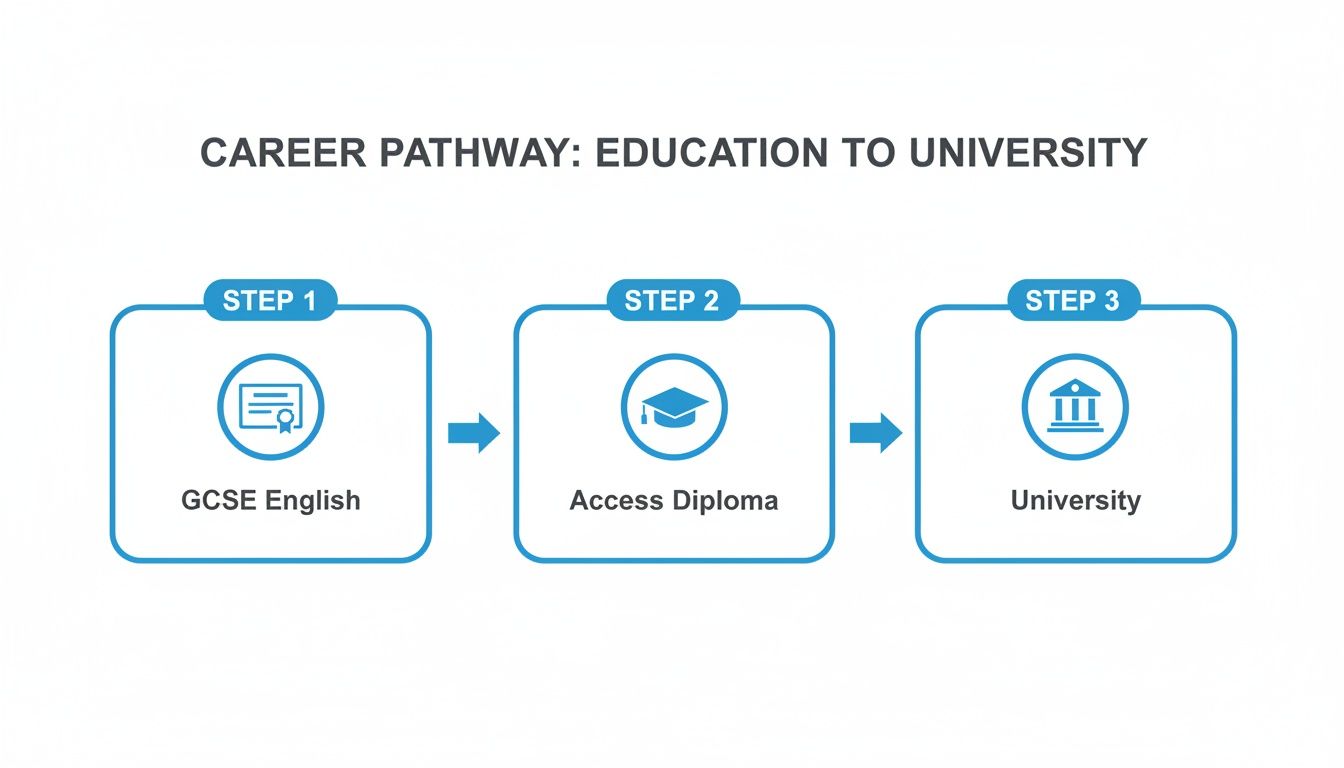
As you can see, finishing your GCSE is the vital first step that opens the door to an Access to HE Diploma, which in turn gives you a direct route to a university degree.
How to Choose the Right Online Course Provider
Picking the right provider for your GCSE English courses online is probably the most important decision you'll make. A good provider isn't just a faceless company that sends you a textbook; they're your partner in this, giving you the support and structure you need to actually get across the finish line. Get this choice right, and you’re setting yourself up for a qualification that universities and employers will respect.
Think of it like choosing a personal trainer. You wouldn't just go for the cheapest one you find online. You’d want someone with proper qualifications, glowing reviews, and a proven track record of helping people succeed. It’s the exact same logic here.
The world of online learning has exploded, which is great because it means you have plenty of choice. For example, some providers like NEC are reporting a 97.1% pass rate across their GCSEs, while others have helped over 10,000 students smash their grade goals with solid tutor support. This means you can find excellent courses from as little as £299 up to £699, making this goal feel much more within reach. If you want to get a feel for what's out there, you can explore the landscape of online GCSE courses in the UK.
Check for Official Accreditation
Okay, this is the big one. It’s completely non-negotiable. Your course provider absolutely must be Ofqual regulated. Ofqual, or The Office of Qualifications and Examinations Regulation, is the government body that signs off on all qualifications in England.
Accreditation is your guarantee that the certificate you earn at the end is legitimate and carries the same weight as one from a traditional school. Without it, you risk universities and employers not recognising your GCSE, which could make all your hard work for nothing. Before you even think about signing up, hunt for the Ofqual logo or a clear statement of accreditation on the provider’s website.
Ensure Alignment with Major Exam Boards
Your online course is the training ground, but the final exam is the main event. It's crucial that your course provider’s syllabus is built around one of the major, recognised exam boards, like AQA, Edexcel (Pearson), or OCR.
These are the very same exam boards that schools and colleges all over the country use. When a provider aligns with them, it means everything you study—from the poetry anthology to the style of exam questions—is perfectly matched to what you’ll face on the day. There will be no nasty surprises.
Evaluate the Quality of Tutor Support
When you're studying online, your tutor is your lifeline. They're your guide, your cheerleader, and the person you turn to when you're stuck. The quality of this support can genuinely make or break your entire experience.
As you look at different providers, be sure to ask some direct questions:
- Who are the tutors? Are they qualified teachers with real experience in teaching GCSE English?
- How can I reach them? Is it just email, or can you get them on the phone or a video call when you really need help?
- What's the feedback like? Do they just give you a grade, or do they provide proper, constructive feedback that helps you actually improve?
- How fast do they reply? When you’re stuck on an essay, how long will you be waiting for a response?
A great online provider invests in top-notch, accessible tutors. They know that personalised guidance is the secret sauce that helps adult learners build confidence and hit their target grades.
When you’re making enquiries, it’s also a good idea to ask about any available learning support and recommended assistive technology for dyslexia to make sure you'll have everything you need.
Look for a Clear Pathway to Your Next Step
Finally, find a provider that gets the bigger picture. For most people, a GCSE in English is a stepping stone to something bigger, like an Access to Higher Education (HE) Diploma that will open the door to university.
A provider that also offers these next-step qualifications understands the entire journey you’re on. They can offer a smooth transition from one course to the next and give you solid advice on what to do after your GCSE. It’s like finding an educational home where you can confidently move from one goal to the next, knowing you’re on a clear path to wherever you want to go.
Your Pathway from GCSE to a University Degree
Finishing your online GCSE in English is a huge achievement, but it’s really just the beginning. Think of it as the starting block for your entire academic and professional future. This qualification is the key that unlocks the next door, making those bigger ambitions feel realistic and within your grasp.For many adult learners, that next door is an Access to Higher Education (HE) Diploma. This is the most established and respected route to university for anyone who doesn't have traditional A-Levels. A GCSE in English at Grade 4 or above is a non-negotiable entry requirement for these diplomas, making it the essential first step on your journey.
From GCSE to Degree: The Proven Route
The pathway is clear and well-trodden. Earning your GCSE shows you have the foundational academic skills needed for more advanced study. This is your green light to enrol on an Access to HE Diploma, where you’ll gain the specialist knowledge and study skills required for your chosen degree.
This progression is at the heart of everything we do. We know your GCSE is part of a bigger plan, which is why we provide a seamless route from one qualification to the next.
Your ambition to get a degree is not just a dream; it’s a structured plan waiting to be put into action. Completing your GCSE is the first, most critical part of that plan.
Our support is designed for this exact journey. With flexible, interest-free payment plans, one-on-one guidance from dedicated tutors, and a wide range of career-focused Access to HE Diplomas, we are here to support you every step of the way.
We offer diplomas in high-demand fields such as:
- Nursing and Midwifery
- Health Professions
- Computer Science and Science
- Social Science and Business
Whether you dream of working in healthcare or technology, your path starts here. By choosing to study with us, you are not just signing up for a course; you are partnering with an institution that can guide you all the way from your GCSE English course online to your first day at university. Take that next step with confidence.
Frequently Asked Questions
Thinking about jumping back into education with an online GCSE English course can bring up a lot of questions, especially if it’s been a while since you were in a classroom. We get it. To help clear things up, we’ve answered some of the most common queries we hear from adult learners just like you.
Can I Really Succeed If I’ve Been Out of Education for Years?
Absolutely. This is probably the biggest worry we hear, but it’s one you can put to rest. Online courses are built from the ground up with adult learners in mind. The self-paced format means you can spend extra time on new concepts without the pressure of a classroom schedule breathing down your neck.
Think of your dedicated tutor as your personal guide. They’re there to give you one-on-one support, helping you build your confidence and get back into the swing of studying. It honestly doesn't matter if it's been five years or twenty; the course is designed to meet you exactly where you are today.
How Long Does It Take to Complete an Online GCSE English Course?
Most of our students wrap up their studies in about nine to twelve months, fitting in a few hours of study each week. We’ve found this timeline works really well around jobs, family life, and everything else you’ve got going on.
But the real beauty of learning online is that you're in the driver's seat. If you have more time to put in, you could finish sooner. If life gets hectic, you can ease off the accelerator. The course timeline adapts to you, not the other way around.
The most important thing is consistency. Even a few focused hours a week will keep you moving forward, ensuring you feel prepared and confident for your exams without getting overwhelmed.
Are Online GCSEs Accepted by All UK Universities?
Yes, they are. An online GCSE has the exact same weight and is recognised just like a qualification earned at a traditional school. What really matters is that the course provider is Ofqual-accredited and the certificate is awarded by a recognised exam board like AQA or Edexcel.
Universities and employers look for this official stamp of approval as a guarantee of quality. As long as your provider ticks these boxes, your online GCSE is a fully legitimate and respected qualification that opens doors to university and career opportunities.
What Happens If I Don’t Pass My Exam the First Time?
First off, it’s not the end of the world, and it’s important to know you have a safety net. A good provider won’t just leave you high and dry. Your tutor will sit down with you to go over your exam performance, pinpoint the areas that need a bit more work, and help you create a fresh revision plan.
You can then register to resit the exam at the next available opportunity, usually the following summer. Knowing you have another shot takes the pressure off and ensures that a temporary setback doesn't stop you from reaching your long-term goals.
At Access Courses Online, we know that your GCSE is the first crucial step on a much bigger journey. We provide the accredited qualifications and dedicated support you need to move seamlessly from your GCSE onto an Access to Higher Education Diploma and straight into university.
Ready to get started? Explore our courses and take the first step towards your future today.