
So, you’ve decided to become a midwife. It’s an incredible choice—a career that’s rewarding, deeply important, and always in demand. You’ll be supporting women and their families through one of the most profound moments of their lives.
But how do you actually get there? The journey requires dedication and a clear plan. Midwifery is a protected profession in the UK for good reason. The standards are incredibly high to ensure the safety and wellbeing of mothers and babies, which means your training will be a mix of intense academic study and hands-on clinical placements.
This guide is your roadmap. We’ll break down every step, from choosing the right course to understanding the finances, so you can start your journey with confidence. To become a registered midwife, you’ll first need to complete an approved pre-registration degree and then register with the Nursing and Midwifery Council (NMC).
Charting Your Course to a Midwifery Career
There isn’t just one single path into midwifery. Your route will really depend on your background, what qualifications you already have, and your personal circumstances. Getting to grips with the options early on is the key to planning your next steps without any stress.
Let's take a look at the main routes you can take.
At-a-Glance Midwifery Entry Routes in the UK
To give you a clearer picture, here’s a quick summary of the main pathways to becoming a qualified midwife in the UK. Each one is designed for people at different stages of their life and career.
| Route | Typical Duration | Best For |
|---|---|---|
| BSc (Hons) Midwifery Degree | 3 Years (Full-time) | School leavers with A-Levels or equivalent, or those with an Access to HE Diploma. |
| Postgraduate Diploma/MSc | 18-24 Months | Graduates with a relevant degree (e.g., adult nursing) looking to fast-track. |
| Midwifery Degree Apprenticeship | Approx. 3 Years | Individuals already working in a healthcare setting (e.g., as a Maternity Support Worker). |
Choosing the right path is your first big decision, so take some time to think about what works best for you.
Finding an Approved Programme
No matter which route you go for, the course must be approved by the Nursing and Midwifery Council (NMC). The NMC is the official regulator for all nurses and midwives in the UK, and you can only register and practise if you’ve graduated from one of their approved programmes.
The easiest way to check is by using the NMC's own search tool on their website. It lets you find every approved course across the country.
You can filter by location and qualification type, making it simple to find a recognised course that's convenient for you.
If you don't have traditional A-Levels, don't panic! An Access to HE Diploma is a fantastic and widely accepted route to meet university entry requirements. You can learn more about how Access courses help in pursuing a career in midwifery in our detailed guide. Getting this foundational knowledge is a brilliant way to prepare for the academic demands of a midwifery degree.
Choosing Your Midwifery Training Route
So, you're ready to take the first big step towards becoming a midwife. Brilliant. The path you choose now will shape your training over the next few years, so it's worth taking a moment to understand your options and figure out what fits best with your life, your background, and how you like to learn.
No matter which route you take, the end goal is the same: becoming eligible to register with the Nursing and Midwifery Council (NMC) and stepping onto the ward as a fully qualified midwife.
Every training programme must hit the high standards set by the NMC – they're the people who make sure every new midwife is skilled, competent, and ready for the realities of the job. Their Standards of Proficiency for Midwives are the blueprint for your education, blending deep academic knowledge with extensive, hands-on clinical placements. This is where you'll develop everything from clinical judgment to providing culturally sensitive care.
To give you a clearer picture, this decision tree maps out the two main pathways in the UK.
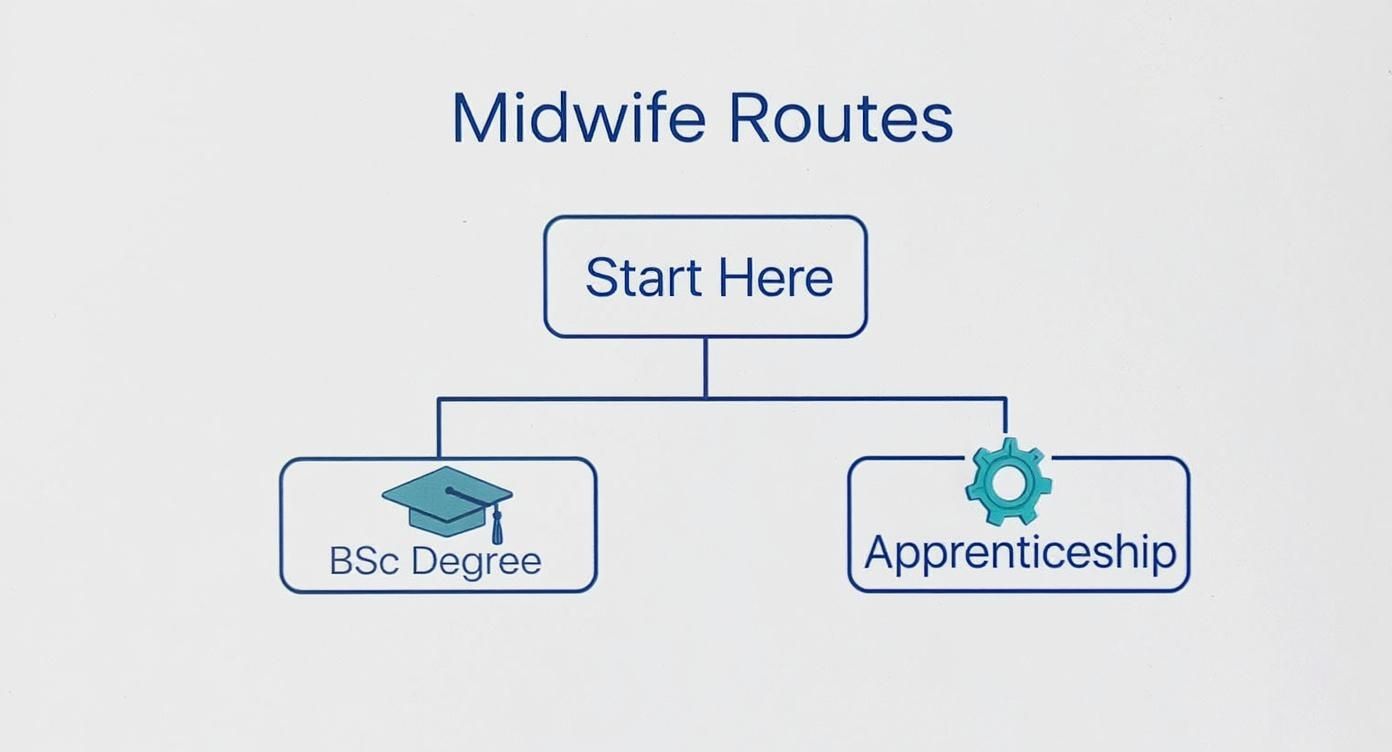
As you can see, both the traditional university degree and the work-based apprenticeship are solid options. They just cater to different people in different situations.
The Traditional University Degree: BSc (Hons) Midwifery
This is the most well-trodden path into the profession. A full-time Bachelor of Science (BSc) in Midwifery is a three-year course offered at universities all over the country.
Your time is split right down the middle. Around 50% is spent on campus, getting to grips with the theory, and the other 50% is spent in clinical placements. This blend is fantastic because it means you’re not just learning from textbooks; you're immediately applying that knowledge in real hospitals, birth centres, and community clinics.
This route is often a perfect fit for:
- School leavers who have the right A-Levels or other Level 3 qualifications.
- Mature students who’ve smashed an Access to Higher Education Diploma in Midwifery.
- Anyone who enjoys a structured academic setting and can commit to full-time study.
The Accelerated Postgraduate Route
Already got a degree in a related field, like adult nursing? You might be able to fast-track your training. A postgraduate course, usually a Postgraduate Diploma (PGDip) or a Master's (MSc) in Midwifery, can get you qualified in just 18 to 24 months.
These courses are intense. They essentially squeeze the entire midwifery curriculum into a shorter period, building on the knowledge you already have. It's a hugely popular option for registered nurses looking to add midwifery to their skillset – a move known as 'dual registration'.
A Real-World Example: Let's say you're an adult nurse who has spent the last few years on a busy surgical ward. A postgraduate midwifery course would let you use your existing clinical skills and understanding of the human body, focusing purely on pregnancy, birth, and postnatal care to qualify in as little as two years.
The Midwifery Degree Apprenticeship
This is a newer, increasingly popular way in. The Midwifery Degree Apprenticeship lets you earn a salary while you train, which is a game-changer for anyone who needs to keep working.
As an apprentice, you're employed by a healthcare provider (like an NHS Trust) and study for your degree part-time with a partner university. The bulk of your time will be spent working in a real clinical role, often as a Maternity Support Worker, putting what you learn in the classroom into practice straight away.
This pathway is particularly well-suited for:
- Existing healthcare support workers ready for the next step.
- People who learn best by doing, not just by reading.
- Career changers who can't afford to take three years out for full-time study.
Be aware, though – apprenticeship spots are like gold dust. They’re highly competitive, and you have to land the job with an employer before you can even start your training.
NHS Sponsored Training Programmes
Keep an eye out for these, as they do pop up from time to time. Some NHS Trusts or health boards offer sponsored training schemes. While they're less common, they can be an incredible opportunity, often providing financial support and a guaranteed job at the end of it all.
You’ll usually find these advertised directly on the NHS Jobs website. Each programme will have its own unique entry requirements and application process, but it’s a direct pipeline into a job with that specific NHS organisation.
Nailing the Entry Requirements
Once you’ve got a training route in your sights, the next step is to get granular and look at what universities and apprenticeship providers actually want from you. Getting a place on a midwifery course is notoriously competitive, so methodically ticking off the entry requirements is your next big task. It’s a combination of your academic background, your personal qualities, and a few practical checks.
The Academic Foundations for Midwifery
Pretty much every single midwifery degree in the UK has a non-negotiable baseline of GCSEs. Think of these less as a box-ticking exercise and more as proof that you have the fundamental numeracy and literacy skills needed for safe and effective practice.
Typically, you’ll need:
- GCSEs: At least five GCSEs at grade 4 (C) or higher.
- Core Subjects: Crucially, these must include English, Maths, and a Science subject (like Biology, Chemistry, or Combined Science).
It's a hard-and-fast rule. Without these core qualifications, your application simply won't get past the first hurdle, no matter what other qualifications you have. If you’re missing any, your first job is to get them sorted before you even think about applying.
Stepping Up to Level 3 Qualifications
With your GCSEs in the bag, you’ll then need a Level 3 qualification. This is what universities use to gauge whether you're ready for the academic demands of a degree.
The specifics can vary quite a bit between universities, but they usually ask for a certain range of UCAS tariff points. For example, one might ask for 120 UCAS points, while another might ask for specific grades in particular subjects.
What are UCAS Tariff Points?
UCAS points are just a way of turning your qualifications into a number, making it easier for universities to compare applicants. For instance, an A* at A-Level is worth 56 points, and so is a Distinction grade in a BTEC. It levels the playing field for students with different educational backgrounds.
So, what are the most common routes to get these points?
Comparing Level 3 Qualification Routes for Midwifery
The right Level 3 qualification for you really comes down to your personal circumstances and background. There’s no single "best" option, just the best option for you.
Here’s a quick look at how the main choices stack up against each other.
| Qualification | Key Features | Ideal Candidate Profile |
|---|---|---|
| A-Levels | The traditional academic route straight from school. Universities often like to see at least one science, usually Biology. | Perfect for a school leaver or someone who recently aced their A-Levels and is ready for university. |
| BTEC Extended Diploma | A hands-on, vocational qualification in Health and Social Care. It gives you practical knowledge that’s directly relevant. | A great fit for students who shine with coursework and practical tasks rather than exams, and already know healthcare is their goal. |
| Access to HE Diploma | Tailor-made for adults (19+) who are returning to education. Courses are laser-focused on subjects like midwifery. | The go-to for mature students, career changers, or anyone without traditional qualifications who wants a direct, respected path to uni. |
For many aspiring midwives who didn’t follow the straight-from-school A-Level path, the Access to Higher Education Diploma is, without doubt, the most effective and widely respected route to take.
A Closer Look: The Access to Higher Education Diploma
The Access to HE Diploma (Midwifery) is a qualification created specifically to get you ready for the challenges of a midwifery degree. It’s recognised and respected by universities everywhere and is designed to give you the exact knowledge and academic skills that admissions tutors are looking for.
These courses are intensive – you’ll usually complete one in just a year – and cover essential subjects like human biology, psychology, and professional healthcare practices. This targeted approach means you don’t just show up at university with the right points; you arrive with a solid grasp of the topics you’ll be diving into from day one.
The official body overseeing these diplomas, the Quality Assurance Agency for Higher Education (QAA), has a handy database where you can check for recognised courses.
Using the official Access to HE website lets you confirm that a course provider is legit, so you can be confident your hard-earned qualification will be accepted by universities across the UK.
Proving You’re the Right Person for the Job
Of course, grades are only one piece of the puzzle. Midwifery is a profession built on empathy, resilience, and trust. Your application, personal statement, and interview are all designed to see if you have these essential personal qualities.
Alongside your academic achievements, you'll also have to pass a few practical checks:
- DBS Check: A Disclosure and Barring Service (DBS) check is mandatory. It’s to ensure you’re safe to work with vulnerable adults and children, and your university will organise this for you.
- Occupational Health Screening: You’ll have a health check to make sure you’re physically and mentally ready for the demands of the training and the job itself.
- Relevant Experience: While it’s not always a formal requirement, getting some experience in a healthcare or caring setting is absolutely invaluable. It proves your commitment and gives you real-world insights to talk about in your application.
Volunteering at a local children’s centre, working as a healthcare assistant, or even helping out at a breastfeeding support group can give you powerful evidence to show you’re right for this career. These experiences demonstrate you truly understand what it means to care for others.
Crafting a Standout Application and Interview
Getting an application right is your first big step towards an interview place. In a field as competitive as midwifery, every single detail matters. Think of your UCAS application not just as a list of grades, but as the very first introduction to the person behind the paper – it's your chance to show admissions tutors why you’re so committed to this incredible profession.

As you start pulling everything together, it’s worth looking at general best practices when submitting nursing school applications, as many of the core ideas overlap. The real goal here is to prove you have a genuine, well-researched understanding of what being a midwife truly involves.
Writing a Compelling Personal Statement
Your personal statement is the absolute heart of your application. This is where you bring it all together, connecting your qualifications and life experiences to the qualities that make an excellent midwife. It has to feel authentic, reflective, and completely focused on your passion for the role.
Don't just list what you've done. Instead, talk about what you learned. For example, that volunteering gig at a local children’s centre wasn't just about childcare; it was about learning to communicate with anxious parents and understanding the power of a calm, reassuring presence in a stressful situation.
To make your statement truly memorable, concentrate on these key areas:
- Motivation: Why midwifery? What was that lightbulb moment or specific experience that made you certain this was the career for you?
- Insight: Show that you get the reality of the job – the tough shifts, the emotional rollercoaster, and the immense responsibility that comes with it.
- Reflection: Link your experiences, whether it’s healthcare work or a customer service role, back to the core values of midwifery.
- Skills: Use real examples to highlight your transferable skills, like communication, empathy, resilience, and teamwork.
For a deeper look at how to structure your story, have a read of our guide on how to write a personal statement that will grab an admissions tutor’s attention.
A memorable personal statement tells a story. It should weave together your experiences and insights to paint a picture of a compassionate, resilient, and dedicated individual who is ready for the rigours of midwifery training.
Preparing for the Midwifery Interview
If you’ve secured an interview, that’s a massive achievement in itself. Well done! These days, most universities use a Multiple Mini Interview (MMI) format. Forget the idea of a single long chat; this is a series of short, timed stations, each with a different scenario or question.
The MMI style is designed to see more than just your academic knowledge. Tutors want to see how you think on your feet, your approach to ethical problems, and how well you communicate under a bit of pressure.
You could come up against a real variety of stations, such as:
- Scenario-based questions: "A patient is refusing a procedure you've recommended. What do you do?"
- Ethical dilemmas: Talking through issues around consent, patient autonomy, or confidentiality.
- Role-playing: Interacting with an actor playing the part of a service user or a worried family member.
- Teamwork tasks: Being asked to work with other candidates to solve a simple problem.
Demonstrating Your Knowledge and Values
Throughout your interview, you need to show you really understand the professional world you’re aiming to join. That means getting familiar with the core principles that underpin all healthcare in the UK.
A solid grasp of the NHS Constitution is non-negotiable. Be ready to talk about its core values – things like respect, compassion, and a commitment to quality of care. These aren't just buzzwords; they are the absolute foundation of midwifery practice.
You should also be comfortable with the 6 Cs: Care, Compassion, Competence, Communication, Courage, and Commitment. Try to think of examples from your own life that show these values in action. When did you show courage to speak up for someone? How have you shown commitment to a really challenging task?
By grounding your answers in these frameworks, you’re showing the interview panel that you're not just passionate about babies – you’re serious about providing professional, high-quality, person-centred care.
Funding Your Training and Life as a Midwife
Deciding to become a midwife is a huge, exciting step. But let's be honest, one of the first questions on your mind is probably: "How on earth will I afford it?" It's a valid concern, but the good news is there's a solid support system in place to help you manage the financial side of things, so you can focus on your training.

For most student midwives in England, the main source of help comes from the NHS Learning Support Fund (LSF). The best part? It's not a loan, which means you don’t have to pay a penny back. Think of it as a support package to help with the costs of studying and getting to your clinical placements.
Understanding the NHS Learning Support Fund
The LSF is a real game-changer for many aspiring midwives, providing several streams of non-repayable funding that can make a massive difference to your finances while you study.
Here’s a breakdown of what’s included:
- Training Grant: A yearly payment of £5,000 for all eligible new and continuing midwifery students.
- Parental Support: An extra £2,000 a year if you have at least one dependent child under 15 (or under 17 if they have special educational needs).
- Travel and Dual Accommodation Expenses (TDAE): This lets you claim back extra travel and temporary accommodation costs you rack up during clinical placements.
- Exceptional Support Fund: A grant of up to £3,000 per academic year for students who find themselves in unexpected and severe financial hardship.
These grants are designed to sit alongside your main student finance, giving you a crucial buffer to help cover the day-to-day costs of living while you learn.
Covering Tuition and Living Costs with Student Loans
On top of the NHS LSF, you’ll also need to apply for a standard student loan through Student Finance England (or the equivalent body in Scotland, Wales, or Northern Ireland). This is split into two parts.
First is the Tuition Fee Loan. This covers the entire cost of your course fees—usually around £9,250 a year—and is paid straight to your university, so you never have to worry about handling that money yourself.
Then there’s the Maintenance Loan, which is there to help with your living costs like rent, bills, and food. The amount you get is based on your household income and where you’ll be living and studying. For a really detailed look at financing your studies, especially if you're returning to education, check out our ultimate guide to Access to Higher Education funding.
A Realistic Look at the Midwifery Profession
Getting your funding sorted is a huge piece of the puzzle, but it’s just as important to have a clear-eyed view of what life as a midwife is really like. It's an incredibly rewarding role, but it's also intense and demanding, calling for a unique blend of clinical skill, emotional resilience, and endless compassion.
You'll be there for families during their most vulnerable and transformative moments. That means working long, often unsociable hours—nights, weekends, and holidays are all part of the job. Shifts can be emotionally charged, and you’ll learn to navigate everything from beautiful, straightforward births to complex, high-risk situations and heartbreaking losses.
The real reward of midwifery is the profound connection you build with families. It's about empowering women, building their confidence, and providing a safe, supportive presence during one of the most significant experiences of their lives.
Despite the challenges, the career offers fantastic progression. You can specialise in areas like public health, sonography, or perinatal mental health. Experienced midwives often move into leadership, research, or education, shaping the future of maternity care.
The demand for skilled midwives is consistently high. As of March 2025, there were 46,606 midwives registered with the NMC in the UK, a 5.6% increase from the previous year. However, organisations like the Royal College of Midwives (RCM) have raised concerns about burnout and retention, highlighting the need for better support in the workforce to keep maternity services safe and sustainable. You can dive deeper into these trends by reading the full NMC registration data report. Understanding this context is vital as you prepare to enter this incredible profession.
Got Questions About Becoming a Midwife? We've Got Answers
Thinking about becoming a midwife is exciting, but it's a path that can feel full of questions and unknowns. It’s a very competitive and demanding career, so it’s completely natural to wonder where you fit in and what your next steps should be. We get asked a lot of the same questions by aspiring midwives, so we've put them all in one place to give you some clarity.
A huge part of your training will be academic, and it's definitely a step up. You'll need to get to grips with the latest research to inform your practice. A great way to get ahead of the curve is to learn how to read scientific papers effectively. Honestly, this skill will be invaluable from your first day at uni right through your career.
With that in mind, let's get into the nitty-gritty.
Can I Become a Midwife Without A-Levels?
Yes, you absolutely can! This is probably the number one question we hear, especially from people looking to change careers or return to education after a break. While A-Levels are the standard route for many school leavers, they are far from the only path into a midwifery degree.
The most common and widely accepted alternative is an Access to Higher Education Diploma. Think of it as a Level 3 qualification specifically designed for adults who want to get to university. A diploma in Midwifery or a related subject like Health and Social Care gives you both the UCAS points and the foundational knowledge universities are looking for.
Other qualifications they might consider include:
- A BTEC Extended Diploma in a relevant subject, like Health and Social Care.
- Foundation Degrees in a related healthcare field.
- Scottish Highers/Advanced Highers.
It's always smart to check the specific entry requirements on each university's website, as they do vary. But time and again, the Access to HE Diploma proves to be the most direct and respected route for those without A-Levels.
Is There an Age Limit to Train as a Midwife?
Nope, not at all. There is absolutely no upper age limit to start your midwifery training in the UK. In fact, mature students are often exactly what universities are looking for and are seen as a massive asset to the profession.
Admissions tutors know that life experience brings skills that you just can't teach in a classroom. Things like resilience, emotional maturity, and brilliant communication skills are often much more developed in older applicants. As long as you can meet the academic and health requirements of the course, your age is a strength, not a weakness.
Don't forget: Your life experience is a huge plus. Whether you've raised your own family, managed a coffee shop, or worked in an office, you bring a unique perspective that can make you a more grounded and empathetic midwife.
How Competitive is Midwifery, Really?
Okay, let's be honest: getting a place on a midwifery course is tough. It’s incredibly popular, and universities always have far more applicants than they have places. For some of the top unis, you could be looking at 10 or more applications for every single spot.
So, what does it take to stand out from the crowd?
- Strong Academics: You've got to meet, or even better, exceed the grades they're asking for.
- Real-World Experience: Getting some hands-on experience in a caring role is non-negotiable. This could be paid work as a Healthcare Assistant or volunteering at a local children's centre or a breastfeeding support group.
- A Killer Personal Statement: Your statement has to do the heavy lifting. It needs to show you have a deep, realistic understanding of what a midwife actually does, reflect on your own experiences, and scream commitment to the core values of the NHS.
Getting in comes down to being methodical and truly dedicated in your preparation. Think of the application process as your very first test of commitment to this amazing, challenging, and incredibly rewarding career.
At Access Courses Online, we specialise in helping people just like you get the qualifications needed to secure that coveted university place. Our flexible, online Access to HE Diploma (Midwifery) is designed to fit around your life, giving you a direct and respected path to achieving your dream.