
You might be reading this after years of putting the idea aside.
Maybe you left school without A-levels. Maybe university never felt possible at the time. Maybe you've built a working life, raised a family, changed direction once already, and still keep coming back to the same thought: I'd love to teach.
That thought matters. It also isn't unrealistic.
A lot of adults assume there's only one way into teaching in the UK. Get a degree first, then train, then apply. For some people, that is the route. But it isn't the only one. If you're trying to work out how to become a teacher without a degree, the main challenge isn't lack of potential. It's that the system uses lots of different terms, routes, and entry points, and that can make the whole thing feel harder than it is.
The good news is that there are genuine pathways open to adults without traditional qualifications. Some let you start working in education straight away. Some help you build the qualifications you need first. And some lead to recognised teaching status without a prior university degree, especially in further education.
What helps most is breaking it into stages.
Think of this as a roadmap, not a leap. First, get close to the classroom. Then build the qualifications that open doors. Then choose the training route that fits the kind of teacher you want to become. When you look at it that way, teaching stops feeling like a closed profession and starts looking like a plan.
Your Dream of Teaching Is Closer Than You Think
If you've ever said, “I'd be a teacher if I had the right qualifications,” you're not alone. Many adults rule themselves out before they've checked what routes exist.
That usually happens for understandable reasons. School might not have gone well. You may have needed to work instead of study. You might have believed that missing one step at 18 meant missing the whole path forever. Teaching can seem especially closed off because people often talk about it as if everyone followed the same route.
They didn't.
There are people in schools and colleges who arrived there after careers in care, retail, construction, administration, the military, early years, and office work. What they had in common wasn't a perfect academic history. It was a willingness to build from where they were.
You haven't missed your chance. You may just need a different starting point.
If you're wondering how to become a teacher without a degree, it helps to separate two very different goals:
- Working in education soon so you can gain experience, confidence, and income.
- Becoming fully qualified through the route that matches the setting you want to teach in.
Those are connected, but they're not the same thing. You don't need to solve your entire future this week. You need to choose your next sensible step.
For some people, that step is applying for a Teaching Assistant job. For others, it's getting the GCSE-equivalent skills or Level 3 study they need. For others, especially those interested in teaching post-16 learners, there's a more direct route through further education.
The important thing is this. Your age, your previous job, and the fact you didn't take the usual route don't automatically count against you. In teaching, life experience often helps. Patience helps. Reliability helps. So does knowing how to explain things clearly, stay calm under pressure, and encourage people who doubt themselves.
Those are teaching strengths already.
First Steps Into the Classroom Without a Qualification
Before you think about formal teacher training, spend time in the environment where you want to work. That gives you two things straight away. It helps you decide whether school or college life suits you, and it gives you the practical experience that many later routes ask for.
Teaching Assistant roles
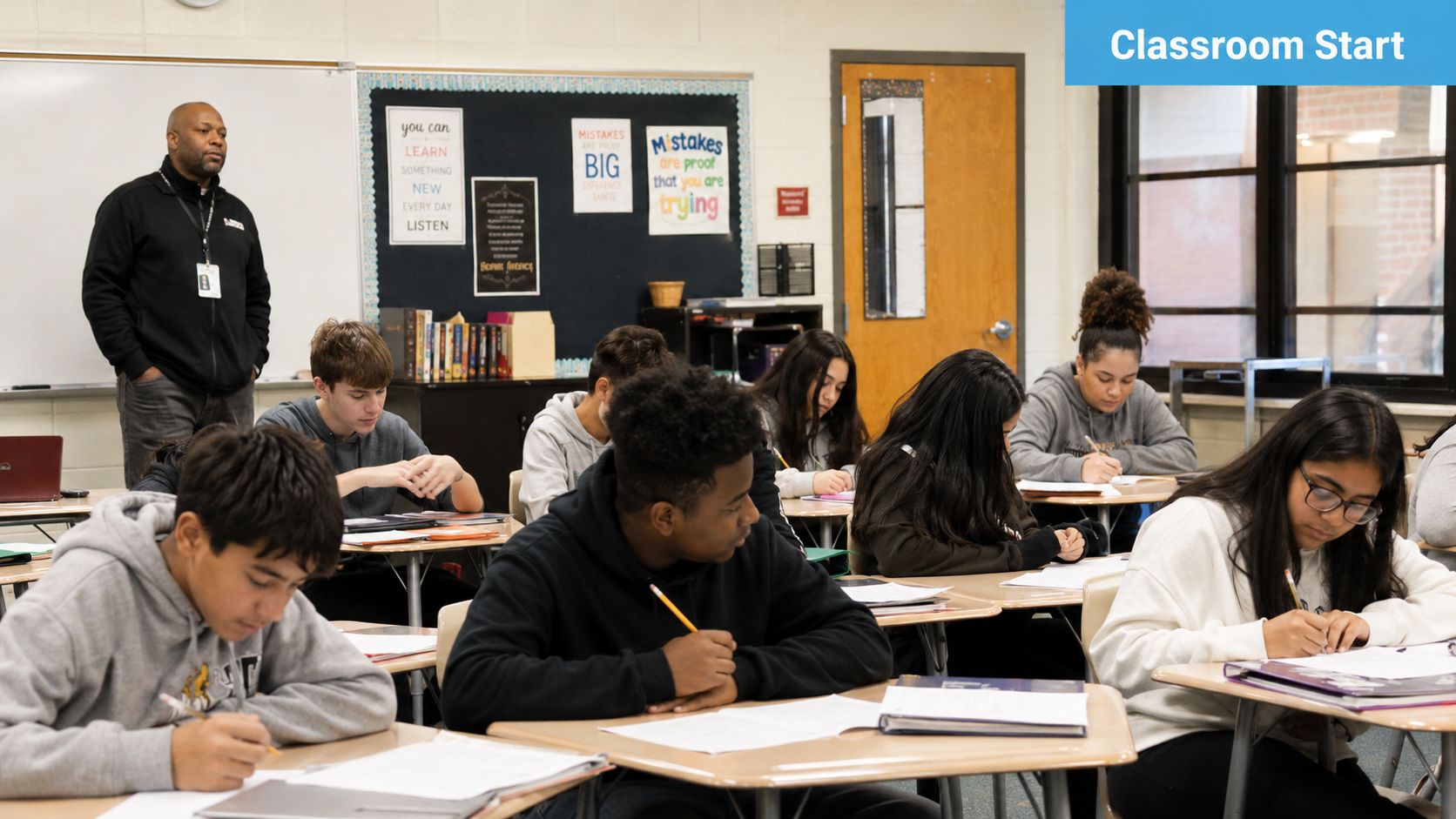
A Teaching Assistant, often shortened to TA, is one of the most realistic entry points. You support the class teacher, help pupils stay focused, work with small groups, and sometimes give one-to-one help to learners who need extra support.
This role teaches you the part of education that job adverts don't always show. You learn how lessons flow, how behaviour is managed, how teachers adapt tasks, and how much quiet organisation sits behind a calm classroom.
If you're new to the sector, a TA role also helps you build language for future applications. Instead of saying “I like helping children,” you can point to actual tasks you've done: supporting reading, supervising interventions, recording progress, preparing resources, or working with pupils with SEND.
A practical starting point is to look into a Level 3 online Teaching Assistant course if you want a structured way to build confidence before applying.
Cover Supervisor work
A Cover Supervisor usually steps into a classroom when the teacher is absent. You won't normally plan the lesson from scratch, but you'll supervise the class, explain the set work, keep pupils on task, and manage behaviour.
This role can feel more intense than TA work because you're in front of the room. That's also why it's useful. You quickly find out how comfortable you are leading a group, giving instructions, and handling disruption.
Schools often value candidates who are steady, punctual, and able to communicate clearly. If you've worked in customer-facing jobs, youth work, coaching, care, or team leadership, you may already have more transferable experience than you think.
Practical rule: Don't wait until you feel “teacher-like” before applying for classroom support roles. Experience is what helps you grow into the role.
Private tutoring and small-group support
Tutoring is another strong first step, especially if you're confident in a subject. It shows that you can explain ideas, adapt to different learners, and build trust. That matters whether you later want to teach children, teenagers, or adults.
Tutoring can be formal or informal:
- Local tutoring: Helping pupils with reading, maths, or revision in your area.
- Online tutoring: Supporting learners remotely around your current job.
- Community support: Volunteering with homework clubs, youth groups, or adult literacy settings.
If your long-term goal is teaching, tutoring also strengthens your understanding of how people learn. You start noticing where they get stuck, what explanations work, and how motivation changes from one learner to the next.
What schools want to see early on
Early applications don't need to prove you can do everything. They need to show that you understand the environment and will take the role seriously.
A good early profile usually includes:
- Reliability: Schools need people who turn up, follow procedures, and communicate clearly.
- Calmness: Pupils respond well to adults who stay steady.
- Willingness to learn: You don't need all the answers. You do need to take feedback well.
- Awareness of behaviour support: Even before formal training, it helps to understand how teachers create positive learning environments.
If you can get into a school in any of these roles, you're no longer standing outside the profession wondering. You're building evidence, references, and confidence from the inside.
Building Your Foundation with an Access to HE Diploma
For many adults, this is the step that changes everything. If your earlier qualifications aren't enough for teacher training, an Access to Higher Education Diploma can bridge the gap between where you are now and the level of study you need next.
An Access to HE Diploma is designed for adults returning to education. It gives you a recognised Level 3 route into higher-level study and helps you prove that you're ready for academic work, even if school was a long time ago.
For aspiring teachers, that matters because some routes don't just want commitment. They want evidence that you can cope with coursework, reflect on practice, and meet entry requirements for further training.
Why this qualification matters so much
If your goal is state primary or secondary teaching and you don't already have a degree, one of the most viable alternatives is the Teaching Assistant to Teacher conversion route via the assessment-only QTS pathway. According to this guide to becoming a teacher without A-levels, it typically takes 12 weeks and requires 24 weeks of prior teaching experience in two contrasting schools. The same source says candidates need GCSEs or equivalent at grade C/4 or above in English and Maths, and they often need an Access to Higher Education Diploma (Level 3) to meet university entry requirements for teacher training programmes.
That's why an Access course isn't just another qualification to collect. It can be the qualification that makes later applications possible.
If you want a clearer overview of what this route involves, this guide to the Access to HE Diploma is a useful starting point.
Why adults often do better than they expect
Adults often worry they've “forgotten how to study”. In practice, many returners bring strengths they didn't have at school. They manage time more carefully. They ask better questions. They understand why they're studying, which makes motivation steadier.
Access courses are especially helpful if you need something flexible around work or caring responsibilities. Online study can give you space to build momentum without reshaping your whole life at once.
Common reasons adults choose this route include:
- They need a recognised Level 3 qualification for progression.
- They want a structured restart rather than trying to piece everything together alone.
- They need flexibility because full-time classroom study isn't realistic.
- They want confidence before applying for more competitive teaching pathways.
What you'll build beyond entry requirements
An Access course does more than tick an admissions box. It helps you practise the habits that teacher training demands later.
You'll usually need to get comfortable with:
- Academic writing: Explaining ideas clearly and using evidence properly.
- Independent study: Planning your own time and keeping up with deadlines.
- Critical thinking: Comparing viewpoints rather than memorising facts.
- Resilience: Finishing work even when life is busy.
That matters because teacher training involves paperwork, reflection, observation, and professional communication. The learners who cope best aren't always the ones with the easiest educational past. They're often the ones who've rebuilt their confidence step by step.
Here's a short explainer if you want to see how online study is typically presented to returning adults:
Returning to study doesn't mean going backwards. It means building the qualification that opens the next door.
If you're feeling overwhelmed, focus on sequence. You do not need to become a teacher all at once. You need to become eligible for the next stage.
Choosing Your Path to Qualified Teacher Status QTS
Once you've built your foundation, the next question is which route towards Qualified Teacher Status, or QTS, fits you best for state school teaching. At this point, many adults get stuck, because several pathways sound similar but work very differently in practice.
Some are more academic. Some are more school-based. Some combine work and training. The right choice depends on how you learn, what qualifications you already hold by that point, and whether you need to earn while progressing.
The main options side by side
| Pathway | What It Is | Best For | Entry Requirements (Post-Access Course) |
|---|---|---|---|
| University-led teacher training | Training delivered through a university, with school placements built in | Learners who want a structured academic framework and formal study support | Usually suitable for people who have progressed to the qualifications needed for teacher training after completing earlier foundation study |
| School-led training such as SCITT | Training based mainly in schools, with practical classroom experience at the centre | Career changers and hands-on learners who want to train in a school environment | Usually requires meeting provider entry requirements after completing the necessary prior qualifications |
| Assessment-only QTS | A route for people who can already prove they meet the Teachers' Standards through existing teaching practice | Experienced school staff already doing substantial teaching work | Best suited to candidates with strong classroom evidence and the required prior experience and qualifications |
| Teaching apprenticeship routes | A work-based route where training is combined with progress towards formal qualification | People who want employed learning and can meet the provider's starting requirements | Entry points vary, and applicants need to check provider expectations carefully |
University-led training
This route suits people who want a clearer academic structure. You'll usually get taught sessions, placement support, written assignments, and a framework that feels closer to formal study.
That can be reassuring if you've returned to education through an Access route and discovered you like having clear milestones, tutor feedback, and scheduled assessment. If you learn well through reading, discussion, and reflective writing, this option may feel steadier.
School-led training such as SCITT
A School-Centred Initial Teacher Training route, often called SCITT, is more immersed in day-to-day school life. You learn on placement and spend a lot of time seeing how experienced teachers run classrooms.
This can be a strong fit if you already know you enjoy school culture and want practical learning from the start. It often appeals to people who've already worked as TAs, cover supervisors, or unqualified classroom staff.
Choose the route that matches how you learn under pressure, not the one that sounds most prestigious.
Assessment-only QTS
For some adults, this appears to be a fast route and the obvious answer. It isn't a beginner route. It's for people who can already show they meet the standards through their existing work.
That means your evidence matters. Your lesson observations, planning, practice across settings, and professional references all carry weight. If you're still at the very start, this is usually something to work towards rather than apply for immediately.
The apprenticeship question
Teaching apprenticeships cause a lot of confusion. Many people hear “earn while you learn” and assume this means a completely degree-free entry from day one.
The picture is less clear than people often think. A video discussing teaching degree apprenticeships highlights the problem well. It notes that videos often claim you can work and earn while completing a degree apprenticeship and eventually gain your degree, but it also points out that no UK government source clearly explains whether these apprenticeships are indeed degree-free starts for adults with limited qualifications. The Department for Education is described as saying you can “gain QTS alongside a bachelor's”, which still leaves applicants needing to check whether providers accept GCSE-only entrants or expect prior Level 3 study.
That uncertainty is important. If you're researching how to become a teacher without a degree, don't assume the word “apprenticeship” automatically means no prior study is needed.
A helpful next read is this overview of routes to university for aspiring teachers without A-levels, which can help you think about the stage before formal teacher training.
A simple way to choose
Ask yourself these questions:
- Do I want more academic structure or more workplace immersion?
- Am I already teaching enough to evidence the standards, or am I still building experience?
- Do I need a route with earnings built in, even if entry requirements are less straightforward?
- Would I cope better with university support or school-based mentoring?
There isn't one perfect route for everyone. There is a route that fits your current reality better than the others.
The Direct Route Teaching in Further Education QTLS
If your interest is teaching older learners, this may be the route that answers your question most directly. Further education, often shortened to FE, includes colleges and training providers working mainly with post-16 students and adult learners.
This part of the sector works differently from state primary and secondary teaching. In FE, a prior university degree isn't always required if you take the right qualification route.
The qualification that opens this route
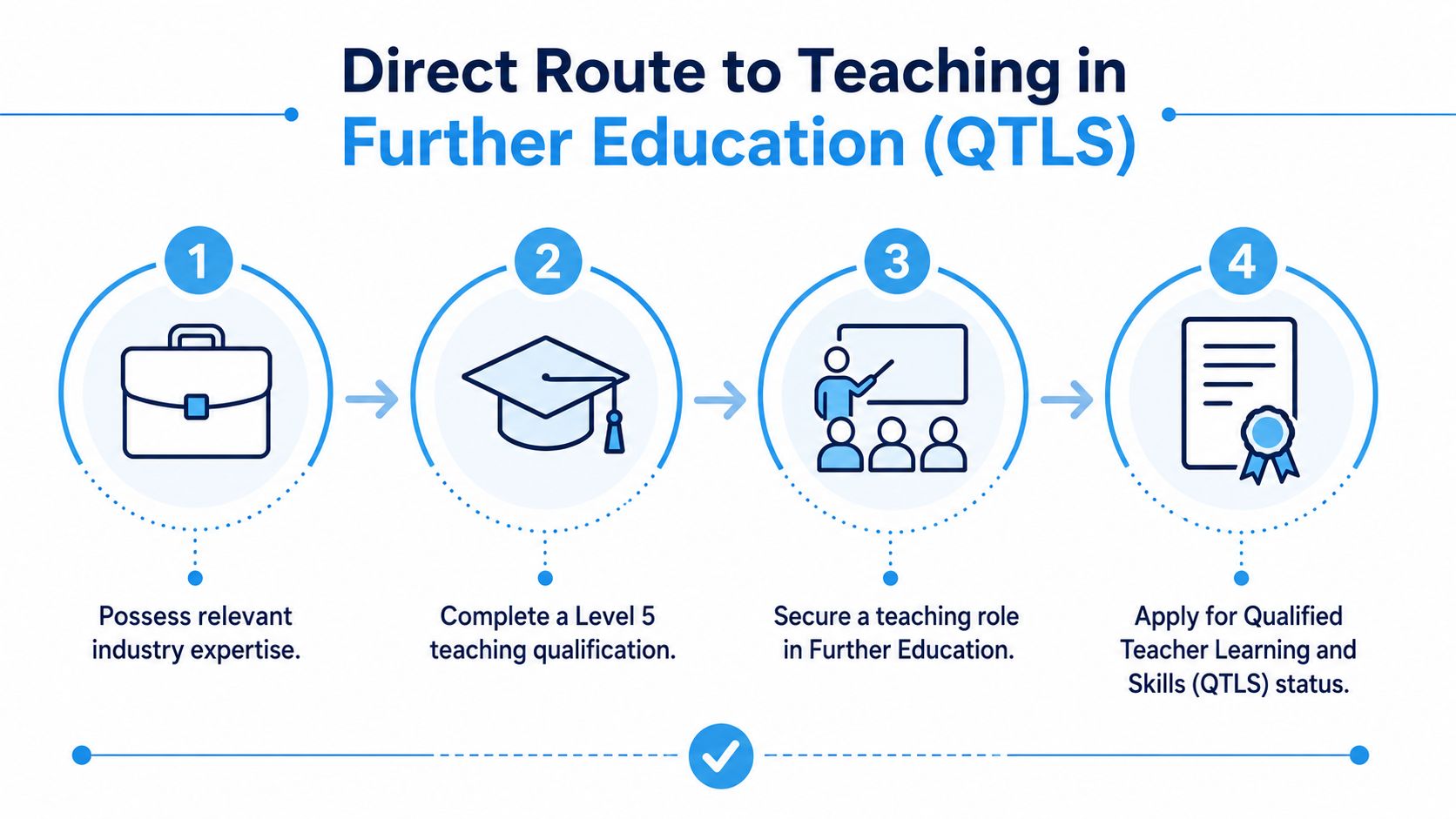
According to Indeed's guide on becoming a teacher without a degree, people in the UK can become qualified teachers in the further education and skills sector by completing the Level 5 Diploma in Education and Training, often shortened to DET. That route requires a minimum of 100 hours of teaching experience and Level 2 proficiency in maths and English as foundational prerequisites. The same source states that the qualification can take between 12 and 24 months to complete, is also known as CertEd or PCE when studied through universities, and can lead to registration for Qualified Teacher Learning and Skills, or QTLS, which has official parity with QTS for post-16 education roles. It also notes that over 300 UK colleges offer the DET annually.
This route makes particular sense if you have vocational or industry experience and want to teach what you know to young adults or adult learners.
Who this route suits well
FE can be a strong fit for people who want to teach:
- Vocational subjects, such as business, health-related topics, trades, or technical areas
- Adult learners, including returners and reskilling professionals
- College students in the post-16 sector
- Skills-based courses where industry knowledge carries real value
If you've worked in a field for years, that background may be a genuine advantage. Colleges often value teachers who understand the workplace side of the subject as well as the teaching side.
A practical way to think about QTLS
For some readers, QTLS is unfamiliar and that can make it sound less secure than QTS. In FE, it isn't a second-rate option. It is a recognised professional route for post-16 teaching.
If your goal is to teach in colleges or the wider further education sector, QTLS is a serious and respected destination, not a fallback.
This is one of the clearest answers to how to become a teacher without a degree in the UK. It doesn't remove the need for training, effort, or teaching practice. But it does mean there is a real degree-free pathway into qualified teaching for the right setting.
Preparing Your Application and Taking the Next Step
Once you've chosen your likely route, the final challenge is action. That usually means applying for school-based roles, arranging experience, gathering documents, and writing about yourself in a way that feels honest but confident.
This part often makes adults nervous. They worry they look too old, too inexperienced, too academic, or not academic enough. Most applications improve when you stop trying to sound impressive and start sounding specific.
Writing a strong personal statement
The best personal statements don't pretend your journey was conventional. They explain why your background makes sense for teaching now.
Focus on evidence like this:
- Relevant experience: Classroom support, tutoring, youth work, coaching, mentoring, care work, or training others at work.
- Subject interest: Why you want to teach that age group or subject area.
- Transferable strengths: Communication, organisation, patience, leadership, or calm behaviour management.
- Real motivation: A grounded reason for changing direction, not a dramatic one.
A stronger statement says, in effect, “Here is what I've done, here is what I learned from it, and here is why I'm ready for the next stage.”
Arranging school experience
If you're not already working in education, try to spend time in a relevant setting. Even a short period of volunteering can help you confirm your direction and give you something concrete to discuss at interview.
Useful places to explore include:
- Primary schools if you want younger age groups
- Secondary schools if you want subject teaching
- Further education colleges if post-16 feels like the better fit
- Community learning settings if you're interested in adult education
Keep notes while you're there. Write down what you observed, what surprised you, and what skills teachers used. Those details make future applications much stronger.
Understanding the DBS check
A DBS check is a background check used for roles involving children or vulnerable people. Schools and colleges usually explain the process clearly once you reach the right stage, but it helps to know the basics.
In simple terms:
- It checks relevant criminal record information
- It helps employers make safer recruitment decisions
- It's a normal part of working in education
- You usually complete it as part of employment or placement processes
It isn't something to panic about. It's an ordinary safeguarding requirement.
Keep a folder for your teaching journey. Save references, dates of experience, certificates, application drafts, and notes from school visits. Small admin habits make later applications much easier.
A checklist you can act on this week
- Choose your first target: TA role, cover work, tutoring, or FE teaching exploration.
- Check your current qualifications: Especially English and Maths.
- Research the missing step: Access course, classroom experience, or teaching qualification.
- Update your CV: Emphasise responsibility, communication, and work with people.
- Contact local settings: Ask about vacancies, volunteering, or work experience.
- Start recording evidence: Keep notes on every relevant role and responsibility.
If teaching still feels right after that, you're no longer only thinking about it. You're in motion.
If you need a flexible route back into study before teacher training, Access Courses Online offers accredited online Access to Higher Education Diplomas designed for adults who want a practical way into university-level progression. It's a strong option if you're balancing work, family, and the goal of building qualifications that can move you towards teaching.