

Think of critical thinking as a mental toolkit. It’s not about memorising facts or having all the answers right away. Instead, it’s about knowing how to take information apart, look at it from all angles, and build a solid, well-reasoned conclusion. It’s the art of questioning assumptions, analysing information without bias, and weighing up the evidence before you decide what to believe.
This guide will give you practical, real-world strategies to build this muscle—because that's what it is, a skill that gets stronger with practice.
Why Critical Thinking Is Your Most Valuable Skill Today
In a world that’s constantly throwing information at us, the ability to think clearly has become non-negotiable. It’s no longer a skill reserved for academics or philosophers; it's essential for navigating everyday life. From making smart career moves to understanding complex news stories, your ability to analyse situations logically will set you up for success.
It’s no surprise that this is one of the top skills for the future that employers are desperate to find. Why? Because people who think critically are natural problem-solvers. They’re adaptable, can see through a weak argument, and aren’t easily fooled by misinformation—all of which leads to better decisions and better results.
Navigating a World of Misinformation
The sheer volume of misinformation out there really brings home why these skills are so vital. Take the UK education system, for example. We’re seeing a massive gap in students' ability to spot fake news. While 85% of UK children know misinformation exists, very few feel equipped to actually identify it. It’s a serious issue when nearly half of UK teachers say their students regularly misinterpret news events, prompting the government to update the curriculum.
And this isn't just a problem for young people; it affects all of us. Without a solid framework for evaluating what we read online, we leave ourselves vulnerable to making poor decisions—with our finances, our health, and our careers—all based on shaky information.
Critical thinking is essentially the art of asking the right questions. It trains your mind to move past the surface-level information and explore the underlying assumptions, evidence, and logic that support any claim.
The Foundation of Effective Learning
If you’re an adult learner, especially one jumping back into education with an Access to HE course, critical thinking isn’t just a nice-to-have—it's the bedrock of your studies. University isn’t about regurgitating facts from a textbook. You’ll be expected to dissect theories, challenge established ideas, and build your own arguments from the ground up. Honing these skills now will prepare you for the academic rigour ahead and make sure you get the absolute most out of your course.
This guide is designed to strip away the jargon and show you exactly how to build these foundational skills. We’ll focus on what I call the four pillars of critical thinking.
Think of these as the core components that form the bedrock of clear, reasoned thinking.
The Four Pillars of Critical Thinking
| Pillar | What It Means in Practice |
|---|---|
| Questioning | Actively challenging assumptions and looking beyond the obvious. |
| Analysis | Breaking down complex information into smaller, manageable parts. |
| Evaluation | Assessing the credibility, relevance, and logic of evidence and arguments. |
| Inference | Drawing well-reasoned conclusions based on the evidence you have analysed. |
By mastering these four pillars, you’ll develop a powerful way of thinking that will serve you not just in your studies, but in your career and your everyday life too. Let's get started.
Mastering the Art of Questioning and Analysis
To really get good at critical thinking, you need to stop passively accepting information and start actively questioning it. It’s a shift in mindset. You're no longer a sponge, soaking everything up. Instead, you're a detective, carefully taking information apart to get to the truth.
This means training yourself to ask the kind of probing questions that cut right to the heart of an issue. Instead of just glancing at a headline, you start to ask, "Who's behind this? What’s their angle? What are they not telling me?" It fundamentally changes how you see the world.
Using the 5 Whys to Uncover Root Causes
One of the most powerful—and simplest—tools for this is the 5 Whys technique. It was originally developed for manufacturing, but it's brilliant for everyday problem-solving. The idea is simple: when you're faced with an issue, just ask "Why?" five times (or more) to peel back the layers and find the real root cause, not just the obvious symptom.
Let's try it with a scenario you might face while studying for an Access to HE course.
- Problem: I didn't get this week's assignment done on time.
- 1. Why? Because I ran out of time to do it.
- 2. Why? Because I spent most of the evening watching TV instead.
- 3. Why? Because I felt too tired and mentally drained to even think about studying.
- 4. Why? Because I’ve been working late all week and my sleep has been terrible.
- 5. Why? Because I took on an extra project at work that wasn't really necessary.
See how that works? The initial problem wasn't really about the assignment. The root cause was taking on too much at work, which led to exhaustion. Now you’ve got a tangible problem to solve—managing your workload—instead of just feeling bad about procrastinating. It moves you from blame to a practical solution.
Deconstructing Arguments with the Socratic Method
Another fantastic tool is the Socratic Method. This isn't about trying to win an argument. It’s about working together to find the truth by asking smart questions that test logic and bring hidden assumptions into the light. You can use this on yourself to check your own beliefs, or when you come across someone else's argument.
Imagine you see an advert for a new supplement that claims it will "boost your immune system." A Socratic approach might look like this:
- What does "boost" actually mean in a scientific context? Is that something you can measure?
- What proof are they offering to back this up? Are there studies, and who paid for them?
- Could there be another explanation? Is it possible the positive reviews are just a placebo effect?
- What are the potential downsides they aren't mentioning? Are there any side effects?
This kind of methodical questioning helps you dismantle weak arguments and spot when a claim is all style and no substance. It forces you to look past the emotional fluff and focus on the logic and evidence. This skill is also absolutely essential when it comes to critically reading scientific papers and getting to the core of what they're actually saying.
This whole process is about moving from questioning to evaluation, as the diagram below shows.
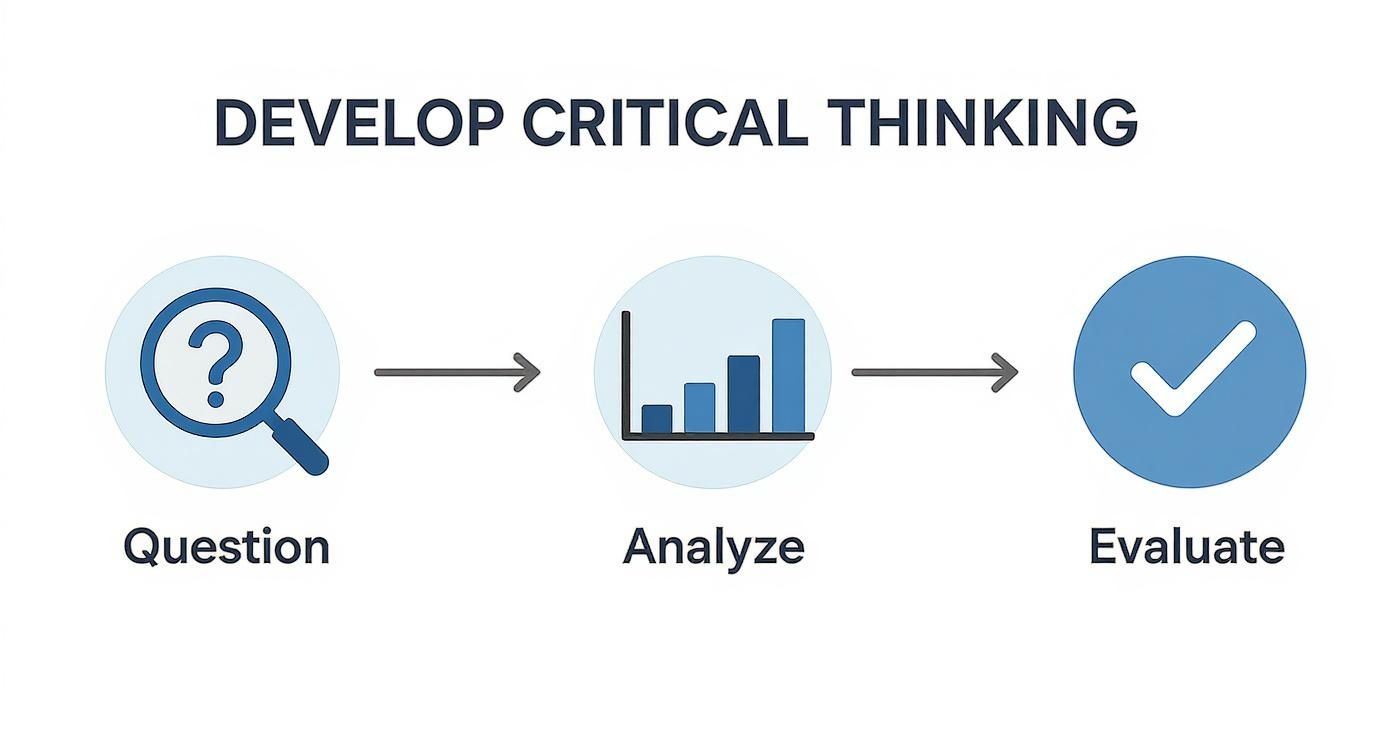
It’s a cycle: you question what you see, which leads to analysis, which then allows you to make an informed judgement.
Spotting Your Own Hidden Biases
Maybe the hardest part of critical thinking is turning that detective’s magnifying glass on yourself. We all have cognitive biases—mental shortcuts our brains use that can lead to some seriously flawed thinking. One of the most common is confirmation bias, which is our tendency to look for and favour information that confirms what we already believe.
To fight this, you have to make a real effort to seek out opposing views. If you're researching a topic, don't just read the sources that agree with you. Go and find well-reasoned arguments from the other side.
This isn’t about being forced to change your mind. It’s about making sure your own position is strong enough to stand up to a real challenge. Ask yourself a few tough questions:
- What do I already believe about this topic?
- Am I emotionally invested in one particular outcome?
- What kind of evidence would it take for me to reconsider my view?
When you start actively questioning your own thought processes, you build the intellectual humility needed for true critical thinking. You shift from just defending a position to genuinely seeking the truth.
Advancing from Analysis to Insightful Evaluation
Once you’ve got the hang of breaking down information, the real magic happens when you start piecing it back together to form a solid, well-reasoned conclusion. This is the moment you graduate from simple analysis to insightful evaluation. It’s about more than just understanding the facts; it’s about forming a judgement you can genuinely stand behind.
The trick is to draw logical inferences, not just jump to assumptions. An inference is a conclusion you reach based on actual evidence and sound reasoning. An assumption, on the other hand, is something you accept as true without any proof. Sharpening your critical thinking skills means consciously choosing inference over assumption, every single time.
Distinguishing Correlation from Causation
One of the biggest logical traps out there—one that catches out even seasoned professionals—is mixing up correlation and causation. You see this everywhere, from misleading news headlines to clever advertisements.
Just because two things happen around the same time doesn’t automatically mean one caused the other. That’s correlation. For instance, ice cream sales often spike in the same months that drowning incidents increase. These two events are correlated, but nobody thinks eating a vanilla cone causes people to drown. The real driver is the summer heat, which encourages both swimming and buying ice cream.
Causation, however, means one event is the direct result of another. Proving it requires you to rule out other factors and demonstrate a clear link between the cause and effect. A true critical thinker always stops to ask: "Is this a genuine cause, or is there a hidden factor C influencing both A and B?"
Always question the relationship between events. Before you accept that A caused B, actively hunt for a third factor that might be pulling the strings. This simple habit will save you from a world of faulty conclusions.
A Practical Checklist for Evaluating Sources
Forming a strong judgement depends entirely on the quality of your information. Not all sources are created equal, and knowing how to spot the good from the bad is a core skill for any student.
Before you trust any piece of information, run it through this quick mental checklist:
- Author Expertise: Who is behind this information? What are their qualifications in this specific field? An opinion from a recognised expert will always carry more weight than a post from an anonymous blog.
- Publication Bias: Where is this published? Does the website, journal, or newspaper have a known agenda, whether it's political or commercial? Always be wary of sources that have something to gain by persuading you.
- Evidence Quality: What proof are they offering? Are they citing peer-reviewed studies and official data, or just relying on personal anecdotes? Strong arguments are always built on a foundation of strong evidence.
- Recency: When was this published? In fast-moving fields like science and technology, information can become obsolete in a flash. Always look for the most current data you can find.
- Tone and Language: Does the writing sound objective and reasoned, or is it emotionally charged? Watch out for loaded words or dramatic appeals to emotion—they’re often a smokescreen for a weak argument.
Putting It All into Practice: A Real-World Example
Let's see how this works in practice. Imagine you're researching the effectiveness of the four-day work week for a presentation. You stumble upon two conflicting articles online.
Report A: This one is published on a major business news site and written by an economist who specialises in labour productivity. The article is packed with data from large-scale company trials, including specific numbers on employee output, sick days, and staff retention. The tone is balanced, and it discusses both the pros and cons.
Report B: This is a blog post on a lifestyle website titled, "Why the Four-Day Week is a Disaster." The author is a freelance writer with no obvious expertise in economics. The piece leans heavily on emotional stories from two small business owners whose trials failed and dismisses positive studies as "hype" without offering any real counter-evidence.
Using your checklist, it’s immediately obvious that Report A is the credible source here. It has an expert author, a reputable publisher, and is built on high-quality, measurable evidence. Report B, on the other hand, is all emotion and no proof, making it completely unreliable for your presentation.
This process of systematic evaluation is what allows you to cut through the noise and form an informed opinion you can trust. As you turn this into a habit, you’ll find your judgement getting sharper and more reliable. To take your skills even further, it’s useful to know how to assess outcomes properly, a topic covered in this complete guide to measuring training effectiveness.
Integrating Critical Thinking into Your Daily Routines

Understanding the theory of critical thinking is one thing, but making it a real, usable skill is another. The goal is to move from simply knowing about it to actively doing it. It’s about weaving these analytical habits into your everyday life until they feel as natural as breathing. Think of it like a mental muscle that gets stronger every time you use it.
This doesn't mean you need to set aside hours for formal practice. Instead, it's about spotting opportunities in your routine moments for a bit of deeper reflection and analysis. With small, consistent efforts, you can build powerful critical thinking skills without it ever feeling like a chore.
Small Daily Exercises to Build Momentum
Turning critical thinking into a habit starts with tiny, deliberate actions. These simple exercises only take a few minutes but are brilliant for retraining your brain to question and analyse things automatically.
-
Question One Headline: Before you even click on that news story, just pause. Look at the headline. Ask yourself: What emotional words are they using? What is this headline implying, and what might it be leaving out just to get my attention?
-
Reflect on One Bias: At the end of the day, think about a conversation you had or a decision you made. Can you spot just one personal bias that might have nudged your perspective? Just noticing it is the first and most important step to managing it.
-
Analyse One Advertisement: Next time an advert pops up, break it down. What are they really selling? Is it just a product, or are they selling a feeling—like happiness, security, or a sense of belonging? This quick analysis helps you see past the sales pitch.
The real magic is in consistency. If you commit to just one of these tiny habits each day, the effect compounds. Over time, that conscious effort becomes an unconscious skill, changing how you see and interact with the world.
Applying Critical Thinking in a Professional Setting
In any job, critical thinking is what separates team members who just follow instructions from those who lead and innovate. It gives you the power to challenge the status quo in a constructive way and spot risks before they snowball into major problems.
A huge hurdle in many workplaces is groupthink—that tendency for everyone on a team to agree just to keep things harmonious, even if it leads to a bad decision.
Next time you’re in a team meeting, try this:
-
Play Devil's Advocate: If everyone agrees on a plan a little too quickly, gently push back. Ask something like, "What are the potential downsides we haven't thought about?" or "What would have to go wrong for this plan to fail completely?" You’re not being negative; you’re making sure the decision is solid.
-
Review a Project Plan for Assumptions: Grab the plan for an upcoming project. Find at least three core assumptions it relies on. For instance, maybe it assumes "the client will give feedback within 48 hours." Then ask, "What’s our backup plan if they don't?"
By doing this, you're not just finding flaws. You’re strengthening the entire project and showing your team that you’re the person who can see around corners.
Sharpening Your Skills as a Student
For students, especially those on an Access to HE course, critical thinking is the absolute engine of academic success. It’s what turns a simple descriptive essay into a compelling, analytical one and helps you truly engage with your reading materials.
When you're writing an essay, don't just summarise what you've read. Use your sources as a launchpad for your own argument. A straightforward way to do this is to analyse every text with a simple framework:
- Author’s Main Argument: What’s the single most important point they are trying to convince me of?
- Evidence Provided: What facts, data, or stories are they using to back it up?
- Underlying Assumptions: What are they taking for granted that their readers will just accept as true?
This structured approach stops you from just repeating information and forces you to actually critique it. Making this a regular habit takes discipline, which is why creating a study schedule that actually works is so vital. When you schedule time not just for reading, but for thinking, you embed this powerful practice right into your learning process.
Overcoming Common Barriers to Clear Thinking

Even with the best intentions, our own minds can be the biggest hurdle to thinking clearly. Our brains are wired for shortcuts—these are the cognitive biases we’ve mentioned. They’re great for making quick, everyday decisions, but they often trip us up when we need careful, logical analysis.
Understanding these common barriers is the first step to dismantling them. This isn't about blaming yourself for having biases; we all do. It’s about learning to spot the default settings in your own thinking so you can consciously choose a more reasoned path.
Confirmation Bias: The Echo Chamber in Your Head
One of the most powerful and sneaky barriers is confirmation bias. This is our natural urge to seek out, favour, and recall information that confirms what we already believe. It’s why our social media feeds often feel like echo chambers, and why we might quickly dismiss an article that challenges a long-held opinion.
For instance, if you're convinced a certain study method is the absolute best, you'll naturally notice every success story that supports it. Meanwhile, you might just skim past any data suggesting it’s not so effective. The real danger here is that it stops you from ever putting your beliefs to the test.
Breaking free requires a bit of deliberate effort.
- Actively seek out opposing views: Make a point of reading articles or listening to experts who hold a different opinion. The goal isn't to find flaws; it's to genuinely understand their reasoning.
- Play devil's advocate: In a discussion or even just in your head, argue passionately for the other side. This forces you to engage with the strongest points of the counter-argument.
The Dunning-Kruger Effect: When We Don't Know What We Don't Know
Ever met someone who’s just started a new hobby and is brimming with confidence? That might be the Dunning-Kruger effect in action. It's a tricky cognitive bias where people with low ability in a particular area tend to overestimate their competence. Put simply, they don’t know enough to realise just how much they don’t know.
This is a real roadblock to learning. If you think you've already got it all figured out, you won't be open to new information or feedback. Sometimes this overconfidence can be tangled up with deeper feelings of self-doubt. Learning how to beat impostor syndrome in adult learning can help you find a more balanced and realistic perspective on your abilities.
The cure for the Dunning-Kruger effect is intellectual humility. It’s that quiet, constant reminder to yourself that there is always more to learn and your current understanding is probably incomplete.
Emotional Reasoning and Social Pressure
Let's be honest, our thinking is rarely a purely logical process. Our emotions play a huge part, and that can lead to emotional reasoning—the trap of assuming that because you feel something strongly, it must be true. Feeling anxious about an upcoming exam might lead you to think, "I feel like I'm going to fail, so I probably will," completely ignoring how much you've prepared.
On top of that, there's social pressure. The desire to fit in can be so strong that we find ourselves agreeing with the group, even when a little voice inside is screaming that something's not right. This is the root of groupthink, where keeping the peace is valued more than getting to the truth.
To fight back, practice hitting the pause button. When a strong emotion pops up around a topic, take a breath and ask yourself: "What's the evidence here, separate from how I feel?" That tiny gap between feeling and concluding is where critical thinking really begins to shine.
Your Questions on Critical Thinking Answered
As you start consciously flexing your critical thinking muscles, a few questions always seem to pop up. It’s completely natural to wonder how long it all takes, or if these skills are even useful outside of your course. Let’s tackle some of those common queries and give you the clear, practical answers you need to keep moving forward with confidence.
How Long Does It Take to See Real Improvement?
This is the big one, isn't it? The honest answer is, it depends. Critical thinking isn’t a piece of software you install and master by Friday. It's much more like building physical fitness – the results you see are a direct reflection of how consistently and intensely you train.
You’ll notice small, immediate shifts. After just a week of actively questioning the news headlines you read or the adverts you see, you’ll probably find yourself doing it automatically. These little wins are brilliant for keeping you motivated.
However, for a deeper change in your default thinking—where spotting bias and weighing up evidence becomes second nature—you’re probably looking at a few months of deliberate practice. The trick is to stop thinking about a finish line and start embracing it as an ongoing process.
Think of it like this: you don't 'complete' fitness, you maintain it. In the same way, you don't just learn critical thinking once. You weave it into your daily life as a habit of thoughtful, reasoned analysis. The real progress isn't about reaching an end state, but in feeling your analytical muscles get stronger over time.
Can You Practise Critical Thinking Outside of Study?
Absolutely! In fact, you should. An academic setting is a fantastic training ground, but the real world is where these skills truly prove their worth. Everyday life is packed with opportunities to put your new abilities to the test.
Here are a few scenarios where you can give those critical thinking muscles a good workout:
- In a team meeting at work: When someone proposes a new project, don't just nod along. Ask thoughtful questions. What are the potential risks? What assumptions are we making? It’s not about being difficult; it's about helping the team succeed.
- When you’re making a big purchase: Looking at a new laptop or a car? Don't let the shiny marketing claims be your only guide. Dig into independent reviews, logically compare the technical specs, and ask yourself if the flashy features actually solve a problem you have.
- Discussing current events with friends: Try to have a respectful debate. Instead of just sharing opinions, back yours up with evidence and really listen to the logic behind your friends' points of view. Make a genuine effort to understand where they're coming from, even if you disagree.
Is It Possible to Be Too Critical?
That's a great question. Can you take it too far and just end up cynical or negative? Yes, but that's a misunderstanding of what real critical thinking is. Cynicism is dismissing ideas without a proper look, usually based on a gut feeling. Critical thinking, on the other hand, is all about open-minded, objective evaluation.
The aim isn't to find fault in everything. It’s to find clarity and truth. A skilled critical thinker knows when an idea needs challenging, but also knows when to accept a conclusion that’s backed by solid reasoning. It’s a balanced approach, not a destructive one.
It also requires a healthy dose of self-awareness. If you catch yourself constantly playing devil’s advocate just for the sake of it, it might be a good moment to turn that analytical lens on yourself and ask why. True critical thinking is constructive – it builds stronger beliefs and leads to better decisions, rather than just tearing things down.
Ready to build the skills that universities and employers are searching for? At Access Courses Online, we provide accredited online Access to HE Diplomas that embed critical thinking into every module, preparing you for academic success and your future career.
Find your course and start your journey today at https://accesscoursesonline.com.