

You're halfway through an assignment, your textbook is open beside you, and the citation you copied from a random website already looks suspicious. The title has too many capital letters, the publisher's location appears in one example but not another, and you're no longer sure whether the person on the cover is an author, editor or translator.
Learning how to reference books becomes much easier when you stop treating referencing as a punctuation test. Every book citation answers a small set of questions: Who created it? When was it published? What is it called? Who published it? How can a reader find it again? Your required style decides the order and punctuation.
This guide compares Harvard, APA 7, MLA 9, Chicago 17 and Vancouver, with particular attention to the current UK situation. Older Harvard templates often include the place of publication, but several UK university guides updated in 2025–2026 now omit it. The guide also deals with e-books, Kindle editions, edited collections, chapters and translated works, the situations where a basic print-book template stops being enough.
If you're still getting comfortable with academic work, the advice in these Model Diplomat citation tips can also help you develop a calmer, more consistent process. For a broader explanation of why citations matter, see what referencing means.
Why Referencing Books Feels Harder Than It Should
Referencing feels difficult because several different decisions are compressed into one short line. A book may display an author on its cover, an editor on the title page, a different copyright year inside, and an edition statement somewhere beneath the title. An online copy may then add a DOI, URL or platform name.
The solution is to separate source identification from style formatting. First, identify the work accurately. Only then should you turn the information into Harvard, APA, MLA, Chicago or Vancouver format.
Five questions to ask first
Before opening a referencing guide, write down:
- Who created the work? Is it an individual author, several authors, an editor, a translator or an organisation?
- When was this edition published? Use the publication information for the version you consulted.
- What is the complete title? Include the subtitle and preserve the wording shown on the title page.
- Who published it? Record the publisher's name accurately.
- Where can a reader locate it? This may be a page number in a print book, a DOI, a stable URL or a chapter title.
Practical rule: Reference the edition you used, not the edition you wish you had used.
UK Harvard guidance commonly presents a book as a structured record containing the author, year, title, edition, publisher and, in older examples, place of publication. The University of St Andrews Harvard book guide explains the familiar author-year approach and the alphabetical reference list, while also showing why the in-text citation and full reference perform different jobs.
The in-text citation helps your reader connect an idea to a source quickly. The reference list supplies enough detail to identify the exact book. Harvard normally uses the author surname and year in the text, APA also uses author and year but applies different punctuation, MLA normally points to the author and page, Chicago may use notes, and Vancouver uses numbered citations.
The UK update adds an important complication. Several university guides now say that the publisher's location is no longer required in Harvard book references, even though many online examples still show the older “place: publisher” pattern. Always check your module handbook or institution's preferred guide before submitting, especially if the template you found online looks dated.
What to Capture Before You Cite Anything
Start with the book itself. Don't rely on a retailer's listing, a library search result or the front cover alone. Those sources may shorten the title, omit an edition statement or display a later reprint date.
Open the book to the title page first. This is usually the page inside the book that gives the formal title and the names of the main creators. Then check the copyright page, normally on the reverse side of the title page, for publication and edition details.
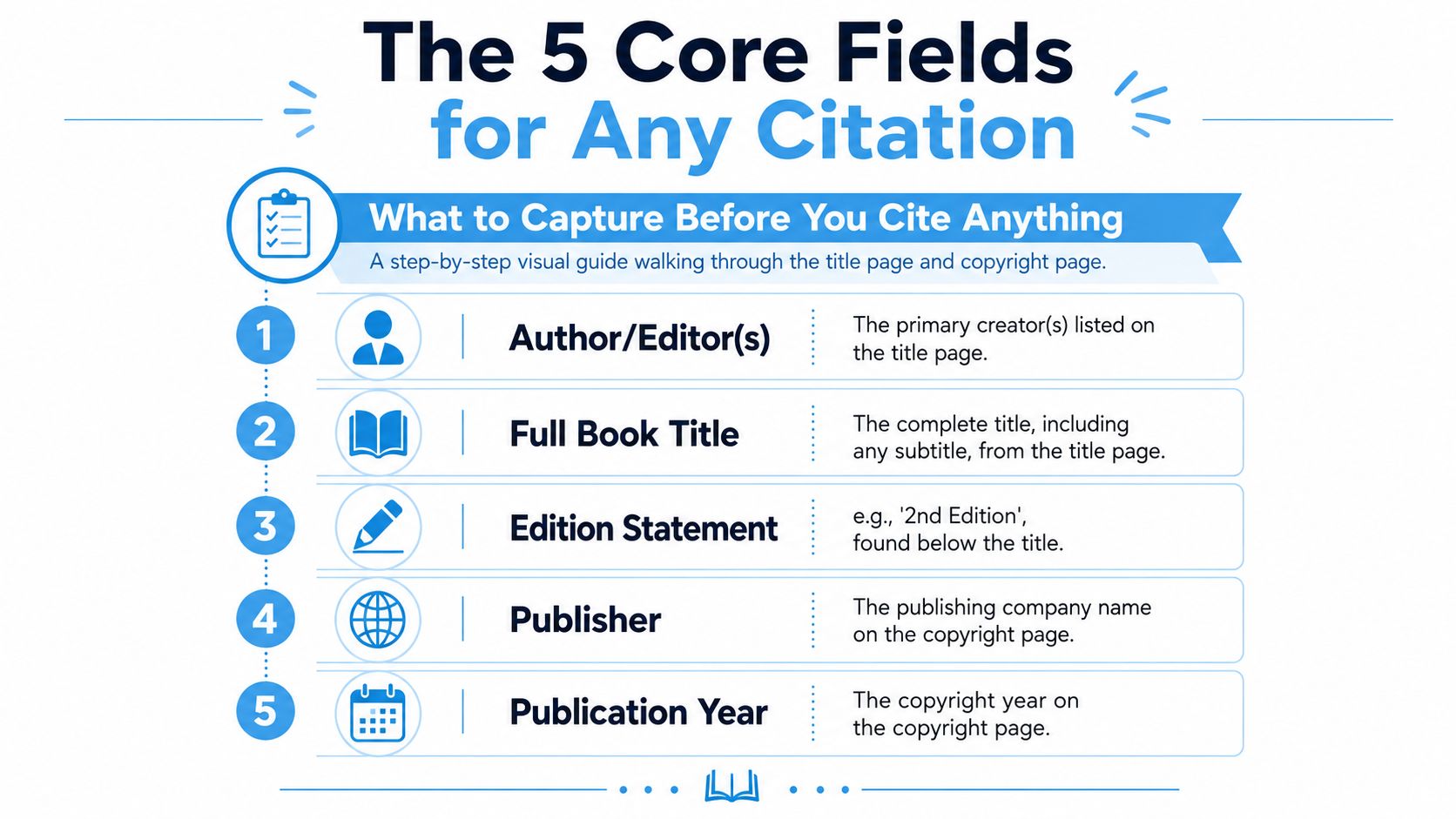
The five fields that prevent most errors
Author or editor. Copy the name as the book presents it, then check whether the person is described as an author or editor. A collection of essays may have editors rather than one author.
Full title. Record the main title and subtitle. Referencing styles differ in capitalisation, but you need the complete wording before applying those rules.
Edition statement. Look below the title or in the publication details for wording such as “second edition” or “revised edition”. The first edition is normally not labelled, so it's usually unnecessary to add “first edition”.
Publisher. Use the publishing company named in the copyright information. Don't substitute the bookseller, library or e-book platform for the publisher.
Publication year. Check the copyright and publication statements carefully. A book may have several dates for original publication, translation, reprinting or revision. The date you use should match the edition you consulted.
ISBNs can help you identify the correct edition, but they aren't normally part of a standard book reference. A DOI or stable URL can matter for an online-only book or an e-book with a persistent identifier.
A reusable source note
Before formatting, create a note like this:
- Creator: surname and initials, plus author or editor role
- Year: publication year of the version consulted
- Title: full title and subtitle
- Edition: edition statement, if applicable
- Publisher: exact publisher name
- Access details: DOI, stable URL or platform information, if required by your guide
The Open University Harvard quick guide recommends checking the title page and copyright page, then using the captured information to build both the in-text citation and reference-list entry. It also explains that an e-book can follow the print-book pattern when it closely resembles the printed edition and has stable pagination.
One point deserves special care. Current UK Harvard guidance may omit the publisher's location, while APA 7 book references also generally focus on the author, date, title and publisher rather than the older city-and-publisher structure. Your university's own instructions take priority if they differ.
Side-by-Side Reference Formats in Five Major Styles
The easiest way to see style differences is to keep the book constant. The examples below use a fictional edition of Ethics in Clinical Practice by Alex Morgan and Priya Shah. They show the structure and punctuation, not a real publication record.
| Style | Reference list entry | In-text citation |
|---|---|---|
| UK Harvard, current location-omitted form | Morgan, A. and Shah, P. (2024) Ethics in clinical practice. 3rd edn. Routledge. | (Morgan and Shah, 2024) |
| APA 7 | Morgan, A., & Shah, P. (2024). Ethics in clinical practice (3rd ed.). Routledge. | (Morgan & Shah, 2024) |
| MLA 9 | Morgan, Alex, and Priya Shah. Ethics in Clinical Practice. 3rd ed., Routledge, 2024. | (Morgan and Shah 42) |
| Chicago notes-bibliography | Morgan, Alex, and Priya Shah. Ethics in Clinical Practice. 3rd ed. Routledge, 2024. | Footnote: Alex Morgan and Priya Shah, Ethics in Clinical Practice, 3rd ed. (Routledge, 2024), 42. |
| Vancouver | Morgan A, Shah P. Ethics in clinical practice. 3rd ed. Routledge; 2024. | Superscript number, linked to reference 1 |
The same facts appear in each entry, but their order changes. Harvard places the year close to the author and commonly uses an author-year in-text citation. APA also uses author-date, with a comma between the names and year, and places the edition in parentheses.
MLA normally uses author-page citations, so the publication year stays in the works-cited entry rather than the parenthetical citation. Chicago notes-bibliography often directs readers to footnotes, while Vancouver assigns each source a number in the order it first appears.
Current UK Harvard practice is especially important here. The older pattern often looked like “Author, A.A. (Year) Title. Edition. Place: Publisher.” Updated UK guidance increasingly removes the place of publication. The MHRA style guidance also demonstrates why institutional systems can differ, particularly around full publication details, punctuation and the treatment of place names.
Don't copy the table mechanically if your department has its own version. A law, humanities or health course may prescribe a house style that modifies the general rules. The same caution applies when citing religious texts or unusual source types. A focused resource such as the BarkerBooks scripture citation guide can be useful when a source doesn't behave like a conventional academic book.
For adjacent source types, compare the structure with this guide to referencing a journal article in Harvard style. The principle stays the same: identify the source first, then apply the correct template.
Handling Edited Volumes, Chapters and Multiple Authors
A whole book with one author is the simplest case. Problems begin when the person named on the title page isn't the only creator, or when you've read one chapter rather than the complete volume.
Multiple authors
For a book written by Alex Morgan, Priya Shah and Daniel Evans, the reference list normally gives the authors in the order shown on the title page, but each style formats their names differently.
Harvard may use:
Morgan, A., Shah, P. and Evans, D. (2024) Ethics in clinical practice. Routledge.
APA uses initials and an ampersand before the final author:
Morgan, A., Shah, P., & Evans, D. (2024). Ethics in clinical practice. Routledge.
MLA keeps fuller names and uses “and”:
Morgan, Alex, Priya Shah, and Daniel Evans. Ethics in Clinical Practice. Routledge, 2024.
For a long author list, consult your exact guide rather than guessing how many names to shorten in the text. The reference list and in-text citation may apply different rules. Never replace named authors with the editor just because the author list is inconvenient.
Edited collections
If the title page identifies Priya Shah as editor of New Directions in Health Ethics, she becomes the principal name in the reference:
- Harvard: Shah, P. (ed.) (2024) New directions in health ethics. Routledge.
- APA: Shah, P. (Ed.). (2024). New directions in health ethics. Routledge.
- MLA: Shah, Priya, editor. New Directions in Health Ethics. Routledge, 2024.
The editor designation matters because it tells your reader what role that person played. Don't cite the editor as though they wrote every chapter.
Chapters in edited books
For a chapter by Daniel Evans in Shah's edited collection, begin with the chapter author, not the editor. Then identify the chapter, the editor, the book and the chapter's page range.
| Style | Edited volume | Chapter in edited book |
|---|---|---|
| Harvard | Shah, P. (ed.) (2024) New directions in health ethics. Routledge. | Evans, D. (2024) ‘Consent and clinical judgement'. In: Shah, P. (ed.) New directions in health ethics. pp. 42–58. Routledge. |
| APA 7 | Shah, P. (Ed.). (2024). New directions in health ethics. Routledge. | Evans, D. (2024). Consent and clinical judgement. In P. Shah (Ed.), New directions in health ethics (pp. 42–58). Routledge. |
| MLA 9 | Shah, Priya, editor. New Directions in Health Ethics. Routledge, 2024. | Evans, Daniel. “Consent and Clinical Judgement.” New Directions in Health Ethics, edited by Priya Shah, Routledge, 2024, pp. 42–58. |
| Chicago | Shah, Priya, ed. New Directions in Health Ethics. Routledge, 2024. | Evans, Daniel. “Consent and Clinical Judgement.” In New Directions in Health Ethics, edited by Priya Shah, 42–58. Routledge, 2024. |
| Vancouver | Shah P, editor. New directions in health ethics. Routledge; 2024. | Evans D. Consent and clinical judgement. In: Shah P, editor. New directions in health ethics. Routledge; 2024. p. 42–58. |
The page range belongs to the chapter, not the entire book. If you read the chapter online without stable pages, follow your institution's e-book or online chapter instructions instead of inventing page numbers.
E-Books, Kindle, DOIs and Translated Works
Digital formats create uncertainty because “e-book” can describe several different things. A downloadable PDF may reproduce the print edition, an online-only book may have a DOI, and a Kindle edition may not have stable page numbers at all.
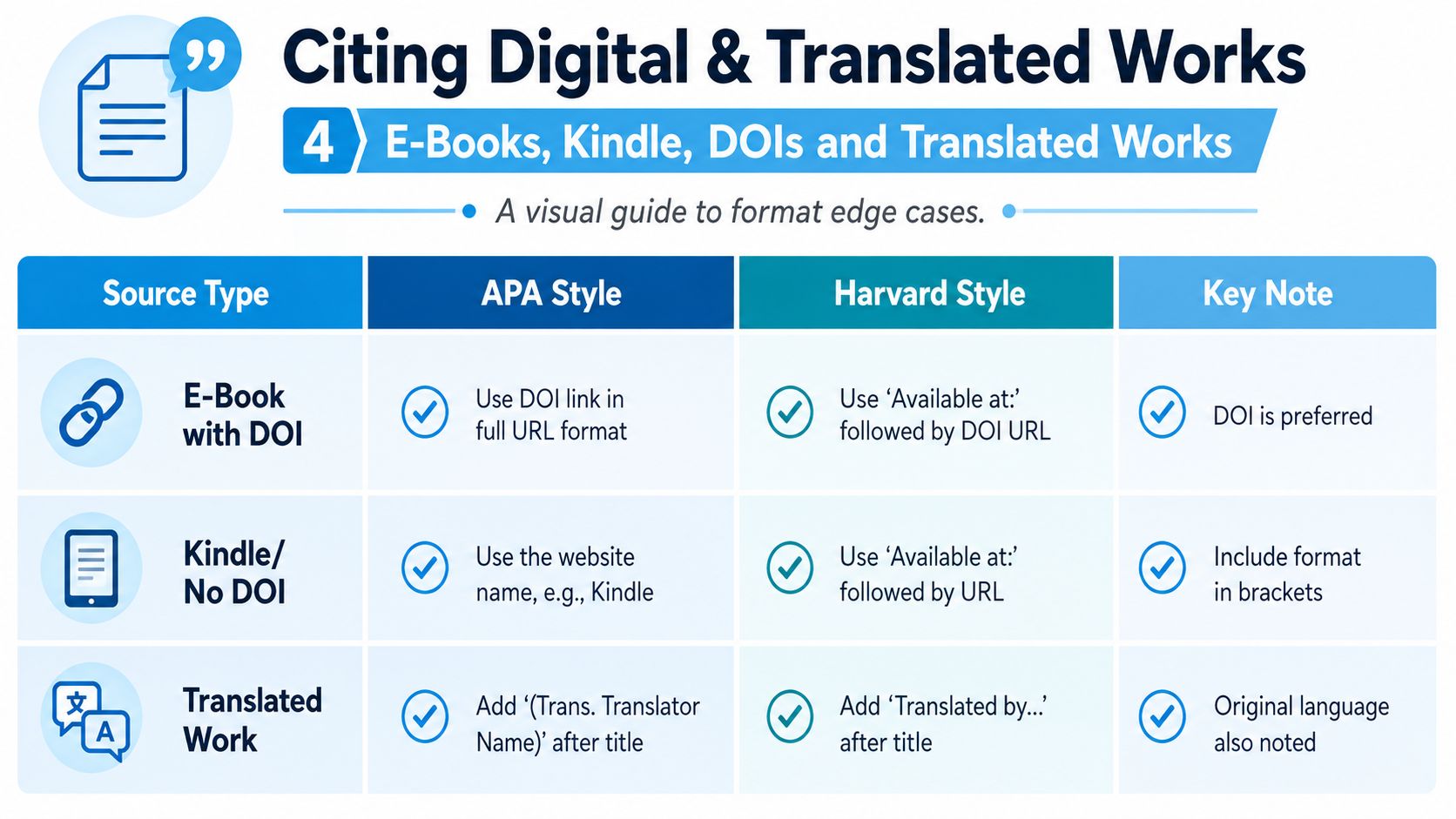
Start with the identifier
If the book has a DOI, record it exactly. APA generally places the DOI in URL form at the end of the reference. Harvard guidance may use wording such as “Available at:” followed by the DOI URL and an access date, depending on the institutional guide.
For an e-book without a DOI, the correct treatment depends on how readers can access it. Some UK library guides treat a digital book like its print equivalent, while others ask for a URL, access date or platform detail when the work is online-only or has unusual pagination. The Reading guide to referencing electronic books sets out why the access method can affect the final details.
A practical decision process is:
- Stable DOI: Include the DOI in the format required by your style.
- Stable public URL: Add the URL if your guide requests it.
- Library platform copy: Don't automatically cite the database name. Check whether your institution treats it like the print edition.
- Changing or restricted page display: Use a chapter, section or other locator in the text when your style permits it.
Kindle references need care. “Kindle edition” isn't automatically required in every style. The device may be relevant when the text has no reliable page numbers, but you should follow your department's guide rather than adding a platform label by habit. If you cite an audiobook, identify the format where the style requires it, and include the narrator or platform information only when the guide treats that detail as relevant.
Translated books
A translated book has at least two creators to distinguish: the original author and the translator. The author remains the person who wrote the work. The translator's name follows the title in the position required by the style.
A general Harvard pattern might look like this:
Dostoevsky, F. (2024) Crime and punishment. Translated by A. Translator. Publisher.
APA commonly places the translator in parentheses after the title:
Dostoevsky, F. (2024). Crime and punishment (A. Translator, Trans.). Publisher.
If the original publication date is important to your discussion, some systems place it in brackets after the translation date or otherwise record both dates. Check your guide, because the exact treatment varies.
The UK Harvard update remains relevant for all these formats. Guidance from UK institutions, including Newman University's reference-list guidance, reflects the move away from including the publisher's location in book references. Don't carry “London: Publisher” into a current assignment merely because an old template includes it.
The following video can help you review the visual difference between common digital-book formats before you finalise an entry.
Common Mistakes and Quick-Reference Cheat Sheets
Most referencing errors are small, but they make a source harder to identify. A missing edition can point readers to the wrong text, while a missing translator can make it appear that you read the original language.
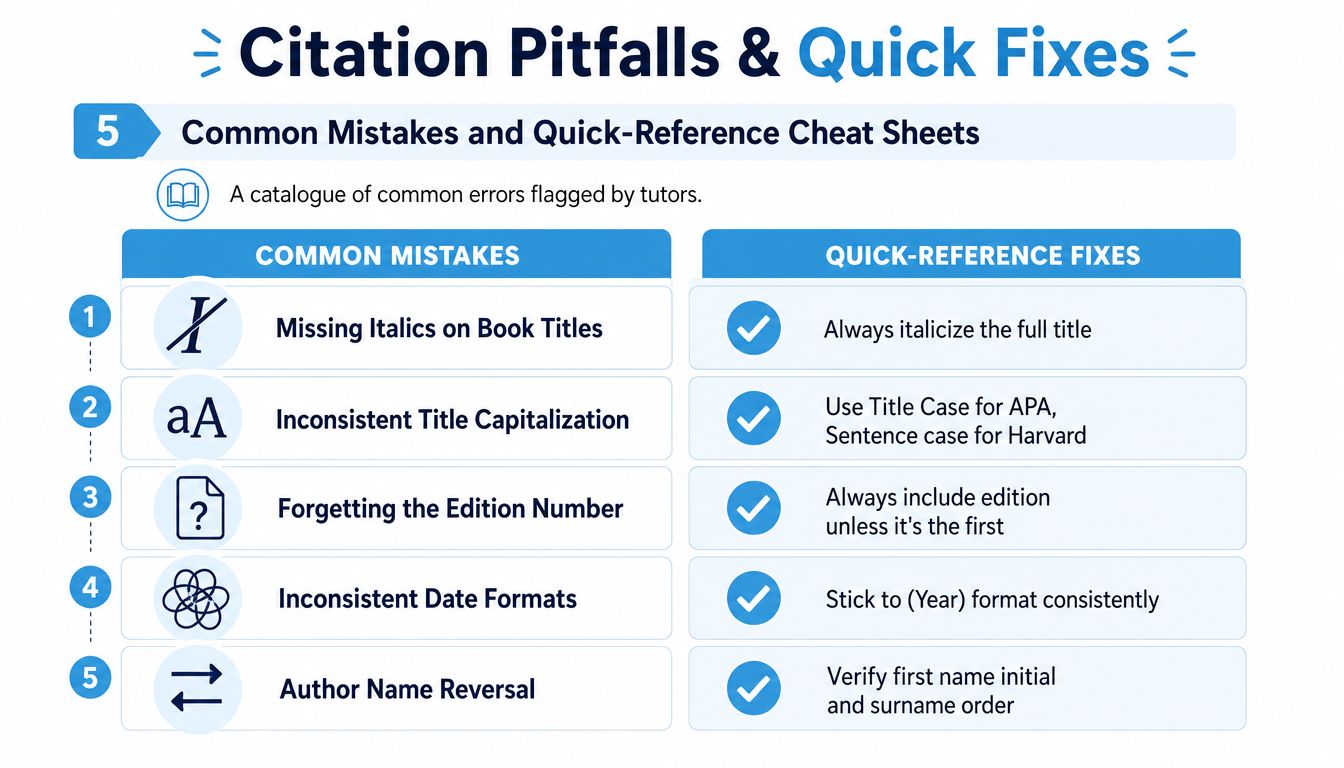
Five quick fixes
- Missing italics: Italicise the complete book title in styles that require it. Don't italicise the author's name or publisher.
- Inconsistent capitalisation: Apply one style's capitalisation rule from beginning to end. APA and Harvard often use sentence-style book titles, while MLA and Chicago commonly use title-style capitalisation.
- Forgotten edition: Add the edition when it isn't the first edition and when the edition information appears in the book.
- Wrong date: Use the publication year for the version you consulted, not automatically the original work's date.
- Reversed names: In a reference list, styles often invert the first author's name. Follow the chosen style for additional authors rather than applying one universal rule.
A DOI is another common checkpoint. If a stable DOI exists, don't leave it out just because you accessed the book through a library platform. Your style may prefer the DOI because it gives readers a persistent route to the source.
Three compact cheat sheets
In-text citations
| Style | Typical book citation |
|---|---|
| Harvard | (Morgan, 2024) |
| APA 7 | (Morgan, 2024) |
| MLA 9 | (Morgan 42) |
| Chicago notes | Footnote with author, title and page |
| Vancouver | Superscript reference number |
Reference-list starting points
- Harvard: Author, initials. (Year) Title. Edition. Publisher.
- APA 7: Author, initials. (Year). Title (edition). Publisher.
- MLA 9: Author, full name. Title. Edition, Publisher, Year.
- Chicago: Author, full name. Title. Edition. Publisher, Year.
- Vancouver: Author initials. Title. Edition. Publisher; Year.
Choose the source type
- Whole book: Cite the book's author or editor and the book details.
- Chapter: Cite the chapter author first, then the edited book and page range.
- E-book: Check for a DOI, stable URL and the presence or absence of fixed pages.
- Translated work: Keep the original author as author and record the translator separately.
A reference manager such as Zotero or EndNote can save time when you're handling many sources, but imported records still need checking. Metadata can contain a shortened title, incorrect capitalisation or the wrong publication year. For a useful distinction between sources you cite directly and wider reading, consult this explanation of the difference between a bibliography and a reference list.
Pulling It All Together and FAQs
Referencing is an academic-integrity practice before it's a formatting exercise. Harvard and APA make the author and year easy to see. MLA emphasises the author and page. Chicago offers notes as well as author-date options. Vancouver keeps citations compact by assigning numbers to sources.
| Academic context | Recommended style | Why it fits |
|---|---|---|
| Social sciences and many UK university courses | Harvard | The author-year system keeps publication dates visible. |
| Psychology, education and related disciplines | APA 7 | The format foregrounds authorship and publication date. |
| English literature and language studies | MLA 9 | Author-page citations suit close textual analysis. |
| History and humanities | Chicago | Notes allow detailed source commentary. |
| Medicine and health sciences | Vancouver | Numbered citations keep technical writing concise. |
Frequently asked questions
What if I only read one chapter? Cite the chapter rather than the whole book when it has its own author and appears in an edited collection. If the same author wrote the entire book and you only consulted one chapter, cite the whole book and add the chapter or page locator in the text where appropriate.
What if no individual author is listed? Look for a corporate author, such as a professional body or government organisation. If nobody is credited, begin the reference with the title and use a shortened title for the in-text citation.
How do I cite a foreword or introduction? Name the person who wrote that part as the contributor, identify the part, then cite the book's author or editor and publication details.
What about a reprint in another publisher's series? Reference the edition you used and record the publisher shown for that edition. Add original-publication information only if your style or assignment requires it.
Do dissertations and theses use book format? Not usually. A published dissertation or thesis is treated as an academic work with its qualification, institution, repository and URL details.
What if the author and editor are the same person? Record the role that matches the work you're citing. If the person wrote the book, cite them as author. If they compiled or edited contributions, include the editor designation.
Before submitting, compare your final entry with your institution's current guide, especially on publisher location, e-books and translated works. Then check every in-text citation against the reference list.
Access Courses Online supports adults preparing for university through flexible, fully online Access to Higher Education Diplomas, tutor guidance and clear progression routes across subjects including Nursing, Health Professions, Social Science, Business and Computer Science. If you're ready to build the academic skills behind confident assignments, visit Access Courses Online to explore courses, funding guidance and flexible study options.