

When you’re writing an academic piece, you'll need to reference journal articles using two key parts. First is the quick in-text citation that looks like this: (Author, Year). Then, you’ll need a much more detailed entry in your reference list at the end: Author, Initial. (Year) ‘Article title’, Journal Name, Volume(Issue), pp. Page range.
Getting this format right isn't just a technicality—it's a massive step towards acing your assignments.
Why Mastering Harvard Referencing Matters
Let's be honest, referencing can feel like a chore. But getting it right is so much more than a box-ticking exercise; it’s a cornerstone of good academic work and shows your tutor you know your stuff.
For anyone returning to education, especially through an Access to HE Diploma, learning how to reference a journal article in Harvard style is a non-negotiable skill. It proves you can find, understand, and properly credit scholarly sources, which immediately builds your credibility.
Proper referencing is also your best defence against plagiarism. This is a huge deal in UK higher education, and universities don't take it lightly. In fact, many unis have their own slight variations of the Harvard style. For the thousands of students who progress to university each year, mastering this is essential. For example, the University of Hull has its own specific 'Hull Harvard' style to help students avoid accidental plagiarism, which can be a real issue in first-year assignments.
Building a Foundation for Academic Success
Try to think of referencing not as a final hurdle, but as an integral part of your research. It forces you to engage critically with your sources and helps you structure your arguments with solid evidence.
This skill is absolutely fundamental to producing high-quality work and is directly linked to better academic writing. If you’re looking for more guidance on putting your assignments together, our guide on how to write academic essays is a great place to start.
Ultimately, taking the time to learn Harvard style is an investment in your academic future. It’s a transferable skill that will serve you well throughout your entire degree and even into your professional life, especially in fields like nursing, social work, or business where everything is based on evidence.
Tutor Tip: Before you even start writing your first paragraph, open a new document for your reference list. Every time you find a journal article you plan to use, immediately add the full reference to that list. This one simple habit will save you hours of panic and frantic searching later on. It’s a real game-changer
Nailing Your In-Text Citations
Think of in-text citations as little signposts you pop into your sentences. They show your reader exactly where an idea or piece of evidence came from, instantly connecting your argument to the full reference list at the end. Getting these right is the bedrock of Harvard referencing, lending your work credibility and proving you've done the reading.
The basic format couldn’t be simpler: it's just the author's surname and the year of publication, all wrapped in parentheses. So, if you're talking about a study by a researcher named Evans from 2021, your citation will look like this: (Evans, 2021). It's a small detail, but it shows you're building your essay on solid, established knowledge.
Handling Different Author Scenarios
Of course, things get a little more interesting when you have more than one author. Don't worry, the key is just to be consistent by following a few straightforward rules.
- Two Authors: When a journal article is written by two people, you just list both their surnames, joined by 'and'. Easy. For example: (Kirby and Evans, 2023).
- Three Authors: For three authors, it's pretty similar. You'll list all three surnames the very first time you cite their work, like this: (Jones, Williams and Davies, 2022).
- Four or More Authors: Now, if you're dealing with an article that has four or more authors, things get much tidier. You only need to list the first author's surname, followed by 'et al.' This is just a bit of Latin that means 'and others'. For instance: (Smith et al., 2020). This handy shortcut keeps your writing from getting bogged down with long, clunky citations.
These rules might seem like a lot to take in at first, but you'll get the hang of them in no time. Using them correctly is a clear signal to your tutors that you’re academically competent, and it makes your arguments much easier to follow. For more tips on getting your academic work organised, check out our guide on creating a solid essay plan template.
Citing Quotes vs. Paraphrased Ideas
The way you cite will change slightly depending on whether you're quoting an author directly or just paraphrasing their ideas. When you paraphrase—which means putting someone else’s idea into your own words—the standard (Author, Year) format is all you need.
However, if you're using an author's exact words, you absolutely must include a page number. This helps your reader pinpoint the exact sentence you've borrowed. The format changes to (Author, Year, p. PageNumber).
For example: A direct quote from a journal article by Woolf, found on page 215, would need to be cited as (Woolf, 2017, p. 215). This is a non-negotiable detail for direct quotes and a really common place where students lose marks.
It's also worth remembering that different universities might have their own specific rules for online sources. With as many as 76% of UK health articles now being digital, institutions are constantly updating their guidance. Some guides, for instance, now require you to include markers like [online] and the DOI in your reference list. To see how practice is shifting, it's always a good idea to check your own university's guidance or look at examples like the University of Glasgow's MyGlasgow library service.
Building Your Reference List with Confidence
Your reference list is the complete, alphabetised catalogue at the end of your assignment. It’s where you give your reader the full details of every source you've mentioned, transforming those brief in-text citations into a comprehensive map of your research. Getting this part right is a non-negotiable step in learning how to reference a journal article in the Harvard style.
Think of each entry as a precise recipe. For journal articles, the core structure you'll almost always follow is: Author, Initial(s). (Year) ‘Title of the article’, Name of the Journal, Volume(Issue), pp. Page range. Every single comma, full stop, and italicised word has a specific job to do.
Getting this right isn’t just about ticking boxes; it’s about making your work credible and showing respect for the original authors. A crucial first step, long before you even start writing your list, is to organise your research papers and build a digital library. Trust me, getting organised from the start will save you from that last-minute panic of trying to find a lost source. This groundwork is just as important as the referencing itself.
This quick guide is a handy visual reminder of the in-text citation formats, which are the building blocks for your final reference list.
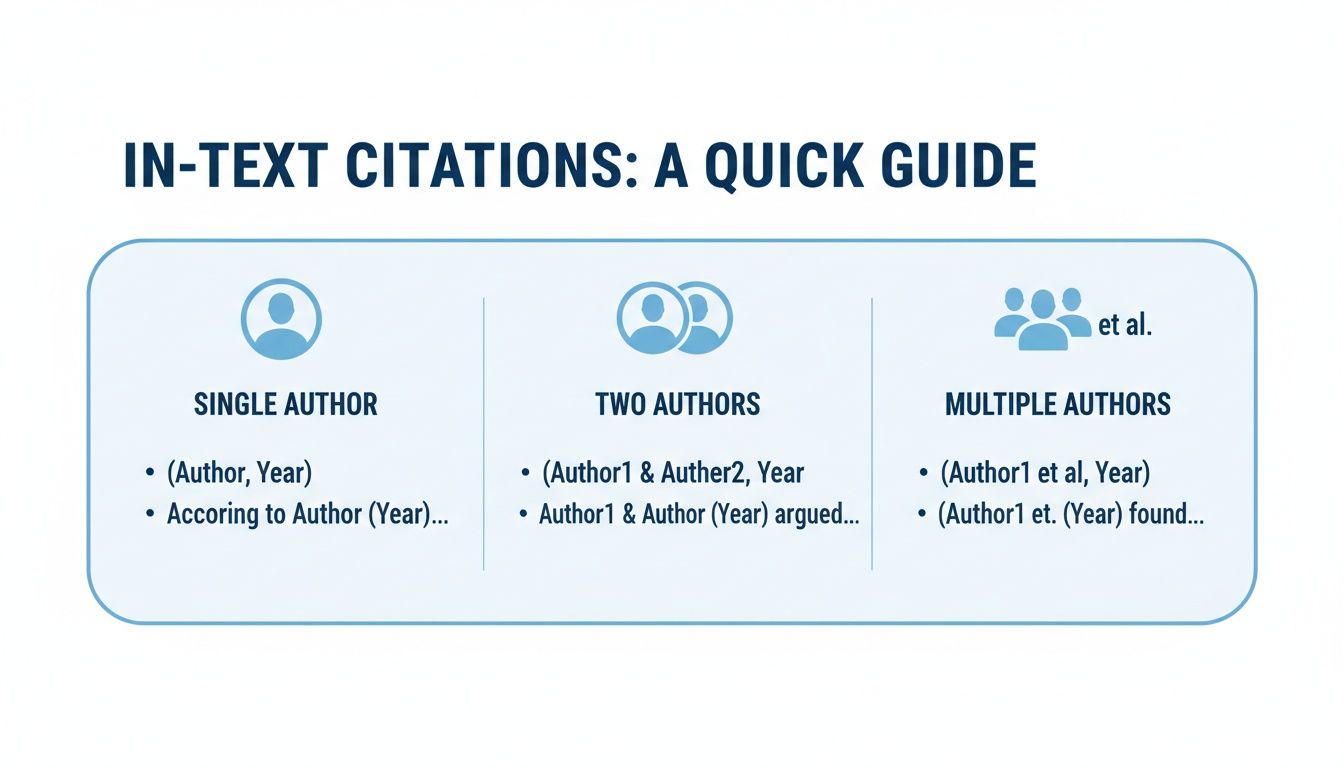
It clearly lays out the small but vital differences between citing one, two, or multiple authors, helping you keep everything consistent and correct as you write.
Deconstructing the Reference List Entry
Let's break down that formula with some real-world examples. The small details matter enormously, and seeing how they work for different types of journal articles makes all the difference.
-
Print Journal Article: This is the classic format. The key things to remember are the italics for the journal title and the "pp." before the page numbers.
- Example: Patel, A. (2021) ‘Innovations in Social Care Practice’, British Journal of Social Work, 51(4), pp. 1125-1142.
-
Online Journal Article with a DOI: Most modern online articles have a Digital Object Identifier (DOI). This is a permanent, unique link to the source. All you need to do is add it to the very end of the standard reference.
- Example: Evans, L. and Davies, R. (2022) ‘Patient-Centred Communication in Nursing’, Journal of Advanced Nursing, 78(2), pp. 567-578. doi: 10.1111/jan.15024.
-
Online Journal Article without a DOI: If you can't find a DOI, you’ll need to provide the URL where you accessed the article, plus the date you found it.
- Example: Green, M. (2023) ‘The Role of Technology in Modern Education’, Education Today, 15(1), pp. 34-45. Available at: http://www.educationtodayjournal.org/vol15/issue1/art3 (Accessed: 14 October 2024).
The subtle differences are what separate a good reference list from a great one. These aren’t just arbitrary rules; they ensure anyone can find your exact source. Being careless is risky—a 2024 Turnitin UK study found that 22% of work from mature students flagged for plagiarism, often due to simple referencing errors. Precision is your best defence.
To help you visualise these key differences, here's a quick comparison of the formats.
Journal Article Reference Formats Compared
| Article Type | Harvard Reference Structure | Example |
|---|---|---|
| Print Journal | Author, Initial(s). (Year) ‘Title of the article’, Name of the Journal, Volume(Issue), pp. Page range. | Patel, A. (2021) ‘Innovations in Social Care Practice’, British Journal of Social Work, 51(4), pp. 1125-1142. |
| Online Journal with DOI | Author, Initial(s). (Year) ‘Title of the article’, Name of the Journal, Volume(Issue), pp. Page range. doi: [DOI number]. | Evans, L. and Davies, R. (2022) ‘Patient-Centred Communication in Nursing’, Journal of Advanced Nursing, 78(2), pp. 567-578. doi: 10.1111/jan.15024. |
| Online Journal without DOI | Author, Initial(s). (Year) ‘Title of the article’, Name of the Journal, Volume(Issue), pp. Page range. Available at: [URL] (Accessed: Day Month Year). | Green, M. (2023) ‘The Role of Technology in Modern Education’, Education Today, 15(1), pp. 34-45. Available at: http://www.educationtodayjournal.org/vol15/issue1/art3 (Accessed: 14 October 2024). |
Seeing them side-by-side makes it clear that the core information is always the same—it’s just the final piece of access information (pages, DOI, or URL) that changes.
Tutor’s Insight: From my experience, the most common mistake students make is inconsistent formatting. They might italicise one journal title but forget the next, or mix up the placement of the year. My advice? Create a simple template for yourself and check every single entry against it before you submit. Consistency shows you care about the details.
Of course, great referencing starts with great research habits. To get the most out of your sources, check out our guide on how to take effective notes. It will help you capture the key information you need for both your essay and your reference list, making the whole process smoother.
Dealing With Tricky Referencing Scenarios
While the basic formats will see you through most of your assignments, you’ll definitely come across sources that don’t quite fit the standard mould. Knowing how to handle these tricky situations is what separates a good reference list from a great one, and it shows your marker you’ve got a real grasp of academic referencing.
It's pretty common to find journal articles with a huge list of authors, especially in the sciences where big research teams are the norm. We’ve already covered that for four or more authors, you just use ‘et al.’ in your in-text citation, like this: (Smith et al., 2020).
But what about the reference list? Your marker needs to see everyone who contributed, so you must list all the authors' names, no matter how many there are. It might seem like a lot of work, but it’s all about giving full and proper credit to the entire research team.
What to Do With Missing Information
You've found the perfect article for your essay, but when you go to reference it, you realise it's missing something obvious like the publication date or a volume number. Don't panic! This happens, and there are simple rules for dealing with it.
If you can't find a publication date – which is rare for journals but can happen with other online sources – you just use the term ‘no date’.
- In-text citation: (Jones, no date)
- Reference list entry: Jones, P. (no date) ‘Title of article’…
Making this small change shows you've spotted the missing detail, rather than just forgetting to include it. In the same way, if a journal article is missing a volume or issue number, you can simply leave that part out of the reference. The main goal is to give your reader as much information as you can find.
Citing Articles That Are ‘In Press’
Academic research moves at a blistering pace. You might discover a brilliant article that’s been accepted for publication but hasn’t been officially published in a journal issue just yet. These are called articles that are ‘in press’.
The good news is you can still cite them, which is a fantastic way to show that your research is right up to date. The format is almost identical to a normal reference, but you just swap the year for ‘in press’.
For example, an in-press article by an author named Kaur would be cited in-text as (Kaur, in press). In your reference list, it would look like this: Kaur, A. (in press) ‘The future of community nursing’, Journal of Health Studies.
This signals to your reader that the source is credible and has been peer-reviewed, even if it doesn't have all the final details like page numbers yet. Getting these specific cases right shows a deeper understanding of academic conventions – and that’s exactly the kind of attention to detail that tutors love to see.
Common Referencing Mistakes to Avoid
You’ve got the basics down, but it’s often the small, easy-to-miss errors that can trip you up and cost you valuable marks. Tutors see the same slips time and time again, so think of this as your final proofreading checklist to help you catch them before you submit.
Attention to detail is what lifts a good assignment into the great category. Learning to reference a journal article properly in the Harvard style is a skill. And like any skill, it gets better with practice and by understanding the common pitfalls. By knowing what to look for, you can train your eye to spot these mistakes in your own work.
Getting the Punctuation and Formatting Right
One of the most frequent problem areas is getting the punctuation and formatting consistent. A misplaced comma or forgetting to use italics can disrupt the entire reference. It looks unprofessional and, more importantly, it's incorrect according to academic standards.
Here are the top offenders to watch out for:
- Forgetting to italicise the journal title. The name of the journal should always be in italics (e.g., British Journal of Nursing). The title of the article itself, on the other hand, just needs single quotation marks.
- Mixing up commas and full stops. Each piece of punctuation has a specific job. You’ll use a full stop after the author's initial(s) and after the year in brackets, but commas are needed to separate most of the other elements.
- Incorrectly using ‘pp.’ for page numbers. The abbreviation ‘pp.’ should always come before the page range for an article in your reference list (for example, pp. 45-59).
These might seem like tiny details, but consistency is key to showing you’re on top of your academic game. A polished, correctly formatted reference list immediately signals to your marker that you take your work seriously.
Ensuring Consistency Between Your Text and List
A flawless reference list is pretty useless if it doesn't match up perfectly with your in-text citations. This disconnect is a massive red flag for tutors and one of the easiest ways to lose marks. Every single source you cite in your writing must appear in your reference list, and every entry in the reference list must have been cited in the text. No exceptions.
Tutor’s Insight: I often see assignments where an author is mentioned in the essay (e.g., Smith, 2022) but is completely missing from the final reference list. Always do a final cross-check. Go through your essay, highlight every in-text citation, and physically tick it off against your reference list.
It's also crucial that the details match exactly. The spelling of the author's name and the year of publication have to be identical in both your in-text citation and the full reference. An in-text citation of (Jones, 2021) can't lead to a reference list entry for (Jonas, 2021). These small inconsistencies can undermine the credibility you've worked so hard to build. A final ten-minute check can honestly make all the difference.
Got Questions About Harvard Referencing?
Even when you feel you’ve got a handle on the main rules, a few tricky questions about Harvard referencing for journal articles always seem to crop up. Getting these sorted can save you a mountain of time and stress, letting you submit your assignment feeling confident.
Let’s walk through some of the most common sticking points. Think of this as your quick-fire guide for those little moments of doubt that can bring your writing to a halt.
What on Earth Is a DOI and Why Does It Matter?
You’ve probably seen ‘DOI’ mentioned in referencing guides and wondered what it is. A Digital Object Identifier (DOI) is a unique string of letters and numbers given to an online article. It’s like a permanent, digital fingerprint for that specific document.
Unlike a regular web link (URL), which can change or break over time, a DOI will always point back to the correct source. This makes it the most reliable way to link to an online journal article. In fact, most universities now say you should always use a DOI if one is available. It makes your reference list look far more professional and allows your tutor to find your sources in a flash.
How Do I Reference an Article I Found Online That Was Originally in Print?
This is a really common one. You find a PDF of a journal article online, but it’s clear from the layout – with volume, issue, and page numbers – that it was first published in a traditional print journal. So, how do you handle the reference?
It’s simpler than you think: you just reference it as a print article.
The golden rule here is to cite the original publication format. The fact you accessed it online as a PDF is just how you got hold of it. Stick to the standard print format and leave out any URLs or access dates, unless your university’s specific style guide tells you otherwise.
This approach keeps your referencing tidy and focuses on the most stable, permanent details of the source.
Do I Really Need an ‘Accessed Date’ for Every Online Source?
This is a point of confusion for many students, but the guideline is actually quite straightforward. You only need to add an access date if the source you’re citing is likely to be updated or changed over time, or if it lacks a stable identifier like a DOI.
For journal articles specifically, the rule is clear:
- If the article has a DOI, you don't need an access date. The DOI is the permanent link.
- If the article has no DOI but has a stable URL, you should include the URL and an access date.
This is because web pages without a DOI can be moved or deleted. The access date simply proves that the information was available at that web address on the day you looked at it. For example, a blog post or an online report without a DOI would need both the URL and an access date, like this: (Accessed: 15 October 2024).
At Access Courses Online, we know that mastering academic skills like referencing is a huge step on your journey to university. Our accredited Access to HE Diplomas are designed to give you the qualifications and confidence you need to succeed. Find your course today and start building your future.