

To really get the most out of studying at home, you need more than good intentions. You need a dedicated space that tells your brain, "Okay, it's time to focus now." This is all about creating a zone free from distractions, setting up a desk that’s actually comfortable, and drawing clear boundaries with everyone else in your house. It’s not about finding a perfect, silent room, but deliberately turning any corner into your personal hub for concentration.
Designing a Study Space That Actually Works
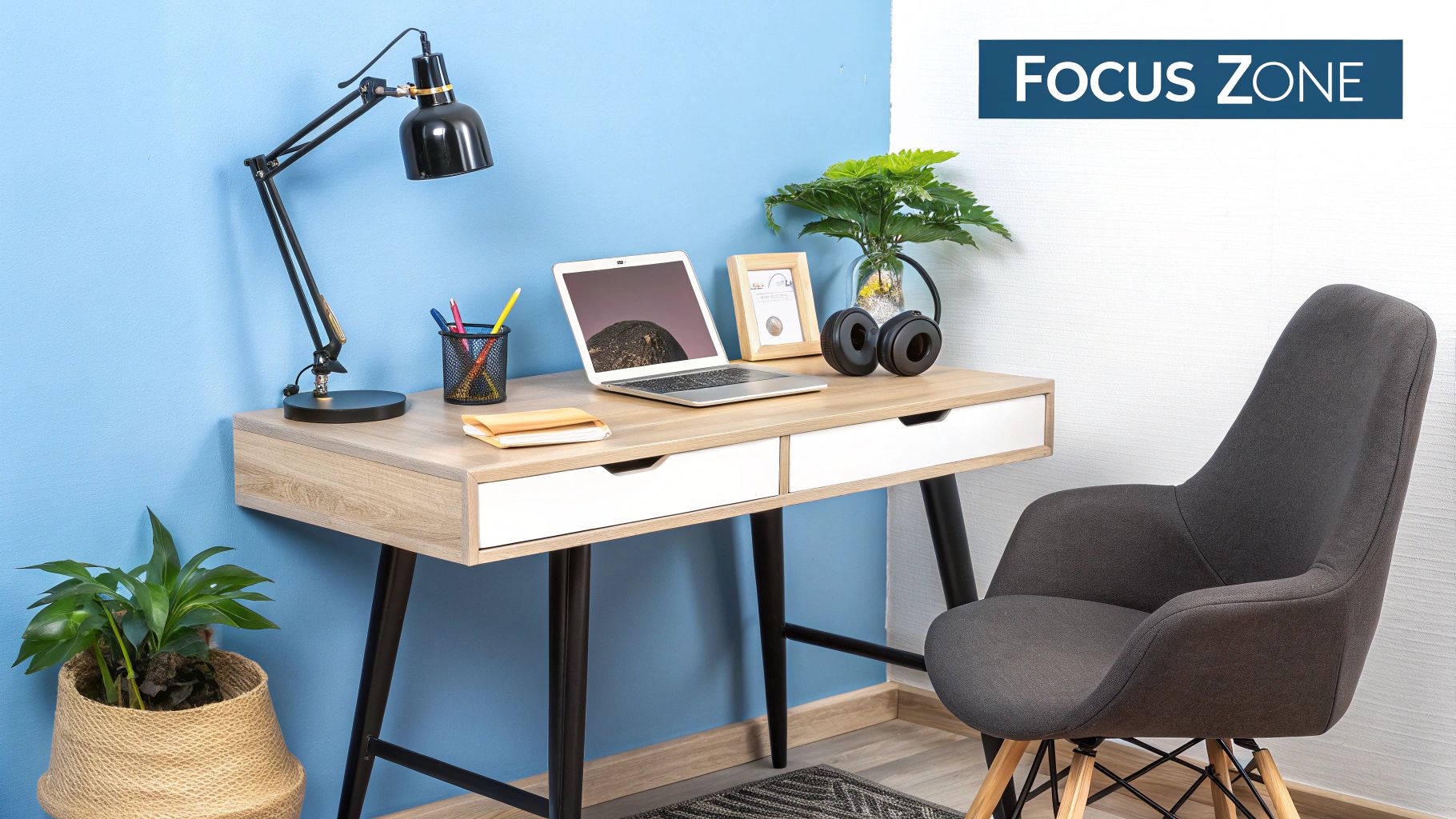
Let's be honest, the usual advice to "find a quiet spot" isn't much help when you're juggling family, pets, or flatmates in a busy home. The real skill is carving out a consistent environment that helps you get into a state of deep work. Our brains love routine. When you always study in the same place, your mind starts to associate that spot with focus, making it much easier to get into the zone.
This doesn't mean you need a fancy home office. It could be a specific corner of the kitchen table, a small desk squeezed into your bedroom, or even a particular armchair. The secret ingredient is consistency. Your bed is for sleep, your sofa is for Netflix, and your study space is purely for learning. That mental separation is vital for flicking the switch to "study mode."
Building Your Concentration Cocoon
First things first, you need to tackle distractions head-on – both the physical and the digital kind. This is about taking back control of your environment. Start by figuring out what your biggest focus-killers are. Is it that pile of laundry you can see from your desk, or the constant ping of notifications from your phone?
To fight back, try a few simple tricks:
- Create a physical barrier. If you can, face a wall instead of an open room or a window. This one small change cuts down on visual noise and stops you from people-watching. Even a cheap portable screen divider can create the feeling of a separate "room."
- Declutter your immediate area. Your desk should only have what you need for the task at hand. A cluttered space leads to a cluttered mind. Take five minutes before you start to clear away mugs, old notes, and anything else that isn't related to your studies.
- Put your phone away. And I don't just mean on silent. Put it in another room. That physical distance removes the temptation for a "quick check." Studies have actually shown that just having your smartphone nearby can drain your brainpower.
Setting Up for Comfort and Endurance
Studying for hours at a time can be tough on your body. An uncomfortable setup just leads to fidgeting, tiredness, and a complete loss of focus. Good ergonomics isn't a luxury; it's a must-have for effective home study.
Your main goal is to create a posture-friendly station. Make sure your chair supports your back and lets your feet rest flat on the floor. Your screen should be at eye level to avoid neck strain, and your keyboard positioned so your wrists are straight. Good lighting is also a big deal; a simple desk lamp can reduce eye strain and help you stay alert, especially if you're studying in the evening.
Setting boundaries with people is just as important as setting up your desk. A quick, friendly chat with your family or flatmates can make all the difference. Let them know your study hours and ask not to be disturbed unless it’s an emergency. A simple sign on the door can be a great non-confrontational reminder.
Essential Tools for Undivided Attention
Sometimes, willpower just isn't enough. Luckily, there are plenty of tools out there designed to help you shut out the world and concentrate. Noise-cancelling headphones are an absolute game-changer in a busy house, letting you create a bubble of silence or listen to music that helps you focus.
On the digital side of things, look into focus apps or browser extensions. These can temporarily block distracting websites like social media or news sites during your study time. By removing the option to get sidetracked, you make focusing on your course the easiest thing to do. This is how you transform your study area from a place of constant interruption into a true sanctuary for learning.
Building a Realistic Study Schedule You Can Stick To
Let’s be honest: a rigid, over-ambitious study plan that doesn’t account for real life is destined to gather dust. The aim isn’t to create a flawless schedule on paper; it's to build a realistic, flexible timetable you can actually live with, week in and week out. This is how you build real momentum and learn to study effectively at home without burning out.
Many people fall into the trap of thinking that effective studying means long, gruelling marathon sessions. But all the research—and our own experience—shows that our brains work much better in short, focused bursts. Forget blocking out a four-hour chunk that you’ll spend half the day dreading. The secret is to be intentional with shorter periods.
This isn’t just a niche idea for adult learners, either. It’s part of a much bigger shift in education. Across the UK, a growing number of families are choosing home education precisely because of the flexibility it offers. In early 2025, over 135,000 children were being educated at home, which really shows how people are moving towards personalised learning that fits individual lives.
Master Your Time with Proven Techniques
You don’t need complicated apps or fancy software to build a schedule that works. All it takes is a couple of simple, powerful methods.
First up is time blocking. This is where you give every block of time in your day a specific job. Instead of a vague to-do list that just makes you feel guilty, your calendar becomes your action plan. For example, putting "Tuesday, 7–8 pm: Read Chapter 3 of Biology" in your diary is infinitely more powerful than a floating task to "study biology."
Then, you combine this with the Pomodoro Technique for laser-like focus. It’s brilliantly simple:
- Pick one single task to work on.
- Set a timer for 25 minutes and work on that task with zero interruptions.
- When the timer rings, take a 5-minute break. Stretch, grab a drink, look out the window.
- Repeat the cycle. After four of these "Pomodoros," you treat yourself to a longer break of 15–30 minutes.
This technique is a game-changer because it makes even the biggest, most intimidating tasks feel manageable. After all, anyone can focus on something for just 25 minutes.
Weave Your Studies into Your Life
Alright, let's put this into practice. Grab a weekly calendar and start by marking off your non-negotiables—work hours, family commitments like the school run, mealtimes, and any exercise you do. Be brutally honest about your energy levels here. If you know you're completely drained after work on a Wednesday, that is not the time to schedule a heavy reading session.
Instead, start looking for those hidden pockets of opportunity:
- Could you squeeze in two Pomodoros (50 minutes of study) during your lunch break on Tuesdays and Thursdays?
- Can you claim a solid 90-minute block on a Saturday morning while the house is quiet?
- Is there a 30-minute window after dinner before you slump in front of the TV?
Think of your schedule as a living document, not a contract set in stone. The best timetables are the ones that can bend without breaking. If an unexpected appointment throws a session off course, don't write off the whole day. Just find the next available slot and pick up where you left off.
For a much deeper dive into crafting a timetable that genuinely fits your life, have a look at our complete guide on creating a study schedule that actually works.
Here is a sample timetable to give you an idea of how this could look for a part-time student juggling work and other commitments.
Sample Weekly Study Timetable for a Part-Time Student
This flexible schedule uses time blocking for commitments and the Pomodoro Technique for focused study sessions, ensuring there's also plenty of time for rest.
| Time Slot | Monday | Tuesday | Wednesday | Thursday | Friday | Weekend |
|---|---|---|---|---|---|---|
| Morning (9 am-12 pm) | Work | Work | Work | Work | Work | Study Session (3 Pomodoros + Long Break) |
| Lunch (12-1 pm) | Break | Study (2 Pomodoros) | Break | Study (2 Pomodoros) | Break | Family/Free Time |
| Afternoon (1-5 pm) | Work | Work | Work | Work | Work | Errands/Life Admin |
| Evening (7-9 pm) | Study Session (2 Pomodoros) | Family/Free Time | Study Session (2 Pomodoros) | Course Resources (Videos/Forums) | Relax | Relax |
Remember, this is just a template! Your own version will look completely different, and that's exactly how it should be. Adjust it to match your energy and your life.
Set Smarter Goals for Each Session
A schedule tells you when to study, but effective goals tell you what you’re actually going to get done. For every study block you schedule, set a small, specific, and measurable goal. This is what turns a passive "study" session into an active learning achievement.
| Instead of... | Try this SMART goal... |
|---|---|
| "Study for my maths module." | "Complete 10 practice problems from section 4.2 and review my answers." |
| "Read the next chapter." | "Read pages 45-60 and summarise the three main arguments in my own words." |
| "Revise for the exam." | "Create 15 digital flashcards for key definitions in Topic 5." |
This simple shift gives every session a clear purpose and a little hit of satisfaction when you tick it off. It’s that feeling of making progress, however small, that keeps your motivation topped up for the long haul.
Finally, try to set aside 15-20 minutes every Sunday to look back at the week and plan the next one. What worked well? Which sessions felt like a slog? Maybe you realised you’re much sharper in the mornings, so you can swap a difficult topic into an earlier slot. This little habit of planning, doing, and reviewing is the real secret to building a sustainable study routine that will carry you all the way to the finish line.
Learning Techniques That Go Beyond Rereading Notes
We’ve all been there. Hours spent staring at the same page of notes, highlighting everything in sight, convinced we’re being productive. But if we’re honest, simply reading your notes over and over again is one of the least effective ways to make information stick. Your brain starts to treat it like background noise.
To really learn how to study effectively at home, you need a different approach. It’s time to shift from being a passive reader to an active participant in your own learning. This means rolling up your sleeves and using methods that force your brain to actually engage with the material.
Real learning happens when you challenge your brain to retrieve information, not just recognise it on a page. It’s the difference between spotting a familiar face in a crowd and having to recall their name, where they work, and how you met them.
Embrace Active Recall to Build Stronger Memories
Active recall is just a fancy term for a simple idea: deliberately pulling information out of your memory without peeking at your notes. Every single time you force your brain to dig up a fact, a concept, or a formula, you’re strengthening the neural pathway to that information. Think of it like exercising a muscle—the more you work it, the stronger it gets.
Here are a few straightforward ways to put active recall into practice:
- Become the question master. After reading a chapter or watching a lecture, close your books and write down as many questions as you can about the key topics. Then, try to answer them from memory alone.
- Use the blank paper method. Grab a blank sheet of paper and scribble down everything you can possibly remember about a topic. Only when you've completely exhausted your memory should you go back to your notes to fill in the gaps.
- Create digital flashcards. Tools like Anki or Quizlet are brilliant for this. Put a key term on one side and the definition on the other. The trick is to force yourself to say the answer out loud or write it down before you flip the card over.
Active recall is so powerful because it shines a spotlight on what you don't know. Getting an answer wrong isn’t a failure; it’s a bright, flashing signpost telling you exactly where to focus your attention next.
The Feynman Technique Explained
One of the best active learning strategies out there is the Feynman Technique, named after Nobel Prize-winning physicist Richard Feynman. It’s built on a simple premise: the truest way to understand something is to try and explain it in the simplest terms possible.
This method breaks down into four simple steps:
- Choose a concept. Write the name of the concept you're trying to learn at the top of a blank page.
- Explain it simply. Now, pretend you’re teaching this to a child who has never heard of it before. Ditch the jargon and use plain language and simple analogies.
- Find your knowledge gaps. The moment you get stuck or your explanation becomes clunky and confusing, you’ve found a weak spot in your understanding. Go back to your course materials to strengthen that area.
- Review and simplify again. Once you’ve filled in the gaps, refine your explanation until it’s crystal clear and concise. If you can explain it easily without complicated terms, you've truly learned it.
For instance, if you’re studying photosynthesis for a biology course, you’d try to explain it without using words like "chloroplasts" or "ATP." You might say, "It's how a plant makes its own food. It takes sunlight, water from the ground, and air, and uses them like ingredients to cook up sugar for energy." This process immediately shows you what you don't fully get.
Use Spaced Repetition for Long-Term Learning
Now that you’re actively pulling information from your brain, the next piece of the puzzle is timing. Spaced repetition is all about reviewing material at increasing intervals over time. Instead of cramming it all in at once, you revisit information just as you’re about to forget it.
This cleverly interrupts the "forgetting curve"—our natural tendency to lose memories over time. Research consistently shows that reviewing information at these strategic, spaced-out moments helps embed it firmly into your long-term memory. A typical schedule might look something like this:
- Review 1: One day after first learning the material.
- Review 2: Three days later.
- Review 3: One week later.
- Review 4: Two weeks after that.
It's a far more efficient and less stressful approach than leaving everything to the last minute. This visual shows how planning your study, focusing your efforts, and reviewing systematically creates a powerful learning cycle.
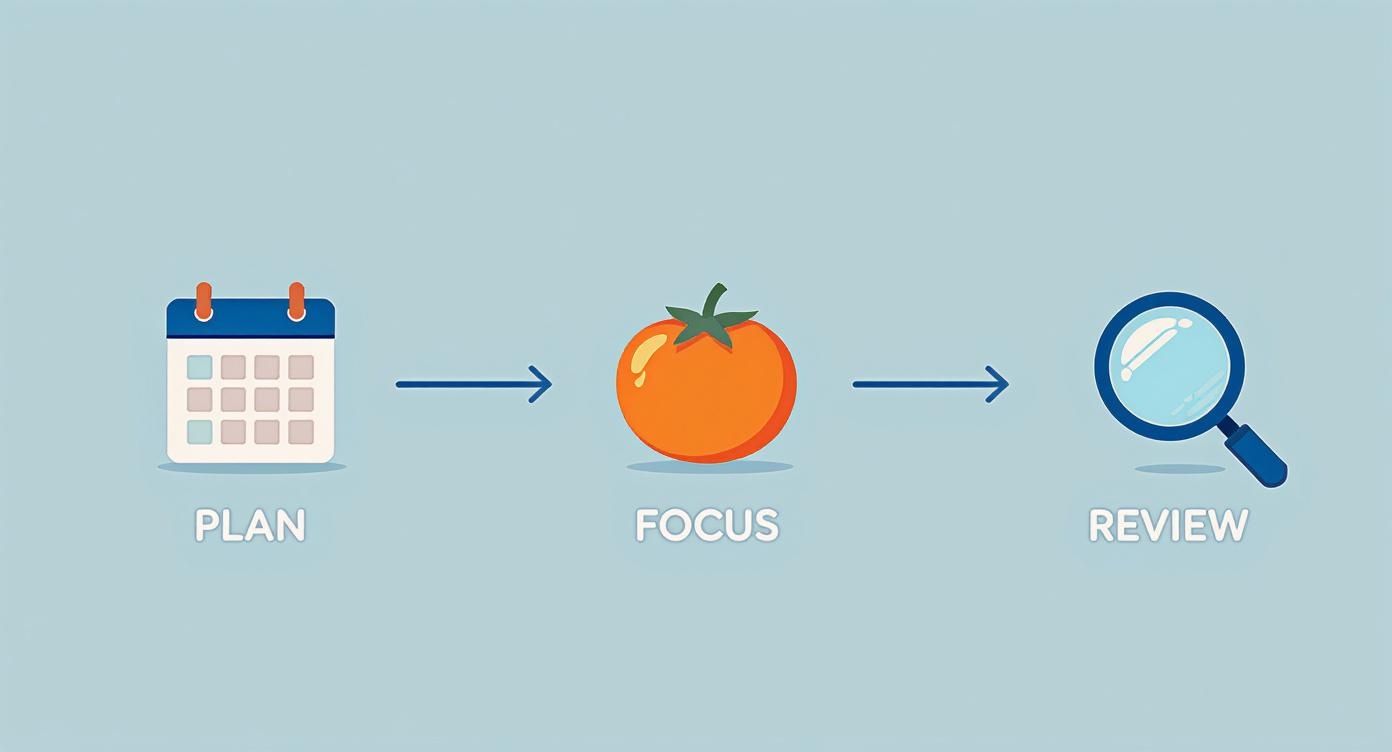
This process shows how a structured approach—planning what to study, focusing intensely on it, and then reviewing it over time—is the secret to making information stick. To deepen your knowledge of powerful learning strategies, you might want to explore these science-backed methods for how to study for exams effectively. By integrating these active techniques into your routine, you’ll transform studying from a passive chore into an engaging and genuinely effective process.
Taming Your Tech for Smarter Studying

As an online learner, your laptop is your campus, library, and lecture hall all rolled into one. But let's be honest—it’s also your biggest potential distraction. Getting your tech to work for you, not against you, is one of the most important skills you can master.
It all starts with bringing a bit of order to the digital chaos. If you waste precious minutes hunting for a specific file or set of notes every time you sit down, your focus is already fractured before you’ve even begun. A simple, logical digital filing system isn't just nice to have; it's non-negotiable.
Organise Your Digital Workspace
You don’t need complicated software to get your digital life in order. A well-thought-out folder system on your computer can work wonders.
Start by creating a main folder for your course, then make sub-folders for each module. Inside those, you can create more folders for lecture notes, readings, and assignments. Simple.
-
Be consistent with naming. A clear convention like
ModuleCode_Topic_Date.docx(e.g.,BIO101_CellStructure_15-10-25.docx) means you can find anything in seconds. - Use cloud storage. Services like Google Drive or OneDrive are brilliant. They back up your work automatically and let you access it from any device, giving you real peace of mind.
If you want a more integrated approach, tools like Notion or OneNote let you build an all-in-one digital notebook. You can drop in documents, create to-do lists, and link notes together, creating a powerful study hub. Have a play around and see what feels most natural for you.
The goal of any organisational system is simple: reduce the friction between thinking about a task and actually doing it. When you know exactly where everything is, you remove one more excuse for procrastination.
Build a Distraction-Free Digital Bubble
Your biggest challenge will likely be the endless temptations just a click away. Willpower is a finite resource, so it’s much smarter to use technology to police itself. The best way to minimise digital distractions is to use one of the many leading website blocker applications.
These tools let you create 'blacklists' of distracting sites—social media, news outlets, online shops—and block them completely during your scheduled study periods. This simple act of removing temptation can have a massive impact on your focus. Learning how to manage your digital space is absolutely essential if you want to excel in an online learning environment.
https://accesscoursesonline.com/blogs/news/how-to-excel-in-an-online-learning-environment
Prioritise Digital Wellbeing
Studying online means a lot of screen time, which can quickly lead to mental fatigue and burnout. Looking after yourself is just as important as mastering your course material.
One of the best habits you can get into is scheduling regular screen breaks. The 20-20-20 rule is a fantastic starting point: every 20 minutes, look at something 20 feet away for at least 20 seconds. It’s a simple exercise that really helps reduce digital eye strain. It's also a great idea to physically step away from your desk during longer breaks to stretch your legs and clear your head.
This kind of preparation is becoming more and more important for students. Recent UK data shows around 414,000 study visas were granted in the year ending June 2025. While numbers have dipped slightly, stricter requirements around financial stability and academic justification mean that students must be better prepared than ever. This just goes to show how crucial effective study habits are, whether you're learning at home or abroad.
How to Stay Motivated and Protect Your Wellbeing
Let's be honest: studying at home can sometimes feel like a solo mission. Your schedule can be perfect and your desk space pristine, but if you don't have the drive to keep going, even the best-laid plans can fall apart. This is where we need to get real about the emotional side of learning from home.
The thing to remember is that motivation isn't some magical resource you either have or you don't. It's something you build and maintain with small, consistent actions. It’s all about creating a system of rewards, knowing your 'why', and giving yourself permission to step back and recharge.
Fuel Your Drive with Small Wins
Staring at a huge assignment or an entire module is a classic trigger for procrastination. It just feels overwhelming. The secret is to break that mountain down into small, manageable hills. So, instead of adding "Complete History Essay" to your to-do list, get much more granular.
Try breaking it down into tiny, satisfying steps like these:
- Find five academic sources for the essay topic.
- Write just one paragraph for the introduction.
- Create a bullet-point outline of the main arguments.
Every time you tick off one of these mini-tasks, you get a little dopamine hit – a feeling of accomplishment that genuinely fuels your desire to tackle the next one. Celebrating these small wins is non-negotiable. Finished a tough chapter? That’s your cue to make a proper cup of tea and grab a biscuit. It reprograms your brain to associate the hard work of studying with positive rewards. For a deeper look into this, check out our guide on how to get motivated to study.
Find Your Why and Connect with Others
On the days when your energy is low, remembering your long-term goal—your "why"—can be incredibly powerful. Are you studying to switch careers, get into university, or build a better future for your family? Whatever it is, write it down and stick it somewhere you can see it from your desk. That simple reminder connects your daily grind to a much bigger, more meaningful purpose.
Studying at home doesn't have to mean studying alone. Loneliness is a huge drain on motivation, so you have to actively seek out connections. Most online courses have student forums or dedicated social media groups. Getting involved helps you realise you're not the only one wrestling with a particular concept and provides a brilliant support network.
"Your 'why' is your ultimate source of fuel. When the initial excitement of starting a new course fades, it's your long-term vision that will carry you through the challenging days and keep you focused on the finish line."
Prioritise Your Wellbeing to Avoid Burnout
You can't pour from an empty cup. Pushing yourself too hard without taking proper breaks is a fast track to burnout, leaving you feeling exhausted, cynical, and completely ineffective. Recognising the signs early is vital. Are you feeling constantly irritable, struggling to concentrate, or just losing interest in your course? These are red flags telling you to take a step back.
Building wellbeing practices into your routine is just as important as scheduling your study time. This means actually scheduling time for physical activity, even if it’s just a 20-minute walk around the block to clear your head. Make sure you're getting enough sleep, too – it’s when your brain works to consolidate everything you've learned.
The importance of effective study habits isn't just a local issue, either. Recent UK visa statistics, for example, show a 32% year-over-year increase in study visa applications for early 2025, with over 47,000 submissions. This surge shows that thousands of prospective students, particularly from countries like India, are dedicating huge amounts of time to preparing at home to meet stricter visa rules, highlighting the global need for strong, sustainable study habits.
Got Questions About Studying From Home? Let's Get Them Answered.
Even with the perfect study plan, hitting a wall is completely normal. One day you’re flying through your modules, the next you can’t seem to focus. It happens to everyone.
Let’s walk through some of the most common questions we hear from our online students. These aren’t just theories; they're practical, real-world solutions you can start using the moment you finish reading. The goal isn't to be a perfect student, but to build a toolkit of strategies for when things inevitably get a bit tough.
"I Just Can't Stop Procrastinating. How Do I Fix It?"
First things first: procrastination isn't a character flaw. It’s rarely about being lazy. More often, it’s our brain's reaction to feeling overwhelmed, scared of not doing a good job, or just being unsure where on earth to start.
The first step is to figure out what your personal procrastination triggers are. Is it the black hole of social media? The sudden, overwhelming urge to deep-clean the kitchen? Or is it just the sheer size of the assignment looming over you? Once you know the 'why', you can start to fight back.
A brilliant little trick is the 'two-minute rule'. The idea is ridiculously simple: if you can start a task in under two minutes, just do it. Instead of your to-do list saying "Write my essay," it becomes "Open a new document and write one sentence." That tiny action breaks through the initial resistance and makes carrying on feel so much easier.
Another great strategy is to make procrastinating harder than actually studying.
- Make your distractions inconvenient. Use a website blocker to put a digital lock on social media during your study blocks. Better yet, leave your phone in another room. If you can't mindlessly reach for it, you're far less likely to get sidetracked.
- Make the task smaller. Break that huge project down into the smallest possible steps. Your goal isn't to "revise for the exam," but to "create five flashcards for Topic 1." It feels much less intimidating, and you get a little win with each step you complete.
By making the first move incredibly easy and your go-to distractions a pain to get to, you completely shift the balance in your favour.
"What Are the Best Free Tools to Help Me Study?"
You absolutely do not need to spend a fortune on fancy software to get organised. In fact, some of the most powerful and effective study tools out there are completely free. The trick is to pick just a few that really work for you and weave them into your routine.
Here are a few standouts that our adult learners swear by:
- For organising everything: Notion is a game-changer. The free personal plan is incredibly powerful, letting you take detailed notes, manage to-do lists, and embed videos and links. Think of it as your all-in-one digital study hub.
- For staying focused: Forest is a clever little app that turns focus into a game. You plant a virtual tree, and it grows as long as you stay in the app and work. If you switch to Instagram, your tree withers. It's a simple, but surprisingly motivating, way to stay off your phone.
- For memorising facts: Anki is a must-have for digital flashcards. It uses a smart system called spaced repetition to show you information just before you’re about to forget it. It's fantastic for locking in key terms, dates, or formulas.
The best tool is always the one you'll actually use. Don't feel you need to use everything at once. Just pick one or two that solve a real problem for you—whether that’s organisation or focus—and make them a proper part of your study process.
"How Can I Possibly Stay Engaged During a Long Online Lecture?"
It’s so easy to zone out when you’re just staring at a screen for an hour. Passive listening is the enemy of learning; the information goes in one ear and out the other. To actually remember what you’re hearing, you need to be an active participant—even if you're just watching a recording.
Try taking notes by hand. The physical act of writing forces your brain to process information in a deeper way than simply typing. Don't try to be a court stenographer and write down every single word. Instead, focus on summarising the big ideas in your own words.
If it's a live lecture, get involved. Use the chat to ask a question or answer the tutor's prompts. This small action shifts you from being a passive viewer to an active part of the conversation.
And finally, as soon as the lecture is over, take five minutes. Just five. Quickly scan your notes and jot down the three most important things you learned. This simple habit helps to cement the information in your brain before you move on to whatever's next on your list.
At Access Courses Online, we understand that returning to education comes with its own unique set of questions and challenges. Our accredited online Access to HE Diplomas are designed with flexible, supportive learning in mind, helping you build the confidence and skills needed for university, no matter your starting point. Discover your path to a new career at https://accesscoursesonline.com.