

The UK still faces a net annual shortfall of roughly 3,800 cyber security professionals, so cyber security is a good career for people who can build practical skills and show employers what they can do. The opportunity is real, but entering it takes more than enthusiasm, especially for adults without traditional qualifications.
You may be reading this after another story about a ransomware incident, a stolen customer database, or a company struggling to recruit technical staff. Perhaps you've worked in administration, customer service, healthcare, retail, engineering, or another field and keep seeing cyber security described as a secure, well-paid career. The obvious question is whether those opportunities are open to you.
The answer is encouraging, with important conditions. Cyber security includes analytical, technical, compliance, investigative, and communication-heavy jobs. You don't have to become a brilliant programmer overnight, but you do need curiosity, patience, evidence of learning, and a route that helps you meet the qualifications many employers expect.
Why People Are Asking If Cyber Security Is a Good Career
A career change often starts with a practical worry rather than a grand ambition. You may want better long-term prospects, more intellectually engaging work, or a profession that lets you use skills you already have in a new setting. At the same time, job adverts can feel discouraging when they ask for a degree, technical experience, and knowledge of tools you've never used.
Cyber security attracts attention because the work has a clear purpose. Security professionals help protect information, systems, services, and people from unauthorised access and disruption. Some investigate suspicious activity, while others design controls, test weaknesses, manage risk, or help organisations recover after an incident.
That variety creates confusion. A security analyst and a penetration tester may both work in cyber security, but their daily tasks and preferred abilities are very different. A governance, risk and compliance professional may spend more time interpreting policies and explaining risk to managers than writing code. Someone in a security operations centre may monitor alerts and respond quickly when an organisation's systems show signs of attack.
What adults often get wrong
Many career guides make entry sound easy. They list short courses, impressive job titles, and attractive salary claims, then skip the qualification gap that blocks many adult learners. Employers frequently want candidates who can combine technical understanding with evidence of disciplined study and workplace judgement.
That doesn't mean a non-traditional background is a permanent disadvantage. Experience in customer service can support communication, an administrative role can build attention to detail, and work in finance or healthcare can provide useful understanding of regulated information. The task is to connect those existing strengths to a specific cyber pathway.
Practical rule: Don't choose “cyber security” as one enormous subject. Choose a first role, identify its requirements, and work backwards from there.
This guide focuses on the UK market, realistic role differences, the advantages and pressures of the profession, and a practical education route through an Access to Higher Education Diploma followed by a Computer Science degree. The aim isn't to promise an effortless switch. It's to show why the demand exists and how an adult without A-Levels or a degree can approach the field methodically.
UK Demand and Job Outlook in 2025
A career changer reading the headlines may see a field with plenty of vacancies, then wonder whether employers will consider someone without a traditional technology background. The UK figures show genuine demand, while also showing why preparation matters. The government's 2025 cyber security labour-market report estimates that employers need at least 12,900 new entrants each year, compared with approximately 9,100 people entering the workforce. That leaves a net annual shortfall of roughly 3,800 people.
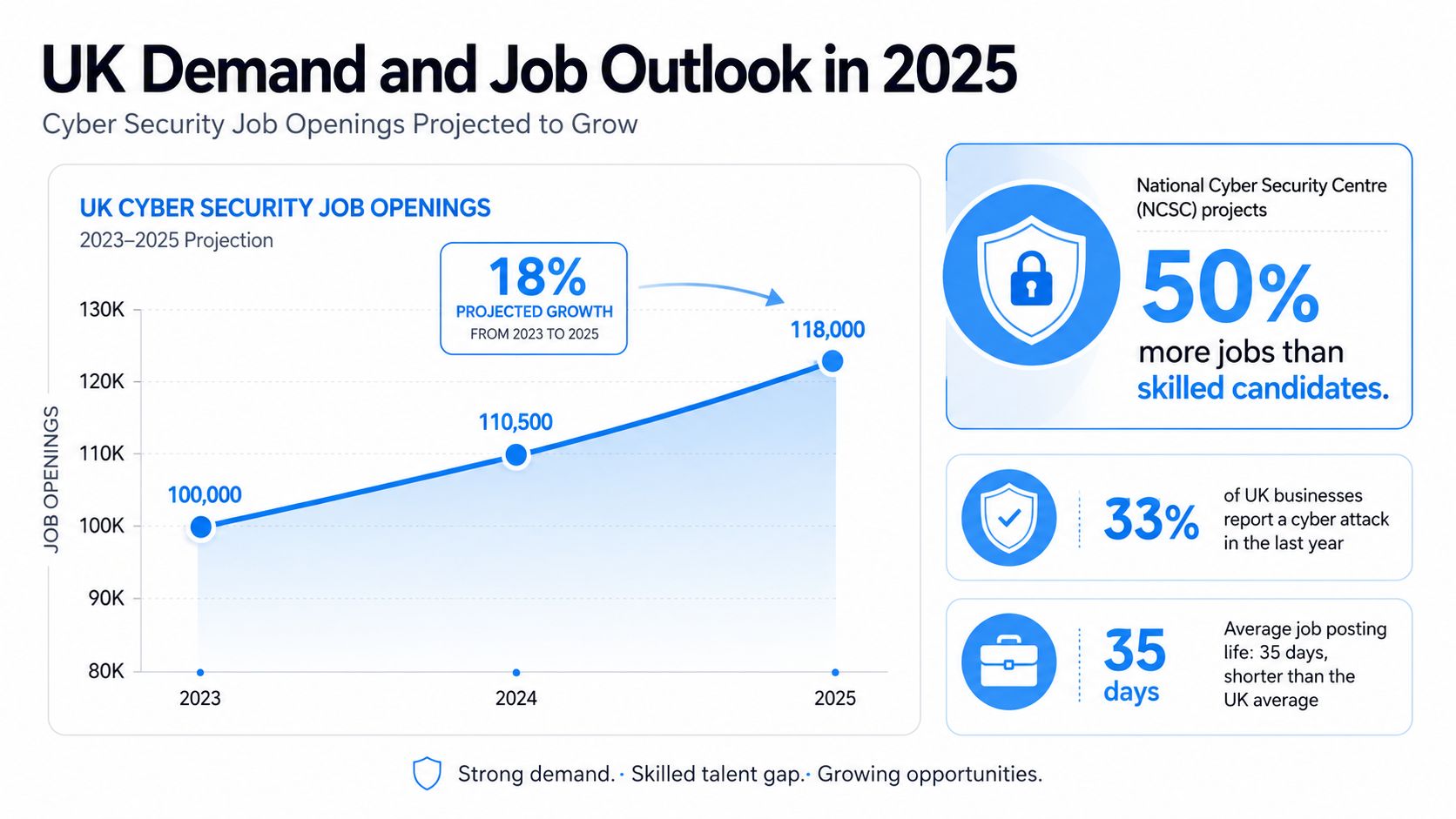
The shortage has narrowed, yet it remains significant. The same report places the workforce gap at around 3,800 professionals, down from 11,100 in the 2023 report. For an adult changing careers, the message is practical. Demand creates an opening, but interest alone is not enough. Employers still look for evidence of technical ability, disciplined learning, and reliable judgement.
A sizeable sector with uneven growth
The 2024 labour-market analysis estimates that around 143,000 people worked in cyber security-related roles across the UK economy in 2024, an increase of about 5% year on year. It also places employment within cyber security firms at roughly 67,300 full-time equivalents. These measures cover different parts of the market, so they should not be added together. They do show that cyber security work extends beyond specialist security companies, including employers in finance, healthcare, government, retail, and technology.
Growth has cooled. The later sectoral analysis reports that employee jobs rose by 3% over the previous 12 months, the lowest recorded rate since that study began in 2018. Hiring continues, although competition makes a focused plan more useful than a vague aim to “get into cyber”. Areas such as security operations, vulnerability management, identity and access management, cloud security, and advanced threat detection can give a learner clearer targets for study and practical experience.
The 2023 government report recorded 160,035 cyber security job postings in the preceding year and a 37% hard-to-fill vacancy rate. Broader technology skills also matter. Guidance on top skills for Atlanta tech workers highlights capabilities such as communication and technical adaptability, which transfer across technology employers.
The wider discussion of digital skills demand in the job market provides further context. For UK adults without A-Levels or a degree, the qualification gap is a problem to solve, not a permanent barrier. An Access to HE Diploma followed by a Computer Science degree can provide the structured foundation needed to compete for this expanding, but selective, field.
Typical Roles, Daily Tasks, and Realistic Salaries
A job title can conceal the actual work. Before choosing a course, read several adverts for the same role. Note the tools, responsibilities, and experience employers mention repeatedly. You will then see whether the day-to-day tasks suit you, rather than choosing a title that only sounds impressive.
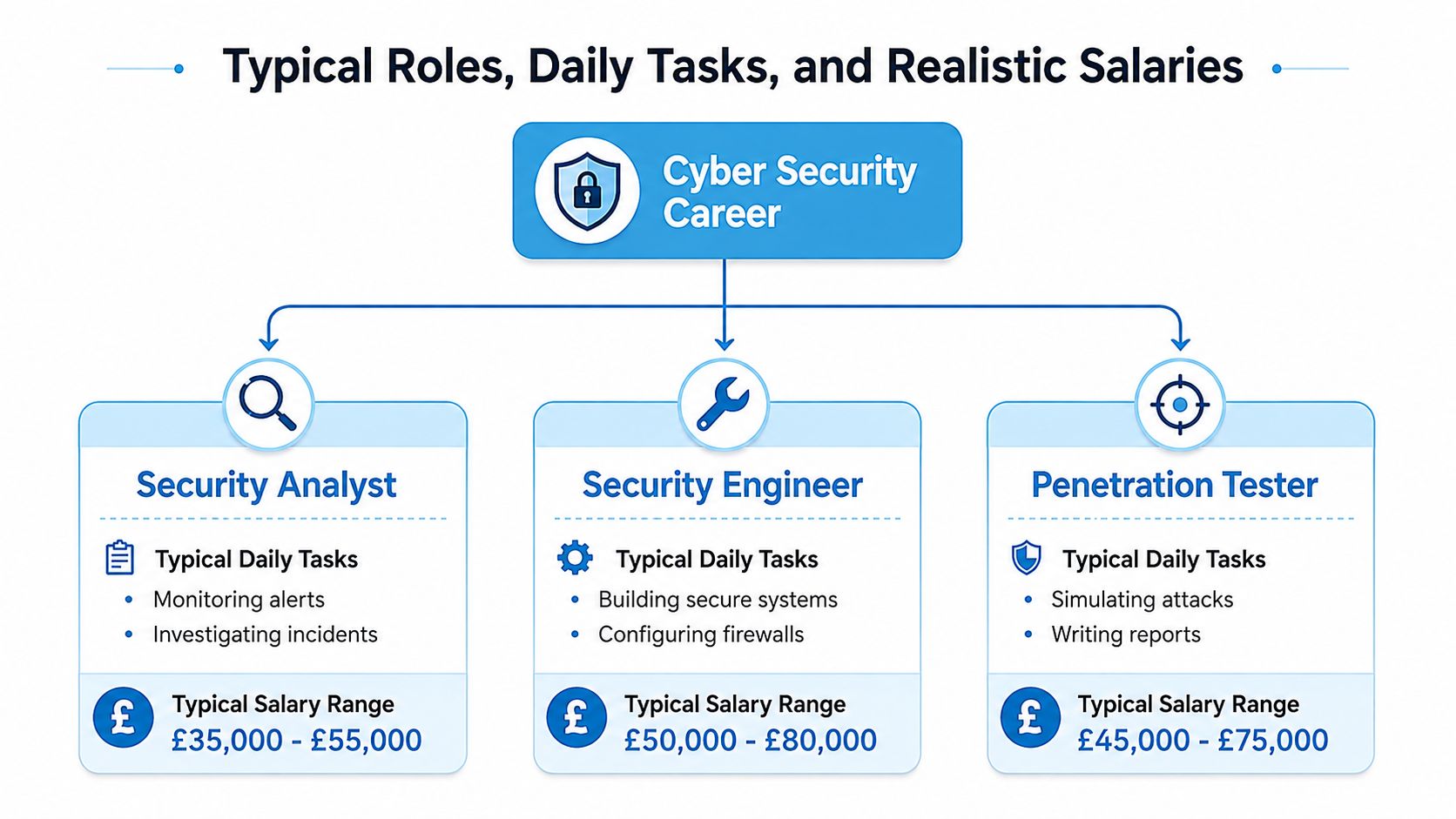
A security analyst reviews alerts, checks suspicious activity, records findings, and escalates incidents. In a security operations centre, a responder might investigate a compromised account, examine logs, and help contain the issue. The work suits people who notice patterns, document carefully, and make decisions with incomplete information.
A security engineer works nearer to the systems themselves. Typical tasks include configuring firewalls, improving access controls, supporting secure cloud environments, and helping teams build safer infrastructure. Troubleshooting matters, as does understanding how networks, operating systems, and applications connect.
A penetration tester carries out authorised attacks to identify weaknesses before criminals exploit them. The role combines test planning, responsible use of security tools, finding validation, and reports that non-specialists can understand. Curiosity helps, but ethical boundaries and clear communication matter just as much.
Roles that use judgement more than code
Governance, risk and compliance, or GRC, is an important route for people who do not want a heavily coding-focused role. GRC specialists assess business risks, maintain policies, prepare audit evidence, and explain practical ways to reduce exposure. Strong writing, organisation, stakeholder management, and commercial awareness may matter more than programming.
Salary figures need careful reading. A market average does not predict a graduate's first offer, and pay varies by employer and region. The government's 2025 sectoral analysis reports mean advertised salaries in core cyber roles at about £55,700. The same analysis says only about 3% of UK cyber security employment is in “UK based cyber security offices”, so many specialists work inside banks, hospitals, retailers, universities, manufacturers, or public-sector organisations.
That variety can widen your choices, although regional pay and flexibility differ considerably. If application security interests you, this AppSec engineer job description resource shows how technical responsibilities may be described, including opportunities connected with AI recruiting for AppSec roles.
A sensible first target is a role whose requirements you can meet and explain, rather than the highest salary displayed in a search result.
Comparing the Main Cyber Security Pathways
The right entry route depends on your temperament, existing experience, study capacity, and preferred working pattern. Salary information for junior roles varies by employer and region, so the table uses qualitative descriptions rather than invented figures.
| Pathway | Typical Starting Salary | Learning Curve | Remote Flexibility | Best Fit For |
|---|---|---|---|---|
| SOC analyst | Entry-level to moderate | Steep at first, especially with alert handling and logs | Often hybrid, depending on shift coverage | Calm investigators who enjoy structured procedures |
| Junior security engineer | Moderate | Steep, with networking, systems, and cloud concepts to master | Often good after practical experience | Hands-on problem-solvers who like configuring technology |
| GRC analyst | Entry-level to moderate | Moderate, with emphasis on policy, risk, and business language | Often comparatively flexible | Organised communicators who prefer structured analysis |
| Junior penetration tester | Moderate | Steep, requiring technical depth, ethical boundaries, and report writing | Can be flexible, though client work varies | Curious puzzle-solvers who enjoy authorised testing |
Match the pathway to the work
SOC work can provide a clear starting point because processes, escalation rules, and monitoring tools create a defined environment. It can also involve repetitive alerts, shift patterns, and pressure during incidents. Someone who likes methodical investigation may find that structure reassuring, while a person who needs constant creative freedom may find it restrictive.
Security engineering usually demands a stronger foundation in networking, operating systems, cloud platforms, and automation. It can offer a rewarding route for people who enjoy building and fixing systems, but the learning curve is demanding. You'll need to understand why a control works, not just how to click through a configuration screen.
GRC is a serious cyber pathway, not a lesser version of technical security. Organisations need people who can translate risk into decisions, track remediation, and help teams meet obligations. This route may suit an experienced administrator, project coordinator, auditor, or compliance worker particularly well.
Penetration testing is often the most romanticised option. In practice, it involves permission, scope, evidence, careful reporting, and client communication. If you enjoy technical experimentation but dislike writing clear explanations, the job may not suit you as much as online demonstrations suggest.
The Honest Pros and Cons of a Cyber Security Career
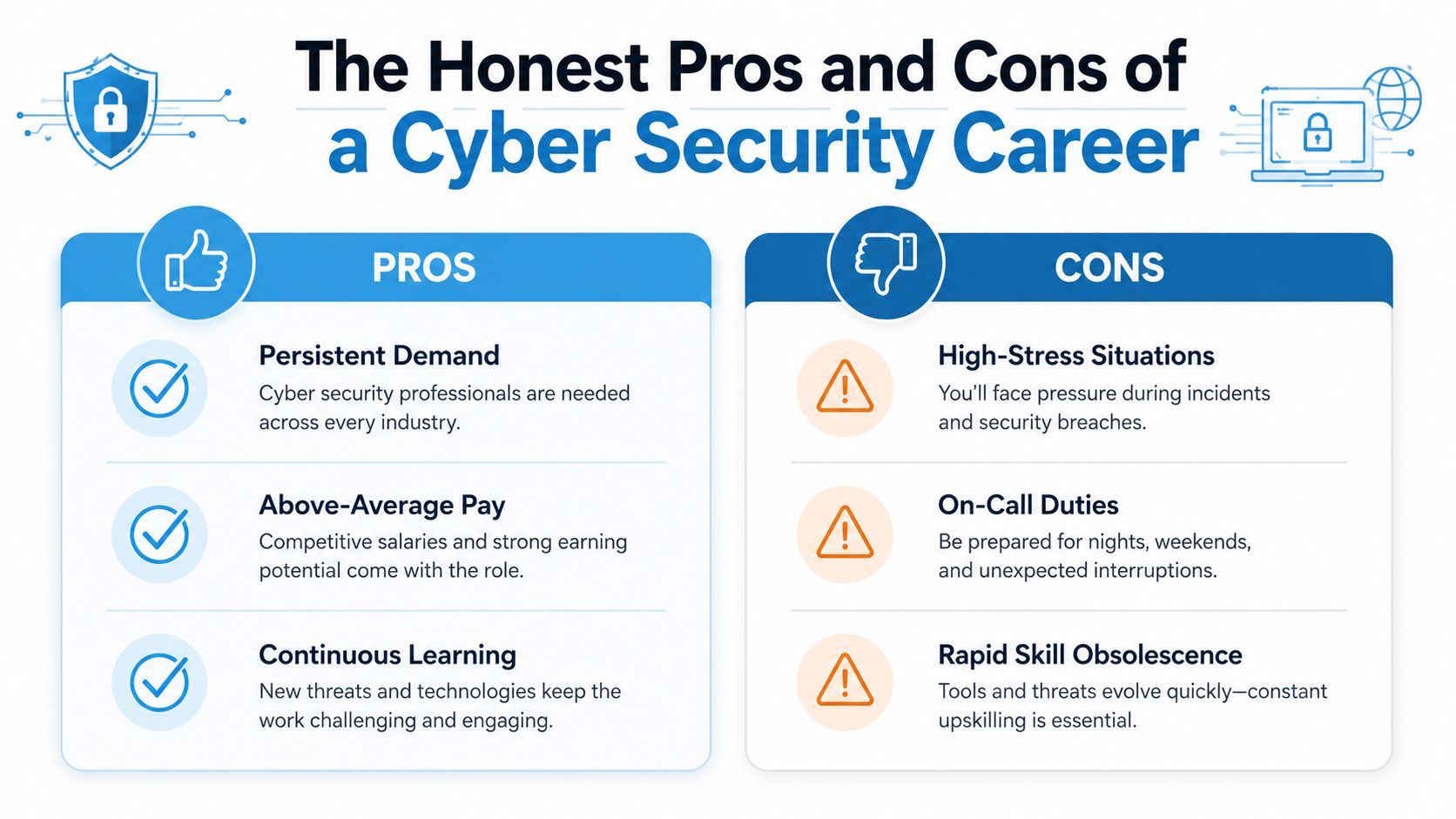
Cyber security can offer meaningful work, varied employers, and a route into a profession where learning continues throughout your working life. You may protect patient records, payment systems, public services, or a small organisation that lacks the resources to recover easily from an incident. That sense of responsibility can make routine tasks feel connected to a wider purpose.
The advantages are strongest for people who enjoy solving unfamiliar problems. Technologies change, attackers adapt, and employers need staff who can investigate rather than follow instructions mechanically. Hybrid and remote arrangements exist in parts of the sector, although monitoring, collaboration, security requirements, and incident coverage can limit flexibility.
The costs people underestimate
The profession also asks a lot from you. Threats and technologies change, so your initial course won't remain sufficient forever. You may need to learn new platforms, revise procedures, practise in labs, and explain unfamiliar risks to colleagues who don't share your technical background.
Incident response can be stressful. A serious alert may require rapid investigation, teamwork, and decisions with limited information. Some roles include on-call duties or shift work, while others offer more predictable schedules. Ask about these conditions during interviews rather than assuming every cyber job follows office hours.
The senior end of the market can be difficult to enter because employers want experience, judgement, and specialist knowledge. The sectoral analysis reports that salary demands remaining unaffordable stayed high at 46% in its 2025 findings. That suggests a mismatch between what some candidates request and what employers can fund, particularly in specialised hiring.
Cyber security is therefore a good career, but it isn't effortless job security. You'll need to accept continuous learning, occasional pressure, and the possibility that your first role won't be your ideal specialism.
How an Access to HE Diploma Opens the Door to a Cyber Degree
The qualification gap is practical, not personal. If you left school without A-Levels or don't hold a qualification universities accept for direct entry, an Access to Higher Education Diploma can provide a recognised preparation route for higher education.
An Access Diploma typically develops academic writing, research, study habits, and subject knowledge. For a Computer Science pathway, that may include mathematics, programming concepts, digital systems, and cyber security topics. You're not avoiding the academic standard. You're building the foundation needed to manage degree-level work.
A flexible route for adult learners
Online study can work around employment and family responsibilities, but flexibility doesn't mean the work disappears. You'll still need regular study time, assignment planning, tutor communication, and the confidence to ask for help when a topic feels unfamiliar. A provider may allow learners to start at different points and work at their own pace, but you should confirm the exact timetable, assessment method, and university progression requirements before enrolling.
Access Courses Online is one provider offering an online Access to HE Computer Science Diploma. Its course information describes a Cyber Security module covering threats, vulnerabilities, protection strategies, and business compliance, alongside preparation for university-level Computer Science study.
Funding can be part of the decision. The publisher states that it offers interest-free payment plans over 12 months, and its registration on the UK Government's Register of Learning Providers is identified by UKPRN 10033485. Treat those details as questions to verify directly with the provider, alongside eligibility for any funding support and the entry conditions for your intended degree.
A Computer Science degree can then broaden your options beyond one junior job. It may help you develop programming, algorithms, databases, networks, systems thinking, and structured problem-solving. Employers won't ignore practical capability, so use projects, labs, placements, and coursework to create evidence that complements the qualification.
A Realistic Story of Retraining Into Cyber Security
Consider a representative learner in their thirties who has no recent qualifications and works full-time. They're comfortable with spreadsheets, patient when solving customer problems, and curious about how technology works, but they don't yet understand networks or programming.
They begin an online Access to HE Diploma while continuing to work. The early weeks feel manageable, then coding assignments expose gaps in mathematical confidence and study technique. They create a weekly routine, use tutor feedback, practise with small exercises, and learn to treat mistakes as part of technical work rather than proof that they don't belong.
After completing the Diploma, they apply for a Computer Science degree and choose modules that support a cyber direction. They seek a placement year in a security operations centre, where they learn how analysts document alerts, investigate unusual activity, and communicate incidents. Rejection remains part of the process, particularly when vacancies ask for experience they haven't yet gained.
By graduation, the learner doesn't claim to be an expert. They can explain their projects, discuss the limits of their experience, and show how their previous work developed reliability and communication. A junior analyst role becomes a realistic first step, not because the route was easy, but because each stage produced evidence.
For adults considering retraining for a new career, the timeline can be roughly two to three years from starting an Access course to entering the cyber workforce, depending on the degree structure, placement choices, study pace, and hiring market. Your route may differ, but the pattern is useful: preparation, degree study, practical exposure, applications, and persistence.
Your Next Steps to Decide If Cyber Security Is Right for You
Don't decide from salary headlines or dramatic breach stories. Test your interest against the actual work, then compare your current qualifications with the requirements of a role you could realistically target.
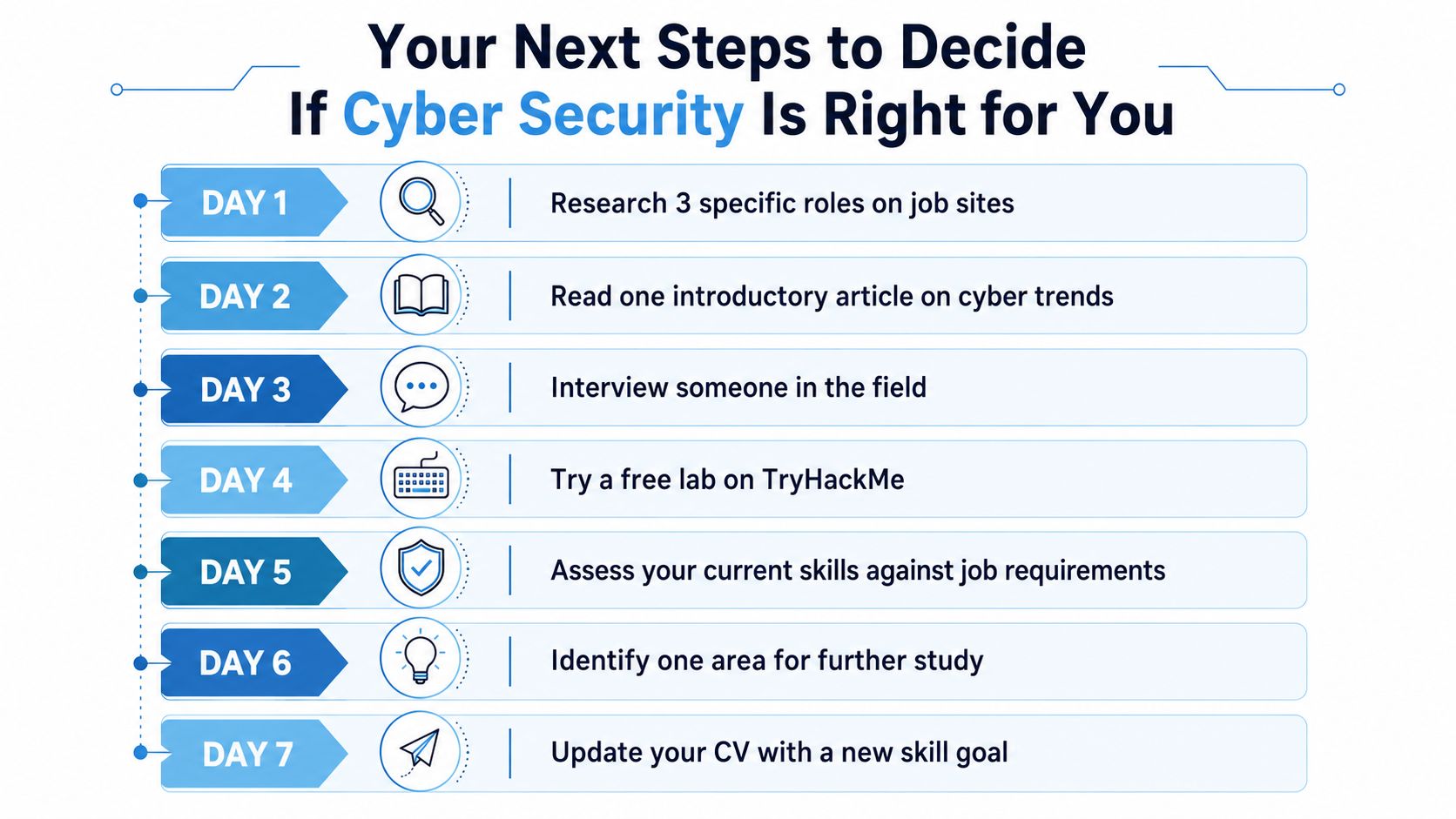
Use the next seven days well
- Day 1, choose three roles: Read adverts for SOC analyst, GRC analyst, security engineer, or penetration tester positions and record repeated requirements.
- Day 2, learn the vocabulary: Study one beginner-friendly introduction to networks, identity, vulnerabilities, incident response, and risk.
- Day 3, speak to a practitioner: Ask how their day is structured, what surprised them, and which entry requirements mattered.
- Day 4, try a lab: Use a beginner platform such as TryHackMe or CyberDefenders and notice whether guided investigation holds your attention.
- Day 5, audit your evidence: List your current skills, qualifications, work achievements, and gaps against real adverts.
- Day 6, select one foundation: Choose networking, Linux, Python, cloud, security operations, or GRC rather than trying to learn everything at once.
- Day 7, write a transition plan: Set a study goal, identify a qualification route, and update your CV so it reflects the direction you're pursuing.
You can also read practical guidance on how to break into tech without a background. If you enjoy the labs, tolerate the learning curve, and feel motivated by protecting systems, cyber security may be a confident yes. If you dislike continuous study or high-pressure incidents, GRC or another digital pathway may fit better. If the interest is there but your qualifications are missing, the answer is not yet, followed by a plan.
Access Courses Online offers an online Access to HE Diploma in Computer Science for adults preparing to progress to university, including study relevant to cyber security. Visit Access Courses Online to review the course route, ask about entry and payment options, and discuss whether it fits your career-change plan.