
Feeling stuck or uninspired at work? You're not alone. That nagging feeling that you're on the wrong path is more common than you might think.
Deciding to retrain for a new career isn't about giving up or starting from scratch. Far from it. It's now a proactive, intelligent move that millions are making to find greater fulfilment and security in their working lives. It’s about building something better on the foundation you already have.
Why A Career Change Is Now a Smart Move

The whole idea of a "job for life" feels like a relic from another time, doesn't it? Today's world of work is constantly shifting. New technology and economic changes are creating roles we couldn't have imagined a decade ago, while others are becoming obsolete. In this environment, standing still is often the biggest risk you can take.
Many of us reach a point where our job just doesn't fit anymore. It might not align with our values, spark our interests, or support our long-term goals. Maybe the challenge is gone, you're desperate for a better work-life balance, or you want to do something that has a more tangible, positive impact on the world.
Recognising the Signs It’s Time for a Change
If you're constantly feeling disengaged, stressed out, or just plain bored, your career might be trying to tell you something. See if any of these sound familiar:
- A growing sense of misalignment: Your work just doesn't reflect what's truly important to you anymore.
- Stagnation in skills: You feel like you're not learning anything new, and there are no real opportunities to develop.
- Industry instability: Your entire sector is facing disruption, and you’re worried about what the future holds for your job.
- The Sunday-night dread: The thought of Monday morning fills you with anxiety instead of a sense of purpose.
Retraining is an investment in your future self. It’s about taking control of your career trajectory and deliberately building a professional life that brings you satisfaction and stability, not just a paycheque.
This isn't just a feeling; it's a massive trend. Economic shifts and a collective re-evaluation of what we want from work have made career changes a mainstream reality. In the UK, retraining for a new career has become essential. Post-pandemic, a staggering 4 million Brits changed careers, with many turning to education to pave the way.
This shift is backed by a growing focus on adult education, helping to boost employability and ensure people have the skills needed for today's jobs.
Embracing this change means shifting your mindset. It’s not about throwing away your experience; it's about seeing it as a solid foundation. Committing to learning is a huge part of any successful career transition, offering countless lifelong learning benefits for both your professional and personal growth.
Every skill you've picked up—from managing projects to communicating with clients—is a transferable asset you can carry into your next chapter. The journey of retraining isn't a step back; it's a powerful leap forward.
Discovering a Career Path You'll Actually Enjoy
Before you even think about committing your time and money to a new course, you need a clear destination in mind. Jumping into retraining without a solid plan is a bit like setting off on a road trip with no map – you’ll burn through a lot of fuel and could easily end up somewhere you don’t want to be.
The first real step in retraining for a new career is taking a moment for some serious self-discovery. It’s about finding a path you will genuinely love waking up for.
This process is about more than just asking, "What am I good at?" While skills are definitely part of the equation, true career satisfaction comes from a sweet spot where your skills, your interests, and your core values all meet.
Uncovering What Really Drives You
Think of your values as your personal non-negotiables. They’re the principles that quietly guide your big decisions and define what feels truly meaningful to you. A job that clashes with these core values is a recipe for unhappiness, no matter how good it might look on paper.
Grab a pen and start reflecting on these questions:
- What kind of impact do I want to make? Do you feel a pull to help people directly, innovate with technology, create something beautiful, or contribute to a greener planet?
- What work environment helps me thrive? Are you at your best collaborating in a busy team, or do you prefer to work autonomously? Is a structured nine-to-five your thing, or is flexibility a must-have?
- What does success feel like to me? Is it public praise, a healthy bank balance, a quiet sense of accomplishment, or seeing the tangible results of your hard work?
Jot down whatever comes to mind without judging it. Soon, you'll start to see themes emerge. These are your clues, pointing you towards a career that will feel authentic and right for you.
Your past career wasn't a mistake; it was research. It taught you what you don't want. Now you can use that knowledge to consciously design a professional life that aligns with who you are today.
Once you have a better handle on your personal drivers, you can start exploring how to apply them. Our detailed guide offers more exercises on how to choose a career path that genuinely fits your life goals.
Mapping Your Skills and Interests
Next up, it’s time for an honest look at your abilities – both the obvious and the hidden ones. So many people underestimate their own skillset, especially when they're thinking about changing industries. Your previous experience, no matter how unrelated it seems, has packed your toolkit with valuable transferable skills.
Create two simple lists:
- Hard Skills: These are the teachable, technical abilities you have. Think things like software proficiency, data analysis, project management, or speaking another language.
- Soft Skills: These are your interpersonal strengths. We’re talking about communication, problem-solving, leadership, empathy, and adaptability. Employers consistently say these are just as important, if not more so.
Right next to your skills, make a list of your genuine interests and hobbies. What topics do you find yourself reading about just for fun? What kind of problems do you enjoy tackling in your spare time? A love for gardening, for instance, might point towards a fulfilling career in horticulture or environmental science. Don't dismiss anything!
Connecting Your Passion to Real-World Demand
Now that you've got a clearer picture of yourself, it's time to see how you fit into the UK job market. The goal here is simple: find where your passions overlap with sectors that have strong growth potential. This ensures your investment in retraining leads to a stable, long-term career.
Focus your research on high-demand industries like healthcare, technology, and green energy. A quick look at industry reports and job sites will show you which roles are consistently being advertised.
Before you start your research, it might be helpful to see where others are heading. This table shows the top sectors people in the UK are currently searching for when they consider retraining.
Popular Retraining Sectors in the UK by Monthly Search Volume
| Rank | Sector or Role | Average Monthly Searches for Courses |
|---|---|---|
| 1 | Sport and Fitness | 49,500 |
| 2 | Nursing | 33,100 |
| 3 | Administration | 27,100 |
| 4 | Accounting | 22,200 |
| 5 | Teaching Assistant | 18,100 |
As you can see, there's a strong trend towards service-oriented and essential roles. There’s also a significant pivot towards green skills, with a 58% increase in horticultural training applications recently, showing a clear move towards careers that offer both personal satisfaction and future growth.
Based on all this, your final task is to create a shortlist. Aim for three to five potential career paths that feel like a strong match for your values, skills, interests, and what the job market is looking for. This focused list will be the foundation for the next exciting phase: choosing the right course to get you there.
Finding the Right Course and Learning Style
Once you have a shortlist of potential new careers, the path forward starts to feel much more real. The big question shifts from "what do I want to do?" to "how do I get there?" Choosing the right qualification is a huge step, and it’s all about finding the perfect fit for your goals, your life, and how you like to learn.
The world of adult education is vast, and it’s easy to feel a bit lost at first. You’ve got traditional university degrees, hands-on apprenticeships, and everything in between. Each route has its own pros and cons. The key isn't finding the "best" one, but the one that’s best for you.
This decision tree gives you a good visual of the key things to think about as you map out your next steps.
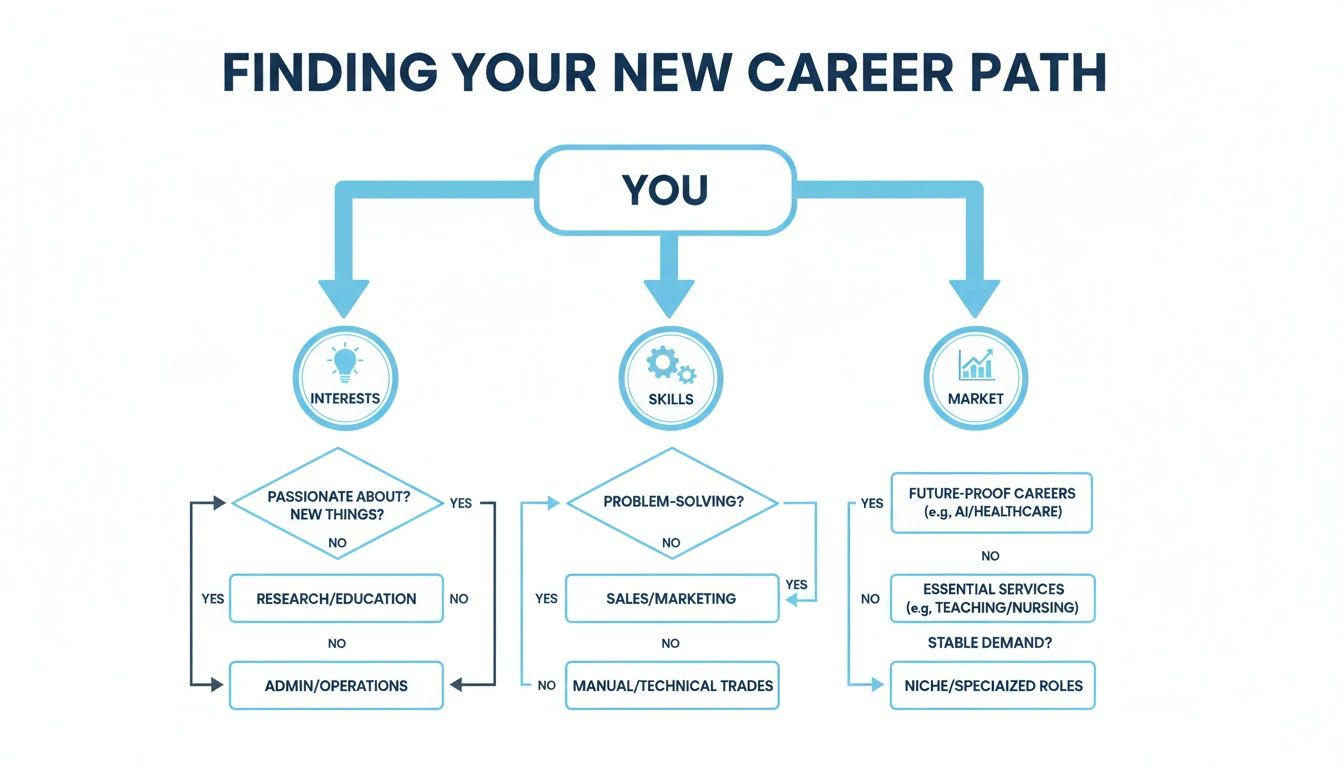
As you can see, finding a satisfying career path is about getting your interests, your skills, and the realities of the job market to all point in the same direction.
Understanding Your Qualification Options
Let's break down the main types of qualifications you'll come across in the UK. They all serve different purposes and lead to different places.
- University Degrees: This is the classic route for professions like medicine, law, and engineering. A degree gives you that deep theoretical knowledge and is often essential for graduate-level roles.
- Vocational Courses: Think practical, skills-based qualifications like BTECs or NVQs. They’re designed to get you ready for a specific job, whether that’s in social care, hairdressing, or plumbing.
- Apprenticeships: A brilliant option if you learn best by doing. You’ll be working for an employer—gaining real experience and a salary—while studying for a formal qualification on the side.
- Industry Certifications: These are usually shorter courses focusing on a specific skill, piece of software, or methodology (like digital marketing or project management). They’re fantastic for showing you have up-to-date knowledge in a fast-moving field.
For many adults who want to get into university but don't have A-levels, there's a specific and powerful pathway designed just for them: the Access to Higher Education (HE) Diploma.
An Access to HE Diploma is a Level 3 qualification that’s recognised by universities all over the UK. It was created specifically for adults returning to education, giving you the subject knowledge and academic skills you need to fly through a degree programme. Whether you’re aiming for Nursing, Midwifery, Computer Science, or Business, an Access to HE Diploma can be your direct ticket to uni.
Matching a Learning Style to Your Life
So, you know the type of qualification you need. The next big question is how you'll actually study for it. This is where your lifestyle, commitments, and personal preferences really come into play.
- Full-time study is the fastest way to get qualified, but it’s a big commitment. It usually means stepping away from work and dedicating yourself completely to your course. It's an immersive experience, but not always practical if you have bills to pay or a family to look after.
- Part-time study gives you more breathing room, letting you balance your studies with a job. The course is spread over a longer period, which makes the weekly workload feel much more manageable.
- Online or distance learning offers the most flexibility, period. You study from home, fitting your learning around your existing schedule. This is perfect for parents, carers, or anyone who needs to keep their job while they retrain.
The rise of flexible online courses has been a total game-changer for adult learners. You can find out more by exploring what distance learning involves and how it can be structured to fit your life. It puts you back in the driver’s seat of your own education.
How to Vet a Course Provider
Choosing where you study is just as important as choosing what you study. Not all course providers are the same, so doing a bit of digging is essential to make sure you’re investing your time and money wisely.
Before you sign up for anything, run through this quick checklist to see if the provider is a good fit:
- Accreditation and Recognition: Is the qualification the real deal? For an Access to HE Diploma, check that the provider is regulated by the Quality Assurance Agency (QAA).
- Tutor Support: What kind of help will you get? Look for providers offering one-to-one support from tutors who are experts in their field. Ask how and when you can contact them.
- Student Outcomes: What happens to their students after they finish? Good providers will happily share stats on how many of their students get into university or employment. Look for testimonials and case studies.
- Flexibility and Resources: Does the course really work for you? Check out the learning platform, the quality of the materials, and whether you can genuinely study at your own pace.
- Funding and Payment Options: Are there flexible payment plans or help with funding like the Advanced Learner Loan? A good provider will be upfront about costs and help you figure out your options.
How to Fund Your Career Transition
Let's get straight to it. For most people thinking about a career change, the big question is: "how on earth can I afford this?" Juggling course fees on top of a mortgage, bills, and family costs can feel completely overwhelming. But it's not impossible.
The trick is knowing where to look for support. Once you understand the funding options available here in the UK, you can build a realistic plan that makes your new start feel genuinely achievable, without the sleepless nights.
The Advanced Learner Loan Explained
If you're an adult learner in England, the Advanced Learner Loan is probably the most important bit of funding you need to know about. This isn't your typical high-street loan. It’s a government scheme designed specifically to cover the tuition fees for approved courses from Level 3 to Level 6.
It's paid straight to your course provider, so you never have to find the cash upfront. Better yet, it isn't based on your income and there are no credit checks.
So, who can get one?
- You need to be 19 or older when your course starts.
- The course and provider must be approved (our Access to HE Diplomas are!).
- You must be a UK national or have 'settled status'.
The repayment system is what makes this loan so manageable. You only start paying it back after you've finished your course and are earning more than the threshold, which is currently £27,295 a year. You don't repay a penny until you're in a much stronger financial position.
Here’s the best part: if you take out an Advanced Learner Loan for an Access to HE Diploma and then successfully complete a university degree, the government will completely "write off" whatever you still owe on that loan. It’s a massive incentive to help people like you get to university.
Exploring Your Other Funding Avenues
While the Advanced Learner Loan is a game-changer, it’s always smart to look at all your options. Sometimes, the best approach is to combine a few different streams of funding to create a plan that fits your life perfectly.
You might be surprised by what's out there.
- Employer Sponsorship: Could your new skills benefit your current company? It’s always worth asking if they’d be willing to pay for some or all of your training. Frame it as an investment that brings new expertise into the business.
- Apprenticeships: This is the classic "earn while you learn" route. You're paid a salary and get real, hands-on experience while your employer covers your training costs.
- Payment Plans: We, and many other providers, offer interest-free payment plans. This lets you break down the cost into smaller, monthly chunks that are much easier to fit into your budget.
For a really detailed look at how funding works, especially when you're aiming for university, check out the ultimate guide to Access to Higher Education funding. It breaks everything down for you.
Making It Work: A Real-World Scenario
Let's think about someone like Sarah, a 35-year-old retail manager dreaming of becoming a social worker. She can't just quit her job, but she needs an Access to HE Diploma to get her foot in the door at university.
Here’s a practical way she could fund her transition:
- Her Main Funding: Sarah applies for an Advanced Learner Loan. This covers the entire tuition fee for her online Access to HE (Social Science) Diploma, instantly removing the biggest financial barrier.
- Covering Bills: She cuts back her hours at work but keeps her part-time retail job. This ensures her mortgage and bills are still paid while she studies flexibly around her shifts.
- The Long-Term Plan: Sarah knows that once she finishes her Social Work degree, Student Finance England will write off her original Access course loan. This makes the whole journey far more affordable in the long run.
By combining the loan with her part-time income, Sarah has created a solid financial bridge to her new career. This step-by-step approach turns a scary financial obstacle into a manageable plan.
Balancing Study with Real Life and Gaining Experience
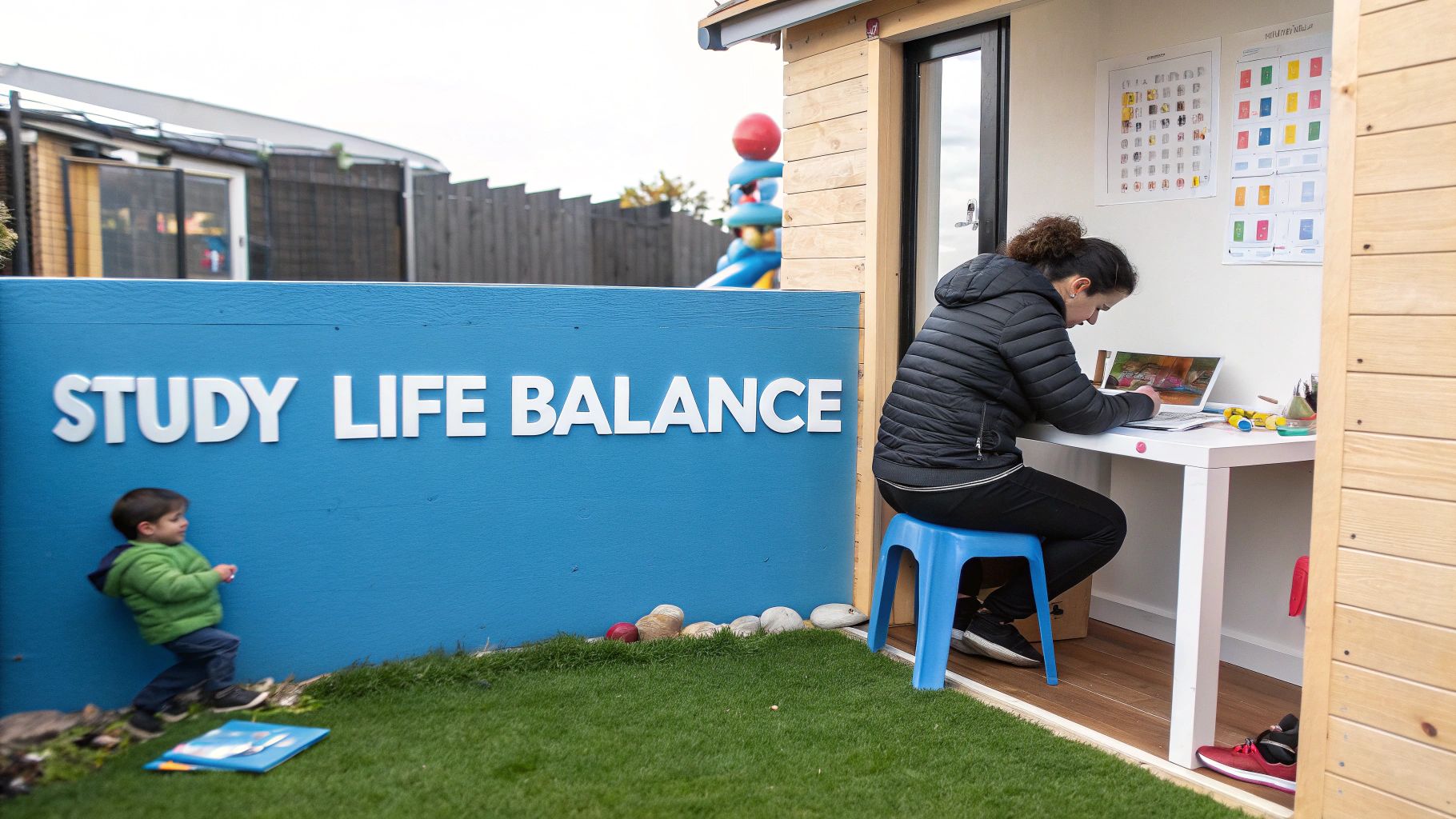
Starting a new course as an adult is rarely just about hitting the books. It’s more like a delicate juggling act, weaving your learning into a life that's already packed with work, family, and everything else. Your success in retraining for a new career will depend just as much on your time management as it does on your academic drive.
The trick is to be realistic right from the beginning. Just hoping you'll "find the time" isn't a strategy – it’s a fast track to burnout. You need to be deliberate and carve out the space your studies need to flourish.
Creating a Sustainable Study Routine
A super-strict, hour-by-hour schedule often falls apart the moment life throws a curveball, like a sick child or an urgent work deadline. A much better approach is to create a flexible framework that protects your study time while still leaving room for reality.
Think in terms of dedicated blocks of time. Could you ring-fence two evenings a week, plus a longer session on a Saturday morning? This gives you structure without being so rigid that it breaks.
It’s also massively important to get your support system on board. Let your partner, family, and friends know about your study blocks. Their understanding can make all the difference, turning potential interruptions into moments of encouragement.
Your support system is your secret weapon. When they understand your goals and your schedule, they can become your biggest cheerleaders, helping you protect your study time and celebrate your progress along the way.
Building Relevant Experience While You Learn
A new qualification is a huge asset, but let's be honest: employers are always looking for real-world experience. The great news is you don't have to wait until you graduate to start building it. Gaining experience while you're still studying is one of the smartest moves you can make.
It proves your commitment to your new field and gives you a massive head start when you begin applying for jobs. Think of it as building your future CV in real time.
Here are a few practical ways to get going:
- Volunteer Strategically: Look for a charity or non-profit in your chosen sector. If you’re aiming for social work, for example, volunteering with a local community support group provides invaluable insight and connections.
- Seek Freelance or Project-Based Work: Sites like Upwork or PeoplePerHour can be fantastic for finding small, manageable projects. An aspiring web developer could start their portfolio by building a simple website for a local business.
- Attend Industry Events (Even Virtually): Many professional organisations run webinars, workshops, and networking events. These are a brilliant way to learn the lingo of your new industry and start making contacts.
Uncovering Your Hidden Transferable Skills
One of the biggest mistakes career changers make is assuming they’re starting from scratch. That couldn't be further from the truth. Your previous jobs, no matter how unrelated they might seem, have loaded you up with valuable transferable skills.
The final piece of the puzzle is to look back and connect the dots. Take a proper look at your old job descriptions and think about the skills you used day in, day out.
For instance, a retail manager has tons of experience in:
- People Management: Leading and motivating a team.
- Budgeting and Financial Oversight: Managing stock, sales targets, and profit margins.
- Customer Service and Conflict Resolution: Handling tricky situations calmly and professionally.
- Project Management: Overseeing things like a store refit or a new product launch.
These aren't just "retail skills"; they are core business skills that are highly valued in almost any professional role. When you start your job search, your mission is to translate this experience into the language of your new industry. By highlighting these skills on your CV, you show employers you’re not a total newbie, but a seasoned professional with a fresh qualification and a solid foundation of proven abilities.
Your Questions About Retraining, Answered
Deciding to retrain for a whole new career is a massive step. It’s totally normal for your head to be buzzing with questions, doubts, and a few "what ifs." Concerns about age, time, money, and just the sheer unknown are part of the journey for pretty much everyone.
Let’s tackle some of the most common worries head-on. We'll give you the clear, straightforward answers you need to start moving forward with real confidence.
Am I Too Old to Start Over?
This is probably the biggest question we hear, and the answer is a huge, emphatic no. Honestly, your age is an asset, not something to worry about. Employers are increasingly waking up to the incredible value that mature professionals bring to the table.
Think about it for a second. You’ve got decades of life experience under your belt. That translates directly into highly sought-after skills like creative problem-solving, resilience when things get tough, and brilliant communication. You’re reliable, you get how workplaces operate, and you bring a level of calm that only comes with experience.
Many UK sectors, especially fast-growing fields like healthcare and social care, are actively looking for career changers who bring exactly this kind of maturity. On top of that, qualifications like the Access to HE Diploma were literally created for adults returning to education, proving there's a well-established and successful path waiting for you.
Don’t think of it as starting from scratch. You’re launching from a platform built on years of rich life experience. Focus on the unique perspective and stability you offer—something a younger candidate simply can't match.
How Long Will This Realistically Take?
The timeline for retraining and landing that new job can vary quite a bit, depending on the career you’re aiming for. There isn't a one-size-fits-all answer, but you can definitely map out a realistic schedule by looking at the specific requirements of your target role.
Some routes are quicker than others. For example:
- Tech Bootcamps for roles like a web developer or data analyst can often be completed in 6 to 12 months.
- An Access to HE Diploma, which is your golden ticket to university, can be finished in just 9 months of focused study with us.
- A full University Degree is typically a three-year commitment.
When you put it all together, the entire process—from day one of your course to your first day in a new job—could realistically take anywhere from one to four years. The trick is to break it down. Plan for the study period, then add on a few months for a dedicated job search afterwards. Suddenly, the whole journey feels much more manageable.
What if I Choose the Wrong Path?
This is such a common fear, but the experience is never, ever a waste. Let's say you complete a course and realise that career isn't quite the right fit after all. You haven't failed—you've just gathered more valuable information about what truly drives you.
The skills you pick up from any structured learning are universally useful. The discipline of studying again, the new knowledge you’ve soaked up, and the resilience you build are all powerful assets. They make you a more adaptable and interesting candidate for other roles down the line. If you do decide to pivot again, you'll be able to do it much more quickly and confidently because of the journey you’ve already taken.
How Can I Get Experience When I Have None?
Getting some hands-on experience while you study isn't just a nice-to-have; it's essential. Employers want to see that you’re proactive and genuinely passionate about your new field.
A great place to start is looking for volunteer roles. It’s a fantastic way to learn the ropes, build your network, and show your commitment on your CV. For more ideas and answers to frequently asked questions about changing careers, you can find some really valuable articles on JobCopilot's blog for career advice.
You could also look for small freelance projects on various online platforms to start building a portfolio. Most importantly, audit your past roles for transferable skills. Project management in retail uses the same core principles as project management in tech. Your job is to highlight these powerful connections on your CV, proving you’re bringing a wealth of relevant experience with you.
Ready to take the next step towards a career you'll love? At Access Courses Online, we specialise in helping adults just like you get the qualifications they need for university and beyond. Explore our accredited online Access to HE Diplomas and find your path today at https://accesscoursesonline.com.