
Thinking about your qualifications can feel a bit like sorting through a set of keys. A traditional GCSE is often seen as the standard key, but for many adults who've been away from the classroom for a while, it can feel like trying to fit an old key into a new lock. It just doesn't quite turn.
This is where a Level 2 Functional Skills English qualification comes in. Think of it less as a standard key and more like a master key, designed specifically for the doors you want to open in the real world. Instead of getting bogged down in analysing old texts, it focuses squarely on the practical, everyday English skills that employers and universities are really looking for.
What Level 2 Functional Skills English Means for You
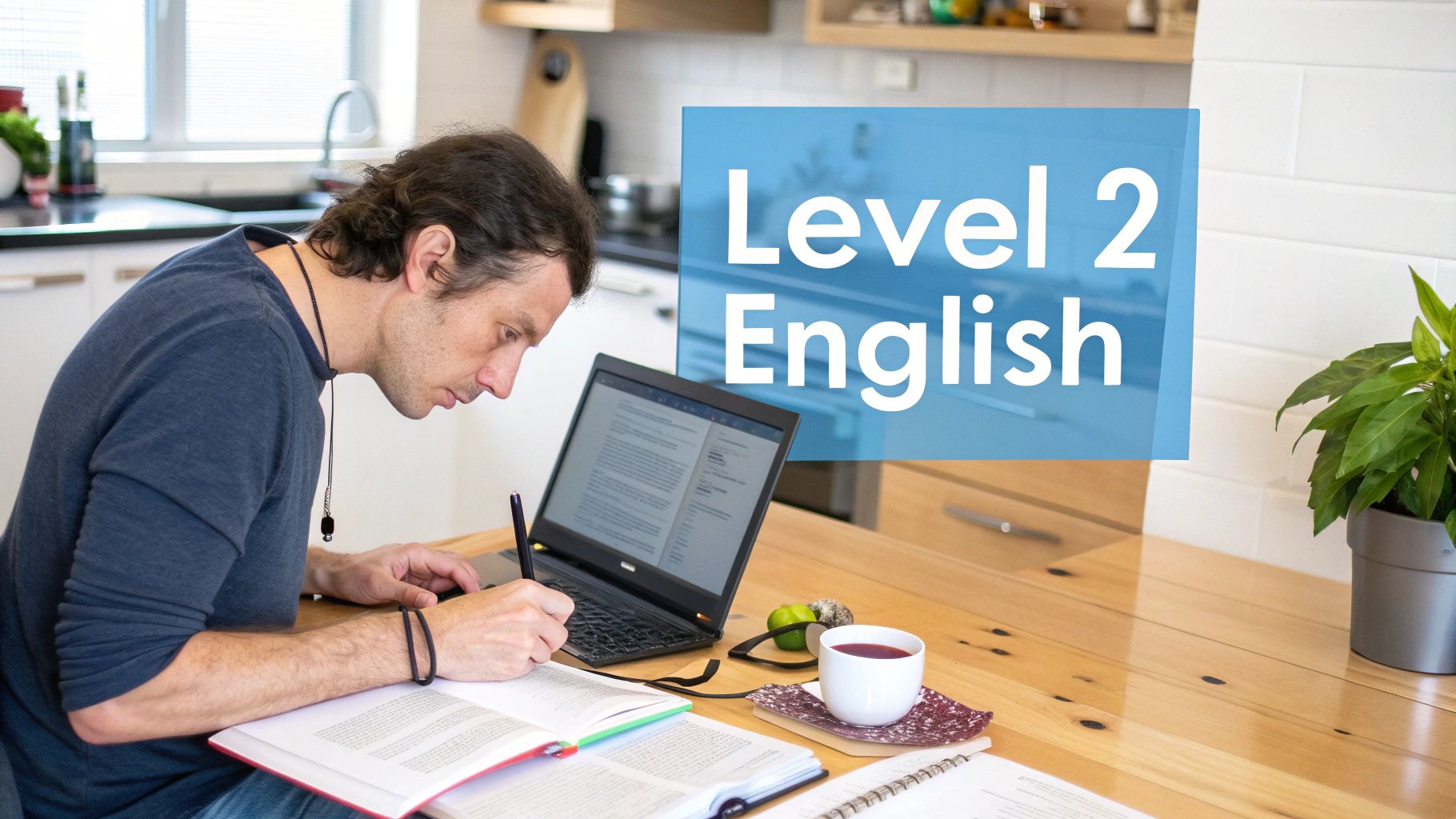
This isn't just another certificate; it's a powerful and practical alternative to a GCSE. Officially recognised by Ofqual (the UK's qualifications regulator), it's a direct equivalent to a GCSE grade 4 (what used to be a C). That means it carries the same weight and opens the same doors, especially when it comes to higher education.
For anyone aiming to enrol on an Access to Higher Education Diploma – your direct pathway to a university degree – this qualification is often the essential first step.
The real difference is its focus. It’s all about skills you can actually use. You'll learn how to:
- Write with purpose, whether that’s drafting a professional email, putting together a clear report, or composing a formal letter.
- Read with understanding, pulling out the important details from articles, instructions, and workplace documents.
- Speak with confidence, taking part in discussions and even giving short presentations.
It perfectly bridges the gap between academic theory and real-world application, which is why it feels so much more relevant and useful for adult learners.
A Quick Look at the Benefits
To put it simply, this qualification is designed for your success. Here’s a quick summary of how its features translate into real benefits for you.
Level 2 Functional Skills English at a Glance
| Key Feature | How It Helps You |
|---|---|
| GCSE Grade 4 Equivalence | Meets university and Access to HE Diploma entry requirements. |
| Focus on Practical Skills | Builds confidence in reading, writing, and speaking for work and life. |
| Nationally Recognised | Valued by employers and higher education institutions across the UK. |
| Flexible Online Study | Allows you to fit learning around your family and work commitments. |
Ultimately, it’s about giving you the tools and the ticket to move forward.
Why Is This Qualification So Popular?
The demand for credible, flexible qualifications is soaring. In fact, over 351,895 Functional Skills certificates were awarded in 2022-2023, a number that highlights just how many people are choosing this practical route to get ahead.
For adults studying with us at Access Courses Online, achieving Level 2 English is a massive confidence boost. It also satisfies the strict entry criteria for degrees in sought-after fields like nursing, business, and social work.
This qualification is your ticket to progression. It’s not just about passing an exam; it's about gaining the confidence and credentials to pursue the career you’ve always wanted, whether that's in healthcare, business, or another professional field.
If you’re keen to understand the bigger picture, our guide on what functional skills qualifications are provides some excellent context.
For anyone with university ambitions, this is your starting block. It proves you have the solid foundation needed to succeed in an Access to HE Diploma and thrive in a degree-level environment, turning those long-held career goals into an achievable reality.
Navigating the Three Parts of the Exam
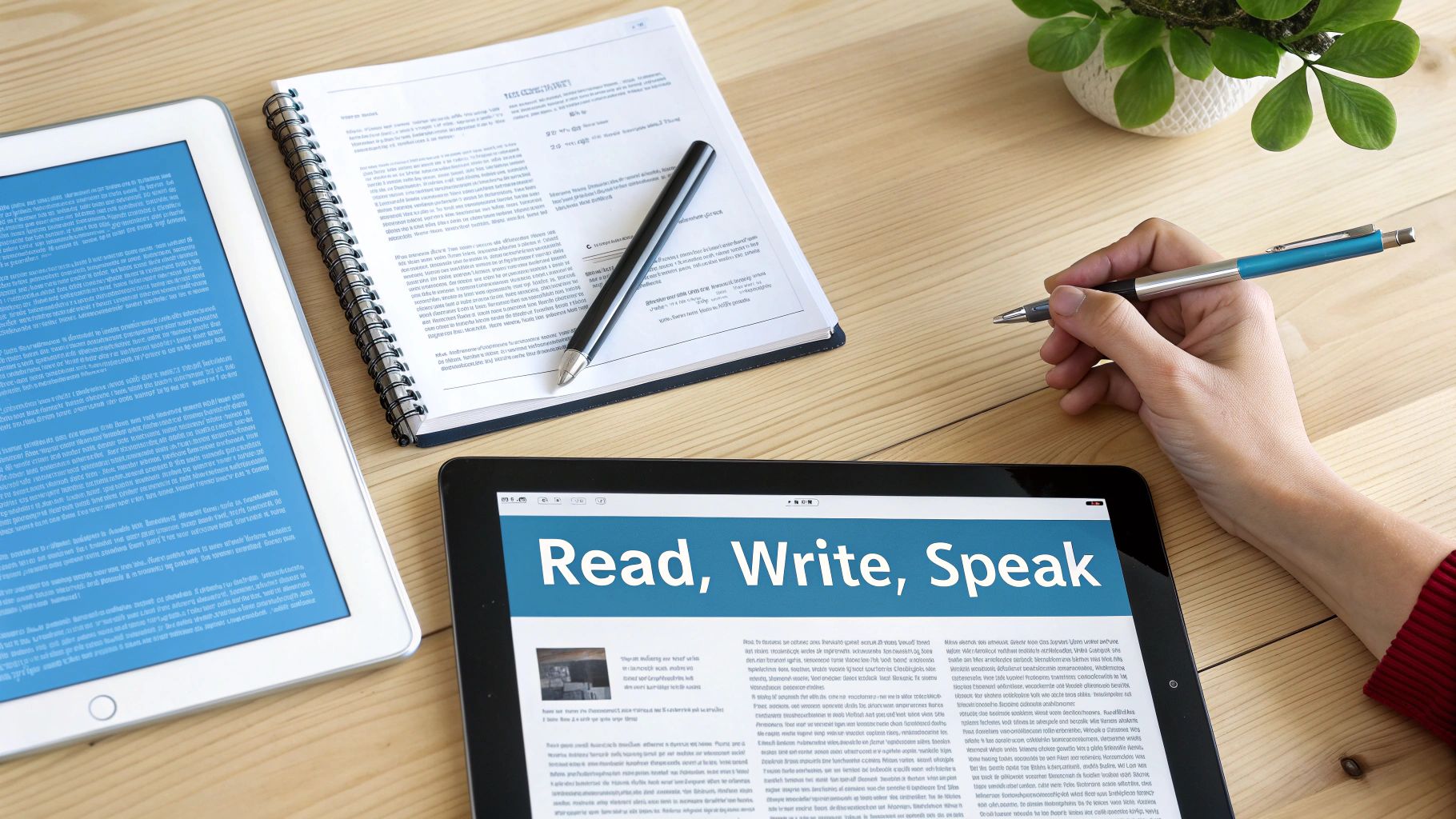
The Level 2 Functional Skills English exam isn't one huge, scary test. It’s actually broken down into three separate assessments, with each one zeroing in on a different, real-world communication skill. Getting to grips with how each part works is your first step to walking into that exam feeling totally prepared.
Think of it a bit like learning to drive. You don’t do everything in one go. You have the theory test (reading and understanding), the practical test (applying the rules in your writing), and you need to show you can communicate safely with others (speaking and listening). The English exam is built on the same idea, testing your skills in distinct, manageable chunks.
To get your qualification, you do need to pass all three components. But the good news is they are marked independently. This is a massive plus because if you trip up in one area, you only need to resit that specific part, not the whole thing all over again.
Mastering the Reading Component
The reading exam is all about seeing how well you understand and interpret the kind of texts you come across every day. This isn't about deep-diving into classic novels; it’s about practical, real-world comprehension.
You’ll be given a few documents to work with, which could be anything from:
- An article from a news website
- A formal email or memo you might get at work
- An instruction manual or a public information leaflet
- A blog post or an opinion piece
Your job is to answer a series of questions based on these texts. The examiners want to see that you can pull out the main points, scan for specific information, and figure out the tone and purpose of a piece of writing. You'll also need to spot the difference between facts and opinions, and identify any bias. The pass mark for this part usually hovers around 55-60%, but this can vary a little depending on the exam board.
Succeeding in the Writing Assessment
The writing exam tests your ability to create clear, well-structured, and accurate documents for different audiences and reasons. Once again, the focus is squarely on practical tasks you’d need at work or in formal situations.
You will typically be given two different writing tasks. These might include:
- A formal letter or email: Think writing a letter of complaint or a formal request to your boss.
- An article or report: This could involve summarising information or arguing a point on a set topic.
- A review or a blog post: Writing something to inform or persuade a more general audience.
So, what are the examiners looking for? It goes beyond just correct spelling and grammar. They want to see that you can adapt your style—using the right tone, structuring your thoughts logically into paragraphs, and choosing language that’s right for your reader. Taking a few minutes to plan your answer is a game-changer here.
The goal of the writing test isn’t to be the next J.K. Rowling. It’s about proving you can communicate clearly and effectively in writing—an absolutely essential skill for both university and the modern workplace.
Communicating with Confidence in the SLC
The final piece of the puzzle is the Speaking, Listening, and Communication (SLC) assessment. For many people, this can sound like the most nerve-wracking part, but it’s often the one students enjoy the most once they get going. It's your chance to show you can actively join in a discussion and present your ideas well.
The SLC is usually split into two activities:
- A short presentation: You’ll prepare and deliver a brief talk (usually 5-7 minutes) on a topic you’ve researched. This shows you can structure your thoughts and speak in an engaging way.
- A group discussion: After the presentations, you'll take part in a discussion with other students, led by an assessor. The focus here is on listening to others, responding to their points, asking good questions, and adding your own ideas constructively.
This part of the Level 2 Functional Skills English exam is all about your ability to express your thoughts, listen properly, and interact professionally in a group. It’s a direct reflection of the skills you’ll need in team meetings, university seminars, and any kind of collaborative project.
Is This Qualification the Right Fit for You?
Deciding to go back to studying is a huge step. But a Level 2 Functional Skills English qualification is built specifically for people with real lives and even bigger ambitions. It’s for those who can’t just press pause on their responsibilities but are determined to get ahead.
Does this sound familiar? Maybe you’re a parent juggling school runs and a household, dreaming of retraining as a nurse but needing a flexible way to get there. Or perhaps you’re great at your job but keep hitting a glass ceiling because you don’t have that formal English certificate.
These are exactly the kinds of people who find Functional Skills so valuable. It offers a practical, online path for adults who simply can’t commit to a rigid, term-time college schedule.
Connecting Where You Are to Where You Want to Be
Think of this qualification as more than just a piece of paper; it’s a launchpad. It’s the essential stepping stone to your next big move, whether that's getting into an Access to Higher Education Diploma or finally securing that promotion you’ve been working towards.
For a lot of people, the end goal is university. A Level 2 Functional Skills English qualification is your key to unlocking courses like:
- Access to HE Diploma (Nursing) to start a fulfilling career in healthcare.
- Access to HE Diploma (Social Science) to dive into fascinating fields like psychology or sociology.
- Access to HE Diploma (Business) to build the skills you need for a management or entrepreneurial path.
This single qualification connects the dots between your life right now and the future you want, making those big career goals feel completely within reach.
A Qualification Designed for Adult Learners
Today’s world of education understands that the traditional school-then-college route isn't for everyone. The popularity of Functional Skills English reflects a real need for flexible options for adults getting ready for university or a career boost. Even as things have shifted in further education, the number of Functional Skills certificates awarded shot up to 351,895 in 2022-2023, showing just how important it remains for adults. You can dig into more of these educational trends through the UK government’s official statistics.
This trend highlights a crucial point: you are not alone in looking for a different way forward. This qualification is popular because it respects your life experience and commitments while giving you the credentials you need to succeed.
This isn’t about going back to school; it's about moving forward in life. It's designed to fit around your commitments, empowering you to gain a GCSE-equivalent qualification without putting everything else on hold.
Ultimately, this qualification is the perfect fit if you're a motivated adult who needs a practical, credible way to open doors to university and better career prospects. It’s about gaining the confidence and the credentials to build the future you deserve. If this sounds like the path for you, take a look at the NCFE Level 2 Functional Skills Qualification in English to see how it can help you achieve your goals.
A Practical Strategy to Prepare and Pass the Exam

Passing your Level 2 Functional Skills English exam isn’t about stressful, last-minute cramming. It’s about building a solid, confident approach from day one. Think of a smart study strategy as your roadmap to success, breaking the journey into smaller, more manageable steps. It’s all about working smarter, not just harder.
The best way forward is to focus on building your skills bit by bit, rather than trying to memorise a mountain of information at once. This means you start with the fundamentals of grammar and structure, apply them to practice tasks, and then, finally, put it all together under exam conditions. It’s a steady approach that builds both your ability and your self-assurance.
This method also helps you avoid the burnout that often creeps in with intense revision. By spacing out your learning, you give your brain the time it needs to really absorb new information, making sure it sticks around for when it really counts.
Create Your Personalised Study Plan
First things first: you need a realistic study schedule that actually fits into your life. Consistency is so much more effective than the occasional marathon session. Honestly, even 30-45 minutes of focused study a few times a week can make a world of difference.
Start by figuring out your weaker areas. Are you a bit nervous about formal writing? Do you struggle to pick out the main point in a long article? A quick look at a past paper can help you pinpoint exactly where to focus your energy. Our guide on creating a study schedule that actually works is a fantastic place to start for organising your time.
Make sure your plan gives some love to all three exam components:
- Reading: Set aside time to read different kinds of texts, like news articles, blogs, and formal emails. Get into the habit of summarising the main points and thinking about the author's tone.
- Writing: Practise structuring different formats, like letters, reports, and emails. Keep an eye on using the correct layout, spelling, punctuation, and grammar (SPaG).
- Speaking, Listening & Communication (SLC): Choose a topic for your short presentation early on. The key here is to practise speaking it aloud to get your timing and confidence up.
If you’re looking for more structured guidance, exploring a practical guide to English lessons can offer some great support and fresh ways to master the language.
Overcome Common Exam Challenges
Lots of learners run into the same hurdles, but just knowing what they are is half the battle won. By preparing for these common trip-ups, you can turn potential weaknesses into strengths and walk into that exam room feeling calm and in control.
It’s easy to make small mistakes under pressure, but with the right strategy, you can avoid them completely. Here’s a quick look at the most common challenges and how to get ahead of them.
Common Exam Challenges and How to Overcome Them
| Common Mistake | Winning Strategy | Exam Component |
|---|---|---|
| Misreading the Question | Highlight keywords in the question. Read it twice to make sure you know exactly what's being asked. | Reading & Writing |
| Running Out of Time | Do practice papers to get a feel for timing. Give yourself a set amount of time for each part and stick to it. | Reading & Writing |
| Poor Structure in Writing | Spend 5 minutes planning before you write. Jot down a quick outline—intro, main points, conclusion. | Writing |
| Nervousness in SLC | Practise your presentation with friends or family. Have a few key points on prompt cards to keep you on track. | Speaking & Listening |
Getting on top of these common issues beforehand helps you build the resilience you need to handle exam day pressures like a pro.
Why This Strategy Works
Following a structured study plan for your Level 2 Functional Skills English isn't just a nice idea—it's a proven path to getting the grade you need. This qualification is designed to be achievable for anyone who prepares properly, and the numbers really back this up.
Recent data from 2021 to 2024 shows that pass rates for Level 2 Reading hit 84.1%, while Writing reached an impressive 85.1%. Compare that to the GCSE Level 2 English pass rate for 17-19-year-olds, which was just 19.3%. It’s clear that Functional Skills is a much more reliable and accessible route for learners who are ready to progress.
Success in this exam is about strategy, not just knowledge. By mastering time management, understanding the question, and building your confidence through practice, you are setting yourself up to not just pass, but to excel.
Ultimately, this methodical preparation gives you the tools to show what you know. It turns the exam from a daunting obstacle into a manageable challenge, putting you firmly on the path to getting your qualification and unlocking whatever comes next.
How We Help You Succeed on Your Learning Journey

Choosing the right support system for your Level 2 Functional Skills English qualification is just as important as choosing the course itself. At Access Courses Online, our entire approach is built around the realities of adult learning. We get it. You're not a traditional student; you have a job, a family, and a million other things going on.
That’s why we’ve torn down the common barriers that stop people from getting the qualifications they deserve. You won’t find rigid term times or impossible deadlines here. Instead, we offer a learning environment designed to fit you, not the other way around.
Flexibility That Actually Works for You
We believe your education should adapt to your schedule, simple as that. Our model is built on complete flexibility, putting you in control of your learning journey right from the start.
This means you get:
- Flexible Start Dates: You can enrol and begin your course whenever you’re ready, any day of the year. There's no need to wait until September to start building your future.
- Self-Paced Study: You decide when and where to study. Whether it’s early mornings, late nights, or during your lunch break, you can move at a speed that feels right.
- Interest-Free Payments: To make your qualification more accessible, we offer simple payment plans that let you spread the cost over 12 months, completely interest-free.
This approach puts you firmly in the driver’s seat, helping you balance your studies with your life without feeling overwhelmed.
Support That Makes a Real Difference
Studying online doesn’t mean you’re studying alone. Far from it. Personalised support is at the heart of everything we do. When you enrol with us, you’re assigned a dedicated personal tutor who is an expert in their field.
Your tutor is there to provide one-on-one guidance whenever you need it. They can help you get to grips with tricky topics, give you feedback on your assignments, and offer the encouragement you need to stay on track. Think of them as your personal guide, ready to help you build confidence and ensure you're fully prepared for your exams.
We are more than just a course provider; we are your partner in education. Our mission is to create a supportive and empowering environment that eliminates obstacles and helps you achieve your academic and career goals.
Our entire system—from flexible enrolment to dedicated tutor support—is designed to give you the best possible chance of success. By understanding the challenges adult learners face, we’ve created a pathway that makes achieving your Level 2 Functional Skills English qualification a realistic and rewarding experience, setting you up perfectly for your Access to HE Diploma and beyond.
Frequently Asked Questions
Thinking about new qualifications can bring up a lot of questions. To make sure you feel completely clear and confident, we’ve put together some straightforward answers to the queries we hear most often about Level 2 Functional Skills English.
Is Level 2 Functional Skills English Truly a GCSE Equivalent?
Yes, it absolutely is. The UK's official qualifications regulator, Ofqual, formally recognises it as equivalent to a GCSE at grade 4 (what many people still remember as a grade C).
This means universities and employers accept it when you apply, making it a powerful and credible alternative for getting into higher education or landing a better job.
How Quickly Can I Complete the Course and Exam?
This is one of the best parts – the timeline is wonderfully flexible because it’s built around you.
With a self-paced online course, some people manage to prepare and sit their exam within just a few weeks. Others might take a few months, fitting their study sessions around work and family life. You are completely in control and can set a pace that actually works for you.
Will Universities Accept This for an Access to HE Diploma?
Absolutely. Nailing your Level 2 Functional Skills English ticks the box for the essential English language entry requirement for Access to Higher Education Diplomas.
It's the perfect stepping stone that qualifies you to enrol on a diploma in fields like Nursing, Business, or Social Work, which in turn sets you up for a strong university application.
One of the biggest benefits is its modular nature. If you don't pass one component, you only need to retake that specific part—not the entire exam. This reduces stress and helps you focus your revision exactly where it's needed.
What Happens If I Don’t Pass One Part of the Exam?
This is where the qualification’s design really helps you out. The Reading, Writing, and Speaking & Listening components are all assessed independently of each other.
If you don’t quite pass one part, you only have to retake that specific section. This practical approach lets you concentrate your revision efforts where they’ll have the most impact, without the stress of redoing the parts you’ve already passed.
For answers to even more common queries, you might find these additional Frequently Asked Questions helpful for building a complete picture of what to expect.
At Access Courses Online, we are dedicated to helping you take this crucial step towards your future. If you’re ready to gain the qualification you need for university and career progression, explore our courses and start your journey today. Find out more at https://accesscoursesonline.com.