
So, you’ve decided you want a career in nursing. It’s an incredible choice—a profession built on skill, compassion, and making a real difference. But what if you feel stuck? Maybe you left school years ago, and the A-Levels needed for a university degree feel like a mountain you can’t climb.
It’s a common story, and if it sounds familiar, don’t worry. This isn’t the end of your journey—it’s just the beginning.
Your Pathway to a Nursing Career Starts Here

This is exactly where the Access to Higher Education (HE) Diploma in Nursing comes in. Think of it as a dedicated pathway, designed specifically for adult learners who want to get to university but don’t have the traditional qualifications. It’s a nationally recognised qualification that universities respect and trust.
Essentially, it’s a one-year course that bridges the gap between where you are now and where you want to be—a student nurse on your way to a fulfilling career.
Who Are Nursing Access Courses For?
These courses are tailor-made for people from all walks of life who share one common goal: to become a nurse. You might be a parent ready to get back into work, a healthcare assistant looking to qualify, or someone simply searching for a more rewarding profession.
The main requirement isn't a list of qualifications from your past, but the drive and commitment to build your future.
A nursing access course is perfect for you if you are:
- Ready to start a university nursing degree but don't have the required A-Levels.
- A mature student returning to education after a break.
- Looking for a focused, one-year programme to get you university-ready, fast.
An Access to HE Diploma is so much more than a certificate. It’s a journey that builds not only your academic knowledge in subjects like biology and psychology but also your confidence and study skills. The goal isn’t just to get you into university—it’s to make sure you thrive once you’re there.
To give you a clearer picture, let's break down the key features.
Nursing Access Course at a Glance
This table offers a quick snapshot of what you can expect from an Access to HE Diploma for Nursing.
| Feature | Description |
|---|---|
| Qualification Level | Level 3 qualification, equivalent to 3 A-Levels. |
| Course Duration | Typically 9-12 months of study. |
| University Entry | Recognised by universities across the UK for entry into nursing degrees. |
| Study Method | Available for online study, allowing you to learn flexibly around your life. |
| Key Subjects | Focuses on core subjects like Human Biology, Psychology, and Sociology. |
| Skill Development | Builds essential academic skills like essay writing and research. |
This diploma is a tried-and-tested route for countless students. These intensive courses are a vital pathway into nursing and midwifery degrees, focusing on the subjects you need while sharpening your academic skills. You can find out more about the structure of these empowering nursing courses to see how it all fits together.
Consider this guide your roadmap. We’ll walk you through everything, from the course structure to applying for university. Your ambition to become a nurse is within reach, and this diploma is the first real step to making it happen.
So, What Exactly Is a Nursing Access Diploma?
Let's break down what an Access to Higher Education Diploma really is. Put simply, it’s a Level 3 qualification specifically designed to get you ready for the challenges and excitement of a university nursing degree. It’s recognised across the country and is equivalent to three A-Levels, making it a trusted and direct route into higher education.
Think of it like a purpose-built bridge. On one side, you have your life experience and the ambition to become a nurse. On the other side is the first day of your degree. The nursing access course is the structure that connects the two, making sure you can cross over with confidence and all the right skills.
But this isn't just about ticking a box to get into university. The whole course is built to give you a solid foundation in subjects that are central to nursing, while at the same time developing the academic skills you'll need to thrive once you get there.
Core Knowledge for Future Nurses
The diploma is made up of different modules, and each one has been carefully chosen to give you a head start in your nursing studies. You won’t find yourself studying irrelevant subjects; every single topic is directly connected to the healthcare world.
The main subject areas usually include:
- Human Biology: This is where you’ll get to grips with anatomy and physiology, exploring how the human body works, from the cellular level right up to major organ systems. It’s the scientific bedrock of everything you’ll do in healthcare.
- Health Studies: Here, you'll look at the bigger picture, like public health, the structure of the NHS, and the ethical dilemmas you might face in healthcare. It gives real-world context to your future role.
- Psychology & Sociology: Understanding people is at the heart of nursing. These modules help you understand human behaviour, mental health, and the social factors that affect a person's wellbeing, which is vital for patient-centred care.
These subjects are picked for a good reason – they often mirror what you'll study in the first year of a nursing degree. That means you’ll walk into university already familiar with key ideas, which is a massive advantage.
More Than Just Subjects – It's a University Toolkit
Beyond the specific topics, nursing access courses put a huge focus on building essential academic skills. For many adults returning to education after a break, this is often the most valuable part of the whole experience. It’s all about learning how to learn at a university level.
The Access to HE Diploma teaches you the language of academia. It transforms you from someone who wants to study into someone who is fully equipped to excel in a demanding university environment.
This practical skill-building makes sure you're not just ready for the content of your nursing degree, but also for the way it's taught and assessed. You’ll learn how to handle things like:
- Academic Writing: You'll learn how to structure essays, write clear reports, and present a solid argument.
- Research Skills: Discover how to find, evaluate, and properly cite credible sources – a non-negotiable skill for evidence-based nursing.
- Critical Analysis: You'll be taught how to look at information critically, question assumptions, and form your own well-reasoned conclusions.
- Time Management: The course itself, whether you study online or in a classroom, helps you build the self-discipline needed to manage a university-level workload.
Gaining Your Ticket to University: UCAS Points
Universities use the UCAS tariff point system to compare different qualifications for entry. As you complete the modules on your Access to HE Diploma, you’ll be awarded credits with grades of Pass, Merit, or Distinction. These grades all add up to give you a final total of UCAS points.
A strong performance on your nursing access course can easily generate enough UCAS points to meet the entry requirements for even the most competitive nursing degrees in the UK. The qualification is regulated by the Quality Assurance Agency for Higher Education (QAA), which means universities respect its rigour and trust the students who come through this route.
And it’s a route that’s becoming more and more popular. Courses for health-related professions are now the most common type of Access to HE Diploma. During the 2021-22 academic year, over 60% of all enrolments were in subjects like nursing and health sciences, with 24,745 students starting their journey. You can read more about these key stats at Skills and Education Group Access. It’s a clear sign of just how trusted this path has become for aspiring healthcare professionals.
Choosing Your Study Method: Online vs On-Campus
One of the biggest decisions you'll make when starting this journey is how you’ll actually study. Should you opt for the traditional buzz of a physical college, or embrace the freedom of an online course? Both routes get you the exact same nursing access courses qualification, but they offer completely different experiences for different lifestyles.
Think of it like choosing how to travel to a destination you’ve always wanted to visit. The on-campus route is like catching a train—it runs on a fixed schedule, you travel with a group of fellow passengers, and the structure is clear and predictable. The online route is like driving your own car—you set the pace, decide when to take breaks, and have complete control over your journey. Neither is better; it’s all about what suits you.
This decision tree can help you visualise which path might be a better fit for your current situation and career goals.
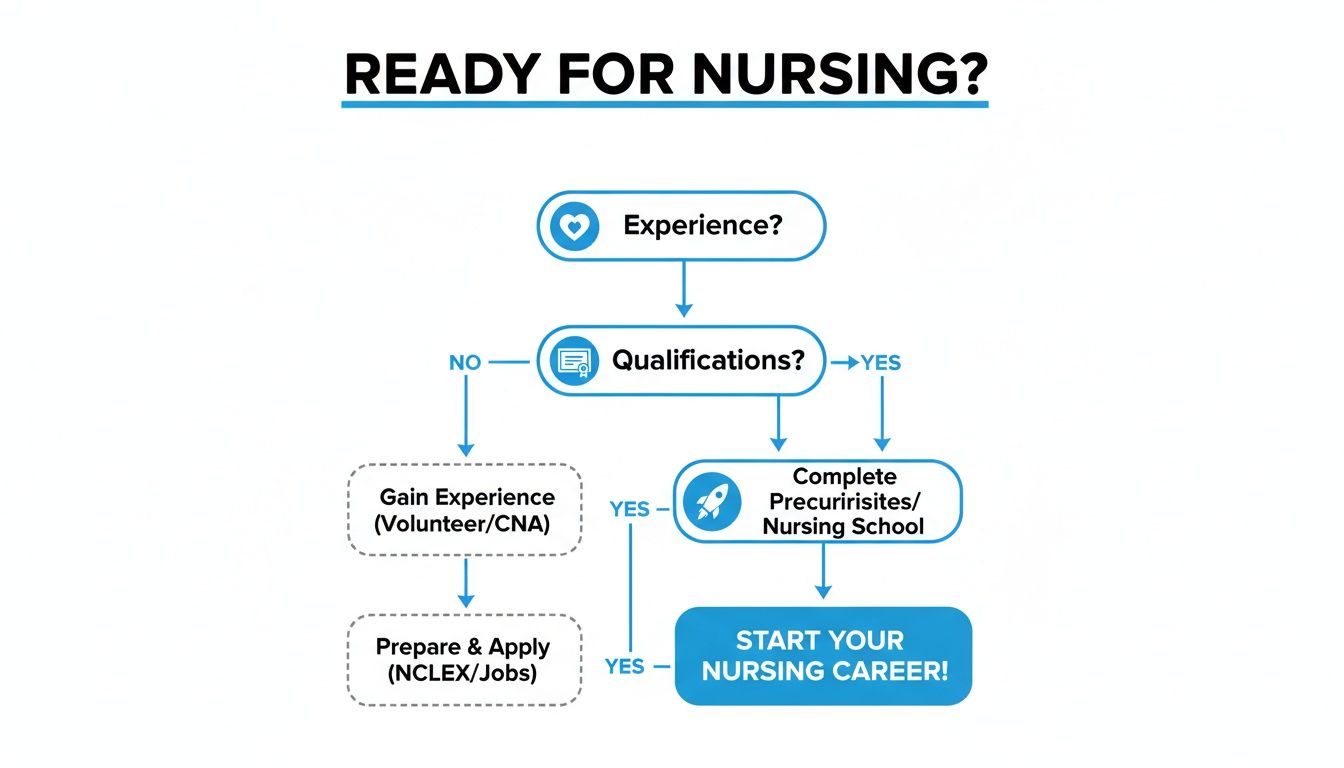
As you can see, no matter where you're starting from—whether you’re coming in with experience or need to build your qualifications from scratch—there's a clear path to get you ready for a nursing degree. Let’s break down what these two paths really feel like day-to-day.
The Case for Online Nursing Access Courses
Online learning has become a lifeline for adult learners, especially for those of us juggling a million other things. The biggest draw? Unmatched flexibility. If you have a job, a family, or other commitments, an online course lets you fit your studies around your life, not the other way around.
You can dive into your modules after the kids are in bed, during your lunch break, or over a quiet weekend. This self-paced approach means you can spend extra time on tricky topics or fly through material you find straightforward, ensuring you truly understand everything before moving on. For many, this freedom is what makes returning to education possible.
Plus, everything you need is in one digital hub—lecture notes, reading materials, assignments, and tutor support are all just a click away. It completely removes the daily commute, saving you precious time and money.
Online study puts you in the driver’s seat of your education. It builds fantastic skills like self-discipline and time management—all of which are hugely valuable at university and in a modern healthcare setting.
The Strengths of On-Campus Learning
On the flip side, studying at a physical college offers a more traditional and structured experience. The standout benefit here is the direct, face-to-face interaction with tutors and your classmates. Being in a classroom means you can ask questions on the spot, get into lively group discussions, and receive immediate feedback.
This collaborative atmosphere can be incredibly motivating. Learning alongside others with the same goal creates a real sense of community and a built-in support network. If you thrive on social interaction and learn best by talking things through, an on-campus course could be a perfect match.
On-campus students also get access to physical facilities like libraries, labs, and dedicated study spaces. The fixed timetable provides a clear structure that some people find essential for staying motivated and on track. For a deeper dive into how our online courses work, you might find our guide on Access to Nursing courses online helpful.
Online vs On-Campus Nursing Access Courses
Still weighing it up? This side-by-side comparison breaks down the key differences to help you decide which study method is right for your circumstances.
| Consideration | Online Learning | On-Campus Learning |
|---|---|---|
| Schedule | Highly flexible; study whenever and wherever you want. | Fixed timetable with set class times. |
| Pacing | Self-paced; you control the speed of your progress. | Tutor-led; the whole class progresses together. |
| Interaction | Digital communication via email, forums, and video calls. | Direct, face-to-face interaction with tutors and peers. |
| Location | No commute needed; learn from the comfort of home. | Requires daily travel to a physical college campus. |
| Learning Style | Perfect for independent, self-motivated learners. | Great for collaborative learners who prefer structure. |
| Support | One-to-one tutor support through digital channels. | In-person support during class and set office hours. |
Ultimately, the right choice is the one that fits with your personal circumstances, your learning style, and your life. Both paths are designed to get you to university and one step closer to your dream of becoming a nurse.
Navigating Entry Requirements and Your Application
Taking that first step can often feel like the biggest hurdle, but when you break the application journey down into smaller, manageable pieces, it suddenly seems much less intimidating. The whole process is designed to be straightforward, making sure your passion and potential are what really get to shine through. Let's walk through what you’ll need and how to kickstart your journey to becoming a nurse.
One of the best things about a nursing access course is that it's built for accessibility. Unlike the traditional university route which often demands a very specific set of A-Levels, the entry requirements here are much more focused on your readiness to learn and your commitment to the field.
Understanding the Core Entry Requirements
While you might find slight differences between course providers, the standard entry requirements are pretty consistent across the UK. It helps to think of them not as barriers, but as a simple checklist to make sure you’re set up for success from day one.
Typically, you will need:
- Age Requirement: To enrol on an Access to HE Diploma, you must be 19 years or older when the course begins.
- GCSEs: Most providers will look for GCSEs in English and Maths at grade 4 (or C) or above. These are seen as the essential building blocks for handling the academic reading, writing, and calculations you'll encounter in a nursing degree.
- Equivalent Qualifications: If you don't have these specific GCSEs, don't panic. Many institutions, including Access Courses Online, accept Functional Skills Level 2 qualifications in Maths and English as a direct equivalent.
The entry criteria aren't there to catch you out. They exist to make sure you have the fundamental literacy and numeracy skills needed to thrive on the course and, later, in a demanding university environment. This is all about setting you up for success, not holding you back.
The rising popularity of Access courses in health-related fields is a direct response to the UK's need for more skilled healthcare professionals. To be eligible, students need to be 19 or over and usually hold GCSEs in English and Maths at grade 4/C or an equivalent, with work experience also being a big plus. This pathway is becoming absolutely vital as the NHS works to fill around 40,000 nursing vacancies in England alone, highlighting just how critical Access graduates are. You can discover more about how these courses address the nursing shortage and help build the future of our healthcare sector.
The Value of Healthcare Experience
While it isn't always a mandatory requirement for the Access course itself, getting some hands-on experience in a healthcare setting can be a massive advantage. It makes your application much stronger, helps you confirm that nursing is definitely the right career for you, and gives you real-world examples to talk about in your personal statement and interviews.
This doesn't mean you need to have worked in a hospital. Relevant experience can come from all sorts of places:
- Volunteering: Helping out at a local care home, hospice, or with a health-focused charity.
- Paid Work: Roles like a healthcare assistant, support worker, or carer provide fantastic, direct experience.
- Community Roles: Even roles that involve looking after vulnerable people can demonstrate the compassion and empathy that are at the very heart of nursing.
Your Step-by-Step Application Guide
Ready to get started? The process is clear, logical, and designed to guide you through.
- Find Your Course Provider: The first step is to research different providers of nursing access courses. Look for one that offers the flexibility you need—like an online provider—and has a strong track record of helping students get into university.
- Complete the Application Form: This is where you'll provide your personal details, previous qualifications, and any relevant experience. Just be thorough and honest.
- Craft Your Personal Statement: This is your moment to shine. Use it to tell your story. Why do you want to be a nurse? What has motivated you? What skills do you already have? Talk about your experiences and connect them to the core values of nursing, like compassion, communication, and resilience.
- Prepare for Your Interview: The final step is usually a friendly, informal interview. Think of it as a two-way conversation—it’s a chance for the provider to learn about you, and for you to ask any questions you have. They'll want to see your commitment and your understanding of what the nursing profession really involves. It’s a good idea to prepare by thinking about common questions, such as "Why nursing?" and "What qualities do you think a good nurse needs?"
How to Fund Your Nursing Access Course
Thinking about starting a new career in nursing is exciting, but it’s completely normal for the practicalities – like course fees – to feel a bit daunting. The good news is, you absolutely don’t have to let finances stand in the way of your dream career.
There are several straightforward funding options out there designed to make your education affordable. Let's walk through them so you can move forward with confidence.
For most people wanting to study a nursing access course, the best route by far is the Advanced Learner Loan. This is a government-backed loan created specifically for learners aged 19 and over who are studying approved Level 3 qualifications, which includes our Access to HE Diplomas.
You can think of it like a student loan, but it comes with a game-changing benefit for anyone heading into nursing.
The Advanced Learner Loan Explained
First off, the loan covers your course fees completely. That means you don’t have to pay a single penny upfront to get started on your studies.
You only start making repayments once you've finished your course and are earning above the repayment threshold, which is currently £27,295 a year. The repayments are designed to be manageable, set at just 9% of whatever you earn above that amount.
But here’s the most important part for aspiring nurses.
Student Finance England will completely 'write off' your outstanding Advanced Learner Loan balance once you complete an eligible higher education nursing degree. This means your Access to HE Diploma essentially becomes free, acting as a direct and fully funded stepping stone to university.
This incredible incentive makes the journey to becoming a nurse more accessible than ever before. It takes the financial pressure of the initial qualification right off the table, letting you focus completely on your studies and your future. For a deep dive into all the details, check out our comprehensive guide to Access to Higher Education funding.
Other Funding Pathways
While the Advanced Learner Loan is the go-to choice for most, it's good to know what other options are out there.
- Instalment Plans: Many course providers, including us here at Access Courses Online, offer flexible payment plans. This lets you spread the cost of your course over several months with interest-free payments, which can make budgeting a lot easier.
- Employer Sponsorship: If you're already working in a healthcare setting, it's worth a conversation with your line manager. Some employers are willing to sponsor or contribute towards training that helps you progress.
- Self-Funding: Of course, you can always choose to pay for the course fees yourself. If you've got the savings put aside and prefer not to take out a loan, this is a great, straightforward option.
How to Apply for the Loan
Getting your Advanced Learner Loan is a simple online process that’s tied directly to your course enrolment. It’s not complicated at all.
- Enrol on Your Course: First things first, you need to be accepted onto an approved Access to HE Diploma course.
- Receive Your Learning and Funding Letter: Once you're enrolled, your course provider will send you this letter. It contains all the key information you’ll need for the loan application.
- Complete the Online Application: With your letter in hand, you’ll head over to the GOV.UK website to fill out the application.
- Approval: Once your application is approved, the loan is paid directly to your course provider. You never have to handle the money yourself.
This streamlined process is designed to take care of the financial side from day one, leaving you free to focus on what really matters – achieving your academic goals and getting started on your path to nursing.
From Access Course to University and Beyond

Finishing your Access to HE Diploma is a massive achievement, but it’s really just the beginning. Think of it as the launchpad for the next exciting stage of your life: securing your spot on a nursing degree course at university. This diploma is the key that unlocks that door.
Universities all over the UK really value the Access to HE qualification. They know it produces students who are dedicated, well-prepared, and ready for the challenges of higher education. The UCAS points you earn are your ticket in, putting you right on par with applicants holding traditional A-Levels.
Turning Your Diploma into a Degree Offer
Once you’ve got that diploma in hand, you're all set to apply for a whole range of specialised nursing degrees. Your hard work opens doors to different fields, so you can chase the area of nursing you’re truly passionate about. If you need some practical advice on what comes next, our guide on how to apply to university after an Access course breaks it all down for you.
You could specialise in areas like:
- Adult Nursing
- Child (Paediatric) Nursing
- Mental Health Nursing
- Learning Disability Nursing
The need for qualified nurses is always high. While there was a huge surge in student numbers between 2019 and 2021, recent figures from early 2025 show a promising 1% increase in acceptances. It’s a great time to be entering the profession, with a real push to create more nursing posts where they’re needed most.
From Student to Professional: A Lifelong Career
Your journey doesn’t stop when you graduate from university; that’s where your professional life truly begins. A nursing degree leads to a stable, respected, and incredibly rewarding career with clear pathways for progression and specialisation. So many of our former Access students are now thriving as registered nurses, clinical specialists, and healthcare leaders.
The path from a nursing access course to becoming a qualified nurse is more than just an educational route; it's a personal transformation. You aren't just gaining a qualification—you are stepping into a profession where you will make a real difference in people's lives every single day.
As you look towards your future, always remember that nursing is all about people. Brilliant communication and empathy are just as crucial as your clinical knowledge. As you get ready for patient-facing roles, it’s a smart move to improve your customer service skills, as these abilities are priceless. Every step you take on this course is a direct investment in a future where you are a valued and essential healthcare professional.
Here's the rewritten section, crafted to match the human, expert tone of the provided examples.
Your Questions About Nursing Access Courses, Answered
Thinking about taking the leap into a nursing access course is exciting, but it’s completely normal to have a few questions swirling around. Getting clear, straight answers is one of the most important steps you can take to feel confident about your decision.
We get asked a lot of questions by people just like you. From how you'll manage the workload to what happens if life throws you a curveball, we've gathered the most common queries right here to give you the practical information you need for the journey ahead.
How Long Does a Nursing Access Course Take to Complete?
One of the best things about an Access to HE Diploma is just how quickly it can get you ready for university. Most of our online learners wrap up their course in about 9 to 12 months.
But life isn’t always that straightforward, is it? That’s where the flexibility of online learning really shines. Most providers give you up to two years to finish your studies, so you can genuinely learn at a pace that fits around your job, your family, and everything else. It’s all about making sure you can succeed without having to press pause on your life.
Is an Online Access Course as Respected as a College One?
Yes, one hundred percent. Universities across the UK see an Access to HE Diploma as a respected and valid qualification, no matter if you earned it online or in a classroom. The diploma itself is nationally accredited and is regulated by the Quality Assurance Agency (QAA), which means it meets the highest standards.
What university admissions tutors really care about is the qualification you earn and the grades you achieve. How you got there—whether online or on campus—doesn’t change the value of your diploma in their eyes.
So, you can feel confident choosing the study method that truly works for you, knowing it leads to the exact same opportunities.
What if I Don’t Have My Maths and English GCSEs?
This is a really common question, and an important one. While most universities ask for GCSEs at grade 4/C or higher, not having them doesn’t have to be a roadblock. There are fantastic alternatives out there.
Many aspiring nurses in this position choose to study for Functional Skills Level 2 in Maths and English. These qualifications are widely accepted by universities as a GCSE equivalent, and you can often study for them online right alongside your main nursing access course.
This approach means you can tick off all your entry requirements at the same time, making your path to a nursing degree that much smoother and more efficient.
Ready to take that next step and start building your future in nursing? At Access Courses Online, we provide the accredited, flexible diplomas designed to get you into university. Explore our Access to HE Diploma (Nursing) and start your journey today.