

Self-paced online courses let you start when it suits you, study at your own speed and finish within the provider's end date, with no fixed weekly timetable. You're probably looking at course pages after work, between shifts or once the children are in bed, trying to work out whether you could keep this up. You don't have spare weekday evenings for a college timetable, and you may not have A levels or recent study to build on. That's exactly the gap online courses at your own pace are meant to fill, provided the flexibility comes with enough structure to get you finished.
What Self-Paced Online Courses Really Are
Think of a library card versus a train timetable. A train leaves at set times whether you're ready or not. A library card lets you borrow the material when it suits you, work through it in your own order of effort, and return it by an agreed date. A self-paced course works like the card, not the train.
This isn't a niche route. The UK Department for Education Further Education and Skills statistics record that 1,174,940 adults in England participated in education and training in the 2024/25 academic year. Adult learning at that scale includes many people studying around jobs and caring, which is why flexible formats keep growing.
Three Features That Make a Course Truly Self-Paced
A genuine self-paced course usually has three things. First, rolling enrolment, so you can start this week rather than waiting for September. Second, on-demand materials, meaning recorded lessons, readings and tasks you open at 6am or 11pm. Third, assessment windows rather than one fixed exam date for everyone, so you submit when you're ready within an agreed period.
If a course calls itself flexible but still requires live attendance every Tuesday, it isn't self-paced in this sense. Check which parts, if any, happen at a fixed time.
| Format | Pace set by | Tutor contact | Weekly commitment | Best for |
|---|---|---|---|---|
| Self-paced online | You, within the provider's end date | Email, messaging or scheduled check-ins | Flexible, set by you | Fitting study around work and family |
| Cohort-based online | Fixed weekly schedule shared with peers | Live sessions and tutor feedback | Fixed hours each week | Learners who want deadlines and group support |
| Evening or weekend classroom | Timetable set by the college | In-person or live teaching | Fixed weekly contact hours | Learners who prefer face-to-face teaching |
| Short self-paced course | You | Forum or none | Short bursts you choose | Informal learning without a recognised award |
Self-paced doesn't mean unsupported. Most accredited providers still set unit deadlines, mark your work and give tutor feedback. The question isn't whether there's structure, but how much sits around the flexibility, and whether that amount matches how you work.
The Real Benefits and Limits of Studying at Your Own Pace
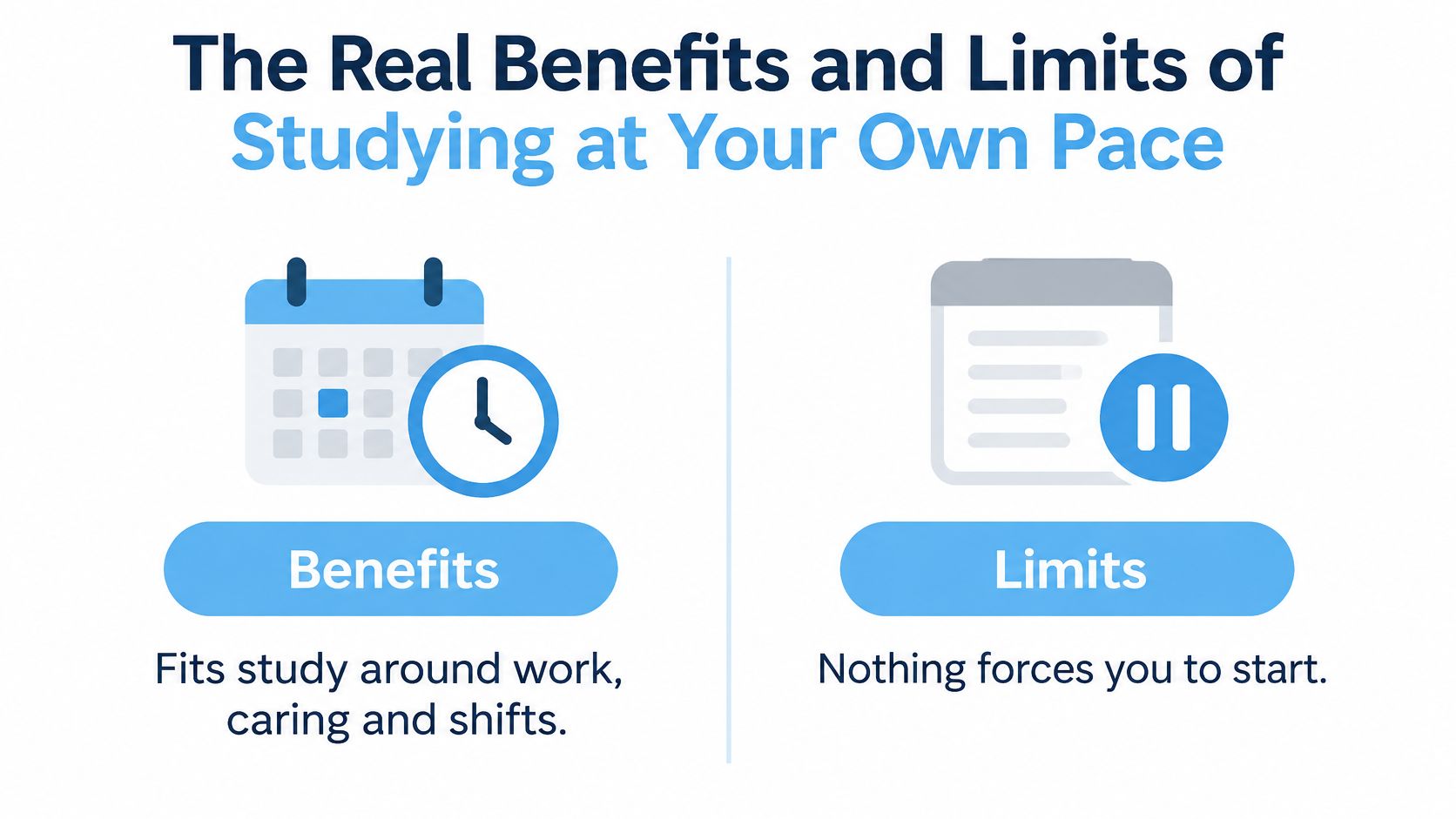
The main benefit is fitting study around work, caring and shifts. The main risk is that nothing forces you to start. Both are true at once, and pretending only the first matters is where learners get caught out.
Online learning is now normal for UK adults, not an experiment. The Learning and Work Institute's 2024 Adult Participation in Learning Survey found that 52% of UK adults were currently learning or had learned within the previous three years, 63% of learners reported at least some of their main learning was online, compared with 47% in 2019, and independent learning was the most common mode at 34%. That pattern supports recorded teaching, downloadable resources and tutor contact that doesn't need you online at the same moment.
| Benefits | Limits |
|---|---|
| No travel and no fixed timetable | Weaker routine and no one prompting you to start |
| Start at any time and replay recorded content | Isolation and slower feedback from tutors |
| Pause around illness or rota changes | Risk of drifting for weeks without a milestone |
The Completion Gap You Need to Know About
Here's the uncomfortable part. Nesta's evaluation of adult online learning, reported alongside that survey evidence, found typical course completion rates of approximately 12%, with most interventions between 10% and 20%. Highly flexible, self-led content generally produced lower engagement, while a structured digital skills bootcamp reached 55.6% completion. Flexibility alone doesn't finish courses. Structure does a lot of that work.
Practical rule: Choose when you study, but don't choose whether there's a next step. A defined sequence with short-term goals protects you on the weeks motivation dips.
Say a warehouse worker studies after night shifts. In week one he's keen and watches three lessons. By week four, overtime has wiped out two study slots and he's lost the thread of the unit. He doesn't recover because the course is flexible. He recovers because his tutor set a weekly milestone, one short task due each Sunday, and he can see exactly what catching up involves.
That's the workable middle ground. You control the timing. The course provides the sequence, regular tutor contact, progress monitoring and clear targets. If a provider offers unlimited time with no checkpoints, treat that as a warning sign, not a selling point.
How to Check Accreditation and Support Before You Enrol
Two questions separate good providers from poor ones. Is the qualification recognised for the next step you want, and will a real person help when you get stuck? Ask both before you look at price.
In plain terms, an Access to Higher Education Diploma is a recognised UK qualification for adults without traditional A levels who want to apply for university. It's usually quality assured through an awarding body and an Access Validating Agency. Ask which awarding body issues the certificate, then check that name independently rather than taking the sales page at face value. If you're weighing this up, reading about whether online diplomas are recognised will help you spot the difference between a regulated qualification and a certificate of completion.
| Criterion | What good looks like | Red flag |
|---|---|---|
| Accreditation | Named awarding body and a recognised UK qualification | Vague claims of accreditation with no awarding body named |
| Provider registration | Listed on the UK Government's Register of Learning Providers with a UKPRN | No UKPRN or registration details given |
| Tutor access | Named tutors and a stated response time | Only automated replies |
| Onboarding and technical support | Induction, platform guidance and help with devices | Learners left to work out the platform alone |
| Progression route | Clear path to named university courses | No stated next step after the diploma |
| Fees and refunds | Transparent fees and clear payment or cancellation terms | Hidden fees or unclear cancellation rules |
Registration is one check among several, not proof of quality on its own. For example, Access Courses Online lists UKPRN 10033485 on the UK Government's Register of Learning Providers. That tells you the provider is registered. It doesn't tell you how fast tutors reply, so you still need to ask.
Why Digital Support Matters as Much as Content
Most adults can get online, but not everyone feels confident studying there. The government Digital Inclusion Action Plan reports that in 2023 97% of UK adults, approximately 50 million people, were online, and 88% used the internet several times a day or once a day, yet an estimated 3.8 million people lacked the digital skills needed for everyday life, and only 43,240 people started an Essential Digital Skills course or qualification through the Adult Education Budget in 2023/24.
That gap shows up in practical ways. Uploading an assignment in the wrong format, joining a video call, finding feedback in a cluttered platform. None of these are academic problems, but each one can stall you for a week if nobody helps.
The Department for Science, Innovation and Technology public engagement survey found 56% of adults improved their digital or online skills during the previous 12 months, with self-teaching the most common method at 37%. Good providers design for that reality with clear navigation, mobile friendly materials and a short induction on platform tasks.
Before you pay, ask three direct questions. How fast do tutors reply, in working days? Is there a starting diagnostic so early work matches your level? And what happens, in writing, if you fall behind?
How Many Hours a Week You Really Need
Start with a worked assumption, then test it against your actual week. For example, take an Access to HE Diploma built on around 600 guided learning hours, and confirm your provider's own figure before you enrol. The maths below uses 600 hours throughout so you can compare completion windows fairly.
| Completion window | Approx. hours per week |
|---|---|
| 6 months (26 weeks) | 23 |
| 12 months (52 weeks) | 12 |
| 18 months (78 weeks) | 8 |
Guided learning hours cover tutor led and structured work, such as set lessons, directed tasks and assessed activities. Your real study time usually runs higher. Reading around a topic, drafting and redrafting assignments, and revising before you submit all sit on top, especially if you haven't written an essay in years.
How to Use the Table Honestly
Don't start from the finish date you'd like. Start from the hours you can repeat in a bad week, not a good one. Find the row that matches, then add a buffer of 20 to 30 per cent for weeks when work, illness or family intrude. If the buffered figure still fits your week, the pace is realistic.
Say you're a parent working 30 hours a week and you can protect about 12 study hours. That points to the 12 month window, with the buffer meaning you should plan roughly 14 to 15 hours in normal weeks so a disrupted week doesn't break the plan. If you've only got 8 spare hours, don't squeeze into 12 months and hope. The 18 month window at 8 hours a week is the honest fit.
An unrealistic pace chosen at enrolment is harder to fix later than a longer window chosen at the start.
Three things change the numbers. A higher intensity cohort with fixed unit deadlines compresses your weeks even if total hours stay the same. A short exam or submission window forces revision into fewer days. A planned break, for a house move or a busy season at work, means the remaining weeks carry more hours, so recalculate before you agree to it.
Plan your weekly hours before you choose a course length, not after enrolment. Most learners who fall behind didn't lack ability. They committed to a pace their ordinary week couldn't support.
Study Habits That Keep Self-Paced Learners on Track
Without a timetable, your habits become the timetable. That sounds like pressure, but it also means a small, repeatable routine does the job a college schedule would otherwise do for you.
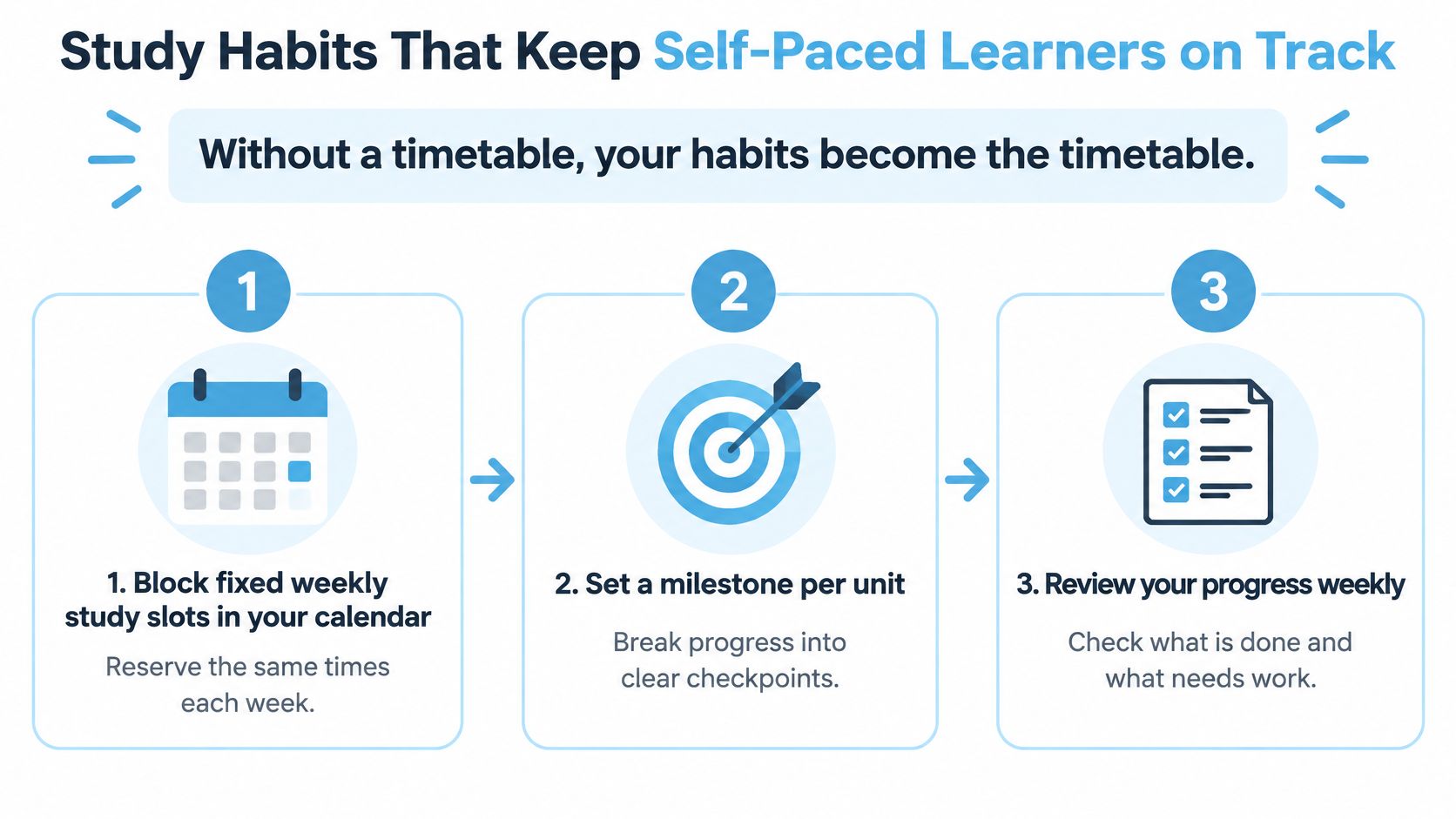
- Block fixed weekly study slots. Put the same times in your calendar each week and treat them like shifts. The common slip is studying only when you feel like it, which usually means not at all after a tiring day. Guidance on creating a study schedule that actually works can help you set slots you'll keep.
- Set a milestone per unit. Replace a vague finish date with a checkpoint for each unit, such as notes complete, draft written, submitted. A milestone tells you whether you're on track this week, not just eventually.
- Study in sessions of 45 to 60 minutes. Start each one with a five minute recall of the last session, from memory, before you open your notes. Skipping the recall is why last week's content feels unfamiliar. Short tools can support this, and a roundup of the best productivity apps for students is a useful place to find a simple timer or task tracker you'll use.
- Produce something every fortnight. Draft or submit one assessment element every two weeks, even if it's rough. Regular output shows gaps early, while they're cheap to fix.
- Book a tutor check-in at each milestone. Don't wait until you're stuck. A short check at each checkpoint keeps feedback tied to the work you've just done.
- Review progress weekly. Spend ten minutes comparing planned and actual hours. Adjust the next week before you fall two weeks behind, because two weeks is where catching up starts to feel impossible.
Flexible but Guided Beats Fully Unrestricted
Recent UK figures underline why this structure matters. The Learning and Work Institute Adult Participation in Learning Survey 2025 shows adult participation in learning fell from 52% in 2024 to 42% in 2025, with only 21% of adults currently learning, down from 30% the previous year, while 95% of current or recent learners use technology and 84% say it enables participation. Technology solves access. It doesn't, on its own, sustain engagement.
So build accountability that doesn't remove flexibility. Progress alerts, tutor check-ins and assignment deadlines can all sit around study times you choose. You're not giving up freedom. You're deciding in advance what happens on a low motivation day.
When work, caring or illness interrupts, act early. Contact your tutor before the missed milestone, agree a revised date, and keep one small task going, even 20 minutes of reading. That keeps the habit alive, so restarting doesn't feel like starting again.
Total Cost and the Hidden Expenses to Budget For
The cheapest course isn't always the most affordable. The Learning and Work Institute Adult Participation in Learning Survey 2025 report found 24% of UK adults identified cost as a barrier to learning in 2025, more than three times the 2019 level of 8%, rising to 28% among people earning up to £17,399 and 32% among unemployed people seeking work. If money is your main worry, you're in a large and growing group.

Price the Whole Course, Not Just the Fee
Build a total cost checklist before you compare providers. Government research in that survey identifies devices, broadband, childcare, travel and missed income as additional costs that can stop learners completing online training.
- Course fee and payment plan: Include any instalment arrangement, such as 12 months interest free, and check the total payable.
- Devices and software: A reliable laptop, plus any specialist software your subjects require.
- Broadband and printing: Monthly connectivity and occasional printing for drafts or forms.
- Travel and childcare: Trips to taster days or assessments, and care cover while you study.
- Lost income: Reduced shifts or turned down overtime during busy assessment periods.
An illustrative example shows the trap. A course with a modest fee looks cheap until you add a replacement laptop and two reduced shifts a month. Suddenly the pricier course with stronger tutor support, which helps you finish first time, costs less overall. For a fuller breakdown, see this guide to Access to Higher Education costs.
Recognition is a cost issue too. If you complete an informal certificate that your target university won't accept for entry, you've paid twice, once for that course and again for the qualification you needed. Confirm the progression route before you pay anything.
Check funding routes that may apply to you, such as Advanced Learner Loans for eligible adult courses in England. Confirm with the provider whether a specific course is funded before assuming the fee is covered, and ask what repayments would look like once you're in work. If money gets tight mid course, contact the provider before you miss a payment and ask what flexibility exists.
Confirm Your Fit Before You Enrol at Access Courses Online
Work through five checks in order, and don't enrol until all five pass.
- Confirm your target university course. Check its entry requirements, including specific subjects or grades, on the university's own pages.
- Match the diploma subjects. Check the Access to HE Diploma subjects align with that course, whether that's Nursing, Computer Science or Business and Management.
- Test the weekly hours. Compare the completion window with your real availability, including your 20 to 30 per cent buffer.
- Run the accreditation checklist. Go row by row and keep the answers in writing.
- Ask for a taster session. Try the platform and a sample lesson before you commit money.
Once those checks pass, Access Courses Online, a trading name of Cambridge Online Education Ltd, is one option to assess against them. It offers accredited Access to HE Diploma courses that are fully online and start at any time, with taster days, funding guidance, interest free payment plans over 12 months and personalised advice by email, phone and WhatsApp. That's a good fit if you need flexibility with tutor support around it, but it isn't the only option, and you should compare it like any other provider.
Take one clear action now. Book a taster or send your target university course to an adviser, and ask for the progression route to be confirmed in writing before you enrol.
If you're ready to study through online courses at your own pace with a recognised qualification and tutor support built in, explore the fully online Access to HE Diplomas at Access Courses Online, where you can start at any time, spread payments interest free over 12 months and get personalised advice before you commit. Send an adviser your target university course today and ask them to confirm your progression route in writing.