

An Access to HE Diploma typically costs a low-thousands figure, paid in instalments, often interest-free over about 12 months. The overall access to higher education cost is higher or lower depending on living expenses, lost earnings, childcare, travel, equipment, and the savings created by choosing a sensible progression route.
You may be comparing course pages after work, calculator open, wondering whether retraining is financially realistic. The fee looks manageable until you add the train fare, a laptop, childcare, reduced working hours, and the income you might lose while becoming university-ready.
That's the mistake most cost guides make. They compare tuition fees in isolation. A useful decision needs to measure the whole weekly cost of preparing for university, then compare it with the cost of delaying your career change or choosing a route that requires relocation.
Why the Sticker Price Rarely Tells the Real Story
Take a working parent who wants to move into nursing. An online Access course may look like a straightforward education purchase, while a campus course may involve daily travel, fixed attendance, extra childcare, and fewer available shifts. The published course fee is only one line in the household budget.
The same problem appears when someone compares an Access diploma with university tuition. England's regulated undergraduate tuition-fee cap rises from £9,250 to £9,535 for the 2025–26 academic year, before accommodation, food, travel, equipment, and childcare are considered, as explained by the Institute for Fiscal Studies' higher-education analysis. Tuition can generally be financed through income-contingent borrowing, but that doesn't make rent or lost wages disappear.
The three costs people forget
At minimum, calculate these categories outside the headline fee:
- Living costs: rent, food, transport, utilities, childcare, and household bills.
- Opportunity cost: wages lost when study reduces your shifts, overtime, or availability.
- Study extras: a laptop, broadband, textbooks, software, travel to assessments, and any checks or examinations.
For students beginning full-time undergraduate study in England in 2024/25, government forecasts put average borrowing for that academic year at £15,450, made up of approximately £8,770 in tuition-fee borrowing and £7,770 in maintenance borrowing. Across the full course, the average borrower is forecast to borrow £44,690, with an average debt of £45,600 at repayment, according to the UK Government's student-loans statistics.
Practical rule: compare routes by weekly cash-flow pressure, not by the cheapest course page.
An Access route can be financially strong when it lets you keep working, stay in your current home, and avoid unnecessary travel before a degree begins. It can be poor value when a cheap-looking course lacks recognition, offers weak progression guidance, or forces you to repeat preparation later.
What an Access to HE Diploma Actually Is
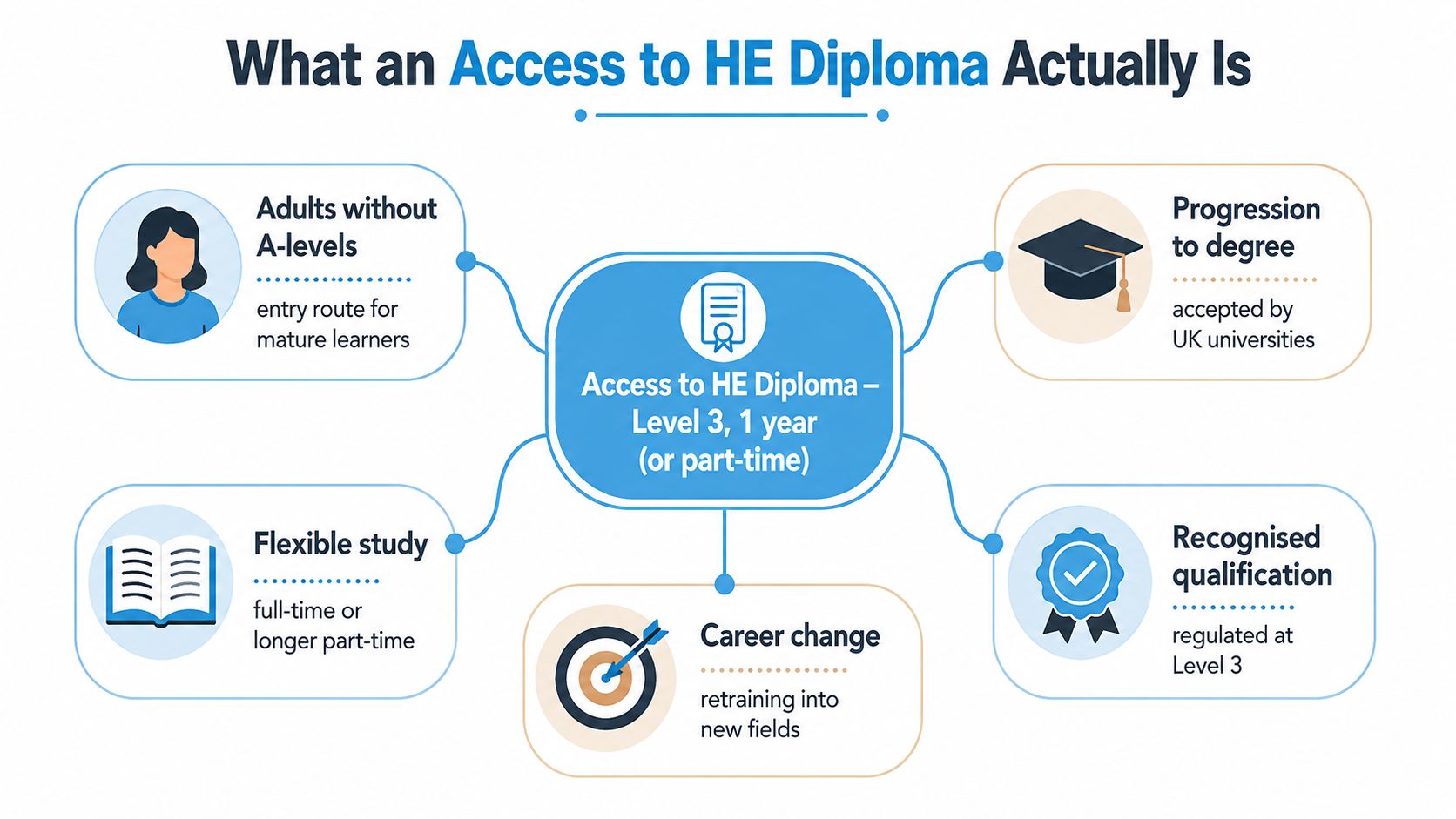
An Access to Higher Education Diploma is a regulated Level 3 qualification designed for adults who don't have the traditional qualifications normally expected for university entry. It develops subject knowledge, academic writing, research, numeracy, and study skills, then supports progression into a relevant degree.
The route is different from taking A-Levels. A-Levels are usually studied as school or college qualifications over a longer period, while an Access diploma concentrates preparation for adult university applicants. It also differs from a BTEC, which may be vocational and assessment-heavy in its own way, and from a foundation year, which normally sits within a university degree rather than acting as a separate pre-degree qualification.
How the qualification works
Most learners choose a subject pathway that matches the degree they want to enter. Common options include:
- Health pathways: nursing, midwifery, healthcare, and allied health degrees.
- Science pathways: biology, chemistry, laboratory, and related scientific study.
- Technology pathways: computer science, digital subjects, and technical progression.
- Social and professional subjects: social science, business, management, and related degrees.
- Creative routes: music technology and other specialist progression options.
A full-time course is commonly treated as a one-year route, while part-time study can take longer and suit people who need to protect work or caring responsibilities. The duration affects more than the timetable. A longer route may preserve income each week, but it can delay university entry and extend the period before a graduate career begins.
What changes the quoted fee
Access course prices vary by provider, subject, delivery model, assessment requirements, and included support. A humanities route may have fewer practical costs than a science or healthcare pathway, where laboratory work, examinations, or additional checks can affect the total.
Don't choose from the fee alone. Ask whether the diploma is recognised for the university courses you want, whether assessment and tutor support are included, and whether the provider accepts the funding route you intend to use. A course that doesn't lead to your target degree isn't a saving.
What Drives the Price of an Access Course
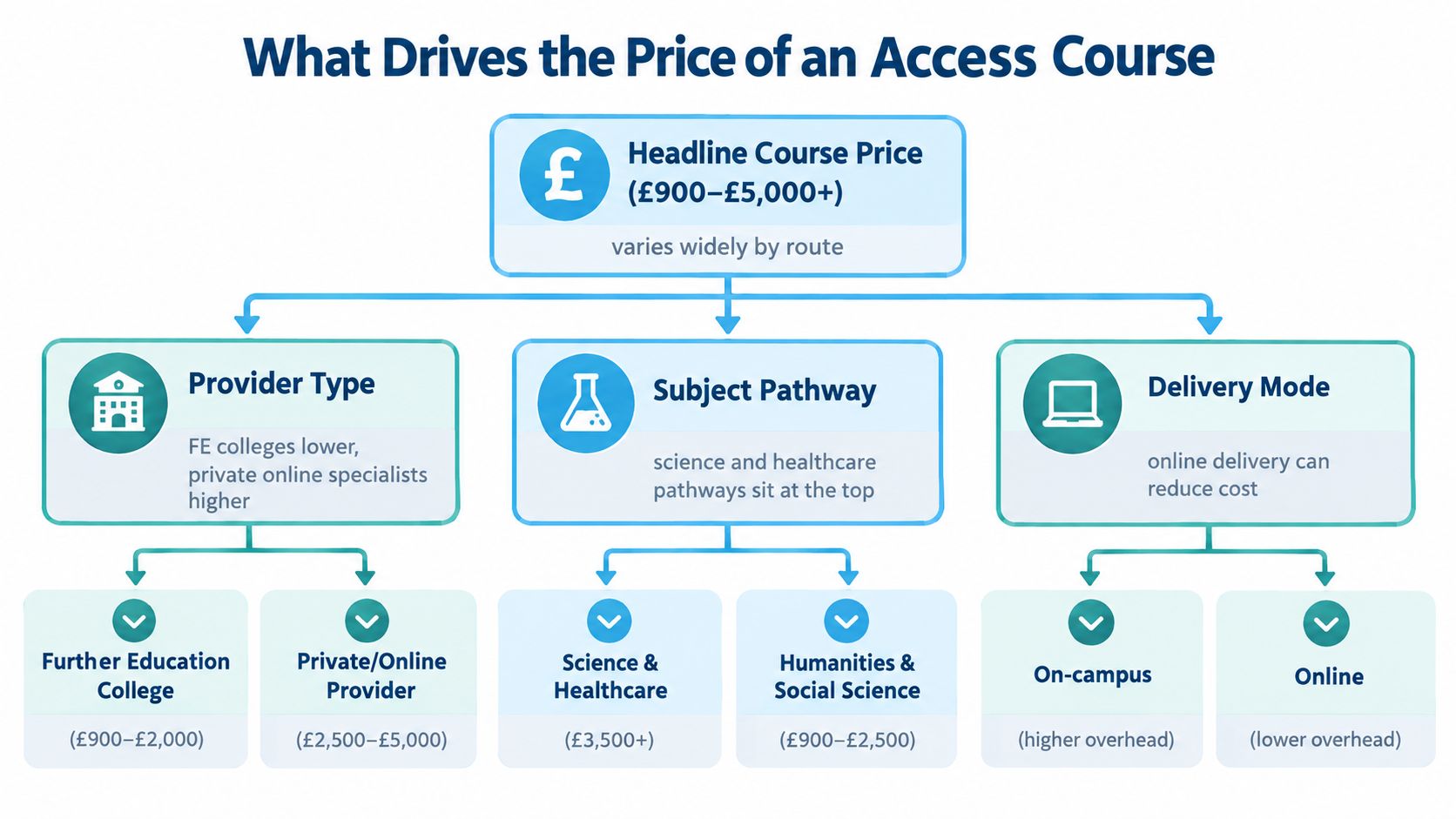
The course fee reflects the route being delivered, not just the number of lessons on a screen. A further-education college, a private online specialist, and a practical healthcare provider may have very different staffing, assessment, support, and compliance costs.
The price ranges shown in the supplied course-pricing infographic are useful as a market orientation, but treat them as illustrative guide bands rather than guarantees. Providers can price differently, and a low quote may exclude important items.
Provider type and delivery
Further-education colleges often benefit from established college facilities and public-sector funding structures. Private online providers may charge more for flexible start dates, remote administration, personalised support, or a delivery model built around adults who study alongside employment.
Online delivery can reduce commuting and relocation costs, but it may introduce digital expenses. You might need a suitable laptop, dependable broadband, software, a quiet place to work, and occasional travel connected with progression or assessment. These costs belong in the same budget as the course fee.
Subject and intensity
Healthcare and science pathways can involve practical requirements, specialist assessment, or examination costs. Humanities and social science routes may have fewer physical-resource demands, although tutor support and assessment quality still matter.
Full-time study may shorten the preparation period but can reduce your available working hours. Part-time study may protect earnings and childcare arrangements, yet the longer timeline can delay progression. The right choice depends on the weekly balance, not on which label sounds faster.
The questions to ask before paying
Request a written breakdown covering:
- The full diploma fee and payment schedule.
- Registration, assessment, examination, or resit charges.
- Books, software, equipment, and practical-session costs.
- DBS or other checks where a target profession requires them.
- Tutor contact, marking arrangements, and expected study hours.
- Recognition and progression acceptance for your intended degree.
- Cancellation, deferral, and refund terms.
You can also use a separate budgeting tool to compare recurring household costs, course payments, and irregular expenses. For example, Fintrack's budgeting app pricing tiers may help you decide whether a paid budgeting service is worthwhile for your planning needs. The tool won't determine your eligibility or progression, but a clear cash-flow view can expose a course that only works on paper.
Comparing Routes by Total Cost
The cheapest published fee isn't automatically the cheapest route to a degree. A campus course may cost less in tuition while costing more in travel, childcare, parking, meals, and reduced shifts. An online course may charge more upfront but allow you to remain employed and avoid moving house.
| Cost category | Campus Access course | Online Access course | GCSE retake plus direct application |
|---|---|---|---|
| Course payment | May be lower or publicly funded, depending on provider and eligibility | Often paid privately or through an agreed finance route | Several separate qualifications may create multiple fees |
| Travel | Regular commuting, meals away from home, and possible parking | Usually limited to occasional progression or assessment travel | Travel depends on the college or exam centre |
| Childcare | Fixed attendance can create predictable but substantial childcare needs | Study can fit around existing care, although discipline is essential | Timetables may vary across GCSE providers |
| Lost earnings | Higher risk if attendance clashes with shifts | Lower risk when study remains compatible with work | Can extend the preparation period and delay progression |
| Equipment | Campus facilities may reduce home equipment needs | Laptop, broadband, software, and quiet study space are important | Requirements vary by subject and provider |
| Progression risk | Ask whether the diploma matches target university requirements | Check recognition, tutor support, and university acceptance in writing | Direct applications may fail if the degree requires specific Level 3 preparation |
| Best fit | Learners who need structured attendance and can manage travel | Working adults, parents, and people outside commuting distance | Learners missing specific GCSE requirements rather than a full Level 3 route |
The weekly-budget test
Write down your current weekly income and essential spending. Then add the proposed course payment, travel, childcare, equipment allowance, and the value of any lost shifts. If the weekly total leaves no margin for an unexpected bill, the route isn't affordable yet.
A flexible online option can be financially sensible when it preserves employment. It isn't automatically suitable, though. Some learners need classroom routines, direct tutor contact, or practical facilities. Choose the route that you can complete, not the one with the lowest advertised number.
Funding and Payment Options in the UK
A course can look affordable until the payment schedule meets rent, childcare, travel, and reduced working hours. Check the qualification, provider, age requirements, residency rules, and progression conditions before assuming funding will cover the route.
Build a funding stack
Advanced Learner Loans can cover tuition for eligible learners and courses, so you do not have to pay the full fee upfront. The rules differ from undergraduate student finance. Ask the provider which application process applies, whether the course is approved, and when funding is released.
Provider support may include bursaries, hardship assistance, scholarships, or fee reductions. These funds are limited and may target particular subjects or personal circumstances. Ask about them before accepting an offer or paying a deposit.
Your employer may contribute if the qualification supports a staffing need. Check learning budgets, professional-development policies, apprenticeship options, and any employer scheme before resigning or reducing your hours.
Separate tuition funding from living-cost funding
In England, maintenance support depends on factors including household income, study location, and living arrangements. For 2025/26, an eligible student living away from home outside London can receive up to £10,544, while a student living with parents can receive up to £8,877. At £45,000, the maximum for a student living away from home outside London is £7,532. At £62,347, support falls to the minimum amount of about £4,915, according to the official guidance on student living costs.
That assessment can leave mature learners earning too much for maximum support without having practical help from parents. Household-income rules may not reflect the money available for rent, childcare, or reduced earnings.
Use the Access to Higher Education funding guide to prepare questions about loans, bursaries, grants, and other support. Confirm the answer with Student Finance England and your provider before relying on it.
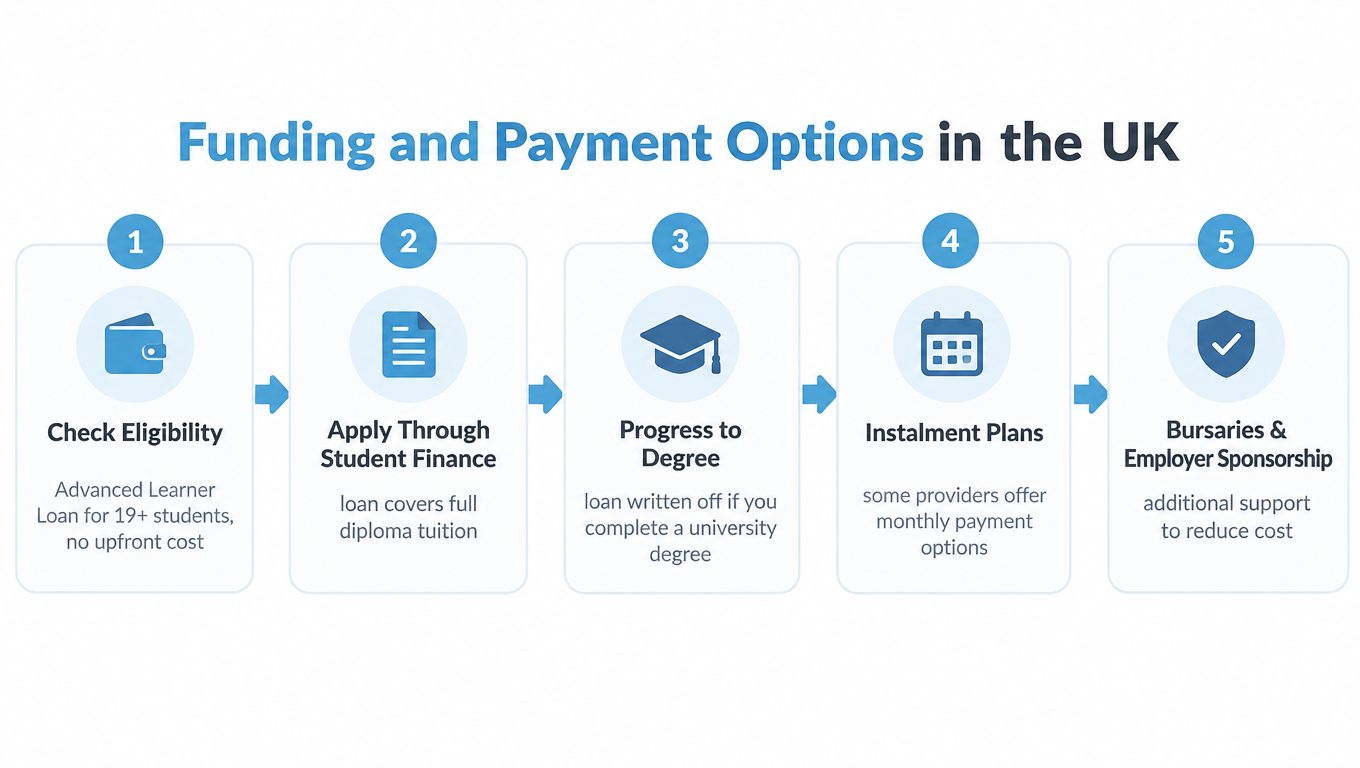
Instalment plans can spread payments across roughly 12 months, including interest-free arrangements offered by some providers. This changes the timing, not the underlying cost, unless the provider confirms a discount. Read the cancellation and missed-payment terms before signing.
The government's Lifelong Learning Entitlement is currently planned to launch in the 2026/27 academic year for eligible courses and modules beginning on or after 1 January 2027, according to current government guidance. Maintenance loans are expected to support courses requiring face-to-face attendance, with eligibility and amounts depending on study mode, location, household income, and course characteristics. Online study can reduce rent and travel, but it may not provide the same maintenance support.
ROI From Access Course to First Graduate Job
The return on an Access diploma isn't measured by the diploma fee alone. Measure the whole path: preparation cost, working hours protected or lost, university borrowing, living costs, and the income available after entering the target profession.
The IFS explains that graduates generally repay 9% of earnings above the applicable threshold through income-contingent repayments, rather than paying tuition upfront. Lower earners therefore repay less through the system, although the debt and repayment rules still need to be understood before enrolment.
Use a personal break-even model
Create three columns:
- Cash paid: diploma instalments, travel, equipment, childcare, and other direct expenses.
- Income protected or lost: the wages you keep through flexible study, minus shifts or hours you give up.
- Future benefit: the difference between your expected graduate income and what you might otherwise earn.
Don't use a generic graduate salary to make the model look attractive. Use the role, region, employment pattern, and entry requirements for your intended career. A regulated healthcare career may require a specific degree and placement structure, while a technology or business route may offer a different sequence of study and employment.
The degree itself can create a substantial finance burden. Government forecasts for England show that maintenance borrowing can be nearly as large as annual tuition borrowing, so your model must include accommodation, food, travel, and other living expenses rather than treating the tuition limit as the total cost.
You should also count progression risk. A cheaper diploma that doesn't meet the entry requirements for your chosen university may add another application cycle, further study, or a change of direction. Paying for recognised preparation and confirming acceptance before enrolment can protect the value of the entire route.
When you reach the job-search stage, a clear CV helps you present previous work, new subject knowledge, transferable skills, and relevant experience as one coherent story. A tool such as ParakeetAI's resume maker can support that drafting process, but check every statement yourself and tailor it to the role.
For a broader framework, the guide to return on investment in education can help you organise the financial and career questions before you commit.
Practical Steps to Cut the Real Cost
Use the next two weeks to turn an attractive course page into a verified household plan.
- Confirm recognition: Ask whether the qualification is an approved Access to HE Diploma and whether your target universities accept it for your intended degree.
- Build a weekly budget: Include course payments, rent, food, travel, childcare, equipment, broadband, and lost earnings.
- Request every support option: Ask about bursaries, hardship funds, Advanced Learner Loans, employer support, and fee waivers.
- Check instalment terms: Get the monthly amount, interest position, cancellation rules, and consequences of missed payments in writing.
- Compare delivery properly: Price commuting and childcare for campus study, then price the laptop, broadband, and study space needed online.
- Speak to your employer: Ask about sponsorship, paid study time, professional-development budgets, and apprenticeship routes.
- Test the provider: Use a taster session or trial option where available before committing to a course that doesn't suit your learning style.
A very low fee deserves scrutiny. Check what it excludes, who awards the qualification, how assessments work, and whether universities will recognise it. You can also review practical ideas to save money in college with AccountShare, then apply only the suggestions that fit your circumstances.
The guide to interest-free payment plans is useful when you're comparing instalment structures. Remember, spreading payments helps cash flow. It doesn't make an unaffordable total affordable.
Where to Get Personalised Cost Advice
A provider should be able to discuss your target degree, existing qualifications, working pattern, caring responsibilities, and funding position before recommending a route. If the first answer is only a price, you haven't received enough advice to make a decision.
Send a concise enquiry containing:
- Your current qualifications and any GCSE gaps.
- The degree and university route you're considering.
- Your available study hours and preferred start date.
- Your work pattern, income pressures, and caring commitments.
- The delivery format you can realistically complete.
Ask the provider to confirm the total cost, not just the tuition headline. You need written answers about assessment charges, materials, payment dates, bursary eligibility, tutor support, progression acceptance, deferral terms, and Advanced Learner Loan availability.
A good adviser won't promise university admission. They'll identify the entry requirements, explain where your plan may fail, and help you compare campus and online costs. Ask whether you can attend a taster day, speak with a tutor, or use a short trial period. Those checks can prevent an expensive mismatch.
The cheapest course isn't necessarily the cheapest route to a degree. The better choice is the one you can fund each week, complete successfully, and use for the progression route you actually want.
Access Courses Online provides accredited online Access to Higher Education Diploma courses for adults preparing for university in subjects including nursing, midwifery, health professions, computer science, science, social science, business, and music technology. Visit Access Courses Online to compare flexible study options, payment plans, and personalised guidance for your own access to higher education cost plan.