
If you've been thinking about getting your GCSE in English, you're in the right place. Online courses offer a brilliant, flexible way to get this key qualification under your belt, letting you study from home and at your own speed. They cover the exact same material as a course you’d take in a traditional school, which makes them perfect for adults getting back into education, people looking to change careers, or anyone who needs to fit learning around a busy life.
Why a GCSE in English Is Your Next Smart Move
Deciding to go back to studying can feel like a massive step, but trust me, you're not on your own. Nailing a GCSE in English is a foundational move that opens up a world of new careers and further education, especially for adults who are already juggling a million other things. Think of this guide as your personal roadmap, walking you through everything from how online GCSE English courses actually work to picking a provider you can trust.

Growing Demand for Flexible Learning
The idea of getting qualifications online has really taken off. In the UK, the total number of people signing up for GCSE English Language exams recently jumped by 7.7% in just one year. That tells you something about how much this qualification is needed.
This huge surge is mostly down to how flexible and easy to access online study has become, allowing more people than ever to chase their goals. You can see the full government data on exam entry trends on GOV.UK.
This trend shows that working towards an English qualification is a common and really valued journey. For so many people, it’s the missing piece of the puzzle for a university application or the one thing they need to get a better job.
An online GCSE isn't a lesser alternative; it's a modern, effective way to get the same respected qualification. It puts you in the driver's seat, letting you master the material without having to pause your life.
Whether you're aiming for a promotion, planning to go to university, or just want to feel more confident in your core skills, this qualification is a powerful tool. By breaking the whole process down into clear, manageable steps, this guide will show you that achieving your English GCSE is completely within your reach.
We'll cover:
- Understanding the Course: What online learning looks like day-to-day.
- Accreditation and Exams: Making sure your certificate is officially recognised.
- Choosing a Provider: What to look for in a quality course.
- Planning for Success: Tips for studying effectively and managing your time.
How Online GCSE English Courses Actually Work
So, what does it really mean to study for a GCSE online? Let's get past the idea of just reading a PDF on a screen. Think of it more like your old school classroom has been packed up and moved into a flexible, digital hub you can pop into anytime, anywhere. That’s the heart of modern online learning.
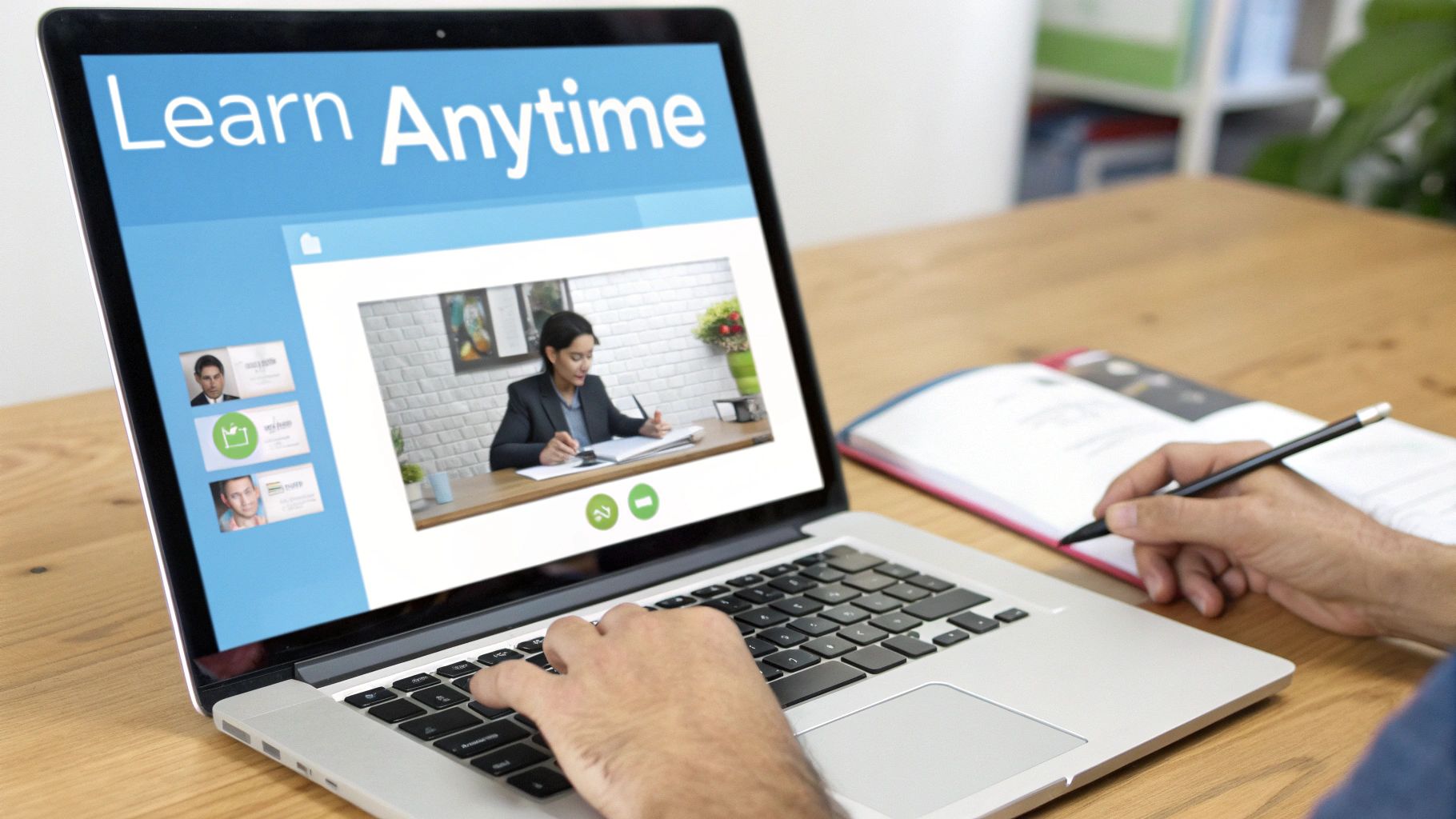
These courses cover the exact same official curriculum you'd find in a traditional school. The big difference isn't what you learn, but how you learn it. All the material is delivered through engaging methods designed to let you set the pace.
The Modern Digital Classroom Experience
Picture your learning journey as a clear path laid out for you in a dedicated online portal. Instead of being tied to fixed lesson times, you move through different modules at your own speed, using a mix of different learning tools.
- Video Lessons: You can watch, pause, and re-watch pre-recorded lessons from expert tutors. This is a game-changer when you're trying to get your head around a tricky concept, like analysing Shakespearean language or spotting poetic devices, without the pressure of a live classroom.
- Interactive Quizzes: These aren't just about testing what you remember. They give you instant feedback, helping you pinpoint areas where you need a bit more practice and cementing what you've just learned.
- Digital Resources: You get a whole library of study guides, practice papers, and reading materials, all neatly organised and available 24/7.
This is a world away from just being emailed a textbook. It's an active, structured environment that puts you firmly in the driver's seat. Many people ask if it works, and you can explore more on whether online learning is as effective as in-person learning to see the evidence behind its success.
Who Is This Model Built For?
The brilliant thing about online GCSE English courses is their flexibility, making them a perfect match for anyone whose life doesn't fit the old 9-to-3 school day. This learning style is designed for real-world situations.
Take the full-time employee who's aiming for a promotion but needs a Grade 4 (that’s a C in old money) in English. They can study on their commute, during their lunch break, or in the evenings, slotting their learning around their work schedule.
Or think about the parent who wants to get back into education once the kids are in bed. Being able to log in and study quietly for an hour each night makes achieving that qualification completely possible, without disrupting family life.
This approach is for anyone who wants a second chance at a qualification without putting their entire life on hold. It removes the geographical and time-based barriers that once made adult education so difficult.
What A Typical Study Week Looks Like
It can be helpful to visualise what your day-to-day might look like. A typical week isn’t about being glued to a screen for hours on end; it's about making small, consistent steps forward.
Your week could look something like this:
- Monday: Watch a couple of short video lessons on analysing unseen poetry.
- Tuesday: Complete the interactive quiz for that module and read through the supplied texts.
- Wednesday: Start working on a short, tutor-marked assignment based on the week's topic.
- Thursday: Look over the tutor feedback from your last assignment and use it to improve your current work.
- Friday: Jump into an online student forum to chat with other students about a difficult text.
This kind of structure breaks the syllabus down into manageable chunks. It helps you build momentum and confidence, proving that you really can earn a vital qualification, entirely on your own terms.
Making Sure Your Qualification is Legitimate and Valued
Putting time and money into an online GCSE in English is a big deal, so you want to be absolutely certain the qualification you get at the end is the real thing. Not all online courses are what they seem, and spotting the signs of a genuine provider is the first, most important step.
Think of it like buying a car. You wouldn't hand over your money without checking the logbook and making sure it has a valid MOT. In education, that official stamp of approval comes from accreditation. It’s your guarantee that the qualification is genuine and will be respected.
Why Accreditation and Exam Boards Matter
The legitimacy of any UK qualification boils down to two key players: Ofqual and the exam boards.
- Ofqual (The Office of Qualifications and Examinations Regulation) is the government body that keeps an eye on all qualifications and exams in England. If a course is Ofqual-regulated, it means it’s met tough national standards for quality and fairness.
- Exam Boards like AQA, Pearson Edexcel, and OCR are the organisations that actually write the curriculum and set the final exams. A proper course provider will always be preparing you for an exam from one of these well-known boards.
When you pass an accredited course, the certificate you receive is exactly the same as one a student would get in a traditional school. It carries the same weight with universities, colleges, and employers, making it a proper asset for your future.
A provider that’s cagey about its accreditation or which exam board it works with is a massive red flag. Always look for these logos and names on their website – it’s a clear sign of quality and trustworthiness.
It's not just about being accredited, either. The best online providers get fantastic results. Online GCSEs have completely changed the game for so many people, making these qualifications more accessible than ever. The top providers are reporting incredible success stories, with some seeing a 98% pass rate among their online GCSE students. Even more impressive, a huge 69% of those students achieved a grade 7 (the old A grade) or higher in their courses, including English. You can learn more about these impressive student outcomes on Oxbridge Home Learning.
How Do I Actually Sit the Exam?
This is one of the most common questions we get from online learners: "How do I physically take the exam?" Since you’re studying on your own terms, you’ll need to register as a private candidate. Don't worry, it sounds more complicated than it is – it’s a standard process.
Your course provider won't book the exam for you, but any good one will give you clear, step-by-step instructions. Essentially, you're responsible for finding a registered exam centre (often a local school or college that accepts private candidates) and booking your spot.
Here’s how it usually works:
- Start Looking Early: Begin your search for an exam centre a good few months before the exam season, which is typically May and June. Exam boards like AQA and Edexcel have search tools on their websites to help you find centres near you.
- Get in Touch: Contact the centre's exams officer to check they accept private candidates for your specific subject and exam board.
- Register and Pay: The centre will give you the forms you need and let you know their fees. This payment goes directly to the exam centre and is separate from what you paid your course provider.
- Keep Good Records: Make sure you keep a note of all emails, deadlines, and payment receipts. While your course provider can offer advice, the final responsibility for getting your exam booked is yours.
How to Choose the Right Online Course Provider
Now that you know what a legitimate qualification looks like, the next step is finding the perfect provider to guide you. This goes way beyond just ticking the accreditation box. It's about finding a partner for your educational journey—one whose support, structure, and costs line up with what you need.
Choosing from the many online GCSE English courses out there can feel a bit overwhelming, but focusing on a few key areas will quickly help you separate the excellent from the average. Getting this right can be the difference between a frustrating experience and a successful one.
Evaluating Tutor Support and Feedback
The quality of tutor support is probably the single most important factor. It's the human connection that transforms a folder of digital files into a proper learning experience. When you're looking at providers, you need to dig into exactly what kind of support is on offer.
Is it a dedicated tutor who gets to know your work and tracks your progress? Or is it a generic helpdesk that just answers basic questions? A dedicated tutor provides personalised, constructive feedback on your assignments, helping you understand not just what you got wrong, but why. This targeted guidance is what makes all the difference.
The best providers see tutor support as a mentorship, not just a service. They offer detailed feedback on tutor-marked assignments (TMAs) and mock exams, which are vital for building your confidence and sharpening your exam technique.
This level of support is proven to get results. The success rates of many online GCSE English courses often beat the national averages, showing just how effective well-supported remote learning can be. As an example, one college's online GCSE English course reported an incredible 99.7% pass rate, with 79% of students achieving grades 4 or above—smashing the national average. You can discover more about these impressive student outcomes on Activate Learning.
This simple decision tree can help you quickly vet potential providers for the most crucial quality signals.
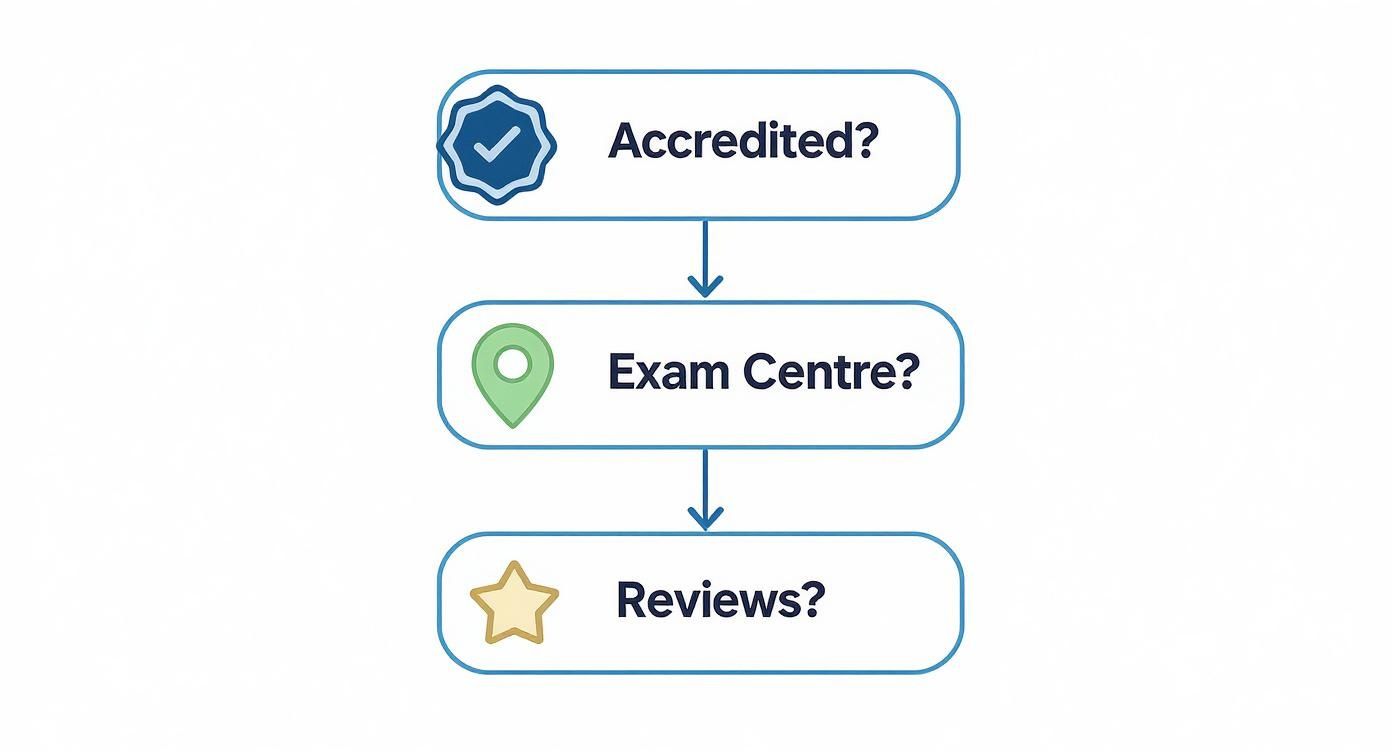
By following these steps, you can confidently filter your options down to only the most credible and reliable course providers.
Understanding the Full Cost of Your Course
Financial transparency is another huge sign of a trustworthy provider. The headline price you see on a website is rarely the total amount you'll end up paying. It’s absolutely crucial to get a clear breakdown of all potential costs before you sign up.
Here are the key costs you need to get straight:
- Course Fees: This is the main charge for the learning materials, tutor support, and online platform. Always check if payment plans are available to spread the cost.
- Exam Centre Fees: This is a separate fee you pay directly to the exam centre where you'll sit your final exams. It can vary a lot, so it’s worth researching local centres early on.
- Textbooks and Materials: Does the course fee include everything you need, or will you have to buy textbooks on top?
- Re-sit Fees: Find out what happens if you need to re-sit an exam. Is there an extra charge for continued course access?
A reputable provider will be completely upfront about these costs. Be very wary of any company that isn't crystal clear about the difference between their course fee and the separate exam fees.
To help you compare, here’s a quick-glance table of what to look for when you're weighing up your options.
Comparing Key Features of Online GCSE English Providers
Use this table to compare essential features when choosing an online GCSE English course provider to find the best fit for your learning style and budget.
| Feature | What to Look For | Why It Matters |
|---|---|---|
| Accreditation | Ofqual regulation and recognition from awarding bodies like AQA or Pearson Edexcel. | Ensures your qualification is nationally recognised and valued by universities and employers. |
| Tutor Support | Dedicated, named tutors offering personalised feedback on assignments. | This one-to-one guidance is key to identifying weaknesses and building confidence for your exams. |
| Exam Arrangements | A guarantee that they can arrange your exams at a UK centre or provide clear guidance. | Without a guaranteed exam spot, your course is worthless. This is non-negotiable. |
| Cost Transparency | Clear separation of course fees from exam centre fees. No hidden costs. | Helps you budget accurately and avoid unexpected bills down the line. |
| Payment Options | Interest-free payment plans to help spread the cost of the course. | Makes the qualification more affordable and accessible without incurring debt. |
| Student Reviews | Genuine, verifiable reviews on independent platforms like Trustpilot or Google. | Gives you an honest insight into the real student experience, beyond the marketing hype. |
Looking at providers through this lens helps you make a truly informed choice, ensuring you find a partner who will genuinely support your goals.
Exploring Funding and Payment Options
Paying for your course is a big investment, but there are often ways to make it more manageable. While GCSEs are usually self-funded, good providers offer flexible options to ease the financial load.
Look for providers that offer interest-free payment plans, which allow you to spread the cost of the course over several months. This makes getting qualified much more accessible without having to find a large lump sum upfront.
For adult learners aiming for higher-level qualifications, options like the Advanced Learner Loan can sometimes be available, although these typically apply to Level 3 courses like Access to HE Diplomas rather than GCSEs. Still, it never hurts to ask a potential provider about any funding support or guidance they can offer. A good provider is invested in your success and should be able to point you in the right direction for financial advice.
By carefully weighing these factors—tutor support, total cost, and payment options—you can find a provider that not only delivers a quality education but also fits your personal and financial circumstances.
Finding the Right Qualification for Your Goals
Deciding to get a new English qualification is a brilliant move, but it's crucial to make sure you're on the right path for what you want to achieve. An online GCSE in English is a powerful and widely recognised qualification, but it’s not the only route available for adults returning to study. Understanding the alternatives is key to making sure your hard work pays off.
It's easy to get lost in the different names and levels, but think of them as different tools for different jobs. Each one is designed for a specific purpose. Your choice really comes down to whether you're aiming for university, a particular career, or simply want to sharpen your practical, everyday skills.
GCSE English: The Academic Standard
A GCSE in English Language is the qualification most people are familiar with. It's the benchmark that UK employers and universities look for as solid proof of your literacy skills. This course really digs into your analytical abilities—you'll be interpreting classic literature, breaking down unseen texts, and learning how to build a well-structured, persuasive argument.
If your goal is to go directly to university or enter a profession that demands a strong academic background, like teaching or journalism, a GCSE is almost always a must-have. It’s seen as the gold standard for showing you can handle complex written information and express your ideas with clarity.
Functional Skills English: The Practical Alternative
Functional Skills English takes a much more hands-on, practical approach. Instead of analysing poetry, this qualification focuses on the communication skills you genuinely need for work and daily life. You'll learn how to write effective emails, create clear reports, understand workplace documents, and take part in discussions with confidence.
Think of it this way: a GCSE proves you can analyse a Shakespearean sonnet, while Functional Skills proves you can write a clear and professional project proposal. Both are valuable, but they get you to different places.
For anyone who needs a qualification to get into a trade, start an apprenticeship, or just feel more confident at work, Functional Skills is often the perfect fit. It’s a direct, no-nonsense qualification that employers really value because it's all about real-world application. To get a better feel for this route, you can find a complete explanation in our guide on what Functional Skills qualifications are.
Access to HE Diplomas: The All-in-One University Pathway
An Access to Higher Education (HE) Diploma is a different kind of beast altogether. It's an intensive, all-in-one Level 3 qualification built specifically for adults who want to go to university but don’t have the right A-Levels. An Access to HE Diploma is equivalent to three A-Levels and is a popular and well-respected route onto degree courses across the country.
Here's the crucial part: a GCSE in English at grade 4 (C) or above is often a mandatory entry requirement for these diplomas, not to mention for the university degree you'll study afterwards. So, instead of being an alternative, a GCSE is frequently a stepping stone towards an Access to HE Diploma.
To help you visualise the differences, here’s a quick comparison of the three main options.
Qualification Quick Glance: GCSE vs Functional Skills vs Access Course
This table summarises the key differences between these popular qualifications for adult learners to help you decide which path is right for your educational and career goals.
| Qualification | Primary Goal | Best For | Typical Duration |
|---|---|---|---|
| GCSE English | Academic achievement and meeting university/professional entry requirements. | Aspiring university students and those entering academic or professional careers. | 9-24 months |
| Functional Skills | Developing practical English skills for the workplace and everyday life. | Learners entering trades, apprenticeships, or seeking to improve job-specific literacy. | 3-6 months |
| Access to HE Diploma | Providing an intensive, A-Level equivalent route to university for adult learners. | Adults without A-Levels who need a direct pathway to a specific degree course. | 9-12 months |
By understanding these key differences, you can confidently pick the qualification that will get you where you want to go.
Your Blueprint for Successful Online Study

Enrolling in an online GCSE English course is the exciting first step, but it’s the habits you build that will truly see you through to the finish line. This section is your practical toolkit for becoming a successful online learner, turning good intentions into a solid plan that takes you from day one right up to exam day.
The cornerstone of any successful study plan is a realistic schedule. Whether you’re aiming to complete the course in nine months or spread it out over two years, consistency is so much more important than cramming. Start by blocking out small, manageable study sessions in your weekly calendar.
Creating Your Study Environment
Believe it or not, your physical surroundings have a huge impact on your ability to focus. Find a dedicated study space, even if it's just a specific corner of your kitchen table. Keeping it organised and free from distractions really does signal to your brain that it’s time to get down to work.
Effective time management is also crucial for balancing your studies with everything else life throws at you. You can explore some detailed time management tips to find what works for you. A popular one is the Pomodoro Technique, which uses focused 25-minute study blocks followed by short breaks. For more ideas, our own guide on creating a study schedule that actually works is packed with useful strategies.
Actively Engaging with Your Course
Just passively reading your notes isn’t going to cut it. To really make the information stick, you need to get hands-on with the material.
- Take Detailed Notes: Don't just copy things down word-for-word. Try to paraphrase concepts in your own words. It’s a great way to check if you’ve actually understood.
- Use Student Forums: Don’t study in a vacuum! Connect with your fellow learners. Chatting about tricky topics or sharing insights can offer a completely new perspective and helps lock in what you've learned.
- Treat Feedback as a Tool: When your tutor sends back a marked assignment, think of their comments as a personalised improvement plan. Go through each point and make sure you apply their advice to your next piece of work.
Think of your tutor's feedback not as criticism, but as a conversation. It's a direct line to an expert who is invested in helping you improve your skills and ultimately pass your exam with confidence.
By adopting these habits, you'll build momentum and feel a real sense of control over your learning journey. This proactive approach is the secret to staying motivated and making steady, meaningful progress towards earning that GCSE English qualification.
Got Questions About Online GCSE English?
Thinking about starting an online course is a big step, and it's natural to have a few last-minute questions bubbling up. To help you feel completely sure about your decision, let's tackle some of the most common things we get asked.
How Long Does It All Take?
This is one of the best parts about studying online: it fits around your life. Most providers give you a generous window to complete the course, typically somewhere between 9 and 24 months.
It’s not a race. The time it takes really depends on how many hours you can realistically set aside each week. Many adult learners are juggling full-time jobs and family life, and they find a 12-18 month timeframe works perfectly. This gives you enough breathing room to properly get to grips with the material and feel confident heading into the exams.
Are Online GCSEs as Good as School Ones?
Yes, one hundred percent. This is a really important point. As long as your course is from an accredited provider that uses a recognised UK exam board like AQA or Pearson Edexcel, the qualification you earn is exactly the same.
The certificate you receive at the end doesn't say "studied online" or "studied at school." Employers, colleges, and universities see a GCSE as a GCSE. It holds the exact same weight and respect, no matter how you got there.
The way you study is different, but the qualification is identical. Your certificate simply shows the subject, the exam board, and your grade—that's all that matters.
Do I Need to Be a Tech Whizz?
Not at all. If you can send an email, browse the internet, and use a word processor like Microsoft Word or Google Docs, you’ve already got all the skills you need.
Good course providers design their online learning platforms to be straightforward and easy to navigate. Their goal is for you to focus on learning English, not battling with complicated tech. And if you ever do get stuck, there’s always a technical support team ready to help you out.
What if I Don’t Pass the Exam?
It can feel disheartening if you don't get the result you hoped for first time, but it's definitely not the end of the road. Most online providers will continue to support you, giving you access to your course materials so you can have another go at the next exam date.
It's always smart to check the provider's specific re-sit policy before you sign up. Some might have a small admin fee for extending your access, but a quality provider will have a clear plan in place to help you get over the line on your next attempt.
Ready to move forward with your university and career ambitions? At Access Courses Online, we specialise in helping adults like you return to education with confidence. Take a look at our range of accredited online courses and find the perfect path for you.