
Thinking about studying Computer Science with the Open University? It's a fantastic path for anyone who needs a respected qualification that actually fits around their life—not the other way around. If you’re juggling work, family, or other commitments, this route is designed for you.
Is Open Uni Computer Science the Right Path for You?
Choosing to do a degree is a big step, and with the Open University, it’s a different kind of experience. To figure out if it's the right move, you first need to get your head around what distance learning education truly is.
Forget rigid timetables and trekking to lectures. The OU works on a model they call "supported open learning."
Think of it like being on a guided hike. You have the map and all the gear (your course materials) and the freedom to tackle the trail at your own pace. You decide when and where you study. But you’re not out there alone. You have an expert guide (your personal tutor) you can call on for advice, support, and feedback whenever you need it. It’s the perfect blend of independence and support.
Who Thrives in This Environment?
This flexible approach attracts a real mix of people. The typical OU student isn't necessarily a fresh-faced school leaver but someone who needs a more adaptable way into higher education.
This often includes:
- Career Changers: Professionals who want to move into the tech world but can't afford to quit their day job. The part-time structure lets you earn while you learn.
- Adults Returning to Education: People who might not have A-levels or missed their chance at university earlier in life. The OU values your life experience and motivation over formal qualifications.
- The Ambitious: Anyone looking to get ahead in their current role or simply pursue a degree for personal growth without putting their life on pause.
And it’s an incredibly popular model. The Open University is the UK’s largest university, with 151,840 students enrolled in the 2021/22 academic year. A massive 100% of them study part-time. In fact, four out of every ten part-time undergraduates in the UK are with the OU, which just shows how dominant it is in flexible learning.
To give you a clearer picture, here’s a quick summary of what the Open University's Computer Science programme offers.
Open University Computer Science At a Glance
| Feature | Description |
|---|---|
| Flexibility | Study from anywhere, at any time, fitting learning around your life. |
| Support System | You get a dedicated personal tutor for academic and pastoral support. |
| Open Entry | No formal A-level requirements for most undergraduate courses. |
| Pay-As-You-Go | Pay for your modules one at a time, making it more manageable. |
| Recognised Qualification | Earn a respected BSc (Honours) degree valued by employers. |
This table just scratches the surface, but it highlights the core benefits that make the OU such a compelling choice for so many people.
The real strength of an OU degree lies in the skills you develop beyond the curriculum. Employers recognise that OU graduates possess exceptional self-discipline, resilience, and time management—qualities essential in any modern workplace.
If you feel you need to build up some foundational knowledge and confidence before diving in, it’s worth understanding how Access courses prepare you for a future in computer science.
Ultimately, if you're a self-starter who needs a degree that works for you, the Open University’s computer science programme is definitely worth a serious look.
Building Your Computer Science Degree Module by Module
Thinking about a full degree can feel like staring up at a huge mountain. A Bachelor of Science in Computer Science is a serious commitment, but with the Open University, it's not a single, intimidating climb. Instead, it’s a journey broken down into manageable trails, which they call modules.
The BSc (Honours) Computing & IT degree works on a credit system. To earn your degree, you need to collect a total of 360 credits. It's a bit like earning badges; each module you finish adds to your total and gets you one step closer to the summit. The whole journey is organised into three distinct stages.
This step-by-step structure is a huge part of the Open Uni computer science experience. It makes sure you build a solid foundation before you tackle the trickier stuff, creating a really logical and empowering way to learn.
Stage 1: The Foundation of Your Knowledge
Your adventure begins at Stage 1, where you'll complete 120 credits. These first modules are designed to give everyone, no matter their background, the essential tools and language of the tech world. You don’t need to be a coding whiz to start here; these modules are the launchpad for your entire degree.
Core topics you'll get to grips with include:
- Introduction to Computing and IT: This covers the absolute fundamentals, from how computers actually work to the basics of networks and the internet.
- Essential Mathematics: You’ll sharpen up the mathematical skills vital for problem-solving in computer science, like logic and discrete maths.
- Introduction to Programming: This is where the fun really starts. You'll begin learning to code, often with a popular language like Python, to understand how programming logic and syntax work.
Think of Stage 1 as learning the alphabet and grammar of a new language. You can't write a novel without mastering the basics first, and these modules give you the core skills needed for everything that comes next.
The Open University is designed to support you at every turn. This diagram shows how their 'Supported Open Learning' framework puts you at the centre of it all.
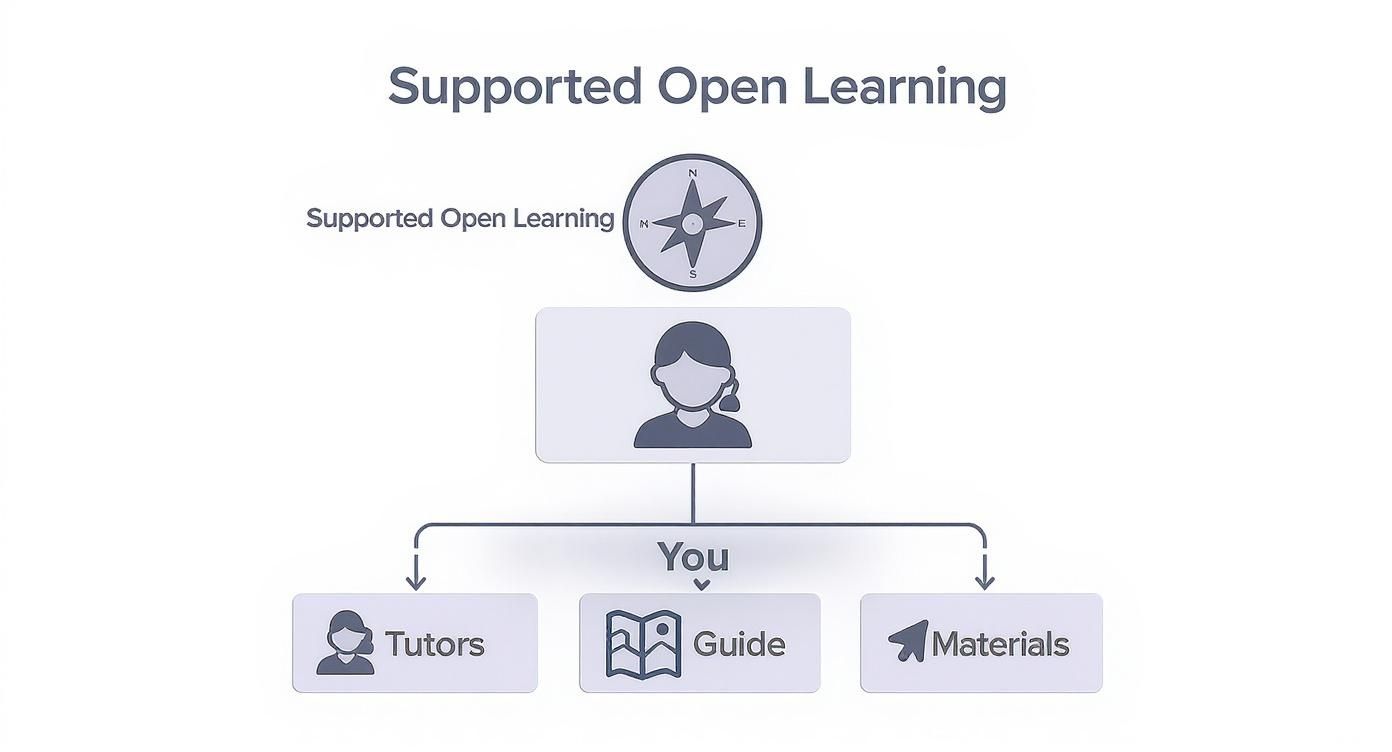
As you can see, you're directly connected to your dedicated tutors and all the course materials you need. You're never just left on your own.
Stage 2: Deepening Your Expertise
Once you’ve got your foundational 120 credits in the bag, you’ll move on to Stage 2. This is where things get more specialised, letting you dive deeper into key areas of computer science. You'll complete another 120 credits here, but the topics will be much more focused and challenging.
This is where you really start building on what you've learned, moving from the 'what' to the 'how' and 'why'.
At Stage 2, you begin to see how different areas of computer science connect. It's like moving from learning individual words to constructing complex sentences and expressing sophisticated ideas.
You’ll tackle modules on subjects like:
- Object-Oriented Programming: A powerful style of programming used to build complex, reusable software.
- Software Engineering: The principles behind designing, building, and looking after large-scale software systems.
- Data Structures and Algorithms: This is the backbone of efficient computing, teaching you how to organise data and create fast, effective programmes.
- Web Technologies: Exploring how modern websites and web applications are actually built and run.
This stage is crucial for developing the practical, job-ready skills that employers are desperate for. You're not just learning theory; you're putting it into practice to solve real-world problems.
Stage 3: Specialising and Completing Your Journey
The final leg of your degree is Stage 3, where you'll earn your last 120 credits. This stage is all about specialisation and bringing everything you've learned together in a final project. The Open University offers several pathways within its Computing & IT degree, so you can tailor your studies to match your career goals.
You can choose to focus on a specific area, essentially 'majoring' in a sub-field of computer science. The main specialist routes often include:
- Software Development: Perfect for aspiring software engineers, focusing on advanced programming, software design, and development methods.
- Web Development: Concentrating on the front-end and back-end tech needed to build modern, interactive websites and apps.
- Networking: For those fascinated by how data travels, covering network security, infrastructure, and management.
This specialisation means you graduate with a degree that gives you both a broad understanding of computer science and deep expertise in a high-demand area. It’s the final step in shaping your qualification to fit your future career, making you a really strong candidate in the competitive tech industry.
How to Start Your Degree Without A-Levels
One of the biggest worries for people thinking about returning to education is that their past academic record might hold them back. If you’re concerned that a lack of A-levels will stop you from pursuing an Open Uni computer science degree, you can relax. This is where the university’s most powerful feature comes into play: its open entry policy.
For most of their undergraduate courses, the main requirement isn’t a specific set of grades but a genuine passion and commitment to learn. The Open University was founded on the principle of being open to people, places, methods, and ideas. They believe in your potential, not just your prior qualifications.
This philosophy means the door to higher education is wide open, even if you’ve been out of a classroom for years. It’s a chance to prove what you’re capable of now, without being judged on exam results from your past.
Assessing Your Readiness for University Study
While the formal entry requirements are removed, starting a degree is still a significant undertaking. Success requires dedication, good time management, and a certain level of academic readiness. It's smart to honestly ask yourself if you feel prepared for the challenge of university-level study.
Think about your current skills:
- Are you comfortable reading and understanding detailed texts?
- Can you communicate your ideas clearly in writing?
- Do you have the basic IT skills needed for online learning?
- Are you ready to manage your own study schedule?
Being self-aware about your strengths and weaknesses is the first step. If you feel confident, you can apply directly. However, if you feel a little rusty or want to build a stronger foundation before you begin, there’s a fantastic route to get you prepared.
The Access to HE Diploma: A Structured Pathway
For anyone wanting a structured warm-up before diving into a full degree, the Access to Higher Education (HE) Diploma is the ideal prep course. Think of it as a training camp specifically designed to get you ready for the demands of a computer science degree.
It’s a nationally recognised Level 3 qualification, equivalent to A-levels, and is widely accepted by universities—including the Open University—as proof of your ability to succeed. It's designed for adult learners who need to bridge the gap between their current knowledge and the start of a degree.
The Access to HE Diploma does more than just teach you subject-specific content. It’s engineered to rebuild your academic confidence and equip you with the essential study skills—like academic writing, research, and critical thinking—that you'll rely on every single day at university.
This course acts as the perfect stepping stone. It not only covers foundational computer science concepts but also eases you back into a learning routine, making the eventual transition to your degree feel much smoother and less intimidating.
Why This Preparation Matters
Jumping straight into a degree without recent study experience can be tough. The pace and depth of the material can feel overwhelming at first. An Access to HE Diploma helps by giving you a running start.
You’ll arrive at Stage 1 of your Open University degree with:
- Essential Knowledge: A solid grasp of core computing and mathematical principles.
- Proven Study Skills: Experience in managing deadlines, writing assignments, and conducting research.
- Renewed Confidence: The certainty that you can handle university-level work because you’ve already done it.
This preparation significantly boosts your chances of not just starting your degree, but excelling in it from day one. If you're interested in a clear path, you can learn more about how to become a computer scientist without A-levels through this kind of structured preparation.
Ultimately, the Open University’s flexible entry means your ambition is the only prerequisite you truly need.
Funding Your Future: Understanding Fees and Loans
Let's talk about one of the biggest questions on anyone's mind when considering university: how do you pay for it? The great news is that the financial side of an Open Uni computer science degree is designed to be just as flexible as the study itself, getting rid of the barrier of huge, upfront tuition fees.
Forget the idea of a massive annual bill. The Open University operates on a much friendlier pay-as-you-go model. You simply pay for your degree one module at a time, which feels a lot more like a manageable subscription than a one-off hit to your bank account. This lets you spread the cost over the entire time you're studying, fitting the expense around your life and your budget.
The Part-Time Tuition Fee Loan Explained
For most students, the main way to fund their studies is with a part-time tuition fee loan from Student Finance. This isn't your typical bank loan; it's created specifically for students and comes with some really important protections.
The loan covers the entire cost of your module fees, meaning you don't have to find any cash out of pocket to get started. The money goes directly from Student Finance to the Open University, so you can get on with your studies without worrying about the admin.
It's a hugely popular option. In fact, 85% of OU students in England fund their undergraduate studies this way, which just goes to show how this accessible model helps people achieve their higher education goals. This approach to affordability has been a game-changer in making university education accessible across the country. You can learn more about how the OU stacks up by reading about the UK's best universities for computer science degrees.
How Do Loan Repayments Actually Work?
The idea of taking out a loan can feel a bit daunting, but the repayment terms are designed to be fair and, most importantly, affordable. You only start paying it back once you’ve finished your course and are earning over a certain amount of money.
Here’s the simple breakdown:
- Earnings Threshold: You only start making repayments when your income is over a threshold set by the government (this figure changes from time to time).
- Income-Based Repayments: The amount you repay is tied to how much you earn, not the total amount you owe. It’s calculated as a small percentage of your earnings above that threshold.
- No Repayments If You're Not Earning: If your income drops below the threshold for any reason—whether you take a career break or work part-time—your repayments automatically stop until you're earning above it again.
Think of it less like a traditional debt and more like a graduate contribution. You only start contributing back to the system once your degree has helped you land a better-paying job. It's a safety net that ensures your education remains a smart investment, not a financial burden.
Exploring Other Funding Avenues
While student loans are the most common path, they aren't the only one. It’s always a good idea to look into other options to see if you can get some extra support.
Other potential sources of funding include:
- Employer Sponsorship: Many companies are happy to invest in their employees' skills. If your computer science degree is relevant to your job, your employer might agree to pay for some or even all of your module fees. It's definitely worth a conversation!
- Instalment Plans: If you'd rather fund the course yourself, the Open University offers a plan called an Open University Student Budget Account (OUSBA). This allows you to pay for your modules in manageable monthly instalments.
By looking at all these different options, you can put together a financial plan that makes your ambition of studying computer science a reality.
What a Typical Study Week Looks Like
The best thing about an Open Uni computer science degree is its flexibility, but what does that actually look like day-to-day? Let's get practical and map out the reality of being a distance learning student. Forget commuting to lectures; your "campus" is a mix of online resources, custom software, and high-quality printed materials that arrive right at your doorstep.
This isn't about sitting alone with a textbook, though. The whole experience is designed to be interactive. Your virtual learning environment is the main hub where you’ll find everything you need – module websites, video tutorials, interactive quizzes, and even forums to connect with other students. It’s a complete world of learning you can tap into whenever and wherever it works for you.

Managing Your Time and Workload
The question on everyone's mind is, "How much time will this really take?" The Open University is pretty clear on this. A standard 60-credit module, which typically runs over nine months, needs about 16-20 hours of study per week. It's a real commitment, but the crucial part is that you decide when those hours happen.
Your week could be pieced together like this:
- Early Mornings: Getting in a couple of hours of coding or reading before the day gets chaotic.
- Lunch Breaks: Using your work break to watch a 30-minute lecture or go over your notes.
- Evenings: Setting aside a few evenings each week to focus on module activities and assignments.
- Weekends: Blocking out a solid chunk of time on a Saturday or Sunday to dig into more complex topics.
This kind of structure lets you build your degree around your life, whether that means a full-time job, looking after kids, or anything else. It takes discipline, but it puts you firmly in control. To get a better feel for this style of learning, it’s worth checking out guides on what online learning looks like for preparatory courses.
Your Support System: The Personal Tutor
A huge part of your weekly routine will be your personal tutor. This isn't just someone who marks your work from afar; they are your academic guide and your first port of call for anything course-related. Think of them as your mentor, there to help you make sense of the material and give you one-on-one feedback.
You’ll typically connect with your tutor through:
- Email and Phone: Perfect for quick questions and bits of advice.
- Online Tutorials: Group sessions where they break down tricky topics and get discussions going.
- Assignment Feedback: In-depth, constructive comments on your work to help you see where you can improve.
This setup means you get the independence of distance learning without ever feeling like you’re on your own.
The relationship with your tutor is what transforms open learning from simple self-study into a genuinely supported educational journey. They provide the context, clarification, and encouragement needed to keep you on track and motivated.
The Rhythm of Assessment and Progression
Your progress is measured through a series of assignments, called Tutor Marked Assignments (TMAs), which you submit throughout each module. A typical week might involve you chipping away at the next TMA, applying what you’ve learned to solve specific problems.
Once you’re ready, you simply upload your work to the online system. A few weeks later, you’ll get it back with your grade and, more importantly, detailed feedback from your tutor. This cycle of learning, applying, and getting feedback creates a steady rhythm that keeps you moving forward. It’s this disciplined process that builds not just your knowledge, but also the fantastic time management and resilience skills that employers love about Open University graduates.
Unlocking Career Opportunities After Graduation
Getting your Open Uni computer science degree is a massive achievement, but the big question is always: what’s next? A degree from the Open University isn’t just another qualification. It’s a powerful signal to employers that you’ve got a unique and valuable set of skills that go way beyond technical know-how.
There’s a reason employers actively seek out OU graduates. They know that successfully completing a degree through distance learning takes exceptional self-discipline, fantastic time management, and a really proactive approach to solving problems. These aren't just fluffy soft skills; they're the bedrock of a successful career in the fast-paced tech world. You don’t just graduate with coding and analytical abilities – you graduate with proven resilience and independence.

High-Demand Career Paths
The practical, job-ready skills baked into the curriculum open doors to a huge range of roles. You're not just learning theory; you’re building a portfolio of real, tangible abilities you can apply from day one.
The table below highlights some of the most common career paths for graduates, showcasing the direct link between what you learn at the OU and what employers are looking for.
Potential Career Paths with a Computer Science Degree
| Job Role | Key Skills Acquired at the OU | Example Industries |
|---|---|---|
| Software Developer | Programming (Python, Java), problem-solving, algorithm design, software engineering principles. | Tech, Finance, Gaming, E-commerce |
| Cybersecurity Analyst | Network security, ethical hacking principles, cryptography, risk assessment, data protection. | Banking, Government, Healthcare, IT Services |
| IT Consultant | System analysis, project management, communication, client management, technical solution design. | Consulting Firms, Public Sector, Retail |
| Network Engineer | Network architecture, protocol management, cloud computing, troubleshooting, system administration. | Telecoms, Internet Service Providers, Large Corporations |
This is just a small sample, of course. The foundational knowledge you gain sets you up for a career that can grow and change right alongside the industry itself.
Your OU degree acts as a powerful launchpad. It demonstrates not only what you know but, crucially, that you know how to learn—an essential trait in a sector where technologies are constantly changing.
The demand for these skills is stronger than ever. Applications for computing degrees in the UK have seen incredible growth, jumping by 33.3% between 2021 and 2023 alone. This surge reflects the massive appetite for tech education and the huge opportunities waiting for qualified graduates.
For those looking to turn their degree into a more flexible career, exploring platforms for remote software developer jobs is a great next step. The self-starting nature of an OU education makes its graduates a perfect fit for the autonomy of remote work. Ultimately, this degree is about launching a tangible, rewarding career in the UK’s thriving tech sector.
Got Questions? We’ve Got Answers
Deciding to jump into a degree involves thinking through all the practical stuff. To help you feel completely sure about your choice, we’ve pulled together some of the most common questions we hear from people thinking about an Open Uni computer science course. Let's clear up any lingering doubts you might have.
How Do Employers View an OU Degree?
This is a big one, and probably the question we get asked the most. The short answer? Employers really value Open University degrees. They know that earning a qualification through distance learning builds a unique set of skills that are gold dust in the workplace.
Think about it. An OU graduate has already proven they have:
- Exceptional Self-Discipline: You’re in charge of your own schedule. There's no one chasing you to show up to a lecture, so you have to be self-motivated.
- Superb Time Management: Juggling studies with a job, family, or other commitments shows you know how to prioritise and hit deadlines, no matter what.
- Proactive Problem-Solving: When you get stuck, you learn to take the lead and figure things out. That kind of initiative is exactly what hiring managers are looking for.
When you combine those abilities with the solid academic knowledge from the degree, you become a seriously well-rounded and attractive candidate.
What Support Is Available if I Fall Behind?
Life happens, and it’s completely normal to feel like you're struggling to keep up sometimes. The Open University has a fantastic support system in place to get you back on track. Your first port of call is always your personal tutor. They can offer one-on-one academic help, walk you through tricky concepts, and give you advice on your assignments.
The university also has a dedicated student support team ready to help with non-academic issues. They can offer guidance on everything from time management techniques to handling study-related stress. The most important thing is to reach out as soon as you feel you're struggling—help is always there.
How Long Do I Have to Complete the Degree?
Flexibility is what the OU is all about, and that definitely applies to how long you can take to finish your qualification. A typical part-time student will complete a BSc (Honours) in Computer Science in six years, but you actually have a maximum of 16 years to get it done.
This huge timeframe is a massive safety net. It means if life throws you a curveball—a new job, a growing family, anything—you can press pause on your studies. You can then pick things back up right where you left off without losing any of the credits you’ve already earned. It ensures your long-term goals don't have to be sacrificed because of short-term events.
Ready to build a rewarding career in tech, even without A-levels? Access Courses Online offers the perfect pathway. Our accredited online Access to HE Diploma in Computer Science will give you the skills and confidence to hit the ground running from day one of your university journey. Explore our courses and start building your new future today at https://accesscoursesonline.com.