

You might be reading this on a lunch break, after a late shift, or once the house has finally gone quiet. You know you want a career change, but the practical questions keep piling up. Am I too old to start over? What if my qualifications are patchy? Would a school even take me seriously?
If that sounds familiar, you're not behind. You're exactly where many adult learners begin. A career as a Pupil Support Assistant can be a realistic, steady, and meaningful next step, especially if you already have life experience in caring, communicating, organising, or staying calm when other people need support.
This role matters because schools rely on support staff in a serious, long-term way. In England, the number of teaching assistants, a group that includes pupil support assistants, has more than trebled since 2000, rising from 79,000 to over 260,000 and making up a quarter of the school workforce according to the Education Policy Institute's analysis of expenditure on teaching assistants. That tells you something important. This is not a minor add-on in schools. It's part of how schools function.
If you're considering a move into education, it helps to see the role clearly. Not as a vague “helper” job, but as skilled work that supports learning, wellbeing, routine, confidence, and independence.
Why 2026 Is the Year for a Career That Matters
You may be looking at 2026 as a line in the sand. The children are older. Redundancy has made you reconsider what comes next. Or perhaps you have spent years in care, retail, admin, hospitality, or parenting, and you want work that uses what you already know about people.
That kind of career change can feel risky. It can also be realistic.
A pupil support assistant role appeals to many adult learners for a simple reason. Your life experience is not baggage here. It is often part of what makes you useful from the start. Schools need adults who can stay steady, notice small changes in behaviour, and help children feel safe enough to learn.
Why schools are paying closer attention to support roles
Schools are dealing with more than lesson delivery. Staff are supporting pupils with different communication needs, gaps in confidence, anxiety, behaviour challenges, and wider wellbeing concerns. In practice, that means support roles are tied closely to how a school day works.
For a career changer, that is significant because it points to work with a clear purpose. You are not stepping into a vague helper role. You are entering a job that supports attendance, behaviour, relationships, classroom access, and daily routines.
The role has changed too. In many schools, support staff are expected to understand SEND, follow safeguarding procedures carefully, and work as part of a wider team around the child. If you want a clearer picture of that side of school life, this guide to studying with SEND is a useful place to start.
Why adult learners often bring the right strengths
Many adults underestimate how transferable their experience is. If you have raised children, supported relatives, worked with the public, managed conflict, handled unpredictable days, or kept going when you were tired, you have already built habits that matter in schools.
The work is a bit like being a reliable bridge. A teacher sets the direction, and the pupil support assistant helps a child cross the gap between what is expected and what they can manage right now.
That might mean noticing a child is close to overload before it becomes a full meltdown. It might mean breaking instructions into smaller steps, helping a pupil reset after a difficult moment, or encouraging them to join in instead of withdrawing. Those actions can change the shape of a school day.
If you are drawn to the pastoral side of education, the benefits of SEL in classrooms can help explain why schools value adults who support emotional regulation, belonging, and confidence as much as task completion.
You do not need to have followed a perfect academic path to start considering this work. You do need patience, consistency, and a willingness to learn. For many adult learners, 2026 is a good time to begin because the question is no longer whether schools need this support. The better question is whether you are ready to recognise that your past experience already counts for more than you think.
What a Pupil Support Assistant Really Does
The job title can sound simple. In reality, the work is varied, skilled, and sometimes emotionally demanding.
A pupil support assistant might begin the morning helping one child settle into class after a difficult start to the day. Later, they may support a small group during reading, supervise transitions between lessons, help a pupil regulate after sensory overload, or check whether a child has understood instructions before frustration turns into disengagement.
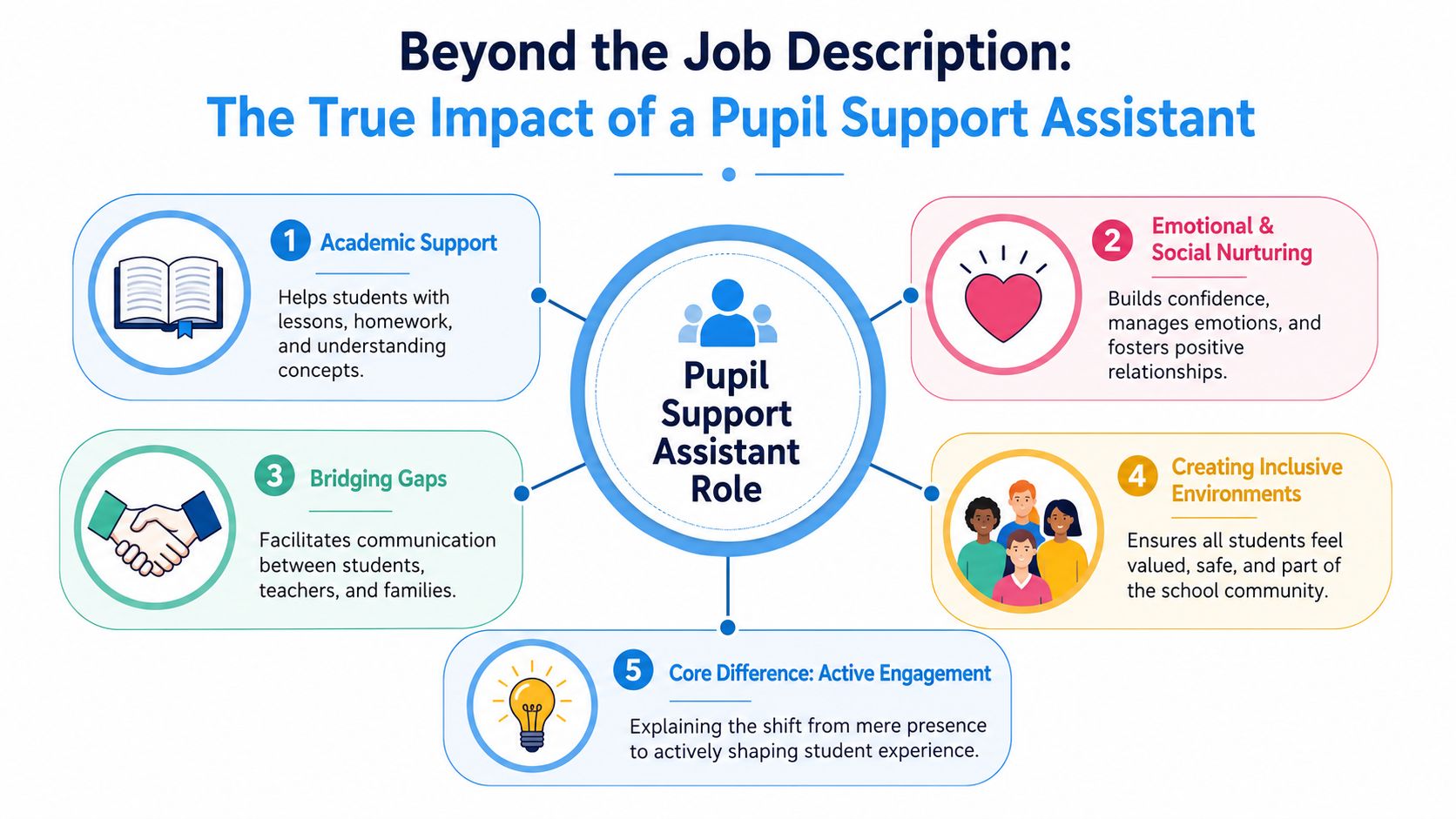
A day can include much more than classroom help
Some responsibilities are academic. Others are practical, social, or pastoral.
A typical day may involve:
- Supporting learning tasks by rephrasing teacher instructions in simpler steps
- Helping pupils stay regulated when they feel anxious, overwhelmed, or frustrated
- Encouraging social participation during group work, lunch, or break times
- Observing and feeding back to the class teacher about what a pupil managed independently and where they struggled
- Providing personal care when needed for pupils with more complex needs
The role often sits in the space between teaching and care. That's one reason it can be hard to describe properly. You are not replacing the teacher, but you are actively shaping whether a child can access the school day.
Presence is not the same as impact
Many new applicants assume the job is mainly about being nearby and offering help when asked. Good support is more deliberate than that.
Pupil support assistants often work closely with pupils who are lower-attaining or who have Special Educational Needs. The Chartered College of Teaching notes that these staff interact with those at-risk groups far more frequently, with 41 per cent of their interaction time focused on them, and the article also discusses a key challenge from the DISS study: pupils receiving the most general TA support made the least progress, while targeted interventions delivered by trained TAs showed benefits for pupils with SEND in focused settings. You can read that fuller picture in the Chartered College article on whether teaching assistants improve pupil outcomes in mainstream schools.
That's an important distinction. Schools don't just need kind adults. They need thoughtful adults who know when to help, how to help, and when to step back.
Practical rule: The aim is not to make a pupil dependent on you. The aim is to help them do more without you.
The shift from caregiver to enabler
It often surprises many that, in some roles, especially with pupils who have complex needs, there can be personal care duties. Yet modern guidance also encourages adults to remain in the background where at all possible so pupils can build social connections and independence. That shift is highlighted in guidance discussed through a pupil support assistant job context.
That balance takes judgement.
You might help a child open their lunch, then realise they can manage the rest if given a bit more time. You might sit beside a pupil during a writing task one week, then move slightly further away the next so they begin seeking help from peers or following a visual prompt independently.
For readers who want a better feel for inclusive classroom practice, these strategies for inclusive learning offer helpful examples of how adults can support access without taking over.
If you're especially interested in working with children with additional needs, it can also help to read about studying with SEND. It gives useful context around the wider support environment that schools and learners operate within.
The Essential Skills and Qualities You Need
Many adults talk themselves out of this career before they've even explored it properly. They assume schools want someone younger, more academic, or already trained in everything. That usually isn't the full picture.
A better question is this. What do you already bring, and what can you learn next?

Qualities you may already have
Life experience often translates well into school support work. If you've raised children, cared for relatives, supervised staff, worked in retail, supported customers, or managed a busy home, you've probably built relevant strengths already.
Look at how everyday experience maps across:
- Patience. Useful when a pupil needs repeated explanation without feeling rushed or judged.
- Empathy. Important when a child's behaviour is really communication.
- Resilience. Helpful when a day doesn't go to plan and you still need to stay steady.
- Organisation. Schools run on routines, transitions, timings, and accurate follow-through.
- Communication. You'll speak with children, teachers, parents, and sometimes outside professionals.
Someone who has handled upset customers without losing their temper has already practised de-escalation. Someone who has supported an elderly relative may already understand dignity, confidentiality, and calm repetition.
Skills you can learn
The professional side of the role is teachable. One of the most useful examples is scaffolding.
Scaffolding means breaking a task into manageable steps so a pupil can succeed without having the adult doing the work for them. The verified data describes it as a core technical competency for teaching assistants and notes that, when done well, it has been shown to increase engagement by up to 15% for learners with special educational needs, as outlined in this overview of the teaching assistant role in the United Kingdom).
In plain language, it looks like this:
| Situation | Unhelpful support | Scaffolding support |
|---|---|---|
| A pupil freezes during writing | “Just write something.” | “Let's think of one sentence together. What happened first?” |
| A child can't start a maths task | Giving the answer | Pointing to the first step and asking them to try that part |
| A pupil gets lost in a long instruction | Repeating the whole thing quickly | Splitting it into short steps and checking understanding after each one |
What schools often value most
Schools usually notice attitude as much as experience. They want adults who are reliable, reflective, and willing to learn.
That means:
- You don't need to know everything at the start
- You do need to accept feedback professionally
- You need to understand boundaries and safeguarding
- You need to see support as a skilled role, not just a caring instinct
Good pupil support work is warm, but it's also structured. Kindness matters most when it's paired with judgement.
Your Pathway to Becoming a Pupil Support Assistant
You might be reading this after years in a different job, wondering whether school support work is realistic for you now. Maybe you have raised children, supported relatives, worked in care, retail, admin, or hospitality, and you are not sure whether any of that counts. It does.
A pupil support assistant role is one of those careers where life experience can help. Schools need adults who can stay calm, notice when a child is struggling, explain things clearly, and stick to routines. Many adult learners already do those things every day. The task is to turn that experience into a route schools can recognise.
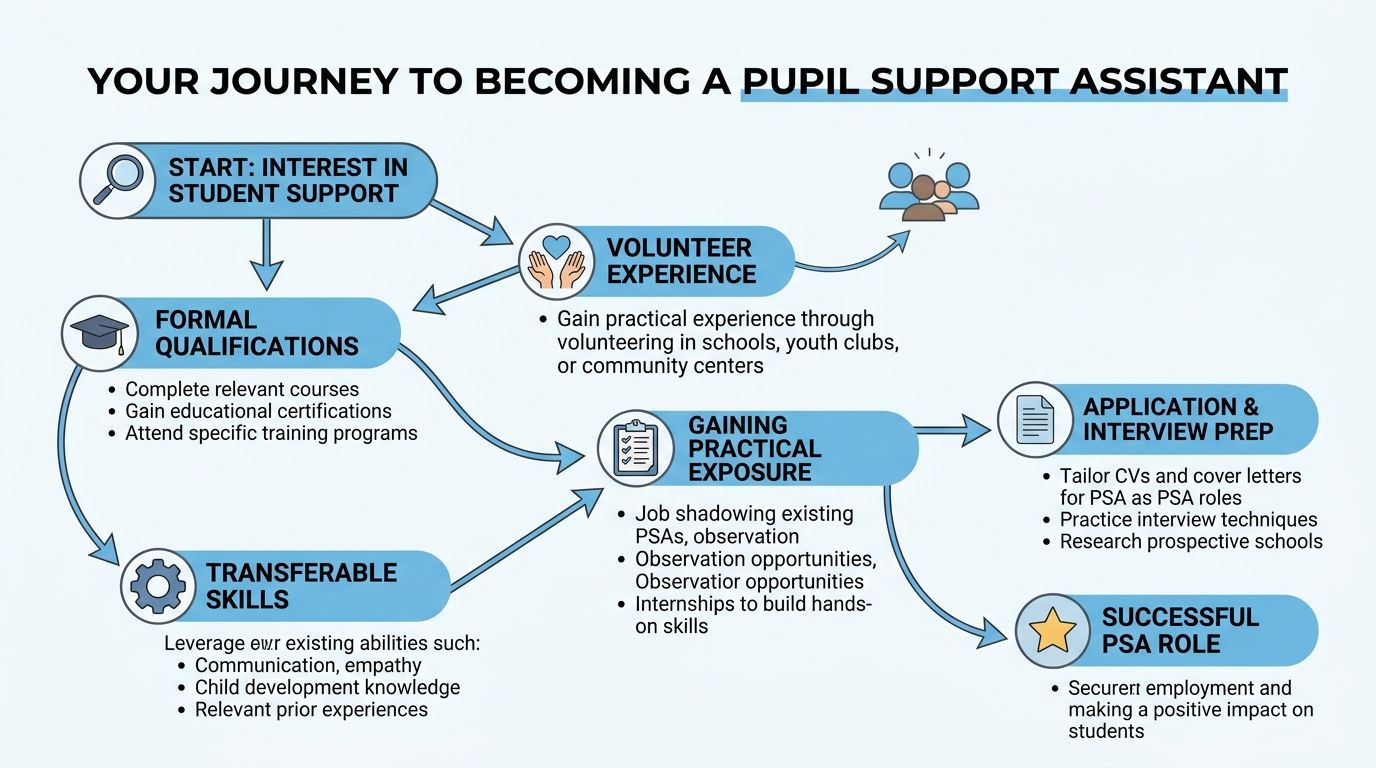
Route one through volunteering and school exposure
If education is new to you, spending time in a school can answer an important question quickly. Do you enjoy the pace, structure, noise level, teamwork, and unpredictability of school life?
That experience also gives you something many adult learners need. Proof. Instead of saying, “I care about children,” you can talk about supporting reading practice, helping pupils settle into routines, or assisting with group activities.
Useful starting points include:
- Volunteer reading support in local primary schools
- Lunch or after-school club support through schools or community groups
- Youth work or mentoring roles in charities and local services
- Parent helper opportunities where schools offer structured volunteer support
Even a small amount of hands-on experience can strengthen an application. It shows that you understand real school routines, not just the idea of the job.
Route two through qualifications and training
Training can give structure to your career change. It works a bit like putting labels on skills you may already have, so employers can see them clearly.
Some entry-level roles are open to applicants who are still building qualifications. Even so, a relevant course can help you learn safeguarding language, child development basics, classroom practice, and the professional boundaries schools expect. For adult learners, that often makes interviews feel less intimidating because you are not relying on instinct alone.
If your English or Maths qualifications are missing, treat that as a practical task rather than a verdict on your ability. Many adults return to these subjects later and do well because they now have a clearer reason for studying them.
If you want a flexible study option that fits around work or family life, this guide to an online teaching assistant course level 3 can help you compare one common route into school support work.
Route three for adults who want future options
Some people want a pupil support assistant role as their long-term career. Others see it as the first stage in a wider plan.
Both approaches are valid.
You may want a route that leaves room for:
- Higher Level Teaching Assistant work
- Specialist SEND support
- Pastoral roles
- Further study in education, psychology, child development, or social work
- Teacher training later on
If that sounds like you, choose training and early experience with progression in mind. A short-term fix is not always the best fit if you know you may want to study further later.
A practical decision guide
If you feel stuck, keep it simple. Pick the next step that matches your situation now.
| Your situation | Best next move |
|---|---|
| No school experience yet | Volunteer or shadow in a school if possible |
| Confident with children but lacking qualifications | Look at entry-level training and English or Maths catch-up if needed |
| Want a quick route into paid work | Apply for entry roles while building experience |
| Want long-term progression options | Choose a pathway that supports further study later |
A career change into education rarely happens in one jump. It usually grows through a series of credible steps. That is good news, especially if you are rebuilding confidence as well as a CV.
Understanding Pay Scales and Career Progression
You may be looking at this role with two questions in your head at the same time. Will I manage financially, and will this job still lead somewhere a few years from now?
Both questions are sensible.
For adult learners changing career, pay is rarely just a number on a job advert. It affects childcare, travel, bills, and whether retraining feels realistic. Pupil support assistant roles are often modestly paid at entry level, especially compared with some full-time roles in retail, admin, or private sector customer service. What makes the decision more balanced is the full picture. Many posts are term-time only, some fit better around family life, and the role can lead to better-paid specialist or senior support work over time.
A useful way to view it is this. Your first role is often the foundation, not the finished house.
What affects pay
Schools do not all pay in exactly the same way. Your pay can vary depending on:
- whether the job is term-time only or full-year
- your local authority or academy trust
- the hours worked each week
- the level of responsibility in the post
- whether you support pupils with more complex additional needs
- your previous relevant experience, even if it came from another sector
That last point matters more than many career changers realise. Experience in care, youth work, early years, behaviour support, family support, customer-facing roles, or community work can all strengthen your starting application. It may not place you straight into a senior post, but it can help employers see that you already understand responsibility, routines, communication, and calm responses under pressure.
A clearer view of the ladder ahead
This section is less about how to get started and more about what happens after you are in.
Here is a realistic progression path:
| Stage | What usually changes | Where it can lead |
|---|---|---|
| Entry-level pupil support assistant | You learn school systems, safeguarding routines, classroom expectations, and day-to-day pupil support | A more settled role with greater responsibility |
| Experienced pupil support assistant | You build confidence with interventions, behaviour support, SEND awareness, and working closely with teachers | Specialist SEND work, intervention roles, or senior support posts |
| Senior or specialist support role | You may support more complex needs, lead small-group work, or become a go-to person for specific pupils or approaches | Pastoral support, behaviour support, family liaison, or higher-level support roles |
| Further development through study or workplace training | You add formal learning to practical experience | HLTA-type work, teacher training, or study in education, child development, psychology, or related fields |
Life experience starts to count in a new way. In your first few months, you are learning the school context. After that, schools often notice the strengths you brought with you all along. Patience from parenting. Professional boundaries from care work. Organisation from admin. Staying calm under pressure from hospitality or health settings.
Progression is not always upward in a straight line
Some adults worry that if they do not want to become a teacher, they have somehow failed to progress. That is not true.
Progression can mean becoming more skilled, more specialised, and more secure in a role that suits your life. You might decide that supporting pupils with SEND is the right fit. You might prefer pastoral work over classroom-based learning support. You might want a steady school-based career with better hours and work that feels meaningful, without taking on full teaching responsibility.
That is progression too.
Weigh the role in practical terms
A lower starting salary can still make sense if the role gives you:
- working patterns that suit family life
- a route back into stable employment
- experience in a sector with several next-step options
- work that feels more aligned with your values
- a stronger long-term CV for education or child-focused roles
If you are worried about how your previous jobs will look on paper, it helps to prepare before you apply for better-paid progression opportunities later. A good place to start is this guide on writing a CV with no direct experience.
Choose this path with open eyes. The starting pay may ask for short-term adjustment. For many adult learners, the trade-off is a role with purpose, a clearer routine, and a career path that can grow as confidence grows.
How to Land Your First Pupil Support Role
Many applicants get stuck because they think, “I've never worked in a school, so I've got nothing to say.” That's almost never true.
The key is translating what you've already done into language schools recognise. Schools are not only looking for direct classroom experience. They're looking for judgement, reliability, warmth, boundaries, and the ability to support children appropriately.
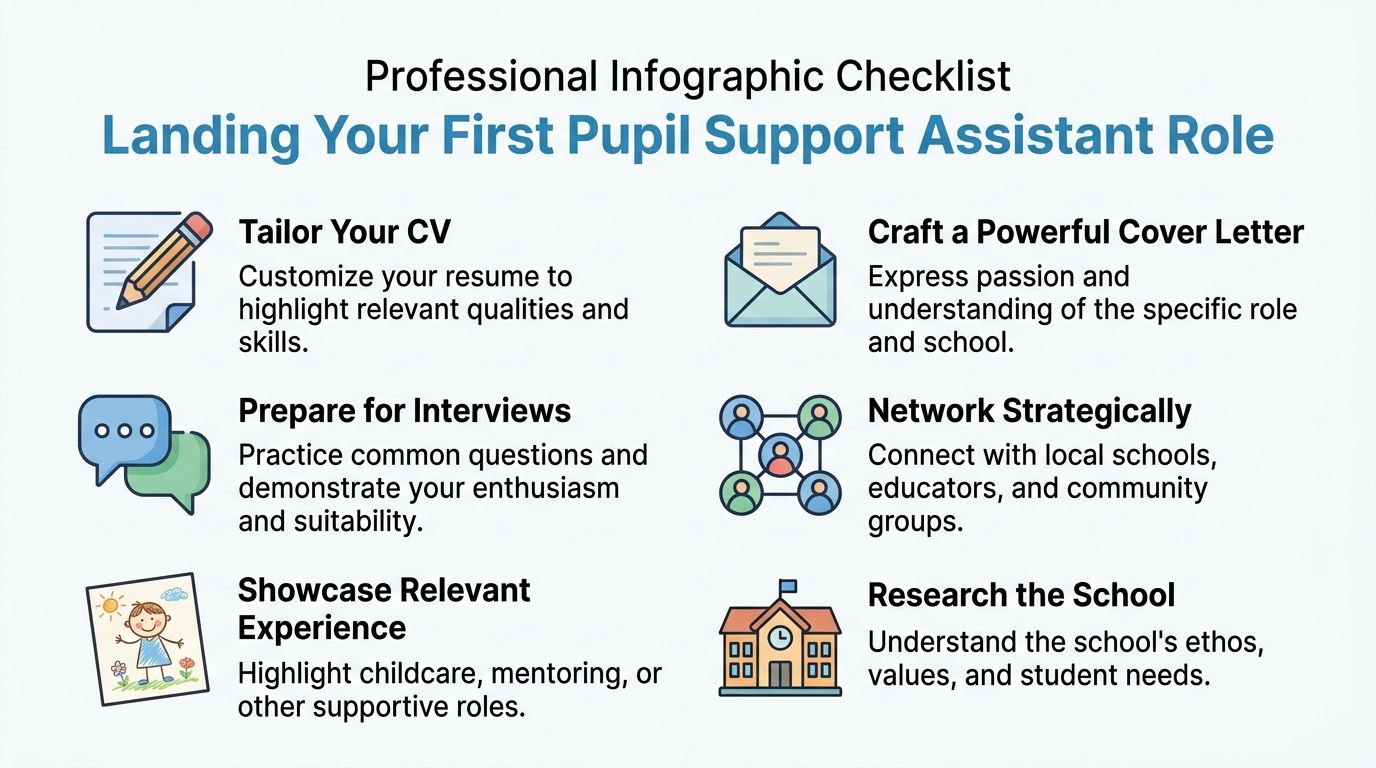
Reframe your experience on your CV
If you've worked in retail, care, hospitality, admin, or parenting-heavy unpaid roles, your experience may already be relevant. The problem is usually presentation, not substance.
Here are some examples.
| Before | Better for a school application |
|---|---|
| “Handled customer complaints” | “De-escalated challenging situations calmly and found positive resolutions” |
| “Looked after children” | “Supported children's routines, wellbeing, communication, and safe participation in daily activities” |
| “Worked on reception” | “Managed sensitive information professionally and communicated clearly with a wide range of people” |
| “Ran a household” | “Coordinated schedules, prioritised competing demands, and maintained consistent routines” |
If you're starting from scratch, this guide on how to write a CV with no experience can help you turn everyday responsibilities into evidence of employability.
Prepare stories, not speeches
Interviews for pupil support assistant roles often focus on your judgement. You may be asked how you'd respond to distressed behaviour, support a shy pupil, follow teacher direction, or maintain boundaries.
A good approach is to prepare short examples from real life that show:
- Calm problem-solving
- Sensitivity with vulnerable people
- Working within rules
- Building trust
- Knowing when to ask for help
If you haven't worked in schools, use examples from parenting, caring, volunteering, customer-facing jobs, or community roles. What matters is the behaviour you demonstrated.
Understand safeguarding without panic
Most school roles involve safeguarding requirements, including checks such as a DBS process. That isn't there to catch you out. It's part of working responsibly with children.
Schools will also expect you to understand basics such as professional boundaries, confidentiality, reporting concerns, and following procedures rather than improvising.
If you don't know the finer details yet, that's okay. What matters at application stage is showing that you respect safeguarding and take it seriously.
Ask questions that protect you too
Interviews are not only for the school's benefit. They also help you judge whether the role matches what you want.
Recent government-linked research indicates that teaching assistants are increasingly used as cover supervisors, which can pull them away from core pupil support duties. That issue is discussed in the research report on the use of teaching assistants in schools.
That means you should ask direct, sensible questions such as:
- How often are support staff asked to cover classes?
- What does a typical day look like in this role?
- How is support for pupils balanced with wider school duties?
- What induction and training do new staff receive?
- How do teachers and support staff communicate about pupil progress?
Those questions don't make you difficult. They make you informed.
Some roles are sold as pupil support posts but include a wide spread of cover and admin duties. Ask clearly so you know what you're applying for.
Your Questions Answered for Adult Learners
Am I too old to start working in a school
No. Schools need mature adults who bring steadiness, perspective, and patience. Age is often far less important than reliability, warmth, and your willingness to learn.
What if I don't have the right qualifications yet
That's a common starting point, not a dead end. Some roles are open at entry level, while other pathways ask for English and Maths or additional study. If your qualifications need updating, you can work on that step by step.
Will schools take my previous work seriously
Yes, if you explain it properly. Schools value transferable strengths such as communication, routine-setting, de-escalation, confidentiality, teamwork, and empathy. You do not need your past job title to say “education” for your experience to count.
What if I'm nervous about going back into learning
That feeling is normal. Many adult learners worry that they've been out of study too long, that they won't fit in, or that they'll struggle with assignments. In practice, adult learners often do well because they're focused, motivated, and clear about why they're studying.
Can I fit training around work and family life
In many cases, yes. Flexible routes exist, and many adults build their way into education gradually rather than all at once. The important thing is choosing a route that matches your real life, not an ideal version of it.
The biggest shift is often mental. Stop asking whether you have a perfect background for this work. Ask whether you care about helping children, whether you can learn, and whether you're ready to take one practical next step.
If you're ready to turn a career change into a plan, Access Courses Online offers flexible online study designed for adults who need to fit learning around work and family life. Their Access to HE Diplomas can help you rebuild confidence, gain recognised qualifications, and move towards university or a new professional path in education and related fields.