
Writing a CV with no experience can feel like a huge challenge. But here’s the secret: it’s not about the paid work you haven’t done, it’s about showcasing the skills, potential, and academic achievements you already have.
The trick is to use a skills-based approach. This flips the traditional CV on its head, highlighting relevant coursework, personal projects, and transferable skills like communication and problem-solving. It proves you're a strong candidate, even without a formal job history.
The No-Experience CV Challenge
Staring at a blank page when you don't have a list of jobs to add is a common struggle. It's something nearly every school leaver, recent graduate, or career changer faces. You’re stuck in that classic catch-22: you need experience to get a job, but you need a job to get experience.
This guide isn’t about making things up. Far from it. It’s about learning how to strategically frame the valuable experience you already have, even if you don't recognise it as 'experience' just yet. So many people fall into the trap of thinking only paid work counts, but that overlooks a massive pool of your abilities.
Uncovering Your Hidden Experience
Your background is much richer than you probably think. The goal is to reframe what you’ve done into language that grabs a hiring manager’s attention. We'll show you how to turn what feels like a weakness into a compelling story of untapped potential.
Here are the key areas we’ll focus on to build your CV from the ground up:
- Your Education: We'll dive into how to detail specific modules, projects, and academic wins that prove your knowledge and dedication.
- Personal Projects: This is where you can really shine. Think about everything from completing an online course to managing a personal blog or even organising a local community event.
- Life and Soft Skills: Teamwork, communication, time management, and problem-solving are skills you build every day—through sports, academic group work, and just life itself.
The best no-experience CVs don't just list what you did; they explain the skills you gained. For example, a group university project isn't just a project—it’s proof of your collaboration, research, and deadline-management skills.
This approach completely changes the conversation. Instead of focusing on what you haven't done, it highlights everything you can do. Rather than a CV with empty sections, you'll have a document packed with evidence of your skills, motivation, and readiness to make a real contribution from day one.
Throughout this guide, we'll give you concrete examples and exact phrasing you can adapt for your own use. So, forget that blank page and the feeling of being underqualified. By following these steps, you’ll learn to confidently articulate your value and build a CV that opens doors. Let’s get started.
Choosing the Right CV Structure
When you're trying to figure out how to write a CV with no experience, the structure you choose is everything. The traditional chronological CV, which lists your work history from most to least recent, is the standard for a reason—but that reason probably doesn't apply to you. It’s designed to highlight a clear career path, which only draws attention to the very thing you lack.
Instead of working against yourself, you need a format that plays to your strengths. The answer is the skills-based CV, sometimes called a functional CV. This approach puts your abilities, knowledge, and potential front and centre, making sure a recruiter sees what you can do long before they notice what you haven't yet done professionally.
This approach is all about framing your potential by focusing on what you've learned and accomplished, rather than where you've worked.
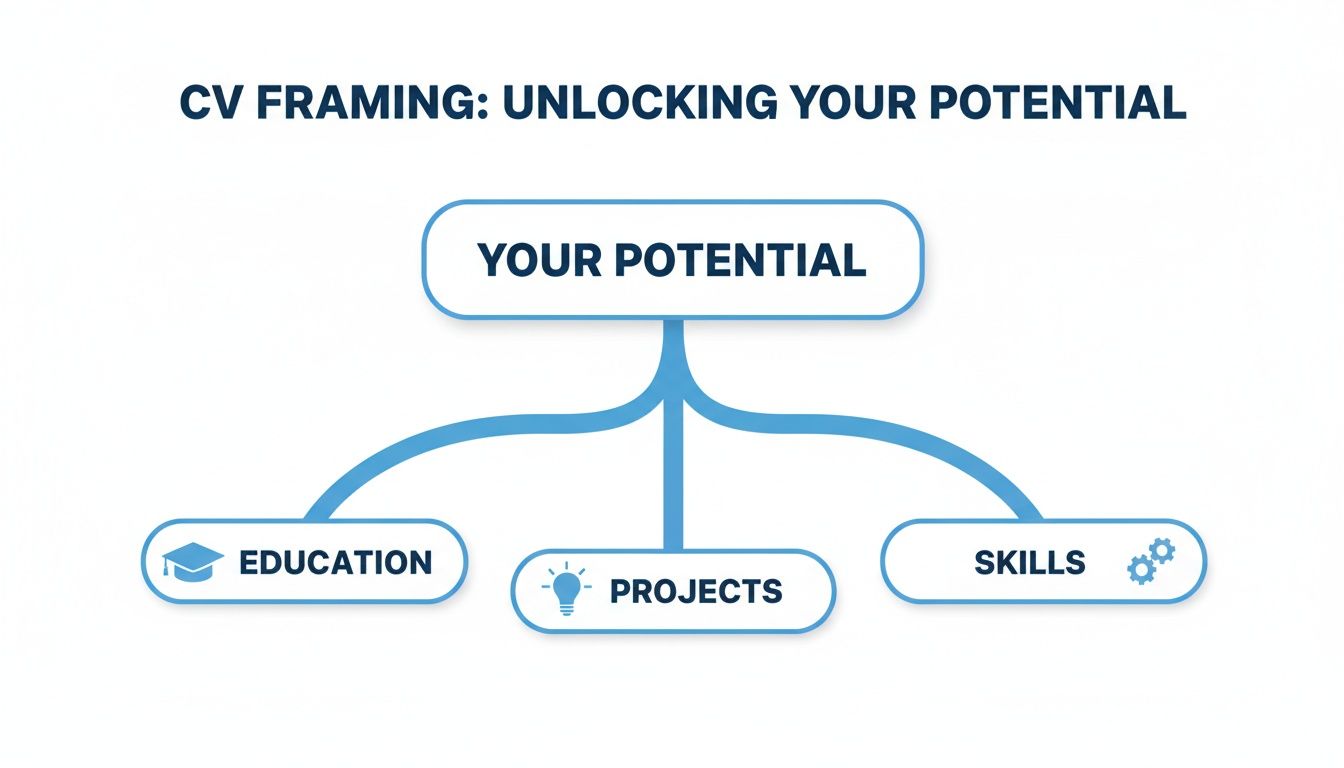
As you can see, your potential isn't just an empty promise. It’s a powerful combination of your academic achievements, practical project work, and the core skills you've developed along the way.
The Skills-Based CV Blueprint
The real power of a skills-based CV is in its strategic ordering. It immediately grabs the reader's attention with the most compelling information about you. You’re not trying to hide your lack of paid work; you’re simply leading with more relevant and impressive qualifications.
Here’s a layout that makes a powerful first impression:
- Contact Information: Your name, a professional email address, phone number, and a link to your LinkedIn profile.
- Personal Statement: A punchy, 3-4 sentence summary of your career goals, key skills, and genuine enthusiasm for the role.
- Key Skills Section: This is the heart of your CV. Use a detailed, bulleted list of your most relevant hard and soft skills, tailored to the job description.
- Education: List your qualifications in reverse-chronological order, highlighting any relevant modules or specific academic achievements.
- Relevant Experience: Dedicate this section to volunteering, academic projects, or even personal endeavours that prove you have practical skills.
This structure completely flips the script. By the time a hiring manager gets to the end, they have a clear picture of what you're capable of, which makes the absence of a traditional "Work Experience" section far less important.
Chronological vs Skills-Based CV for No-Experience Candidates
Seeing the two formats side-by-side makes it obvious why one is a much better choice for your situation. One tells a story of where you've been, while the other tells a compelling story of what you can do right now.
Regardless of the format, it’s always a good idea to follow fundamental professional resume writing best practices to make sure your CV stands out for all the right reasons.
| Feature | Chronological CV (Traditional) | Skills-Based CV (Recommended) |
|---|---|---|
| Primary Focus | Work History and Career Progression | Skills, Abilities, and Potential |
| Opening Section | Work Experience (most recent first) | Personal Statement and Key Skills |
| Best For | Candidates with a consistent work history | Students, graduates, career changers |
| Recruiter Impact | Immediately shows employment gaps | Immediately shows relevant competencies |
| ATS Friendliness | Highly compatible with screening software | Very compatible when structured clearly |
At the end of the day, your CV's job is to secure an interview. The skills-based format is your best tool for getting past that initial 6-second scan most recruiters perform. It gives them a fast, clear answer to their most important question: "Does this candidate have the skills we need?"
Re-Thinking Your Experience Section
Here’s a simple but incredibly effective trick: rename the "Work Experience" heading. That title can feel pretty intimidating when you have nothing to put under it. By changing it, you broaden the scope of what actually counts as valuable experience.
Try one of these alternatives instead:
- Relevant Experience
- Projects and Volunteering
- Practical Experience
This small change gives you permission to include a much wider range of activities. Did you manage a budget for a university society? That's financial management experience. Did you build a personal website from scratch? That’s web development and project management. This approach helps you fill your CV with compelling proof of your skills, all drawn from things you've already done.
Writing a Powerful Personal Statement
Think of your personal statement as the most valuable bit of real estate on your CV. It's your 30-second elevator pitch, sitting right at the top of the page, designed to make a brilliant first impression. When you're figuring out how to write a CV with no experience, getting this short introduction right is absolutely essential.
This little paragraph, usually just 3-5 sentences long, is your chance to tell a recruiter who you are, what you can bring to their team, and why you’re genuinely interested in this specific role. It really does set the tone for everything that follows and can be the single thing that makes a hiring manager decide to keep reading.

The biggest mistake people make is writing something generic that could be pasted onto any application. Your goal is the exact opposite: to create a tailored, high-impact summary that hooks the reader and makes them want to know more about you.
Crafting Your Opening Hook
The formula for a great personal statement is actually pretty straightforward. It’s all about blending your current situation, key skills, and ambitions into a short, confident story. Essentially, you're answering three key questions for the recruiter before they even have to ask.
- Who are you? (e.g., A motivated student, a dedicated career changer, an aspiring professional.)
- What can you offer? (e.g., Key skills from your education, relevant knowledge from projects, strong soft skills like communication.)
- What are your goals? (e.g., To secure a role where you can apply your learning, to contribute to their team, to grow in the industry.)
A great personal statement connects the dots for the recruiter. It shows them you've not only read the job description but have also thoughtfully considered how your unique background, even without formal employment, aligns with their needs.
This isn’t the place to highlight what you don’t have. The focus has to be entirely on your potential, your enthusiasm, and the value you can add from day one. When you lead with confidence, you frame the rest of your CV in a much more positive light. For a deeper dive, you can learn more about how to write a personal statement in our detailed guide.
Examples for Different Career Paths
Seeing the formula in action is the best way to get it. Notice how each example below is specific, uses positive language, and directly links the candidate's education and skills to a clear career goal.
For a future healthcare professional:
"A compassionate and dedicated student currently pursuing an Access to HE Diploma in Nursing, equipped with a strong foundational knowledge of patient care principles and human anatomy. Eager to apply theoretical learning and excellent interpersonal skills to a practical healthcare setting. Seeking to contribute to a supportive team and begin a rewarding career in patient-focused care."
For an aspiring IT professional:
"Highly analytical and detail-oriented student completing an Access to HE Diploma in Computer Science, with practical experience in Python and database management from academic projects. A natural problem-solver with a passion for technology, seeking an entry-level role to apply technical skills and contribute to innovative software development solutions."
For someone entering the business world:
"A proactive and organised individual undertaking an Access to HE Diploma in Business and Management, possessing a solid understanding of marketing principles and financial analysis from coursework. Combines strong teamwork and communication skills with a drive to achieve results. Looking for an opportunity to develop practical business acumen within a dynamic company."
Each of these statements is short, sharp, and packed with relevant information. They successfully shift the focus away from a lack of paid experience towards a wealth of academic knowledge, valuable skills, and genuine ambition.
Turning Your Education into Experience
When you’re trying to build a CV with no work history, your education section stops being a simple list and becomes your most powerful tool. This is your chance to pivot, turning academic qualifications into concrete proof of your skills and dedication.
Think of it as the cornerstone of your application. It’s where you can show a potential employer what you know, how you think, and the value you’ve already developed through your studies. The trick is to go beyond just listing the name of your school and the dates you were there. You need to unpack your qualifications and show a recruiter what’s really inside.
Go Beyond the Qualification Title
Just writing "Access to HE Diploma in Business and Management" on your CV is a huge missed opportunity. To really make an impression, you need to break it down. What modules did you love? Which parts of the course line up perfectly with the job you’re applying for? Highlighting these specifics transforms a simple line of text into active proof of your abilities.
Instead of just the course name, flesh it out with bullet points that showcase what you actually did. This gives a hiring manager something tangible to work with.
- Standard Entry: Access to HE Diploma in Business and Management, Access Courses Online (2023 - 2024)
-
Impactful Entry: Access to HE Diploma in Business and Management, Access Courses Online (2023 - 2024)
- Achieved a Distinction in the 'Principles of Marketing' module, developing a comprehensive marketing plan for a fictional startup.
- Conducted in-depth market research and competitor analysis for a final project on consumer behaviour.
See the difference? The second example immediately flags up skills in strategic planning, research, and analysis—all things that businesses are desperate for.
Structuring Your Education Section Correctly
In the UK, the standard approach is to list your education in reverse chronological order. Your most recent, and therefore most relevant, qualification should be right at the top. This is especially vital for recent graduates or school leavers, as it puts your newest achievements front and centre.
This structure is a game-changer when you have no work experience to fall back on. While many CVs will feature university degrees, qualifications like an Access to HE Diploma are fantastic for bridging that gap. Always include the institution, dates, and any standout grades. For example, 'BSc Computer Science, University of Bristol, 2015-2018' or 'Access to HE in Science, ongoing at Cambridge Online Education'. If you don't have a degree, don't leave out your GCSEs, but make sure your most recent qualifications lead the way.
An Access to HE Diploma is a nationally recognised qualification designed to prepare adults for university. For a more direct route into a specific career, you could also explore various online certificate courses that focus on practical skills. Understanding if you can get a job with an Access course is the key to framing it effectively on your CV.
Translate Coursework into Tangible Skills
Every single assignment, presentation, and exam you’ve tackled has helped you build professional skills. Your job is to translate them into the language of the employer. Go through the job description and pull out keywords like "research," "analysis," "communication," and "project management," then dig through your coursework for matching examples.
Imagine a student who completed an Access to HE Diploma in Nursing. They can turn their academic work into compelling proof that they’re ready for a healthcare role.
Instead of saying you 'studied human anatomy,' rephrase it to highlight the skill: 'Developed a detailed understanding of human physiological systems, applying this knowledge to analyse complex case studies and patient scenarios.'
That tiny shift in wording changes the focus from just learning something to actively using that knowledge, which is exactly what recruiters want to see.
Use Action Verbs to Demonstrate Achievement
When you’re writing those bullet points, kick each one off with a strong action verb. This small change injects energy and a sense of ownership into your CV. Words like "analysed," "developed," "collaborated," and "researched" pack a much bigger punch than passive phrases like "was responsible for."
Let's take a group project as an example:
- Weak Phrasing: "Worked in a team on a final presentation."
- Strong Phrasing: "Collaborated within a four-person team to research, synthesise, and deliver a final presentation on business ethics, resulting in a Merit grade."
The stronger version paints a clear picture of your contribution and the successful outcome, proving you can work in a team, conduct research, and deliver quality work. By framing your education this way, you're not just telling a recruiter what you've learned; you're showing them what you can do. This is how you make your application stand out.
Making the Most of Unpaid and Personal Projects

It’s a common misconception that valuable experience only comes from a paid job. When you're putting together a CV with no work history, your personal projects, volunteer roles, and even certain life responsibilities become your strongest assets. This is your chance to really show a recruiter what you’re made of.
The trick is to frame these activities in professional terms. You need to pull out the transferable skills you’ve developed and, whenever possible, the tangible results you’ve delivered. This is how you confidently fill that ‘experience’ gap on your CV.
Re-framing Your Contributions
The biggest mental block is often learning to see your unpaid work through an employer's eyes. Honestly, a recruiter doesn’t care if you were paid; they care if you can manage your time, communicate well, and solve problems.
Instead of just listing what you did, focus on the skills you used. That simple shift in perspective will unlock a huge amount of content for your 'Relevant Experience' section.
Your goal is to show, not just tell. Simply writing ‘I’m a hard worker’ means nothing. Describing how you organised a three-day charity event, coordinated volunteers, and managed a budget is concrete proof.
This part of your CV is where you can demonstrate your drive and passion—qualities that are incredibly valuable to any team.
From Bake Sale to Business Acumen
Let’s take a common example and see how we can level it up. Many people would brush off helping at a local bake sale as irrelevant, but with the right phrasing, it can showcase a whole range of professional skills.
- Vague Description: "Helped at a local charity bake sale."
- Professional Description: "Managed budget and promotion for a local charity bake sale, increasing funds raised by 25% over the previous year."
The second version is so much more powerful. It uses strong action verbs ("managed") and gives a measurable result ("increasing funds raised by 25%"). Suddenly, you’ve shown skills in financial management, marketing, and hitting targets.
Showcasing Personal and Academic Projects
Personal projects are an absolute goldmine for demonstrating technical skills and self-motivation. They prove you're passionate enough about a subject to pursue it in your own time. This could be anything from building a basic website to diving deep into a research project for one of your courses.
Think about how you could frame your projects on a CV:
- For an aspiring web developer: Independently designed and built a personal portfolio website using HTML and CSS, resulting in a fully responsive and mobile-friendly user experience.
- For a future marketer: Created and managed a personal blog about classic cinema, growing a small following through social media promotion and basic SEO techniques.
- For a creative professional: Started an independent project to explore digital illustration techniques, which can be a great first step if you want to know how to get going with an art and design project.
Each of these points highlights initiative, specific skills, and a real commitment to learning—all without needing a formal job title.
The Power of Quantifiable Achievements
Recent UK research on CVs really highlights how vital it is to make your experience count, no matter where it comes from. One study found that while a tiny 1.6% of job hunters have zero work experience, the average CV lists about eight skills. By including certificates or detailing skills from volunteering, you get a serious advantage, especially since over 80% of CVs list no formal certifications. The full LiveCareer research on the average job hunter is worth a read to see how you can get ahead.
Adding numbers to your achievements gives them weight and proves your impact. Think about anything you can measure:
- The number of people you supervised or trained.
- The amount of money you raised or managed.
- The percentage of improvement you achieved.
- The size of the audience you presented to.
Even if you need to estimate, providing a tangible metric makes your contribution feel real and significant. It transforms a simple task into a measurable success that any recruiter will notice.
Common CV Mistakes to Avoid
You’ve put in the hard work to build your CV, and the last thing you want is for a simple, avoidable slip-up to land it in the 'no' pile. Think of this as your final pre-flight check before you hit send. When you're just starting out, there’s less room for error, making every detail count.
One of the biggest pitfalls is firing off a generic CV for every single application. Trust me, hiring managers can spot a copy-paste job from a mile off. You absolutely have to tweak your Personal Statement and Key Skills section to reflect the keywords and requirements you see in the job description. It shows you've actually read it and are genuinely keen.
Another instant deal-breaker? Poor proofreading. Spelling mistakes and grammar errors scream a lack of attention to detail, which is a red flag for any employer, no matter the role. A great tip is to read your CV out loud or, even better, get a fresh pair of eyes to check it over for you.
Formatting and Presentation Errors
It’s a complete myth that your CV needs a flashy, over-the-top design to stand out. In fact, overly complex layouts packed with graphics or unusual fonts can cause major issues for Applicant Tracking Systems (ATS). Most companies use this software to do the initial screening, and if the machine can’t read your CV, a human never will.
Stick to a clean, professional look. Use a standard font like Arial or Calibri in a 10-12pt size, and always save the final version as a PDF. This locks in your formatting so it looks the same on any device. And please, make sure your email address is professional—something like firstname.lastname@email.com is perfect.
A word of warning on photos: don't include them. In the UK, it’s not standard practice and can open the door to unconscious bias. Research has shown that CVs with photos can face an 88% rejection risk, so it’s much safer to leave them off entirely.
Finally, let's be realistic about the job market. A massive 51.3% of "entry-level" job ads still ask for previous experience. This stat really highlights why every single detail on your CV matters. You need to make your transferable skills from uni, college, or personal projects shine, turning your "no experience" into a story of untapped potential. You can dig deeper into the challenges of entry-level job applications on standout-cv.com.
Your Top CV Writing Questions Answered
Trying to figure out the rules of CV writing for the first time can feel a bit confusing. Let's tackle some of the most common questions that pop up when you're putting together a CV with no experience, so you can finish it with total confidence.
Should I Go for a Functional or Chronological CV?
When you don't have work experience, a functional, or skills-based, CV is absolutely the way to go. This format is brilliant because it puts your best assets—your skills, education, and potential—front and centre. It tells a recruiter what you can do, right from the get-go.
A traditional chronological CV, which lists your jobs in order, doesn't do you any favours here. It just ends up highlighting the one thing you're trying to work around. Stick with a skills-first approach; it’s your strongest move.
How Long Should My CV Be if I Have No Experience?
Keep it short, sharp, and impactful. Aim for one single A4 page. Recruiters can spend just a few seconds on each application, so you need to make your point quickly and clearly.
A single page gives you plenty of space for a powerful personal statement, a detailed skills section, your education, and any projects you've worked on. There's no need to overwhelm them with extra fluff.
Brevity is your friend. A packed, relevant one-page CV is always more impressive than a two-page document padded with filler. It shows you can prioritise information and respect the recruiter's time.
Is It a Good Idea to Include Hobbies and Interests?
Only if they’re directly relevant to the role and show off valuable, transferable skills. Generic interests like 'watching films' or 'socialising' don't add much and just take up precious space.
But sometimes, a hobby can be a massive plus. Think about it:
- Captain of a local sports team? That screams leadership, teamwork, and dedication.
- Managing a personal blog? This shows off strong writing skills, self-motivation, and digital literacy.
- Volunteering for a community project? That’s proof of commitment, organisation, and great interpersonal skills.
If your hobby strengthens your application by giving real evidence of your abilities, then it’s definitely worth including. If not, it’s best to leave it out and use that space for something more compelling.
Ready to build the qualifications that will make your CV shine? Access Courses Online provides accredited, flexible online diplomas that prepare you for university and your dream career, no matter your background. Find your perfect course today.