
Thinking about a career in social work? Exploring social work courses online can be a brilliant, flexible way to get started, especially if you're trying to fit studying around your busy life. These courses give you the knowledge you need to get into university and eventually become a registered social worker, often without needing A-Levels.
Your Guide to Starting a Social Work Journey Online
Deciding to become a social worker is a huge step. It’s not just a career change; it’s a commitment to helping vulnerable people, families, and whole communities. It’s a job that needs empathy, strength, and a real desire to fight for social justice.
For many people, the traditional path of A-Levels followed straight by university just isn’t an option. That’s where the beauty of online learning comes in.
Studying online lets you shape your education around your life, not the other way around. Whether you’re a parent, changing careers, or coming back to learning after a break, it removes the old barriers of location and fixed timetables. You can learn from home, at a pace that works for you, and build a strong foundation for your future. To get the most out of it, it helps to understand how to stay motivated and on track. You can explore proven strategies for student engagement in online learning which can really help you succeed.
Why Social Work Needs People Like You
The need for skilled social workers in the UK is always there, and it’s growing. The profession thrives when it includes people from all walks of life, with different experiences. Your personal journey, the challenges you’ve faced, and your unique point of view aren't just a bonus—they're incredibly valuable assets.
Social work is about working alongside people, their families, and communities in a holistic way to meet their needs, as well as advocate for wider societal change. It requires a blend of academic knowledge and genuine human connection.
This is exactly what online courses help you develop. They give you the theory and academic grounding while valuing the life experience you already have. This guide is your roadmap, showing you how courses like the Access to HE Diploma can be your first real step. Find out more in our article about how access courses can help you kickstart your career in social work.
What This Guide Will Cover
We've designed this guide to give you a clear, straightforward overview of the whole process. We'll break down everything you need to know, from that first spark of interest to becoming fully qualified. You’ll get a much better picture of:
- The different kinds of online social work courses out there.
- The key skills and knowledge you’ll pick up along the way.
- What you’ll need to get started, plus info on accreditation and essential work placements.
- How an Access to HE Diploma is a direct ticket to a university degree.
By the end, you’ll see that a rewarding career helping others isn’t just a dream. It's a completely achievable goal, with a clear and flexible path to get you there.
Understanding Your Online Course Options
Trying to figure out social work qualifications can feel like looking at a map without any street names. But instead of a tangled mess of roads, think of it as a clear ladder. Every rung you climb takes you one step closer to your goal, and the most important part is finding the right place to start.
When you begin looking into social work courses online, you’ll find different levels, each serving a unique purpose. It’s not just a random list of options; it’s a structured pathway designed to meet you exactly where you are in your journey.
This visual guide shows the typical path someone takes, from that first spark of curiosity all the way to becoming a qualified social worker.
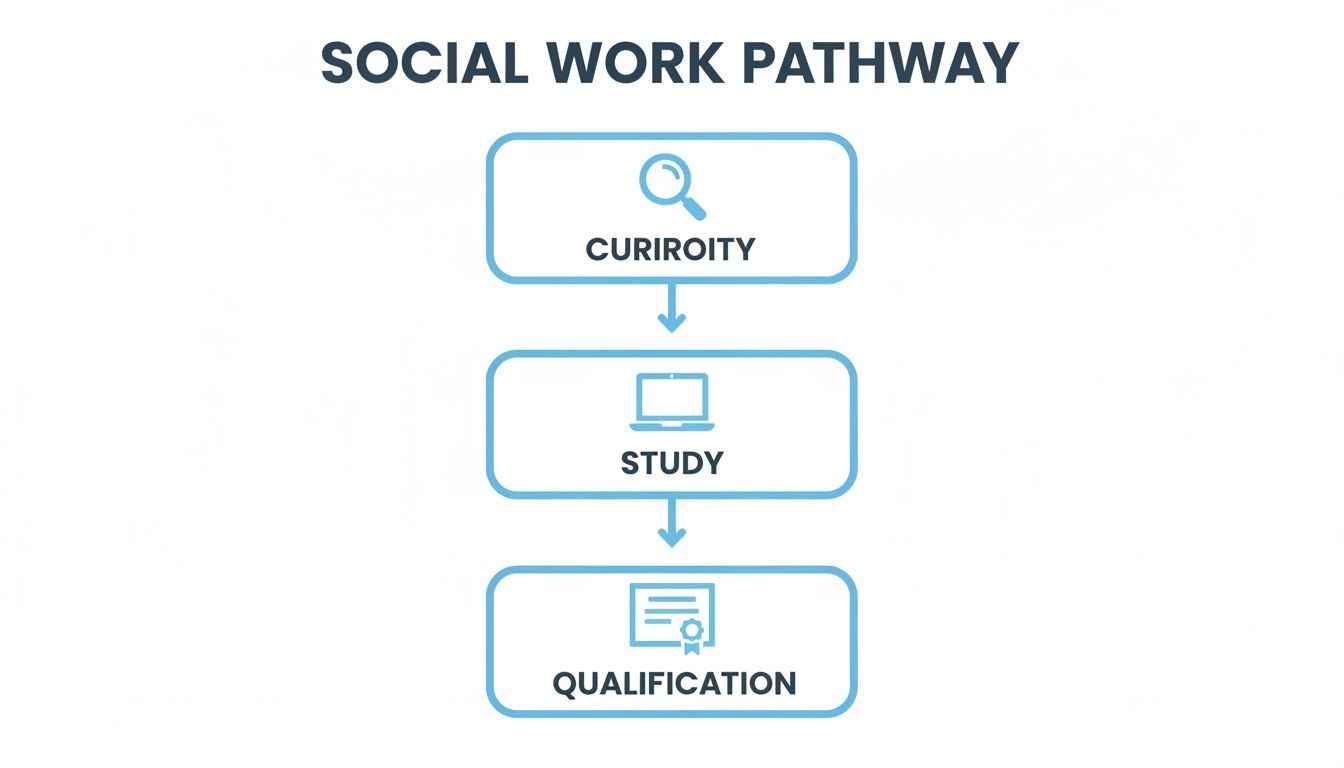
As you can see, it’s a logical flow: exploring your interest, committing to formal study, and finally, earning a professional qualification.
The First Rung: Introductory Courses and Certificates
Right at the bottom of the ladder, you'll find introductory courses. These are usually short and flexible, designed to give you a real taste of the subject without a huge commitment. They're perfect if you’re curious about social work but not quite ready to dive into a full-blown qualification.
Think of them as a 'taster session'. You might see them called Level 2 Certificates or short CPD (Continuing Professional Development) courses. While they won’t get you into university by themselves, they are fantastic for confirming this is the right path for you and building some core knowledge.
The Crucial Step: Access to HE Diplomas
The next rung up is often the most important one for aspiring social workers: the Access to Higher Education (HE) Diploma. This is a proper Level 3 qualification, putting it on the same academic level as A-Levels.
This course is built specifically for adults who want to get to university but don't have the traditional qualifications. It’s the bridge that connects your ambition to a university degree. A completed Access to HE (Social Work) Diploma is your ticket to applying for uni and is widely accepted by institutions all over the UK.
An Access to HE Diploma is so much more than an A-Level replacement; it's a targeted preparation programme. The entire curriculum is designed to give you the exact academic skills, theoretical knowledge, and study habits you'll need to hit the ground running in a social work degree.
Reaching the Top: University Degrees
The top rungs of the ladder are the university-level qualifications, which are absolutely essential if you want to become a registered professional.
- BA (Hons) Social Work: This is the standard three-year undergraduate degree. It’s what you’ll apply for once you have your Access to HE Diploma or A-Levels. It’s a mix of deep academic learning and compulsory, real-world placements.
- MA in Social Work: Already have a degree in another subject? A two-year Master's degree is the quickest route to becoming qualified.
Both of these degrees must be approved by the relevant UK regulatory body (like Social Work England) for you to be able to register and legally practise as a social worker.
To give you a clearer picture, this table breaks down the different pathways, helping you see where you might fit in.
Comparing Online Social Work Course Pathways
| Course Type | Primary Goal | Typical Entry Requirements | Leads To |
|---|---|---|---|
| Introductory Certificate (Level 2/3) | To explore the subject and build foundational knowledge. | Usually none; GCSEs in English and Maths can be helpful. | Further study or entry-level support roles. |
| Access to HE Diploma (Social Work) | To gain a Level 3 qualification for university entry. | GCSEs in English and Maths (or equivalents). Life experience is valued. | A BA (Hons) Social Work degree at university. |
| BA (Hons) Social Work | To become a qualified and registered social worker. | Access to HE Diploma, A-Levels, or equivalent qualifications. | Professional registration and a career as a social worker. |
| MA in Social Work | A postgraduate route for graduates to become a social worker. | A 2:1 or First-Class undergraduate degree in any subject. | Professional registration and a career as a social worker. |
Choosing the right course is all about being honest about where you are now and where you want to be. For most adult learners in the UK who don't have A-Levels, the online Access to HE Diploma is the most direct and flexible starting point for this incredibly rewarding journey.
What You Will Actually Learn and Why It Matters
Moving past the course titles and qualification levels, let's get into the heart of it: what you will actually learn and how it shapes you into a capable, confident social worker. The curriculum on a good social work course online is designed to build not just your academic knowledge but also your practical skills and emotional readiness for the role. This isn't about memorising theories from a textbook; it's about learning how to apply them to make a real difference in people's lives.
You’ll learn to see the bigger picture. Imagine you're supporting a family facing eviction. A surface-level approach might just focus on finding temporary housing. Your studies, however, will train you to dig much deeper.

Core Knowledge: The Building Blocks of Your Practice
Your course will be built on several key pillars of knowledge, and each one gives you a different lens through which to see a person's situation. Think of them not as separate subjects, but as interconnected tools in your professional toolkit.
You'll typically dive into modules covering:
- Sociology and Social Policy: This is where you understand the societal structures—like poverty, housing policy, and the benefits system—that have a huge impact on individuals. It’s the difference between seeing a single eviction and recognising a pattern of systemic housing inequality affecting an entire community.
- Psychology and Human Development: This module takes you through the human lifespan, from childhood attachment right through to the challenges of ageing. Understanding these stages is absolutely vital for supporting a child in care or an older person experiencing isolation.
- Law, Ethics, and Professional Practice: This is the bedrock of safe and legal practice. You’ll get to grips with the laws that protect vulnerable people and the ethical codes that guide every single decision a social worker makes, ensuring you always act in a person's best interests.
Translating Theory into Essential Skills
Academic knowledge is only half the story. The real goal of any social work course is to grow the practical and interpersonal skills you'll need on the front line. The theory you learn is the foundation, and these critical abilities are built right on top of it.
Social work is about working alongside people, their families, and communities in a holistic way to meet their needs, as well as advocate for wider societal change. It’s a dynamic process that connects individual support with the push for a fairer society.
This process demands a unique mix of hard and soft skills that your online course will help you develop. For example, you’ll learn to pull together complex information from different sources to make a reasoned judgement about a child's safety. That's critical thinking in action.
A huge part of social work is navigating tough situations, and your training will teach you how to handle difficult conversations with confidence and empathy. You'll also build the resilience needed to manage the emotional demands of the job and the advocacy skills to speak up for those whose voices aren’t being heard.
Ultimately, every module and every assignment has one purpose: to prepare you to be an effective, compassionate, and ethical practitioner. The knowledge you gain from your online studies directly translates into your ability to protect, empower, and support the most vulnerable people in our society.
Decoding Entry Requirements, Accreditation and Placements
Trying to figure out the practical side of starting your studies can sometimes feel like the trickiest part. You're probably wondering what you need to get accepted, whether a course is officially recognised, and how the hands-on experience actually works. Let’s break these three key areas down so you can move forward feeling clear and confident.
Think of these elements as the foundation, framework, and hands-on wiring of a house. Get them right, and you’re building a solid career. Get them wrong, and you could end up wasting time and effort on a qualification that won't get you where you need to be.
What Do I Need to Get Started?
It’s a common myth that you need a string of recent A-Levels to start a journey towards social work. While that’s certainly one route, it’s far from the only one – especially for adults exploring social work courses online. Universities and course providers often value life experience just as much as formal qualifications.
For a university-level social work degree, the typical requirements include:
- Level 3 Qualifications: This usually means A-Levels, a BTEC, or, for many adult learners, an Access to HE Diploma.
- GCSEs: You will almost always need GCSEs in English and Maths at grade C/4 or above. An equivalent like Functional Skills Level 2 is usually accepted too.
- Relevant Experience: This doesn’t have to be paid work! Volunteering, caring for a family member, or any role where you’ve supported others shows the empathy and resilience that are so vital for social work.
Access to HE Diplomas are specifically created for people who don’t have A-Levels. The main entry requirements are usually your GCSEs and a genuine passion for the field, making them a fantastic starting point. To see how this fits into the bigger picture, you can learn more about the complete path to getting a social worker degree online and see how each step connects.
The Non-Negotiable Role of Accreditation
Accreditation is your guarantee of quality and professional recognition. It’s the official stamp of approval confirming your qualification meets the high standards needed to practise safely and ethically in the UK. Without it, your qualification simply isn’t valid for professional registration.
It's a bit like a driving licence. You can learn to drive in any car, but to be legally allowed on the road, you have to pass a test set by an official body. In social work, that official body is your country's regulator.
In the UK, each nation has its own regulatory body responsible for social work standards, education, and registration. For a qualification to be valid, it must be approved by the correct one.
The key regulatory bodies are:
- Social Work England (SWE)
- Scottish Social Services Council (SSSC)
- Social Care Wales (SCW)
- Northern Ireland Social Care Council (NISCC)
When you’re looking at university degrees, you must ensure it is approved by the regulator in the nation where you plan to work. This is non-negotiable for your future career.
Understanding Placements: The Hands-On Element
While you can study the academic theory for many social work courses online, the practical element is an essential, in-person requirement. Every single accredited social work degree in the UK includes mandatory placements where you apply what you've learned in real-world settings under professional supervision.
This isn’t an optional extra; it’s a core part of your training. Placements are where you go from understanding concepts to actually practising them. You'll work directly with service users, families, and other professionals, building the confidence and competence needed for the job.
Typically, a social work degree includes a minimum of 170 days of practice learning, often split into two different placements. These are organised by your university and are designed to give you experience in varied settings, like a local authority children’s services team or a mental health charity. This hands-on experience ensures that by the time you graduate, you are not just academically knowledgeable but also practically prepared to support vulnerable people effectively.
The Access to HE Diploma: Your Flexible Path to University
For so many people dreaming of a career in social work, the biggest hurdle isn't a lack of passion or skill. It’s the practical stuff. Maybe you don’t have A-Levels from school, or you need a study schedule that can actually bend around a full-time job, family life, and everything else that comes your way. This is exactly where an Access to Higher Education (HE) Diploma comes in.
Think of it as a purpose-built bridge connecting where you are now to where you want to be. An Access to HE Diploma in Social Work is a formal, nationally recognised Level 3 qualification, putting it on the same academic level as A-Levels. The big difference? It’s designed from the ground up for adults who are returning to education.
That distinction changes everything. The entire course, from its self-paced online format to the one-on-one tutor support, is built to see you succeed. It recognises that you're bringing valuable life experience to your studies and provides the precise academic skills and subject knowledge UK universities are looking for in social work applicants.
Designed for Your Life, Not the Other Way Around
The flexibility of an online Access to HE Diploma is its real superpower. You can start whenever you feel ready and move through the material at a pace that genuinely works for you. Forget rigid term times and stressful commutes to a campus; this is about fitting your learning around your life.
This approach is especially vital for the kind of people drawn to social work. A 2023 analysis from Skills for Care highlights that the profession attracts many mature learners, with a huge number of students aged 25 and over. For working adults trying to balance jobs and childcare, this kind of flexible online course creates a realistic path into a profession where, statistically, most trainees are people just like them. You can read the full analysis of social work education trends on Skills for Care's website.
This structure gives you back control over your education, letting you build both your confidence and your qualifications without having to put your life on hold. You can get a much deeper understanding of what makes this qualification so effective by reading our guide on the Access to HE Diploma online.
A Real Learner's Journey to Success
To see how this works in the real world, let’s imagine the journey of someone like Sarah, a 35-year-old working parent who left school with good GCSEs but no A-Levels.
- Getting Started: Sarah enrols in an online Access to HE (Social Work) Diploma. She gets her login details and is introduced to her personal tutor, who helps her map out a realistic study plan that fits around her part-time job and the school run.
- Flexible Learning: Over the next ten months, Sarah dives into modules on sociology, psychology, and professional practice. She studies in the evenings and on weekends, submitting assignments online and getting detailed, supportive feedback from her tutor that helps her sharpen her academic writing.
- UCAS Application Support: Halfway through, Sarah's tutor guides her through the UCAS application process. They help her craft a powerful personal statement that showcases not just her new academic skills but also the invaluable experience she's gained from her life.
- Securing a University Place: Armed with strong predicted grades and a standout application, Sarah receives conditional offers from two universities to study for a BA (Hons) in Social Work.
- Achieving Her Goal: Spurred on by her offers, Sarah finishes her final modules and successfully achieves her Access to HE Diploma. She meets the conditions of her first-choice university and is ready to start her degree, feeling fully prepared for the academic challenges ahead.
Sarah’s story isn’t an exception; it's a blueprint. It shows how the Access to HE Diploma provides a structured, supportive, and flexible route that turns the ambition of a career in social work into a tangible reality.
Career Opportunities in a High-Demand Field
Investing your time and energy into your education is a big decision. It’s only natural to want to know what’s on the other side – a stable, secure, and meaningful career. Completing one of the many social work courses online opens the door to a profession that is not only emotionally rewarding but also consistently in demand right across the UK.

The simple truth is, we need more qualified social workers. In England alone, the number of children and family social workers jumped from around 30,700 in 2017 to 33,100 by 2023. That's an 8% increase in just six years.
At the same time, vacancy rates have stubbornly hovered between 16% and 18%, highlighting a real need for fresh talent and creating a strong job market for new graduates. You can dig into the numbers yourself by exploring the children's social work workforce statistics on GOV.UK. This sustained demand creates a secure environment for anyone starting their career journey.
Exploring Diverse Career Paths
Social work is so much more than the stereotypes you might see on TV. While working with children's services is a vital and common path, your qualification can lead you into a huge range of specialised and impactful areas. You're not locked into a single track; you can find a role that truly aligns with your personal values and interests.
Just a few of the settings where social workers are absolutely essential include:
- Adult Social Care: Helping older adults or people with disabilities live with the independence and dignity they deserve.
- Mental Health Services: Working with NHS trusts or charities to support people navigate mental health challenges.
- Hospital and Healthcare Settings: Assisting patients and their families as they manage the emotional and social impact of an illness or injury.
- Youth Justice: Working with young offenders to get to the root causes of their behaviour and guide them toward rehabilitation.
- Substance Misuse Services: Providing crucial support for individuals and families affected by addiction.
This variety means you can build a long-term career that grows and evolves with you, offering new challenges and specialisms along the way.
Salary Expectations and Career Progression
A career in social work doesn't just offer emotional rewards; it also provides a clear path for professional and financial growth. As a Newly Qualified Social Worker (NQSW) in the UK, you can typically expect a starting salary of between £28,000 and £35,000, depending on your employer.
Your career doesn't stand still. With experience, you can progress into senior practitioner, team manager, or specialist roles, with salaries often rising to over £45,000 and beyond in leadership positions.
This clear progression structure, combined with the high demand for professionals, makes social work a practical and sustainable choice. Your investment in an online access course is the first step towards a career that offers both profound personal fulfilment and real long-term stability.
Answering Your Key Questions
Thinking about starting a social work course online can bring up a few last-minute questions. It’s completely natural. Getting clear, straightforward answers is the best way to feel confident about taking that next step. Let’s tackle some of the most common queries people have when they’re ready to begin their journey.
Can I Qualify as a Social Worker Entirely Online?
This is a big one. While you can complete foundational courses like an Access to HE Diploma entirely online, every accredited UK social work degree is a blend of online and in-person learning. To become a registered social worker, you must complete mandatory, hands-on practice placements.
This isn’t just a box-ticking exercise; it’s a non-negotiable part of your training. This practical experience is where you'll translate theory into action under professional supervision, ensuring you’re fully prepared for the real world of social work.
How Long Does the Entire Process Take?
Your timeline really depends on your starting point. If you’re beginning with a flexible online Access to HE Diploma, you can typically get that done in nine to twelve months.
From there, you’ll move on to your degree:
- A full-time BA (Hons) Social Work degree takes three years.
- A postgraduate MA in Social Work (if you already have a degree in another subject) is two years.
So, if you kick things off with an Access course, you're looking at a journey of around four years to become fully qualified. The big advantage is that the crucial first year offers maximum flexibility to fit around your life.
Are Online Qualifications Respected by Employers?
Yes, absolutely. What truly matters to employers and the official regulatory bodies isn't how you studied, but the accreditation of your final qualification.
As long as your university degree is approved by Social Work England (or the equivalent body in Scotland, Wales, or Northern Ireland), it carries the same weight. Online Access to HE Diplomas are a standard and highly regarded way for UK universities to assess your readiness for these degrees, proving you have the academic skills to succeed.
The quality of your qualification is determined by its official accreditation, not where you completed the coursework. An approved degree holds the same professional weight whether it was earned through blended learning or a traditional on-campus route.
What Funding Options Are Available for These Courses?
For an Access to HE Diploma, you can apply for an Advanced Learner Loan. The brilliant thing about this is that the loan is often written off by Student Finance England once you complete an approved university course, which could make your Access course effectively free.
When it comes to the degree itself, you can apply for the standard student finance package to cover tuition fees and living costs. On top of that, many social work students are eligible to apply for a Social Work Bursary to help with study costs, though it's good to know these can be competitive.
Are you ready to take the first step towards a rewarding career in social work, even without A-Levels? Access Courses Online provides the accredited Access to HE (Social Work) Diploma, a flexible and supportive online pathway designed to get you to university. Start your journey today at https://accesscoursesonline.com.