

So, you're standing at a career crossroads, wondering if an online social work degree is a real, legitimate path to a meaningful profession here in the UK. The short answer is a resounding yes. It’s an increasingly popular and flexible route into a field where you are desperately needed.
This guide is designed to walk you through that exact journey, step by step.
Your Path to Becoming a Social Worker Starts Here

We’ll cut through the jargon and show you exactly how these flexible degrees work, from the online theory you’ll study to the hands-on, in-person placements that are an essential part of your training. We'll explore the different ways adult learners can get started, break down the costs and funding, and give you a clear roadmap to follow when you're ready to apply.
The need for skilled social workers is only growing. In fact, employment in the field is expected to grow by 6% between 2024 and 2034 – that’s faster than the average for all other occupations, which tells you a lot about the stability of this career choice.
Think of this guide as a friendly mentor, giving you the honest advice you need to decide if this is the right move for you. To get a feel for the kind of incredible work you could be doing, it's well worth looking at some of the top social innovation examples making a real difference in communities worldwide.
Ready? Let’s take that first step together.
What an Online Social Work Degree Really Involves
Thinking about studying social work online? It’s a common misconception that it just means watching pre-recorded lectures in your pyjamas. The reality is far more engaging and demanding, designed to meet the exact same professional standards as any university-based course.
You’ll dive into core academic subjects like social policy, human development across the lifespan, and the professional ethics that underpin everything a social worker does. Much of the coursework is designed around collaborative learning, and you'll often see social learning concepts in online courses used to help you and your peers build a shared understanding together.
But the single most important part of your degree is the mandatory, in-person placement. You can learn all the theory in the world from a book, but you can’t learn to be a social worker without actually doing it. It’s a bit like learning to fly – the theory is vital, but you have to get in the cockpit to earn your wings.
Don't worry, you won't be left to find these placements on your own. Universities have dedicated teams that arrange local opportunities for you, making sure you get that vital hands-on experience. This practical element isn't just a suggestion; it’s a non-negotiable requirement for professional registration with bodies like Social Work England. It's the final piece of the puzzle that ensures your accredited degree truly prepares you for the real-world complexities of the job.
Finding Your Way into Social Work
There isn't just one path into social work, especially if you're coming back to education as an adult learner. While many people think of A-Levels as the standard route, a qualification like an Access to HE Diploma is often a much more direct and relevant option for those with life experience.
These diplomas are specifically designed to get you ready for the unique demands of a university degree, building the exact skills you'll need to succeed. If you're curious, you can learn more about how Access courses can help you kickstart your career in social work.
The reality is, the typical student profile has changed a lot. Online learning has opened doors for mature students who need that extra flexibility. In fact, between 2007 and 2022, a massive 84,240 students enrolled in initial social work courses across the UK, with many of them using these more adaptable pathways to get there.
This diagram perfectly illustrates how an online social work degree works in practice. It's a blend of flexible, online theory modules and the essential, hands-on placements that you complete in person.
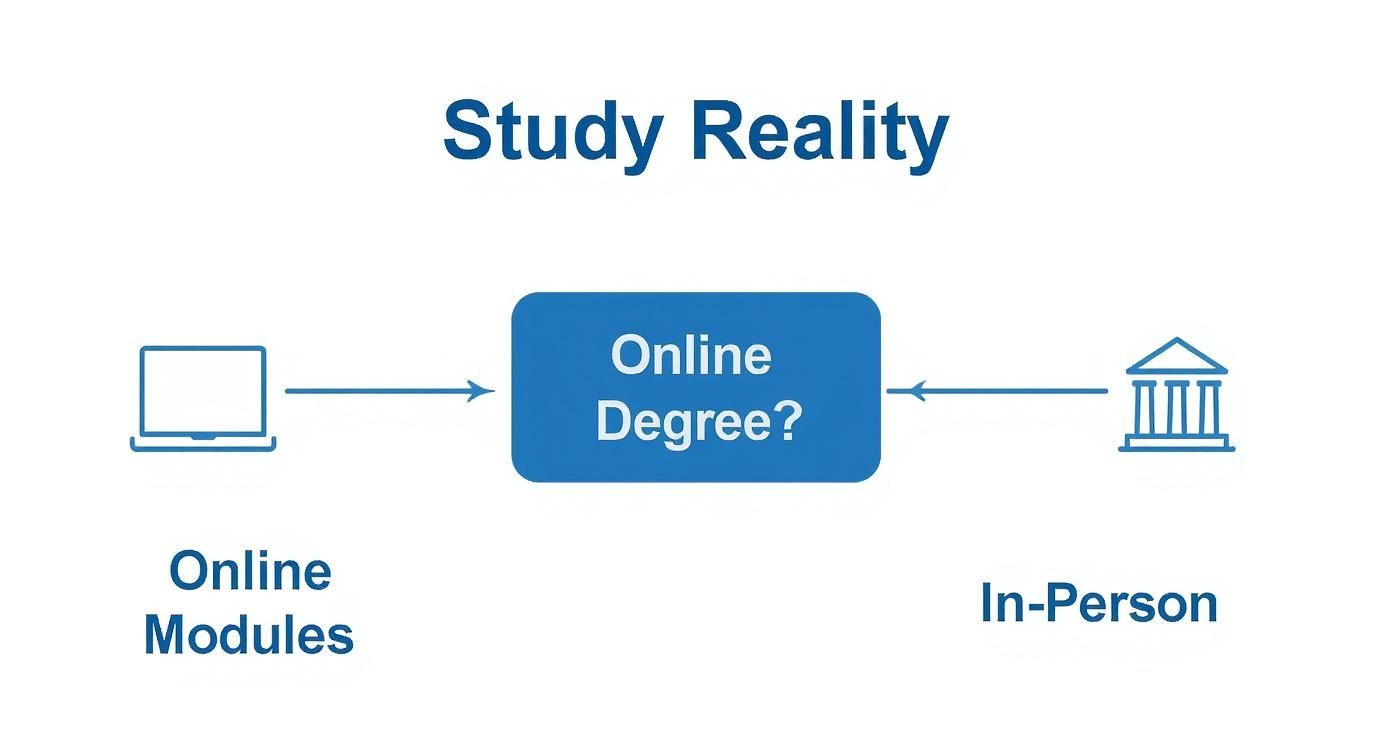
Ultimately, you need both of these components. The theory gives you the knowledge, and the placements give you the real-world experience needed to become a fully qualified and registered social worker.
Understanding the Costs and Funding Your Degree

Let's talk about the financial side of things. Deciding to study for a social work degree is a big commitment, and it’s natural to wonder about the cost. The main expense will be your university tuition fees, which can vary quite a bit depending on the institution. On top of that, you'll need to think about smaller costs like textbooks and the mandatory DBS check.
The good news is, you don’t have to figure this all out on your own. Most students in the UK can apply for a student loan, which is a massive help for covering tuition fees and sometimes even living costs. Getting your head around the loan system can feel a bit overwhelming at first, but our guide to Access to Higher Education funding breaks it all down and makes the process much clearer.
It's also worth knowing that social work students can often apply for the NHS Social Work Bursary. This is a non-repayable grant, meaning it’s extra money you don't have to pay back. It can provide a real financial boost, though it is often capped and isn't guaranteed for every single student. It’s definitely worth looking into, as this and other grants can take a lot of the financial pressure off.
The Pros and Cons of Studying Online
So, is an online social work degree the right path for you? It’s a big question, and the answer isn’t the same for everyone.
On one hand, the flexibility is a massive plus. Remote learning gives you the freedom to fit your studies around your life, not the other way around. It also builds some incredibly valuable skills in self-discipline and digital confidence – things employers really notice in today's world.
However, it’s a path that comes with its own hurdles. You’ve got to be your own cheerleader, staying motivated without the structure of a physical classroom. For some, it can feel a little isolating at times. The key is to be honest about your own learning style and what works for you. To help you figure it out, have a read of our comparison of whether online learning is as effective as in-person learning.
The demand for these courses is definitely on the rise. In 2021/22, a huge 26,580 students were enrolled in social work programmes across the UK, partly thanks to these more flexible online options. You can read more about social work education trends to see just how much the field is growing.
Your Actionable Steps to Apply

All this information is great, but real change happens when you take action. Let's break down the application process for a social worker online degree and turn your ambition into a clear, manageable plan.
First things first, do your homework on different universities. It’s absolutely essential to make sure your chosen course is approved by the relevant regulator, such as Social Work England.
Next up is your personal statement. This is your chance to shine. Don’t just list your achievements; weave in your life experiences to show a genuine commitment to the values at the heart of social work.
You’ll almost certainly apply through the UCAS system, so get comfortable with how it works and, most importantly, be aware of the key deadlines. Missing one can mean waiting a whole year.
Finally, get ready for the interview. They’ll be looking for more than just the right answers. Be prepared for questions that test your ethical judgement and your resilience under pressure.
Think of these steps as your launchpad. Following them will give you the structure and confidence you need to move forward and start your journey towards a deeply rewarding career. Your first step starts right now.
A Few Common Questions
Can I Actually Become a Registered Social Worker with an Online Degree?
Yes, you absolutely can. The key isn't whether you study online or on campus, but whether the degree is officially approved by the UK's social work regulators, like Social Work England. As long as your social worker online degree has that stamp of approval, it holds exactly the same professional weight as a traditional university qualification. This accreditation is your guarantee that the course meets the strict standards required for practice, including the all-important in-person placements.
How Do the Practical Placements Work If the Course Is Online?
This is a great question and one we get all the time. While your lectures and assignments are done online, the hands-on practice is very much in the real world. Universities have dedicated placement teams whose job is to find and arrange these crucial experiences for you, usually in your local area. You'll be placed in a real social work setting, like a local authority, an NHS trust, or a charity, where you’ll be supervised and get stuck into the practical side of the job. You attend these in person, just like any other social work student.
Is an Online Degree an Easier Option?
Not at all. It’s a more flexible option, but definitely not an easier one. The academic standards, the workload, and the professional expectations are identical to a campus-based degree. In fact, studying online demands a huge amount of self-discipline and motivation. You're in the driving seat of your own learning, so being organised and proactive is essential to stay on track and succeed.
Ready to take that next step towards a fulfilling career without putting your life on hold? An Access to HE Diploma from Access Courses Online could be your most direct route to university.