

If your grades are fine, is a social worker uni place basically yours? For most adults, that is the wrong test. Offers turn on whether you can complete 200 practice-learning days and whether the money still works once travel, lost shifts and childcare sit on the table. A qualifying degree is a professional licence route, not a flexible theory course you squeeze around the school run.
Which Social Worker Uni Route Fits You
Can you reach a qualifying social work degree from where you are now? In 2026 there are four usual routes: A-levels or an equivalent Level 3, an Access to Higher Education Diploma, a degree apprenticeship with an employer, and a postgraduate qualifying course if you already hold a degree.
| Route | Usual entry | Time to qualification | Who pays | Best if |
|---|---|---|---|---|
| A-levels or equivalent | Level 3 qualifications such as A-levels or BTEC | 3 years full-time undergraduate | Student Finance England | You are leaving school or college with Level 3 |
| Access to HE Diploma | No A-levels needed; GCSE English and maths often required | Usually 1 year, then 3 years degree | Access course fee or Advanced Learner Loan, then degree funding | You lack A-levels and need a flexible adult route |
| Degree apprenticeship | Job offer plus Level 3, including maths and English | Typically 3–4 years while employed | Employer pays tuition; you earn a wage | You can secure a council, trust or employer vacancy |
| Postgraduate qualifying MA or MSc | A degree, often a 2:2 or above, plus relevant experience | Usually 2 years | Postgraduate loan where eligible, plus a capped bursary | You already have a degree and want the protected title |
The title is the point
A general social science degree can be interesting and still leave you unable to register. In England the course must be Social Work England approved and lead to the protected title of social worker. Scotland, Wales and Northern Ireland use their own regulators and their own funding, so check the regulator for the nation where you will train, not a prospectus slogan from another country.
If A-levels were missed, an Access to Higher Education Diploma aimed at social work is the usual bridge into the undergraduate row. It is a separate year of study before the degree, not a shortcut around placements.
UCAS analysis of 2019 admissions found that 42% of students accepted onto social work courses were aged over 30, the highest proportion among major undergraduate subject areas. Treat that as a historical benchmark, not this year's offer rate.
Pick one row. Then test it against placement time and monthly cost before you apply.
Placements, DBS and Whether You Can Fit Them In
Could placement days fit around your paid work and caring responsibilities? Social Work England requires at least 200 practice-learning days, including no more than 30 skills-development days, across at least two contrasting settings. At least one placement must be statutory, involving enough high-risk decisions and legal interventions.
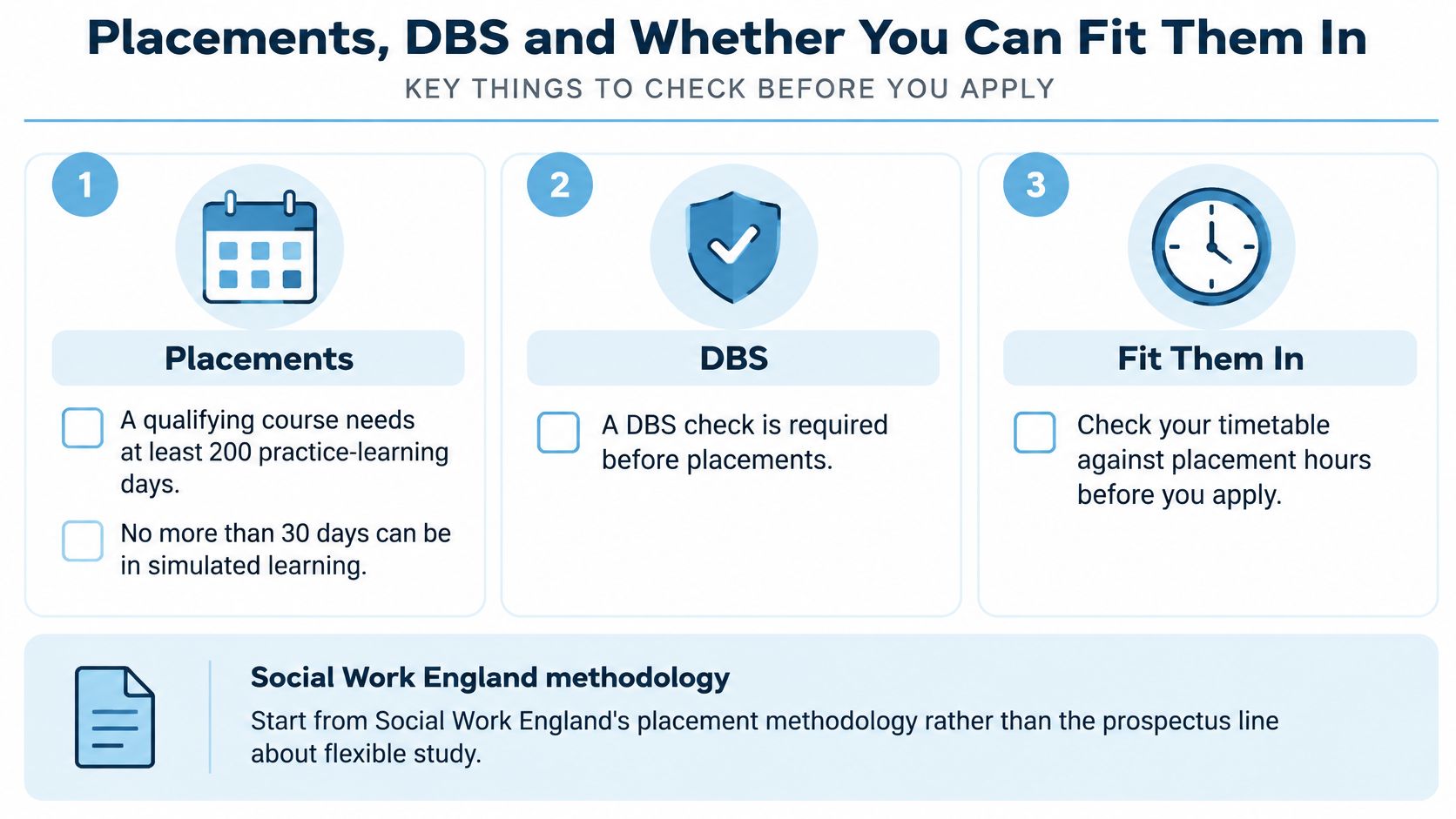
Voluntary-sector work can teach valuable skills but may not meet the statutory placement requirement. You must attend every placement day, including skills days. Part-time or online teaching does not reduce the placement total, so the pattern of days matters as much as the course timetable.
A check a working parent can run
Before shortlisting, put the placement pattern beside your work hours and caring commitments:
- Confirm the university is Social Work England approved.
- Ask how the placement days are split across the years and which block is statutory.
- Ask about typical travel distances and whether placements ever run in the evenings or at weekends.
- Ask what happens if a placement is delayed, and who supervises and assesses you.
- Check whether you can cover the days, travel and any childcare changes without relying on a timetable that has not been confirmed.
Ask each course for its current placement structure rather than relying on a brochure promise. Apprentices also need experience in contrasting settings; their own workplace cannot count as both placements.
Suitability checks take weeks
An enhanced DBS check, including the relevant barred-list checks, and the university's health and character process are normally required before placement. Apply when the university tells you to. A delay could push back a placement block.
If your week is already full, compare time management tools for students and mark placement days as fixed commitments rather than optional study time.
Email admissions these five questions before you apply:
- Split of days: How are the days divided, and which year includes the statutory placement?
- Travel: What is a typical commute, and is a car assumed?
- Hours: Are any placement days in the evenings or at weekends?
- Delays: What happens if a placement slips, and could that extend the course?
- Assessment: Who is the practice educator, and what attendance is required to pass?
Flexible teaching does not reduce placement days. If you cannot attend them all, first check whether the course can offer a pattern that fits your responsibilities.
What Social Work Training Will Cost You
In England, tuition for a first undergraduate degree is normally covered by a Student Finance England tuition loan, repaid later on income-contingent terms. A postgraduate qualifying course may use postgraduate loan rules instead. Loans do not pay the bus fare, the lost shift or the extra nursery day.
On top of that, the Department of Health and Social Care caps the Social Work Bursary. For the 2024 to 2025 academic year it set 4,000 awards: 2,500 undergraduate and 1,500 postgraduate, as set out in the Social Work Bursary information for that year. Eligibility is not an award.
Uptake sat well below that cap. The government consultation on the bursary records that in 2024/25 only 1,700 undergraduates and 900 postgraduates applied for and received one. Ask the university how it nominates students, and diary the deadline in freshers' week, not after Christmas.
| Support | Who it is for | Scale | Catch |
|---|---|---|---|
| Undergraduate student finance | First degree in England | Tuition loan plus means-tested maintenance | Repaid later; does not cover every living cost |
| Social Work Bursary, undergraduate | Eligible students on qualifying courses | 2,500 awards inside the 4,000 cap; 1,700 received in 2024–25 | Not automatic; university nomination and a deadline |
| Social Work Bursary, postgraduate | Eligible postgraduate students | 1,500 awards; 900 received in 2024–25 | Capped, and separate from a postgraduate loan |
| Placement travel help | Often tied to undergraduate bursary support | Extra help towards practice-travel costs | Does not replace lost earnings or childcare |
| Degree apprenticeship | Employed trainee with a sponsoring organisation | Employer pays tuition and you draw a wage | You need the vacancy before the university place |
Where the monthly gap usually sits
Build one ordinary placement month. Add return travel, fewer paid shifts, lunch and any extra childcare. Subtract the maintenance loan, any bursary and any travel help. The gap is usually the wages you stopped earning and the care you still have to buy. Undergraduate packages can add living-cost help and practice-placement travel. They do not automatically cover either of those two.
A degree apprenticeship sits outside tuition fees because the employer pays and you earn. The trade-off is getting the vacancy first. Access to HE is an earlier cost, often spread with an interest-free plan or an Advanced Learner Loan for Access study. That fee is not the bursary.
Scotland, Wales and Northern Ireland run different support. Do not quote the English cap as UK-wide. Money pressure is not theoretical. In early 2024, 73% of 302 surveyed social work students in Northern Ireland said they were unable to make ends meet or were struggling to do so, in a survey published by the British Association of Social Workers Northern Ireland and the Social Workers Union.
Practical rule: Check fee status, the loan, bursary nomination and placement travel before you firm an offer. Budget the full month before the course starts, not after the first placement.
Apply and Make the Application Stand Out
You can move this month if you follow one order. Each step has a usual slip. Fix that slip before you move on.
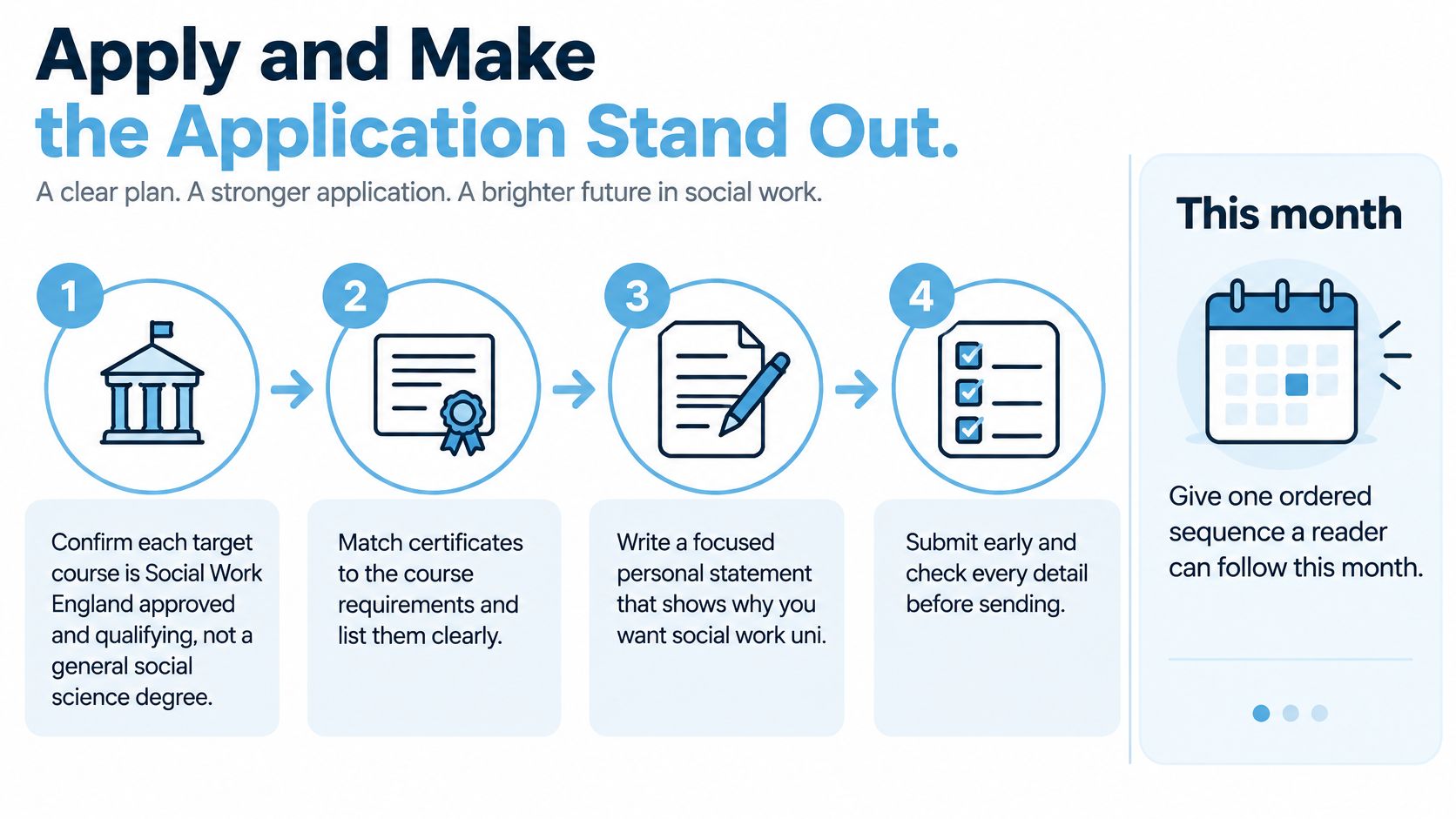
Confirm the course, then the certificates
1. Check it is qualifying. Open the Social Work England list and match the exact course title. The slip is choosing a social policy or sociology degree because the modules look similar. That degree does not give you the protected title.
2. Match the certificates to the row you picked. Predicted or achieved A-levels, a BTEC, or an Access to Higher Education Diploma if Level 3 was missed. Access Courses Online is one provider of an online social science diploma for adults in that position. If you already have a degree, you are on the postgraduate row and the first degree subject matters less than the grade, often a 2:2, plus people-facing experience. The slip is assuming "any degree" with no experience will clear an interview.
3. Log the work, not the feeling. Care, housing, schools or community roles all count. Write what you did with risk, consent and confidentiality: who you told, what you recorded, what you left alone. The slip is a list of job titles with no decisions in them.
4. Clear English and maths early. Offers stall on a missing GCSE or Functional Skills Level 2. Book the exam before you write the statement. Waiting until an offer arrives is how adults lose a year.
Apply in the right system
5. Use the right form and the earlier date. Undergraduate courses go through UCAS, and you want to be in before the January equal-consideration deadline. Postgraduate courses use the university's own system, and many close their internal date well before that. The slip is treating both routes as one January deadline.
6. For an apprenticeship, find the employer first. Councils, trusts and some independent providers advertise the vacancy, then link you to the partner university. Applying to the university alone does not create a wage. The slip is holding a conditional university place and discovering there is no sponsor.
7. Prepare the interview as a piece of practice. Expect values, a short safeguarding scenario, and a question on why social work rather than nursing or advice work. Answer with what you would notice, who you would tell and what you would write down. The slip is a speech about wanting to help people.
8. On an offer, do the boring work before you firm. Meet academic conditions, start suitability checks, and request the placement calendar. Firming without that calendar is how people discover a 9-to-5 block that clashes with a job they cannot drop.
Turn one moment into evidence
Statements fail when they stay at motive. Take one moment and show judgement.
Say a support worker noticed a tenant being pressed to hand over a bank card. They paused, wrote down what was said, and raised it with a supervisor rather than confronting the relative alone. In the statement, name the setting, your role and the hours. Say what you saw, which value it touches (consent, safeguarding, accurate recording), and what you would do with more authority. That is evidence. Childhood trauma as the main motive is not.
Ask a referee who has seen you with the public, and give them two weeks before the deadline. Access students can point to a graded unit as proof they can write at the level a degree expects. Do not leave the referee guessing what social work is.
This week, not this year
- Shortlist three approved, qualifying courses and bin any that are social science only.
- Email admissions one placement question from the list above, and keep the reply.
- Book a taster if Access is the gap, so you know the study load before you pay a fee.
Name real settings, real hours and your actual role. Selectors can tell a job from a wish.
Outcomes, Demand and Your Next Step
What do completion figures, employment and demand tell you about a social work degree? They answer different questions, so check each one separately.
In England in 2024/25, 5,360 students left social work courses and 4,920 qualified, a 92% achievement rate, according to Skills for Care's report on social work education.
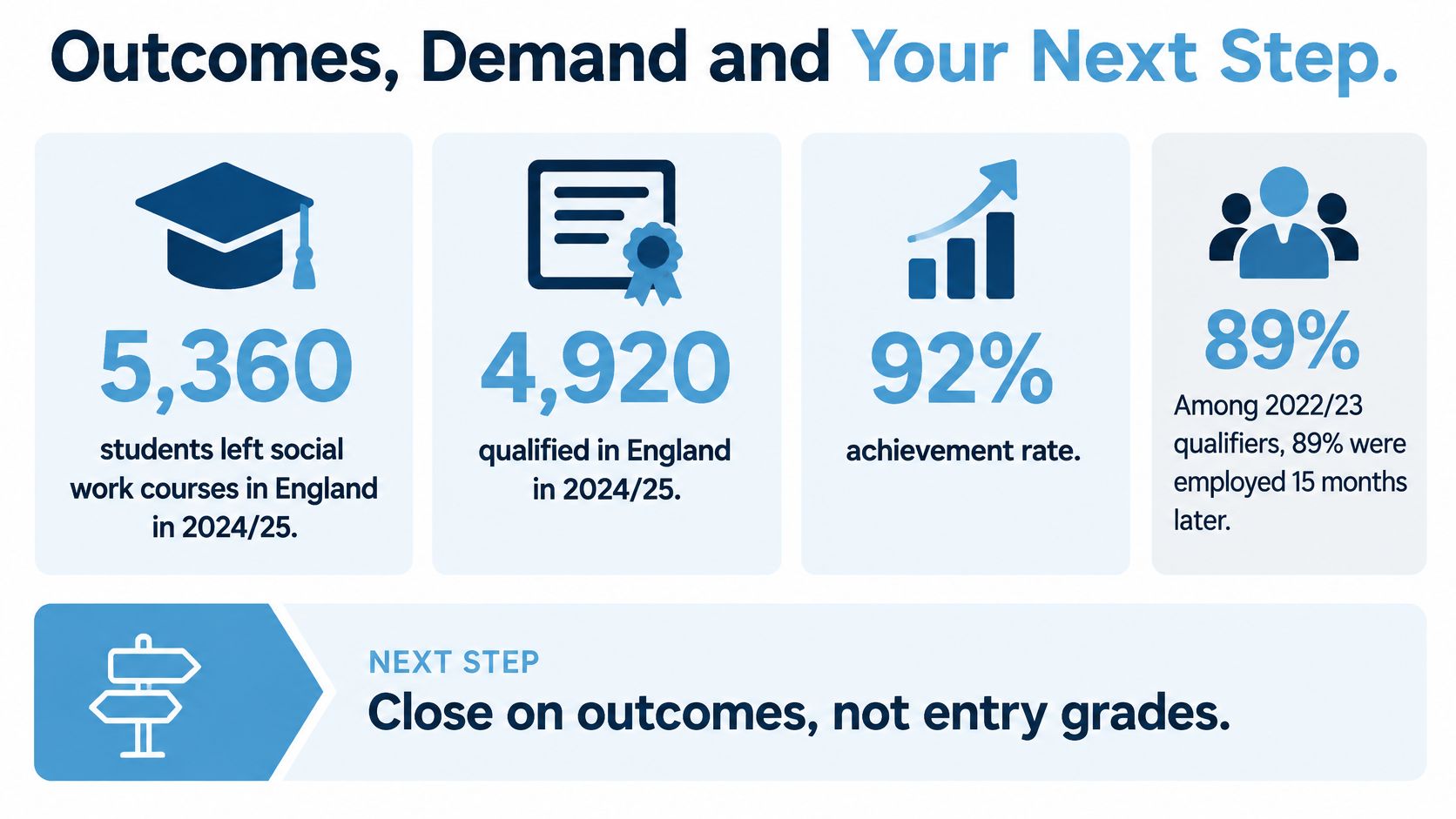
The measures describe separate stages:
- Course achievement: 92% of that leaving cohort qualified.
- Any employment: Among 2022/23 qualifiers, 89% were employed 15 months after graduation. That included 81% who were working and 8% who combined work with study.
- Employment as a social worker: 78% were working specifically as social workers.
Employment outcomes vary by region. Compare each university's HESA Graduate Outcomes data, checking which graduates are counted and the period covered. Those details help you judge whether a headline matches the question you are asking.
Demand is another part of the picture, not a guarantee of a particular job. Health and social work had 39,100 skill-shortage vacancies in 2024, the second-highest volume in the UK employer skills survey, according to the Department for Education's Employer Skills Survey.
After the degree, you still need to register with Social Work England. Many statutory teams then provide a supported first year with closer supervision. Your placements can help you decide whether adults' or children's services suits you. To explore related roles, read this guide to careers in health and social care.
If you want a short introduction to the day-to-day work, this overview is a useful watch.
Access Courses Online offers accredited online Access to Higher Education Diplomas for adults preparing for university, including a social science diploma for those aiming at social science degrees. Flexible study can fit around work, while interest-free payment plans and funding guidance can help you understand the costs before committing. You can explore Access Courses Online, book a taster day or speak with an adviser about your next step.