

So, you’ve stumbled across the term ‘UCAS points calculator’ and are wondering what it's all about. In simple terms, it's a handy tool that translates your grades from qualifications like A-Levels, BTECs, or Scottish Highers into a single numerical score. This score, known as Tariff points, gives universities a straightforward way to compare applicants from all sorts of educational backgrounds.
What Are UCAS Points and Why Do They Matter?

If you're gearing up to apply for a university place in the UK, "UCAS Tariff points" is a phrase you'll hear a lot. Think of it as a universal language for qualifications. It’s a simple, numerical system that helps admissions tutors make sense of the huge variety of qualifications people apply with.
This is a lifesaver for universities. After all, how can they fairly compare an applicant with three A-Levels against someone with a BTEC Extended Diploma or an Access to Higher Education Diploma? The UCAS Tariff system is the answer.
The Purpose of the Tariff System
The main goal here is to create a level playing field. Rather than trying to memorise the grading systems for dozens of different qualifications, admissions teams can just look at a single points total. This makes the whole initial screening process much more efficient and fair for everyone.
The UCAS Tariff system first appeared back in 2001, and by 2002, a streamlined single points system was in place to standardise how different post-16 qualifications were valued. This was a game-changer, allowing universities to set entry requirements using points totals instead of just specific grades. You can read more about the history of the UCAS Tariff system if you're curious.
This flexibility is a massive plus for students. Let’s say a course is asking for 112 UCAS points. You could get there in a few different ways:
- Achieving grades BBC in your A-Levels (40 + 40 + 32 = 112 points)
- Getting grades A*C in two A-Levels (56 + 32 = 88 points) and a Distinction in a BTEC Subsidiary Diploma (48 points), totalling 136 points.
- Earning a Distinction, Distinction, Merit (DDM) in a BTEC National Extended Diploma (which is equivalent to 128 points).
The system recognises that achievement isn't one-size-fits-all. It values your unique mix of subjects and qualifications as a whole.
Do All Universities Use UCAS Points?
This is a really important point: not every university or course uses the Tariff system. While roughly a third of UK university courses list a Tariff point requirement, many of the most competitive institutions still make offers based on specific grades (e.g., "AAA in A-Levels").
So, why the split? Universities asking for specific grades are often looking for proven expertise in subjects directly relevant to the degree. For a highly academic course like medicine or engineering, they need to see you have a deep, solid understanding of subjects like Biology, Chemistry, or Maths. Points alone don't show that.
Key Takeaway: Always, always check the specific entry requirements for every single course you're interested in. Never assume a university will accept points if they list grades, or the other way around. The course page on the university's own website is the only source you should trust.
Even if your dream universities only make grade-based offers, calculating your UCAS points total is still a smart move. It gives you a much better perspective on your academic achievements and can help you spot a wider range of potential university choices, including some brilliant "safety" options that might have more flexible entry criteria. It's all about seeing the full picture of what your hard work has earned you.
How to Use the Official UCAS Points Calculator
So, you've got your grades (or your predictions) and now you need to turn them into a number universities actually understand. That's where the official UCAS points calculator comes in. It's the go-to tool for taking the guesswork out of your application and giving you a clear, solid total to work with.
Navigating it for the first time can feel a bit intimidating, but honestly, it’s much more straightforward than it looks. Let's walk through it together, from finding the right page to plugging in your qualifications, so you can get a number you can trust. This isn’t just about maths; it's about getting the info you need to plan your future.
Finding and Starting with the Calculator
First things first, you need to head over to the official UCAS website. A quick search for "UCAS Tariff calculator" will get you there. My biggest tip? Stick to the official one. Unofficial calculators can be outdated, and the last thing you want is an incorrect total throwing off your uni research.
Once you’re on the page, you’ll find a simple interface ready for you to start adding your qualifications. This is where you begin to build a complete picture of your academic achievements in a language that universities speak.
Here’s what the calculator's main page looks like – nice and clean, prompting you to get started.
As you can see, it’s all laid out to let you add things one by one, keeping a running total as you go. No surprises.
Adding Your Qualifications Step by Step
The beauty of the calculator is that it does all the heavy lifting for you. You just need to tell it what you’ve studied.
You’ll add each qualification one at a time. Here’s how it works:
- Select Your Qualification: Click the dropdown menu and find what you've studied. The list is massive – it has everything from A-Levels and BTECs to Scottish Highers and even music grades.
- Choose Your Subject (If Needed): For things like A-Levels, the subject doesn’t actually change the points, but it’s helpful to add it so you can keep track of what you've entered.
- Enter Your Grade: Pick your achieved or predicted grade from the next list. The calculator already knows how many points each grade is worth.
- Add to Calculator: Hit the button, and you'll see your qualification, grade, and points pop up in a list below. Your total score will update instantly.
Just keep repeating this for every qualification you want to include. It’s the best way to make sure all your hard work is properly accounted for.
The real magic happens when you see all your different achievements come together as a single, powerful number. It's that moment your BTEC Distinction and your Grade 6 Music certificate are seen on the same scale, reflecting your unique mix of skills.
Universities across the UK rely on this system. Many, like the University of Portsmouth, even have their own versions of the calculator to help applicants see where they stand, as most Level 3 qualifications carry specific points values. It’s all about making the entry requirements transparent. You can learn more about how unis use the UCAS points calculator to see it from their perspective.
Reviewing and Using Your Total Score
Once everything is in, you’ll have your final UCAS points total sitting right there at the bottom. This number is your golden ticket for the next stage of your uni research. It’s a real, tangible result of all your efforts so far.
Before you rush off, take a second to double-check that you’ve included everything and that all the grades are correct. A simple typo can make a big difference, so getting it right now is vital. This isn't just a box-ticking exercise; you're building the foundation for your application strategy. In a way, it’s a bit like how businesses use tools such as a customer acquisition cost calculator to plan their growth – both take complex information and turn it into a clear number for making smart decisions.
Calculating Points for Different Qualifications
The UCAS Tariff system is pretty clever. It’s built to recognise that great students come from all sorts of academic backgrounds, not just the traditional A-Level route. Figuring out how your specific qualifications stack up in terms of points is one of the most important first steps you can take when planning your university application.
Let's break down some real-world examples to see exactly how different achievements translate into those all-important UCAS points. It’s much simpler than you might think.
This visual guide shows the straightforward flow of finding your total using a UCAS calculator.
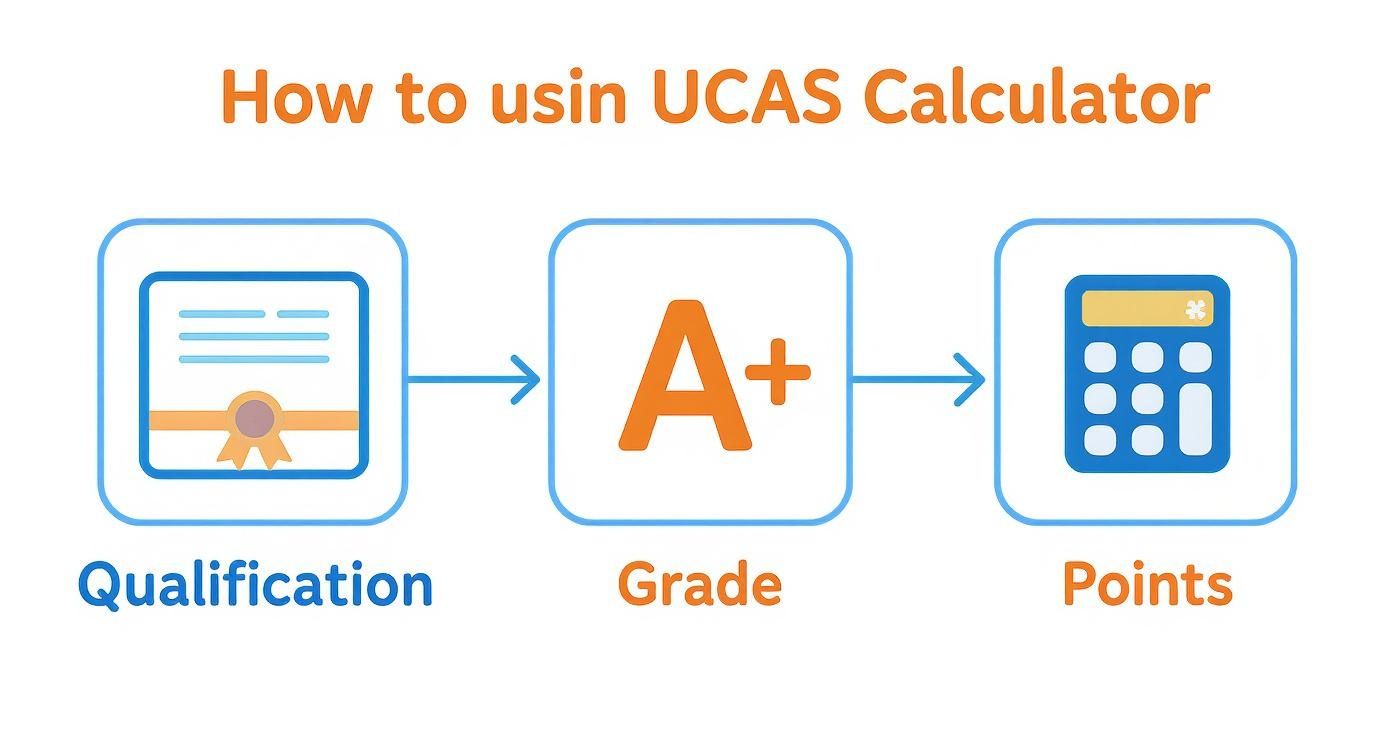
As you can see, the calculator does the heavy lifting, turning your hard-earned grades into a single score that universities can easily understand.
A-Levels and Scottish Highers
A-Levels are the qualification most people are familiar with when it comes to UCAS points. The calculation is nice and direct – the better your grade, the more points you get.
- An A* at A-Level gets you 56 UCAS points.
- An A is worth 48 points.
- A B will add 40 points to your total.
So, if you walked away with grades of A, B, and C, your total would be 48 + 40 + 32 = 120 UCAS points. Simple.
The system for Scottish Highers and Advanced Highers works in much the same way, though the points values are different to reflect the unique structure of the Scottish education system. For instance, an A at Advanced Higher is worth 56 points (the same as an A* at A-Level), whereas an A at the Higher level is worth 33 points.
BTEC National Diplomas
BTECs are graded differently, using Pass (P), Merit (M), Distinction (D), and the top grade, Distinction* (D*). Because they are often equivalent to taking several A-Levels at once, they can rack up a huge number of points.
Let's take a common one: the BTEC Level 3 National Extended Diploma, which is seen as equivalent to three A-Levels.
- D*D*D* (Triple Distinction Star) is the highest possible grade, worth a massive 168 UCAS points.
- D*D*D is worth 160 points.
- DDD (Triple Distinction) gets you 144 points.
- DDM (Distinction, Distinction, Merit) adds up to 128 points.
These big numbers really show how much vocational qualifications are valued in the UCAS system, giving students a strong, clear pathway into higher education.
Expert Tip: Pay close attention when you're using the UCAS calculator. It's so easy to accidentally select a "National Diploma" (worth two A-Levels) instead of a "National Extended Diploma" (worth three). This is a common slip-up that can make a huge difference to your final points total.
Access to HE Diplomas: A Special Case
Access to Higher Education (HE) Diplomas are a fantastic way for mature students to get to university, but the way their points are calculated is totally unique. Instead of getting points for one overall grade, your total is built from the number of credits you achieve at Distinction, Merit, and Pass.
An Access to HE Diploma is made up of 60 credits. Of these, 45 are graded at Level 3 – and these are the ones that generate UCAS points. The other 15 credits are ungraded.
Here’s a practical example. Say a student completes their Access to HE Diploma in Nursing and their final profile is:
- 30 credits at Distinction
- 15 credits at Merit
- 0 credits at Pass
Using the official UCAS conversion, this profile translates into 122 UCAS points. That's a really competitive score, putting them on par with a student who achieved A-Level grades of AAB. It just goes to show how effective an Access course can be in getting you ready for university.
For a more detailed look at how different credit combinations add up, it’s worth digging into how to convert your Access course results into UCAS points. This will give you a much clearer picture of where you stand.
To help you quickly compare some common qualifications, here's a handy reference table.
UCAS Tariff Points for Common Qualifications
This table gives a quick snapshot of how different grades stack up.
| Qualification | Grade | UCAS Tariff Points |
|---|---|---|
| A-Level | A* | 56 |
| A | 48 | |
| B | 40 | |
| AS Level | A | 20 |
| B | 16 | |
| BTEC Extended Diploma | D*D*D* | 168 |
| DDM | 128 | |
| Scottish Higher | A | 33 |
| B | 27 |
While this table is a useful guide, always double-check with the official UCAS calculator. It has the most up-to-date information and covers a much wider range of qualifications than we can list here.
Turning Your Points Total into a University Strategy
So, you've got your UCAS points total. Fantastic! That single number neatly sums up your academic achievements, but it’s just the beginning. Now, the real work starts: turning that figure into a smart, targeted university application.
Think of your points total as your research tool. It’s the key to sifting through thousands of courses and pinpointing the ones where you'll be a competitive applicant. Jump onto university websites and the main UCAS course search, and start filtering by your score.
This is the best way to build a realistic longlist of potential courses. As you browse, pay close attention to how each university words its entry requirements. Some will give a straight points total (e.g., "120 UCAS points"), while others will ask for specific grades (e.g., "AAB").
Decoding University Entry Requirements
Once you have that longlist, it's time to get into the details. A university might ask for 112 points, but they could also specify that those points must come from at least two A-Levels, or that you need a certain grade in a relevant subject.
For instance, a Psychology degree might advertise 120 points but also require a grade B in a science or Maths. Your total points get your foot in the door, but these subject-specific requirements are every bit as important.
Your UCAS points are a massive piece of the puzzle, but they don't work in isolation. They sit alongside your personal statement, references, and subject grades. Think of the points as the headline number that proves you have the academic chops, while the other parts of your application tell the story of why you’re the right person for their course.
When Your Score Exceeds the Requirements
Finding yourself with more points than a course requires is a brilliant position to be in. It can make you a much more attractive candidate, especially for popular courses where admissions tutors have to choose between stacks of well-qualified applicants.
A strong points total could also unlock scholarships or bursaries. Lots of universities offer financial perks to high-achieving students, so it's always worth checking the "fees and funding" section on their websites to see if you’re eligible for extra support.
You can see how much this matters at top-tier institutions. During the University of Cambridge's 2017 admissions cycle, a staggering 96.7% of accepted students had at least A*AA grades. That’s 168 tariff points from just three A-Levels, showing how elite universities use high scores as a key indicator of academic excellence.
Strategies for When You Fall Just Short
What if you're a few points shy of the entry requirements for your dream course? Don't panic. You still have options.
Your first move should be to contact the university's admissions department directly. Explain your situation politely and ask if they would still consider your application. Sometimes, a knockout personal statement, a glowing reference, or relevant work experience can be enough to convince them.
Beyond that, it’s worth looking into other routes:
- Foundation Years: Many universities offer an integrated foundation year, which is basically a preparatory year to get you up to speed for degree-level work. The entry requirements are usually much lower.
- Contextual Offers: Some universities make lower offers to students from particular backgrounds, like attending a school with lower-than-average results or living in an area where few people go to uni. See if you meet the criteria.
- Alternative Qualifications: If you're returning to education, qualifications like an Access to HE Diploma are tailor-made to prepare you for university. Admissions teams value them highly and they provide a clear, respected pathway to a degree. If this sounds like you, you can learn more about how an Access course can help you get into a top university.
Your UCAS points are more than just a number; they're the starting block for your entire university journey. Use them strategically to research effectively, find the right opportunities, and build a compelling case for your place.
Common Mistakes When Calculating UCAS Points

Figuring out your UCAS points should be pretty simple, but a few common slip-ups can easily lead to the wrong total and a lot of unnecessary stress. Getting your score right is the foundation for a realistic university application strategy, so let's walk through the most frequent errors and how to sidestep them.
One of the biggest tripwires involves vocational qualifications. It's surprisingly easy for a student to select a "BTEC National Diploma" in a calculator when they've actually studied for a "BTEC National Extended Diploma". That small difference in wording actually represents an entire A-Level's worth of study, and getting it wrong can slash your calculated score.
Before you even open a calculator, grab your official college or school documents and double-check the exact title of every qualification. This is the only way to ensure the ucas calculator points tool gives you the credit you’ve worked so hard for.
Forgetting About the 2017 Tariff Changes
This one catches out so many people. Back in 2017, the entire UCAS Tariff system got a major overhaul. The points values for qualifications like A-Levels and AS-Levels were completely re-scaled. For example, an A grade at AS-Level, which used to be worth 60 points, is now only worth 20.
If you're scrolling through old advice on student forums or looking at outdated university guides, you might easily stumble across the old numbers. This creates a huge amount of confusion and could leave you thinking your total is much higher than it really is.
The simplest way to avoid this is to make a personal rule: only ever use the official UCAS Tariff calculator on their website. It’s always kept up-to-date with the correct, current values, giving you the confidence that your total is accurate for this year’s application cycle.
Including Qualifications That Don't Carry Points
It’s natural to want to include every single achievement you have, but not all of them actually carry UCAS Tariff points. This is where a lot of applicants go wrong.
The most common mistake here is trying to add GCSEs. While your GCSE results are absolutely vital for meeting specific course entry requirements (especially in Maths and English), they do not contribute to your overall UCAS points total. The Tariff system is designed specifically for Level 3 qualifications—the ones you study after your GCSEs.
Crucial Reminder: Only Level 3 qualifications, like A-Levels, BTECs, T-Levels, and Access to HE Diplomas, are included in the Tariff. Adding anything else will just give you an inflated and incorrect score.
Other qualifications that often get added by mistake include:
- General Studies A-Levels (many universities don't accept these for points).
- Lower-grade music or drama awards (e.g., ABRSM grades below Grade 6).
- Certain professional or workplace training certificates.
Always stick to what the official calculator recognises. If you steer clear of these common mistakes, you can work out your UCAS points with total confidence, knowing your university research is built on a solid and accurate foundation. That clarity is the first step toward a successful application.
Got Questions About UCAS Points? We've Got Answers
Getting your head around the university application process can feel like learning a new language. This final section is here to clear up some of the most common questions we hear about the UCAS Tariff system, giving you that last bit of confidence before you hit ‘submit’.
Think of this as your final check-in. We’ll cover everything from having extra qualifications to how universities actually see your points total. Nailing these details now will save you a lot of stress later on.
What If I Have More Points Than Required?
First off, well done! Having more UCAS points than a course requires is a fantastic position to be in. It really makes your application stand out and flags you as a high-achieving candidate to admissions tutors.
While it’s not an automatic guarantee of a place, it definitely strengthens your profile, especially for those really competitive courses. Plus, a strong points total can sometimes unlock access to university scholarships or bursaries. It’s always worth having a look at the "fees and funding" pages for the universities you’re keen on – you might be pleasantly surprised.
Can I Get More UCAS Points After My A-Levels?
Yes, absolutely. If you find you’re just a few points short of where you need to be, there are several great ways to top up your total. Taking an additional qualification is a really popular route.
Many students give their score a boost by completing things like:
- An Extended Project Qualification (EPQ): Universities love these, and they can add up to 28 points to your total.
- Music or Performance Grades: If you have graded exams from bodies like ABRSM or LAMDA (Grade 6 and above), they all carry Tariff points.
- Core Maths: This qualification is super useful for many degree subjects and can add up to 20 points.
These aren't just about the points, either. They show commitment and help you develop skills that will be invaluable at university.
Our Top Tip: Don’t just chase the points. Think about how an extra qualification makes your whole application stronger. A well-researched EPQ, for instance, is a brilliant talking point for your personal statement and shows a real passion for your subject. It’s a huge part of learning how to write a personal statement that really gets you noticed.
Do UCAS Points Expire?
Nope, your UCAS points don't have a sell-by date. Any qualifications you earned, even years ago, are still perfectly valid and can be used to apply to university whenever you’re ready. This is a massive relief for mature students who are coming back to education after a break.
One thing to bear in mind, though, is that the Tariff system itself had a big update back in 2017. If your qualifications are from before then, the points values will have changed. Always use the official ucas calculator points tool to find the current value for your older qualifications. It ensures you’re working with the right numbers from the start.
At Access Courses Online, our entire focus is on helping students get to university, no matter their starting point. Our accredited online Access to HE Diplomas are designed to fit around your life, providing a clear and respected route to your degree. Discover how we can help you achieve your goals.