

A UCAS point calculator is simply a handy tool that turns your qualification grades into a numerical score, known as Tariff points. This system is what helps universities compare apples and oranges—pitting different qualifications like A-levels, BTECs, and T-levels against each other using a single, standardised score.
What Are UCAS Tariff Points and Why Do They Matter?

Let’s cut through the jargon. Think of UCAS Tariff points as a universal currency for your qualifications. Whether you've studied A-levels, BTECs, or an Access to HE Diploma, the Tariff system assigns a number to your grades, creating a level playing field for everyone.
This is a massive help for university admissions tutors. It gives them a quick way to assess an applicant's overall academic achievement, especially when they're looking at a mix of traditional and vocational qualifications. For you, it means you have a clear target to aim for when you're looking at course entry requirements.
Creating a Common Currency for Qualifications
At its heart, the UCAS Tariff is designed to translate a huge range of different qualifications into one comparable metric. It recognises the hard work and academic challenge involved in all sorts of courses, from hands-on BTECs to theory-heavy A-levels.
The system really shines when you have a mixed bag of qualifications. For instance, you might be applying with:
- Two A-levels in traditional subjects
- A BTEC National Diploma in a more vocational area
- An Extended Project Qualification (EPQ) showing off your independent research skills
Instead of trying to weigh these up individually, a university can just look at your total UCAS points. It provides a more holistic view of your academic profile and ensures all your hard work gets counted. It’s a system built to value different educational journeys.
Key Takeaway: UCAS points don't replace your grades; they complement them. They offer a single score that helps universities make fair and consistent decisions across a massive pool of applicants.
Understanding the 2017 Tariff Update
It's really important to know that the Tariff system you see today isn't the one that's always been around. It got a major overhaul back in 2017, which completely recalibrated how points were calculated. The update was designed to better reflect the size and grading of different qualifications.
This is the system we have now, where an A* at A-Level is worth 56 points and an A is 48 points. You can read up on the history and thinking behind these changes on the UCAS Tariff system and its evolution page.
What does this mean for you? If you stumble across an old university prospectus or a blog post from before 2017, the points requirements will look much higher and are now completely out of date. Always, always use a current UCAS point calculator to make sure your numbers are right for this year's application cycle.
Why Some Universities Prioritise Points and Others Grades
You've probably noticed that while about a third of UK university courses list Tariff points, many others—especially the most competitive ones—still make offers based on specific grades, like "AAB at A-level." So, what's the deal?
Universities using point-based offers often do it to attract a broader range of applicants from different educational backgrounds. They like the flexibility the Tariff system offers. On the other hand, courses that need very specific subject knowledge, like medicine or engineering, will almost always demand certain grades in relevant A-levels. They need to be sure you have the solid foundation required to hit the ground running.
How to Calculate Points for A-Levels and AS-Levels
Understanding your UCAS tariff score early removes guesswork when choosing courses. At its core, an A* at A-level is worth 56 points, while an A earns 48 points. AS-levels sit at roughly 40% of A-level value—so an A at AS yields 20 points.
To keep your maths tidy, grab the table below and match each grade to its tariff value.
A-Level and AS-Level UCAS Tariff Points
Here’s a quick snapshot of how each grade translates into UCAS points. Use it as a go-to reference whenever you’re totalling up.
| Grade | A-Level Points | AS-Level Points |
|---|---|---|
| A* | 56 | — |
| A | 48 | 20 |
| B | 40 | 16 |
| C | 32 | 12 |
| D | 24 | 10 |
| E | 16 | 6 |
Keep this chart close at hand—it’s your best defence against simple arithmetic slip-ups.
Worked Examples
Imagine you’re aiming for AAA at A-level. Multiply 48 points by three and you reach a total of 144 points.
Swap one A for a B and an AAB haul looks like this: 96 points from two As, plus 40 for the B, giving 136 points overall.
A BBC line breaks down into 40 for the first B and 64 for two Cs, landing you on 104 points.
"Tip: Always base your university shortlist on predicted—not wished-for—grades. It keeps your offers realistic."
Predicting Your Final Points
Your predicted grades guide where you apply and shape targets for mocks. If you retake an AS-level within a full A-level, those early AS points drop away—only the final A-level grade counts.
- Check your online calculator uses current predictions.
- Cross-reference each university’s stance on AS results.
Universities sometimes exclude AS grades once you sit the full A-level exam. A quick email to admissions can save a last-minute shock.
Setting Realistic Targets
Match your total to course entry requirements. If you’re a few points shy, a foundation year could bridge the gap. Top institutions often expect 144 points from three A-levels, so plan accordingly.
- Focus on your three strongest grades unless a course specifies more.
- Don’t forget the EPQ—an A* here adds 28 points, plus a dash of depth to your application.
An EPQ not only nudges your tariff total upwards but also gives you fresh talking points in interviews.
Tips For Access Courses Online Students
As an Access Courses Online learner, you’ll want to present a clear points breakdown to tutors and admissions tutors alike. That means listing every grade alongside its tariff value, and flagging any EPQ or AS results still in play.
- Outline each qualification and its point equivalent.
- Highlight additional awards, such as EPQ, in your personal statement.
If there’s any ambiguity in your calculations, a brief note on how you arrived at your total can make all the difference.
Common Mistakes To Avoid
- Mixing AS and A-level points for the same subject.
- Keeping dropped AS scores in your tally.
- Overlooking lower-graded qualifications that still add value.
A final proof-read of your UCAS form will catch any simple addition hiccups.
Next Steps
Once you’ve got your total, compare it against course pages on university websites. Keep an eye on mock results to fine-tune targets as the year progresses.
With a solid grasp of your A-level points, you’ll approach firm and insurance choices with genuine confidence—freeing you up to craft standout personal statements and nail those interviews.
Converting BTECs, T-Levels, and Other Qualifications
The path to university isn't just about A-levels anymore. Far from it. The admissions landscape has broadened, and qualifications like BTECs and the newer T-levels are highly respected by universities for the practical, in-depth skills they represent. Getting to grips with how these grades convert into UCAS points is the key to unlocking your full potential.
Unlike the straightforward A-level letter grade, vocational awards often have more detailed grading structures. Figuring out how terms like Distinction, Merit, and Pass translate into a hard number is essential. It’s the only way to ensure all your hard work is properly recognised when you apply.
Calculating Points for BTEC Nationals
BTEC Nationals are one of the most popular alternatives to A-levels, and for good reason—they carry serious UCAS Tariff points. The final total depends on two things: the size of your qualification (like an Extended Diploma vs. a Diploma) and the grades you achieve.
The grading system uses Distinction* (D*), Distinction (D), Merit (M), and Pass (P). Your final award is a combination of these.
Let's walk through a common, real-world example. Imagine a student completes a BTEC Level 3 National Extended Diploma, which is the same size as three A-levels. They come out with a final grade of DDM (Distinction, Distinction, Merit). Here’s how that translates:
- Distinction (D): 48 points
- Distinction (D): 48 points
- Merit (M): 32 points
Add them up (48 + 48 + 32), and that student has a grand total of 128 UCAS Tariff points. That's a fantastic result, equivalent to getting AAB at A-level.
T-Levels and the UCAS Tariff
T-levels are a newer qualification on the block, blending classroom theory with a hefty industry placement. They are equivalent in size to three A-levels and are fully integrated into the UCAS points system. Your overall T-level grade—Pass, Merit, Distinction, or Distinction*—is what determines your points.
Here’s a quick breakdown of how T-Level grades convert:
| T-Level Overall Grade | UCAS Tariff Points | A-Level Equivalent |
|---|---|---|
| Distinction* | 168 | A*A*A* |
| Distinction | 144 | AAA |
| Merit | 120 | BBB |
| Pass (C or above on core) | 96 | CCC |
| Pass (D or E on core) | 72 | DDD |
So, a student who earns a Merit in their T-level walks away with 120 UCAS points, putting them in a strong position for a wide range of university courses.
Access to HE Diploma Points
The Access to Higher Education Diploma is a brilliant and focused route to university, built specifically for adult learners. While it has a clear tariff value, universities often make offers based on the number of credits you achieve at Distinction, Merit, and Pass, rather than just a total points figure.
The total points awarded are tied directly to your credit profile. For example, achieving 45 credits at Distinction level is worth a massive 144 UCAS points. We've put together a detailed guide on how to work out your exact total in our article on Access course UCAS points. This is vital reading for Access Courses Online students who want to present their achievements effectively.
Key Insight: While the UCAS Tariff gives a numerical value to your Access to HE Diploma, universities will often look deeper. Their offer might be something like, "45 credits with at least 30 at Distinction." Always check the specific entry requirements for your chosen course.
Boosting Your Total with Extra Qualifications
Many students round out their applications with qualifications they've taken alongside their main studies. These are a great way to show dedication to a subject you're passionate about, and they all add valuable points to your total.
This vertical bar chart visualises the UCAS points for the top three A-Level grades, showing how each grade contributes to a student's total tariff score.
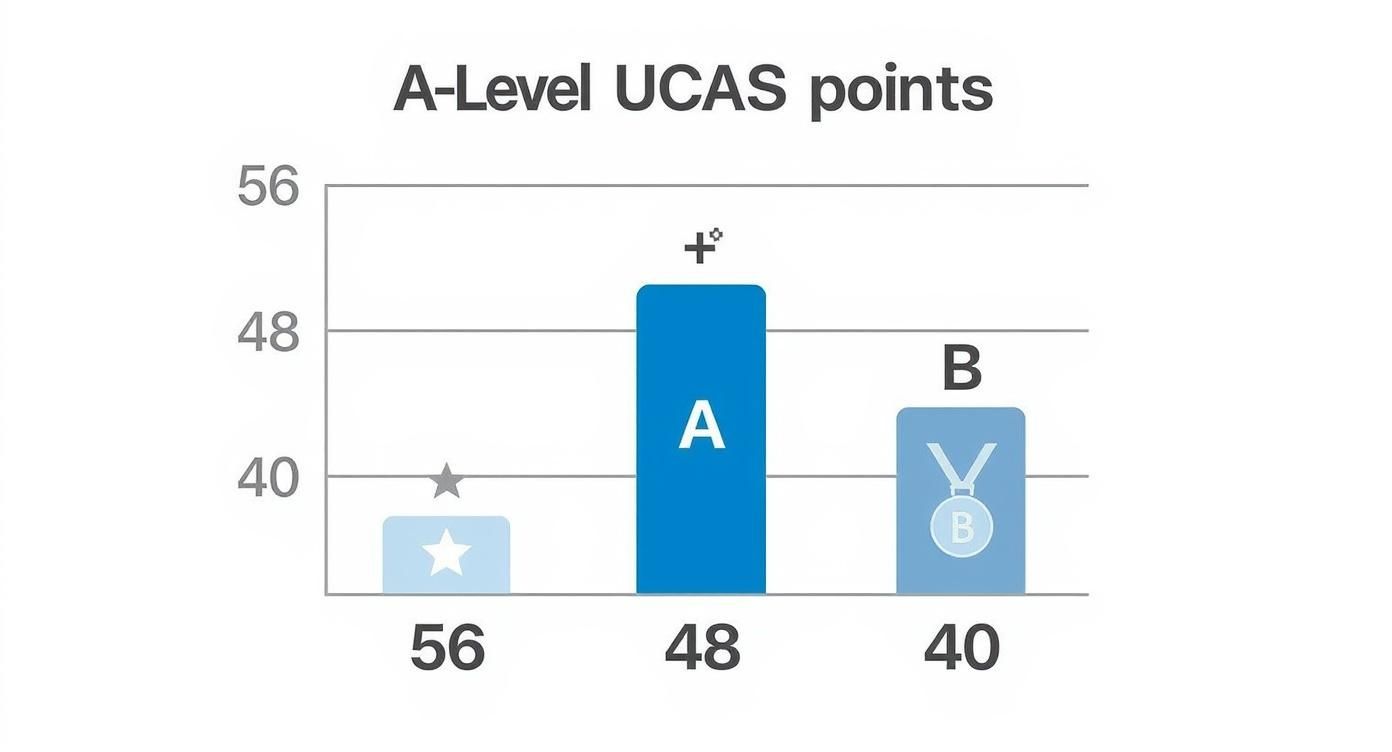
The chart clearly illustrates the significant jump in points between grades, with an A* grade providing 56 points, making it a powerful asset in a competitive application.
Here are a few common extras that can give you an edge:
- Extended Project Qualification (EPQ): An A* here adds 28 points and, more importantly, proves you have the independent research skills that universities love.
- Music Grades (ABRSM or Trinity): Your musical talents count! Practical and theory exams from Grade 6 upwards carry UCAS points. A Grade 8 Distinction in a practical exam, for instance, is worth 30 points.
- LAMDA Awards: Qualifications in speech and drama from the London Academy of Music and Dramatic Art also have tariff points, rewarding your performance and communication skills.
These "bolt-on" qualifications can genuinely make a difference, sometimes pushing your points total over the line for the course you really want. When you're using a UCAS point calculator, be sure to include every single qualification to get the full, accurate picture of what you've achieved.
Handling Complex Scenarios and International Qualifications
Not everyone’s academic journey fits into a neat little box. Your path to university might involve resits, a mix of different qualifications, or awards from outside the UK. This is completely normal, and admissions tutors see unique academic profiles all the time.
The trick is knowing how to present your specific circumstances clearly on your application. Let's break down some of the most common complex scenarios.
What About Resits?
This is one of the most frequent questions we get. If you've retaken an A-level or a BTEC module, will the new, better grade count? The short answer is yes, but there's a small caveat. For the vast majority of courses, universities will happily accept the higher grade and the UCAS points that come with it.
However, if you’re aiming for a super-competitive course like Medicine, Dentistry, or Veterinary Science, some universities might prefer applicants who got their grades on the first try. It’s not necessarily a deal-breaker, but it is something to be aware of. The best advice is to always check the specific entry requirements on the course page or just give their admissions team a call if you’re unsure.
Combining Different Types of Qualifications
What happens if your profile is a blend of A-levels and BTECs? This is an increasingly common and perfectly valid route to university. In fact, the UCAS Tariff system was designed for exactly this kind of situation, allowing you to pool points from different qualifications to meet an offer.
For instance, you might be studying:
- A-level Biology: Predicted B (40 points)
- A-level Chemistry: Predicted C (32 points)
- BTEC National Diploma in Health and Social Care: Predicted DM (Distinction, Merit) (80 points)
That gives you a total of 152 UCAS points—a strong score that shows you have both academic and vocational skills. A mixed portfolio like this can be really attractive to universities, as it demonstrates a fantastic breadth of abilities.
The UCAS Tariff system is crucial for UK university admissions, helping institutions compare applicants from diverse educational backgrounds. Top universities set high standards; for example, in 2017, the vast majority of successful Cambridge applicants achieved A*AA or better at A-Level, equivalent to at least 168 tariff points. Learn more about the importance of UCAS points for competitive courses.
When Your Qualification Isn't on the Calculator
It can be a bit unsettling when you pop your details into a UCAS point calculator and your qualification doesn't show up. This happens all the time for students with international awards, like the International Baccalaureate (IB), or qualifications from other parts of the UK, such as Scottish Highers.
Don't panic! This absolutely does not mean your qualifications aren't recognised. Many of these awards are highly respected by UK universities; they’re just assessed on their own terms rather than being converted directly into tariff points.
- International Baccalaureate (IB): Universities will usually make you an offer based on your overall IB Diploma score (out of 45) and grades in your Higher Level subjects. For example, "36 points overall with 6,6,5 at Higher Level."
- Scottish Highers/Advanced Highers: While these have their own tariff points table, universities in England, Wales, and Northern Ireland will often make specific grade-based offers, like AABBB at Higher.
- Other International Awards: For qualifications from Europe, the US, or anywhere else, universities have specialist international admissions teams who are experts at evaluating them. They’ll compare your grades to their A-level or IB equivalents. If you are an international student exploring your options, our guide on how international students can access higher education diplomas offers some great insights.
Your best move is to get in touch with the admissions departments of your chosen universities. Explain what qualifications you have and ask how they would assess your application. Taking this proactive approach not only gets you the right information but also shows real initiative.
Using Your UCAS Points to Build a Strong Application

So, you've tallied up your UCAS points. Great! That number is a crucial piece of the puzzle, but knowing it is just the beginning. The real art is learning how to use that score to build a compelling, strategic university application that gets you noticed.
It's time to shift your thinking from simple calculation to smart application strategy.
Your total score is a powerful signal to admissions tutors, but it never tells the whole story. They're looking at you as a complete package. A brilliant tariff score is a fantastic start, but it's the combination of your points, specific grades, personal statement, and any interviews that makes your application truly stand out from the crowd.
Looking Beyond the Headline Number
It's so easy to get fixated on the big number a university advertises on its course page. But you absolutely have to dig deeper. A course might ask for 120 UCAS points, but tucked away in the entry requirements, they might also specify that this must include a B in A-Level Maths or a Distinction in a particular BTEC module.
Always, always read the small print. A sky-high overall score is no good if you don't meet the subject-specific requirements. For each of your top university choices, make a quick checklist:
- What's the total UCAS points target?
- Are there any mandatory subjects and minimum grades?
- Do they accept a mix of qualifications (like A-Levels and BTECs together)?
- What's their policy on things like resits or the EPQ?
Doing this homework now stops you from accidentally wasting one of your five UCAS choices on a course you were never really eligible for.
Why Points Are Not a Golden Ticket
A strong tariff score is an excellent sign of your academic ability, no doubt about it. Research consistently shows a clear link between higher tariff points and degree success. However, it's not an automatic guarantee of an offer, especially for the most competitive courses.
This is where your personal statement comes in. It’s your opportunity to shine, to give context to your grades and show them the person behind the points.
This is particularly true for our Access Courses Online students, who often bring a wealth of valuable life experience to the table. Use that space to show your passion for the subject and explain how your unique journey has prepared you for the rigours of university study. For more detailed advice, check out our guide on how to write a personal statement that will grab an admissions tutor’s attention.
A study by Cambridge Assessment found that A-Level tariff points were the most influential variable in predicting a First-class degree, with a relative influence of 65.2%. This shows how valuable points are, but also suggests they don't capture the full picture of a student's potential.
Choosing Your Firm and Insurance Choices
Your predicted grades and the UCAS points they translate to are your most powerful tools for picking your firm and insurance choices. The key is to be both ambitious and realistic.
- Firm Choice: This is your dream course. It should be ambitious but still achievable, with entry requirements that line up closely with your predicted points total.
- Insurance Choice: Think of this as your safety net. Your insurance choice should have lower entry requirements than your firm choice, giving you a solid backup plan just in case results day doesn't go exactly as planned.
Whatever you do, don't pick an insurance choice with the same or higher entry requirements than your firm one—it completely defeats the purpose. A smart insurance choice brings peace of mind when it matters most. To help with organisation, you might want to look into the best AI tools for students.
The Advantage of Points During Clearing
If you end up in Clearing – either because your grades weren’t quite what you needed for your firm and insurance choices, or you decided to decline your offers – your UCAS points total becomes a massive asset. Clearing can be a frantic process, with universities looking to fill their remaining spots quickly.
Having a solid tariff score makes you an attractive candidate right away. You can clearly and confidently tell admissions tutors your score over the phone, proving you meet the criteria for their available courses. Students with a strong points total often find they have more options, turning what could be a stressful day into a fantastic new opportunity.
Common Questions About the UCAS Point Calculator
Applying to university can feel like piecing together a puzzle—and even after you’ve run your results through a UCAS point calculator, a few niggling doubts often remain. Below, we’ve gathered the most common queries we hear at Access Courses Online, along with clear, no-nonsense answers to help you finalise your application with confidence.
Think of this as your go-to guide for those last-minute what-ifs. We’ve based every insight on real conversations with students just like you.
Do All Universities Use UCAS Points?
Not quite. While many courses list their requirements in UCAS points, a significant number—especially competitive degrees—still ask for specific grades.
Grade-Based Offers demand set results in certain subjects (for example, A*AA at A-Level). They leave little wiggle room but guarantee you’ve covered core material.
Point-Based Offers let you pool a mix of qualifications until you hit the target number of points.
• Always check each course’s official entry requirements
• Note whether they prefer a points total or fixed grades
• Don’t assume high points alone will secure a grade-based offer
Double-check the university website to avoid unpleasant surprises.
Can I Combine Points From Different Qualifications?
Absolutely—and that’s one of the UCAS Tariff’s greatest strengths. You can blend academic and vocational awards to build a competitive total.
For example:
• A-Level Grade B (40 points)
• BTEC Diploma Grade MM (64 points)
• EPQ Grade A (24 points)
This adds up to 128 UCAS points, equivalent to AAB at A-Level. It’s perfect if you’ve balanced academic study with practical qualifications.
Tip: Confirm your subject combination is accepted by your chosen courses before you finalise your application.
What Happens If My Final Grades Are Lower Than Predicted?
It’s a worry, but missing your firm choice by a few points isn’t necessarily game over. Universities sometimes honour offers in low-demand years. If not, you’ll automatically move to your insurance choice—another reason it pays to pick one with lower requirements.
During Clearing, your UCAS points become a powerful tool. You can quickly see which vacancies match your total and apply in minutes.
Do Extra Qualifications Like Music Grades Really Count?
Yes they do—and they often make a real difference. Graded music exams from Grade 6 upwards, LAMDA qualifications and similar awards all carry UCAS points.
Including them can:
• Push your total over an entry threshold
• Highlight your commitment and discipline
• Give you an edge when academic scores are close
Don’t underestimate the value of those bonus points.
At Access Courses Online, we understand every student’s story is unique. Our Access to HE Diplomas have helped thousands of learners rack up the points—and the confidence—they need for university. Ready to take that next step? Explore our courses and start your application at Access Courses Online.