
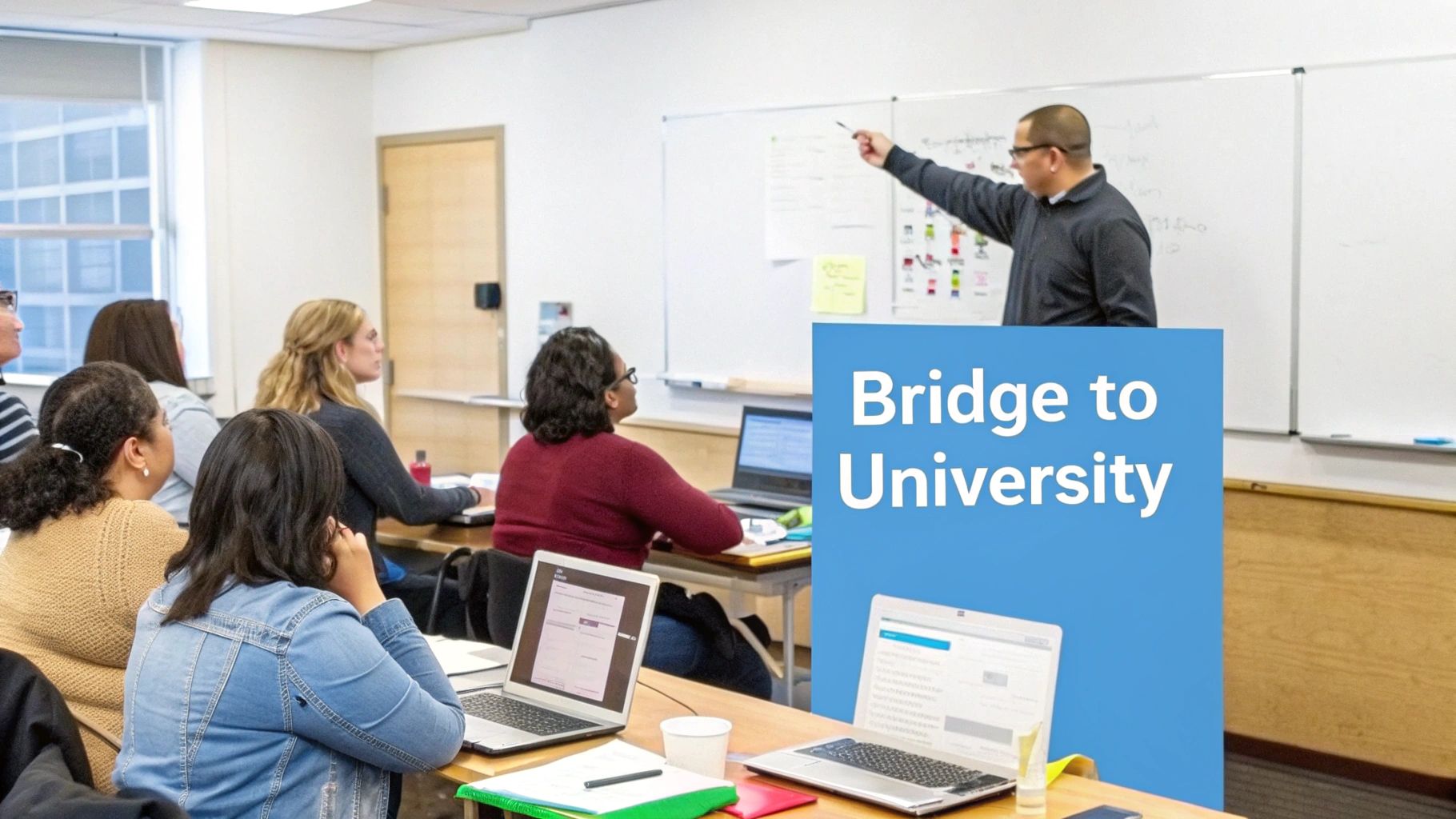
An Access to Higher Education (HE) Diploma is a nationally recognised qualification designed specifically for adults who want to get into university but don't have the typical qualifications, like A-Levels. Think of it as a purpose-built bridge connecting your life experience and ambitions directly to a degree course, and it’s usually completed in just one year.
Your Second Chance at Higher Education
Imagine wanting to become a nurse, a social worker, or a computer scientist, but feeling like the door to university slammed shut years ago. The Access to HE Diploma was created to reopen that door, offering a structured and supportive path for motivated adults who are ready for a new chapter.
This qualification isn't just a substitute for A-Levels; it's a specialised programme built for the realities of adult learning. Instead of piling all the pressure on final exams, it uses continuous assessment. This means your progress is measured through assignments like essays, reports, and presentations spread throughout the year, which is a much more manageable approach when you're juggling other life commitments.
The Bootcamp Approach to University Prep
You can think of an Access course as an intensive academic bootcamp. It doesn’t just teach you about a specific subject like psychology or biology; it also trains you in the essential skills you'll need to thrive in a demanding university environment.
You'll get to grips with key skills that many first-year university students often struggle with, including:
- Academic Writing: Learning how to structure arguments, write compelling essays, and meet university standards.
- Critical Thinking: Developing the ability to analyse information, evaluate sources, and form well-reasoned conclusions.
- Research Skills: Understanding how to find, cite, and correctly use academic sources.
This dual focus on subject knowledge and practical skills is what makes Access to HE students so well-prepared for degree-level study. The model has proven itself to be incredibly effective for decades.
The Access to HE Diploma has become a vital pathway for UK adults returning to education. In the 2022-23 academic year alone, 38,220 students registered for these diplomas across England, Wales, and Northern Ireland, showing just how important they are in widening access to university. You can discover more about these key statistics on the Access to HE website.
How Is It Different from A-Levels?
While both qualifications can get you into university, they’re designed for very different learners at very different life stages. A-Levels are typically spread over two years and aimed at school leavers, whereas an Access course is an intensive, one-year programme tailor-made for adults.
The targeted nature of an Access diploma means you focus solely on subjects relevant to your chosen degree, saving you a huge amount of time and effort. This structure acknowledges that as an adult learner, your time is valuable and your goal is crystal clear.
Access Course vs A-Levels at a Glance
To make it even clearer, here's a quick comparison of the key differences between an Access to HE Diploma and traditional A-Levels.
| Feature | Access to HE Diploma | A-Levels |
|---|---|---|
| Duration | Typically 1 year | Typically 2 years |
| Target Audience | Adults (19+) returning to education | School leavers (16-18) |
| Assessment | Continuous assessment (essays, reports) | Mostly final exams |
| Curriculum | Focused on a specific degree path | Broad study of 3-4 subjects |
| Pace | Intensive and fast-paced | Slower, more spread out |
| Study Skills | Integrated into the course | Taught separately or assumed |
Ultimately, the best choice depends on your personal circumstances, but for adults aiming for university, the Access to HE Diploma is often the most direct and efficient route.
So, Who Are Access Courses Really For?
An Access to HE Diploma isn't your typical route for a school leaver. It's a special pathway designed for adults with real-life experience under their belts. It’s for anyone who feels like the traditional school-to-uni pipeline wasn’t the right fit for them back then, but now has a burning ambition to get a degree.
If you’ve ever thought university was off the table because of your age, a long break from studying, or the grades you got years ago, this qualification was made for you. It turns what you might see as a disadvantage—like life experience—into your greatest asset.
The Career Changer
One of the most familiar faces in an Access course is The Career Changer. This is someone who has spent years building a solid career, gaining loads of practical, hands-on experience. But now, they've hit a wall. To get that promotion or pivot into a new specialism, they need a formal degree.
Think of a healthcare assistant who has spent a decade caring for patients. They're brilliant at their job, but they now want to become a registered nurse. An Access to HE Diploma in Nursing is the perfect bridge. It allows them to formalise their practical knowledge and get the qualifications they need for a nursing degree, putting them on the fast track to a new professional role.
The Parent Returner
Another key group we see is The Parent Returner. Many people press pause on their own ambitions to raise a family, and rightly so. But now, with the kids a bit more independent, they finally have the time and headspace to chase a dream they put on a shelf years ago.
This could be someone who always wanted to study psychology but chose to focus on their family instead. An Access course gives them a flexible, manageable way back into education. With online options that can fit around lingering family commitments, it’s the perfect way to turn a "what if" into a reality.
The beauty of an Access course is that it meets you where you are. It’s not about what you did or didn't do at 18; it’s about your motivation and goals right now. It provides the academic toolkit you need to succeed, building upon the resilience and time management skills you’ve already developed.
The Passion Pursuer and Second Chance Seeker
Finally, there are two other profiles that fit right in with Access courses.
- The Passion Pursuer: This is someone who has discovered a new academic interest later in life. Maybe a love for history documentaries has blossomed into a real desire to study the subject, or a newfound passion for social justice has sparked an ambition to get a law degree.
- The Second Chance Seeker: So many adults feel their school results just didn't show what they were truly capable of. An Access course offers a completely fresh start—a chance to prove to themselves, and to universities, that they are more than ready for degree-level study.
For both of these learners, an Access course is the green light they’ve been waiting for. It validates their ambition and lays out a clear, structured path to turn that passion or untapped potential into a university place. It’s a powerful reminder that people grow and change, and a past chapter doesn't have to define their future.
How Access Diplomas Are Structured And Assessed
So, how does an Access to HE Diploma actually work? Think of it as a comprehensive qualification that gets you university-ready in roughly one academic year. It's built around a system of credits, with a total of 60 credits needed to complete the course.
This isn't just about memorising facts. The course is cleverly designed to immerse you in your chosen subject while simultaneously teaching you the essential academic skills you’ll need to thrive in higher education – things like writing essays, conducting research, and referencing correctly.
Here’s how those credits break down:
- Graded Subject Modules (45 credits): This is the core of your learning, focusing on the specific topics directly related to the degree you’re aiming for.
- Ungraded Core Units (15 credits): These modules are all about building your academic toolkit. You'll master essential study skills that universities look for.
It's this balanced blend that builds not just your subject knowledge but also the strong study habits that will set you up for success from day one of your degree.
Study Modes And Flexibility
Life is busy, and your education should fit around it, not the other way around. That’s why you can take an Access Diploma full-time, part-time, or entirely online.
A full-time course is pretty intensive, usually involving about 15 hours of taught sessions each week, plus your own independent study time. If you’ve got work or family commitments, a part-time option lets you spread the course over two years, making it far more manageable.
Online courses, like the ones we offer, give you the ultimate freedom. All your materials are delivered digitally, so you can study whenever and wherever you want, completely cutting out any commute time.
Visual Guide To Learner Types
The infographic below paints a clear picture of the kind of people who really thrive with an Access Diploma.
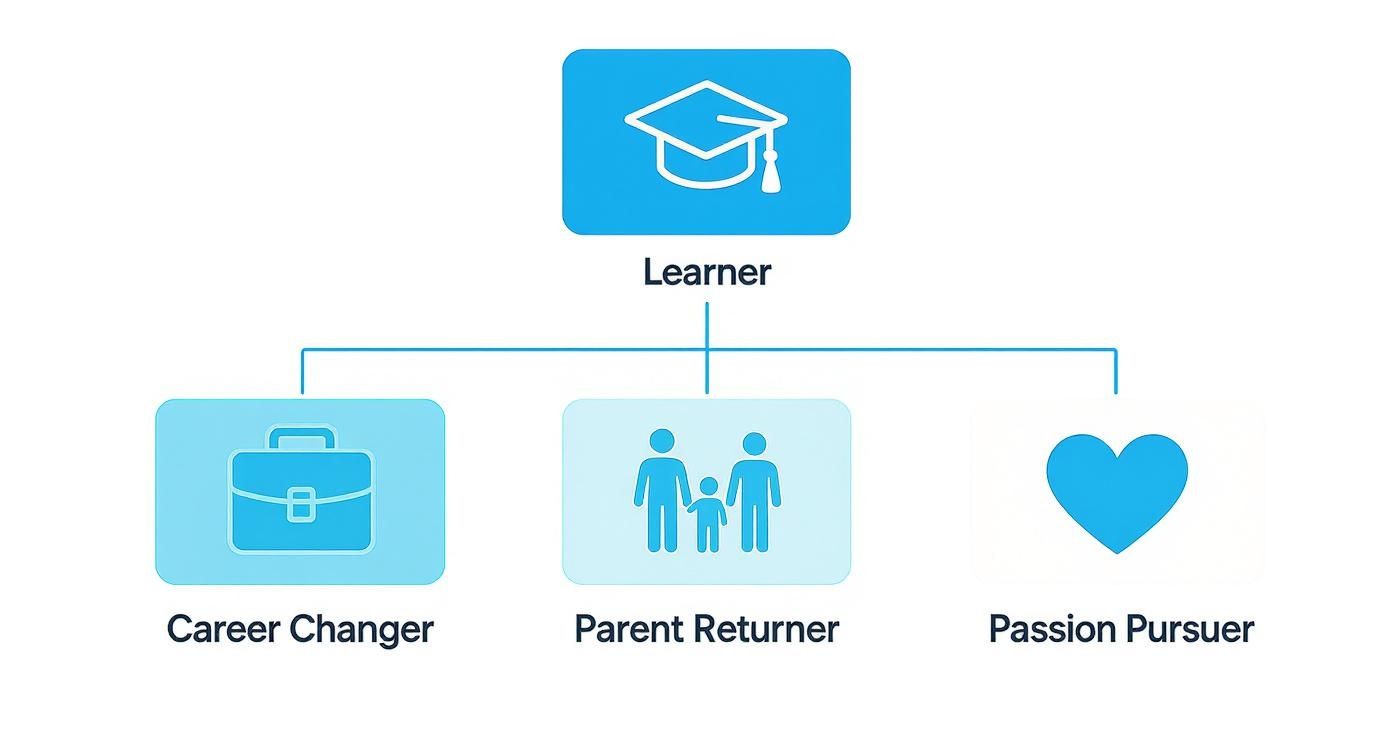
As you can see, the diploma is perfect for career changers, parents returning to education, and anyone who's ready to chase a long-held passion.
Continuous Assessment Over Final Exams
Forget the stress of one huge, all-or-nothing final exam. Access Diplomas use a much friendlier approach: continuous assessment.
This means your progress is tracked throughout the course with a series of assignments. You’ll tackle everything from essays and reports to presentations and controlled tests, building your skills and confidence as you go. This model gives a much more accurate and rounded picture of your abilities.
Want to know more about what to expect? Check out our detailed guide on how Access courses handle exams.
Continuous assessment helps learners manage stress and improve steadily over time, rather than relying on a single exam performance.
Credit Breakdown And Progression
To earn your Access Diploma, you need to pass all 60 credits. The grades you get for each graded module are key, as they show universities just how ready you are for degree-level study.
Grades are awarded as Pass (P), Merit (M), or Distinction (D). Here’s what they mean:
- P (Pass): You’ve shown a solid understanding of the material.
- M (Merit): You’ve demonstrated strong performance and deeper analysis.
- D (Distinction): Your work is excellent, showing critical insight and advanced skills.
Most universities will want to see at least 45 credits at Merit or Distinction level. Hitting this target turns your diploma into a powerful key that unlocks university entry through UCAS, proving you have what it takes to succeed.
Popular Course Pathways and Career Opportunities

Choosing an Access to HE Diploma isn't just about ticking a box to get a qualification. It’s about creating a direct, laser-focused path to the exact university degree and fulfilling career you’ve been dreaming of.
These courses are built with the end goal firmly in sight. Think of it less like a general education and more like a specialised key, crafted to unlock the door to a specific professional field. Every module is a deliberate step towards your future, whether you see yourself in healthcare, law, science, or business.
The Dominance of Health and Social Care
When you look at the most popular Access to HE pathways, one area stands head and shoulders above the rest: health and social care. Year after year, these diplomas attract a huge number of students, and for good reason. It’s a perfect storm of personal ambition meeting a massive national need for skilled professionals.
In 2021-22, an incredible 60% of all enrolments were for diplomas in Health, Public Services, and Care. That’s 24,745 individuals ready to step into these vital sectors. You can dive deeper into these key Access to HE statistics to see the full picture.
This isn't just a coincidence. For many adult learners, a career in healthcare offers more than just job security. It’s a chance to find real purpose and make a tangible difference in people's lives every single day.
Spotlight on Key Diploma Pathways
While healthcare might be the giant, Access to HE Diplomas open up a whole world of opportunities across countless industries. Let's take a closer look at some of the most sought-after pathways and the exciting university degrees they lead to.
1. Nursing and Midwifery
This is the big one. This pathway is the go-to for aspiring nurses, midwives, paramedics, and other allied health professionals who are ready to make a change.
- Typical Modules: You'll get stuck into units like Human Biology, Psychology, Health Studies, and Professional Practice in Healthcare.
- University Degrees Unlocked: This diploma is your direct ticket to degrees like BSc (Hons) Adult Nursing, BSc (Hons) Midwifery, and BSc (Hons) Paramedic Science.
2. Social Sciences
If you're fascinated by what makes people and society tick, this is the path for you. It's the perfect launchpad for a career in social work, counselling, or public policy.
- Typical Modules: Expect to cover core subjects like Sociology, Psychology, Criminology, and Social Policy.
- University Degrees Unlocked: It will prepare you for degrees such as BA (Hons) Social Work, BSc (Hons) Psychology, and BA (Hons) Criminology.
3. Law
Got a sharp, analytical mind and a passion for justice? The Access to HE Diploma in Law gives you the rock-solid foundation needed for a career in the legal world.
- Typical Modules: You'll cover essential topics like The English Legal System, Criminal Law, Contract Law, and Constitutional Law.
- University Degrees Unlocked: This is the main route onto an LLB (Hons) Law degree, the qualifying degree you need to become a solicitor or barrister.
4. Science and Engineering
For those with a technical brain who want to solve problems, this pathway is ideal. It opens up careers in everything from biomedical science to engineering.
- Typical Modules: Depending on your focus, you could be studying Biology, Chemistry, Physics, and Advanced Mathematics.
- University Degrees Unlocked: It paves the way for a huge range of STEM degrees, including BSc (Hons) Biomedical Science, BEng (Hons) Mechanical Engineering, and BSc (Hons) Computer Science.
Each of these pathways is carefully designed to give you the precise academic toolkit you need to hit the ground running at university, so you'll arrive on campus feeling confident and fully prepared.
Funding Your Course with the Advanced Learner Loan
Let’s be honest, one of the first questions on anyone’s mind when considering a return to education is: "How on earth can I afford this?" It’s a completely valid concern. The financial side of things can feel like a massive roadblock, but for an Access to HE Diploma, there’s a fantastic funding option designed with adult learners in mind: the Advanced Learner Loan.
This isn’t just any old loan. It’s a government-backed scheme created specifically to make qualifications like the Access Diploma achievable. It covers your full course fees right from the start, so you can dive into your studies without paying a penny upfront. You only start thinking about repayments once you’re in a stable career and earning a decent salary.
How the Advanced Learner Loan Works
The Advanced Learner Loan is available for anyone in England aged 19 or over who is enrolling on an approved Level 3 qualification – and yes, that includes all our accredited Access to HE Diplomas. Applying is refreshingly straightforward. It’s not based on your credit history or household income; if you’re eligible for the course, you’re pretty much eligible for the loan.
You only begin to pay it back after you’ve completed your course and are earning more than £27,295 a year. If your income ever dips below that threshold, for whatever reason, your repayments simply pause until you’re earning above it again.
The Best Part? The Loan Can Be Wiped Clean
Now, here’s the feature that makes the Advanced Learner Loan a truly incredible opportunity for Access to HE students.
If you use an Advanced Learner Loan to fund your Access to HE Diploma and then successfully complete a higher education course (like a university degree), the Student Loans Company will completely write off whatever is left of your loan for the Access course.
Read that again. It’s a genuine game-changer. It means that for students who continue on to university, the Access course essentially becomes free. This isn't a loophole; it's a deliberate incentive from the government to encourage and support adults in taking that huge, exciting step into higher education by removing a major financial worry.
Eligibility and Getting Started
Getting the loan is a pretty painless process. You just need to tick a few boxes.
- Age and Residency: You’ll need to be 19 or older on the first day of your course and have lived in the UK for the last three years.
- Course: The loan is for an approved Access to HE Diploma at an approved provider (like us!).
- Nationality: You must be a UK national or have ‘settled status,’ meaning there are no time limits on your stay in the UK.
The application itself is all done online through the GOV.UK website. Once you’ve enrolled with us, we’ll provide you with a ‘Learning and Funding Information Letter’. This has all the details you’ll need to complete your application smoothly. To get a full picture of your options, check out our detailed guide on Access to Higher Education funding.
Are There Other Financial Support Options?
While the Advanced Learner Loan is the go-to for most students, it’s always worth seeing what else might be out there. Some colleges and providers offer their own bursaries or grants to help with other costs like childcare, travel, or even books and materials. These are usually means-tested and designed to help learners on lower incomes. The best advice is to always have a chat with your chosen course provider to see what extra support you might be able to get.
How to Apply to University with an Access Diploma
Finishing your Access to HE Diploma is a massive achievement, but it’s really just the first step on an exciting new path. Next up is applying to university, and the great news is that unis genuinely value applications from Access students. They see the commitment, life experience, and academic drive your diploma represents.
The whole application process is handled through UCAS (the Universities and Colleges Admissions Service), the very same system used by A-Level students. But your application will look a bit different, and that’s a good thing. You have a unique story to tell, and that’s your biggest advantage.
The UCAS Application: A Step-by-Step Overview
Diving into UCAS might feel a bit daunting at first, but it’s a well-structured and logical process. As a mature student, you’ve got a wealth of experience that can make your application stand out from the crowd. Your life skills, work history, and sheer determination are exactly what admissions tutors are looking for.
Here’s a simple breakdown of what to expect:
- Register with UCAS: The first step is to create your account and fill in your personal details, education history, and any relevant employment.
- Choose Your Courses: You can pick up to five different university courses. Make sure you do your homework and check the specific entry requirements for Access to HE Diploma students for each one.
- Write Your Personal Statement: This is where you really get to shine. It's a 4,000-character essay explaining why you want to study your chosen subject and what makes you the right person for the course.
- Add Your Reference: Your course tutor will provide an academic reference for you, which will include your predicted grades for the diploma.
- Submit and Wait for Offers: Once your application is in, universities will start reviewing it and sending out offers.
For a more detailed walkthrough, our guide on how to apply to university after an Access course gives you all the in-depth advice you need to put together a winning application.
Crafting a Powerful Personal Statement
Your personal statement is, without a doubt, the most crucial part of your UCAS application. It’s your chance to connect your life and work experience directly to what you want to study. Don’t just list what you’ve done; explain how it has prepared you for university life.
Think of your experience not as a gap in your education, but as a rich source of practical knowledge. Frame your past roles and responsibilities as evidence of your maturity, resilience, and time-management skills—all things universities look for in successful students.
For example, if you're applying for a Social Work degree and have worked in customer service, you can talk about your experience de-escalating conflict and showing empathy. If you’re a parent heading into a Nursing course, talk about the patience, organisation, and compassion you’ve developed. These are real-world skills that make you an incredible candidate.
Understanding University Offers
When you start receiving replies from universities, the offers will usually be conditional. This just means you’ll need to achieve specific grades in your Access to HE Diploma to secure your place. Universities are very familiar with the diploma's credit-based structure and will tailor their offers accordingly.
A typical offer for an Access student will look something like this:
- "Obtain the Access to HE Diploma with 45 credits at Level 3, of which 30 credits must be at Distinction and 15 credits must be at Merit."
These requirements can change depending on the university and how competitive the course is. It’s vital to check the entry requirements for every course you’re interested in before you apply. Meeting these conditions is the final piece of the puzzle in turning your university dream into a reality.
Got Questions About Access Courses? We've Got Answers
Deciding to go back to education can bring up a lot of questions. It's completely normal to have them! We've put together some straightforward answers to the most common queries we get from people just like you, so you can feel clear and confident about your next steps.
One of the biggest worries we hear is about age. People often ask, "Am I too old for an Access course?" Let's clear this up right away: the answer is a firm no. There’s no upper age limit at all. In fact, colleges and online providers love the life experience that mature students bring to the table. It creates a much richer and more supportive learning environment for everyone.
Academic and Practical Concerns
What about old school qualifications? A lot of people wonder if they need specific GCSEs to get started. This can vary, but it’s true that many university degrees—especially competitive ones in healthcare and science—will ask for GCSE English and Maths at grade C/4 or higher. The best thing to do is to check the specific entry requirements for the university course you're aiming for.
Another common question is whether Access courses are harder than A-Levels. They're not necessarily harder, just different. The content is packed into a single year, so it's intensive and requires a good amount of self-discipline. But the big difference is that the teaching style and support are built for adults. The focus is on building your skills steadily, not just cramming for a few high-pressure exams at the end.
The real difference is in the style of learning. An Access course is much more self-directed, which is brilliant preparation for the independent study you’ll be doing at university. It gives you a real head start on the skills you'll need to do well in your degree.
And the most important question of all: will universities actually accept the diploma? Absolutely. The Access to HE Diploma is a nationally recognised qualification accepted by over 95% of UK universities. That said, it's always a good idea to double-check the entry requirements on the website of your chosen university and course, just to be sure.
As you get into your studies, finding smart ways to stay organised is key. Checking out guides on the best note-taking apps for students can be a great way to find tools that make learning more effective and a lot less stressful.
At Access Courses Online, we provide accredited, flexible online diplomas that fit around your life. Start your journey to university today.