
Ever heard the term Continuous Professional Development (CPD)? It’s the simple idea that you never stop learning and improving throughout your career. Think of it less as a box-ticking exercise and more as a commitment to being brilliant at what you do.
Demystifying Continuous Professional Development
Imagine your career is a long road trip. To keep the car running smoothly for the whole journey, you need to top up the fuel, get it serviced, and maybe even upgrade the tyres now and then. Your professional skills are exactly the same – they need regular attention to keep you moving forward. That’s what CPD is all about: the essential maintenance for your career.
This isn’t about collecting a stack of certificates just for the sake of it. It’s about adopting a mindset of constant improvement, making sure you stay relevant and valuable in a world that’s always changing. In many professions, like nursing or social work, it’s a non-negotiable part of keeping your registration. In others, it’s the quiet secret that separates the real high-flyers from everyone else.
The Core Idea Behind CPD
At its heart, CPD is built on one powerful truth: your first qualification was just the starting line. The world doesn’t stand still, so why should your skills? To really get ahead, you have to be proactive and look for ways to grow.
This approach boils down to a few key things:
- Identifying Gaps: Being honest with yourself about where your knowledge or skills could be a bit stronger.
- Setting Goals: Figuring out what you want to learn and, crucially, how it’s going to help you get where you want to go.
- Active Learning: Actually doing the things that will help you reach those goals, whether that’s a formal course or just reading up on your industry.
- Reflection: Taking a moment to think about what you’ve learned and how you can actually use it in your day-to-day work.
CPD is your personal roadmap for career growth. It’s the intentional process of managing your own learning and development to ensure your skills and knowledge remain current and you continue to improve your professional practice.
When you embrace this cycle, you’re no longer just a passenger in your career – you’re in the driver’s seat. It’s a key part of the journey of lifelong learning, where it's never too late to start taking control of your future. Ultimately, getting your head around what continuous professional development is all about is the first step toward building a career that’s not just successful, but fulfilling and resilient, too.
The Three Pillars of Professional Learning
Continuous professional development isn't a single, rigid path. Instead of picturing it as just one type of activity, like attending a course, it’s much more helpful to see it as a blend of different learning styles that all fit together. Think of it like building a structure; you need different materials for different parts. The foundation, walls, and roof all play a unique role.
Similarly, a strong CPD plan is built on three distinct pillars: formal, informal, and reflective learning. Each one contributes something essential to your overall growth. Understanding these pillars is the key to spotting and making the most of every learning opportunity, turning everyday experiences into valuable assets for your career.
This diagram shows how these pillars support the core outcomes of CPD: growth, skills, and staying relevant in your field.
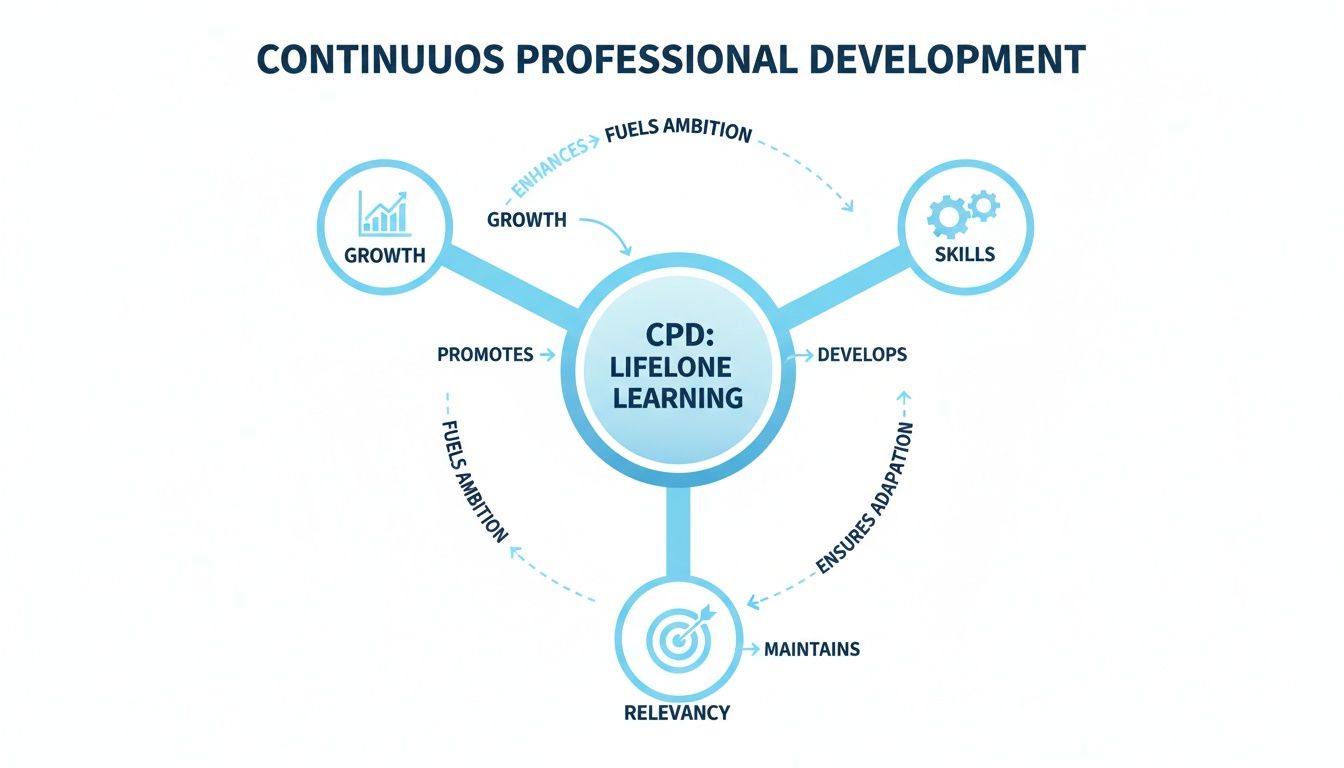
As the image shows, a commitment to continuous learning directly fuels your professional growth, sharpens your practical skills, and ensures you keep pace with your industry.
Pillar One: Formal Learning
Formal learning is the most structured and easily recognisable type of CPD. It involves planned educational activities, often leading to a qualification or certification from an accredited body. This is the pillar most people think of when they hear about professional development.
Think of it as the foundational knowledge you intentionally set out to acquire. A perfect example is completing an Access to Higher Education Diploma. This is a deliberate, structured programme designed to equip you with the specific knowledge and academic skills needed for university and a new career.
Other examples of formal learning include:
- Attending a certified workshop on new healthcare software.
- Completing a professional qualification relevant to your industry.
- Enrolling in a university degree or postgraduate course.
The main benefit here is credibility. Formal learning provides a validated, official framework for your knowledge. It’s tangible proof to employers and professional bodies that you have met a certain standard of competence.
Pillar Two: Informal Learning
While formal learning lays the foundation, informal learning is the everyday, on-the-job development that often goes unnoticed but is incredibly powerful. This type of learning is usually unstructured, self-directed, and happens naturally as you go about your professional life.
It’s the gold you mine from your daily experiences. For instance, listening to a podcast about new practices in social care, watching a documentary on advances in medical science, or having a detailed problem-solving chat with a mentor are all forms of informal CPD. It’s learning by doing, observing, and engaging with the world around you.
Informal learning accounts for as much as 75% of the learning that takes place within an organisation. It’s the spontaneous, collaborative, and experience-based knowledge that drives real-world problem-solving and innovation.
Recognising and valuing these activities is crucial. It helps you see that you are constantly learning, even when you aren't in a classroom.
Pillar Three: Reflective Learning
Reflective learning is the secret sauce that binds the other two pillars together. It’s the intentional process of pausing to think about your experiences—both formal and informal—to pull out meaningful insights. Without reflection, a lot of what you learn can remain on the surface.
Imagine you've just finished a challenging assignment for your Access to HE Diploma (formal learning) and also had a tough conversation with a colleague (informal learning). Reflective practice is taking the time to ask yourself questions like:
- What went well in that situation, and why?
- What would I do differently next time?
- What specific skill did I use or develop?
- How can I apply this new understanding in the future?
This pillar transforms experiences into wisdom. It’s where you connect the dots, making sense of what you've learned and how it shapes your professional identity and skills. Keeping a simple journal or log to jot down these thoughts is a highly effective way to practise reflective learning.
Comparing the Three Types of CPD
To help you see how these pillars work together in the real world, this table breaks down the key differences and shows how you can spot learning opportunities in all aspects of your professional life.
| Type of CPD | What It Looks Like | Key Benefit | Example for an Aspiring Nurse |
|---|---|---|---|
| Formal | Structured courses, workshops, qualifications. | Provides accredited knowledge and clear credentials. | Completing an Access to HE Diploma in Health Science Professions. |
| Informal | Reading articles, listening to podcasts, shadowing a colleague. | Offers flexible, real-world insights and practical skills. | Volunteering at a local care home to observe patient interaction. |
| Reflective | Journaling, self-assessment, discussions about experiences. | Turns learning into actionable wisdom and personal growth. | Writing about a challenging patient interaction during volunteering to understand your response. |
By actively engaging with all three pillars, you create a balanced and powerful approach to your professional development. This ensures you aren't just collecting knowledge, but truly growing from it.
Why CPD Is Your Career Superpower
Getting involved in continuous professional development is so much more than just a box-ticking exercise for your manager. Think of it as a strategic advantage – a personal superpower that actively fuels your career growth and gives you a real confidence boost in a competitive world. Now that we’ve covered the 'what', it’s time to really understand 'why' CPD is so vital for your future.
Imagine your skills are a toolkit. If you never update it, your tools eventually become rusty, outdated, and pretty useless for new projects. CPD is the process of constantly sharpening those tools and adding new ones, making sure you’re always ready for whatever challenge comes your way.
This commitment to growth has a massive impact on your employability. When you can show a potential employer a clear record of recent learning, you’re not just telling them you’re qualified; you’re showing them you’re proactive, adaptable, and completely dedicated to being the best you can be.
A Non-Negotiable for Regulated Professions
For many career paths, especially in healthcare and social care, CPD isn't just a nice-to-have – it's a mandatory requirement. Professional bodies rely on it to make sure their members are maintaining the highest standards of practice and keeping the public safe.
This means that for anyone aspiring to become a nurse, midwife, paramedic, or social worker, getting to grips with continuous professional development is essential from day one. It’s the very framework that allows you to keep your professional registration and your licence to practise.
Key regulatory bodies in the UK have strict CPD requirements, including:
- The Nursing and Midwifery Council (NMC): This body requires nurses and midwives to complete 35 hours of CPD every three years as a core part of their revalidation process.
- The Health and Care Professions Council (HCPC): This council, which oversees professions like paramedics and social workers, mandates ongoing CPD to ensure everyone registered remains fit to practise.
Falling short of these standards can genuinely put your registration at risk. A well-maintained CPD portfolio isn’t just paperwork; it’s a crucial part of your professional identity in these vital sectors.
Your Secret Weapon in Career Advancement
A detailed CPD record is one of the most powerful things you can bring to a job interview or a performance review. It gives you concrete proof of your ambition and your value to an organisation. Instead of just saying you’re a committed professional, you can open up a portfolio that proves it beyond any doubt.
This documented history of learning shows that you are an asset worth investing in. It signals to employers that you take real ownership of your personal growth, making you a top candidate for promotions and new responsibilities. This is exactly why upskilling is a key to advancing your career, as it directly proves you’re ready for the next level.
A strong CPD portfolio completely changes your professional story. It shifts the conversation from what you have done to what you are capable of doing next—all backed up with tangible proof of your ongoing learning and development.
This proactive approach is especially important in fast-moving industries where knowledge can become outdated almost overnight. Whether you’re in tech, business, or data science, continuous learning is what keeps your skills sharp and relevant.
A Structured Approach in Public Service
The importance of structured development is crystal clear in demanding roles like those within the UK Civil Service. For specialist roles, CPD isn’t left to chance; it’s a core part of their career framework, ensuring they have the skills needed to tackle complex, data-driven challenges.
For example, civil servants in the Government Statistical Group (GSG) have a mandatory requirement of 60 to 100 hours of CPD every single year. This policy ensures they stay at the cutting edge of statistical and data science skills, which are essential for shaping government policy. This structured approach underpins their competency framework and guarantees consistently high standards across the board.
Building Your Personal CPD Action Plan
Knowing why you should do continuous professional development is one thing, but actually putting it into practice is a whole different ball game. The most effective CPD isn't something that just happens by chance. It’s the result of a deliberate, personal plan that gives your learning some real direction and purpose.
Crafting this plan isn't as complicated as it sounds. It’s all about shifting from being a passive learner to becoming the active architect of your own career. By following a few simple, structured stages, you can turn those big career dreams into a clear roadmap for success. Understanding how to write a comprehensive development plan that's tailored to you is the next logical step.
Stage 1: Start with a Self-Assessment
Before you can map out your journey, you need to know exactly where you’re starting from. A self-assessment is just an honest look in the mirror at your current skills, knowledge, and experience. It’s about figuring out what you’re great at and where you have some room to grow.
Just ask yourself a few key questions:
- What am I already good at? Pinpoint the skills that make you feel confident in your current role or the one you're aiming for.
- Where are my knowledge gaps? What skills do I need to pick up to hit my next career goal?
- What feedback have I received? Think about comments from tutors, managers, or even colleagues that pointed out areas for improvement.
This isn’t about being hard on yourself; it’s about being strategic. When you know where the gaps are, you can focus your energy where it’s going to make the biggest difference.
Stage 2: Set Clear SMART Goals
Once you know what you need to work on, it’s time to set some clear and motivating goals. Using the SMART framework is a brilliant way to make sure your goals are properly defined and actually achievable. This keeps your CPD plan focused and lets you see your progress.
- Specific: What, exactly, do you want to achieve? (e.g., "I want to improve my understanding of palliative care.")
- Measurable: How will you know when you’ve done it? (e.g., "By completing a short online course and writing a reflective summary.")
- Achievable: Is this a realistic goal for you right now? (e.g., "Yes, I can definitely fit a 10-hour course into my schedule.")
- Relevant: How does this goal line up with your career plans? (e.g., "It’s absolutely essential for my goal of becoming a hospice nurse.")
- Time-bound: When will you get this done? (e.g., "Within the next three months.")
Setting goals this way gives your learning a clear purpose. It’s also a massive help in keeping you on track, especially when you’re trying to create a study schedule that actually works alongside everything else you have going on.
Stage 3: Find the Right Learning Opportunities
With your goals locked in, you can start looking for the right activities to help you reach them. Don’t forget the three pillars of learning—formal, informal, and reflective. A good plan will have a healthy mix of all three.
For adults returning to education, flexible online options are a game-changer. In fact, the UK government's Free Courses for Jobs initiative has seen 111,620 enrolments by eligible adults since 2021, with 28,340 in the current academic year alone – many of them in health-related fields. This just goes to show the huge demand for accessible routes into new careers.
Stage 4: Record and Reflect on Your Progress
The final stage—and arguably the most important—is to keep a record of everything you do. This isn't just about making a list. It's about reflecting on what you've learned and how it’s changed your perspective. Think of your CPD log or portfolio as your personal evidence of growth.
Your CPD record is a living document that tells your professional story. It demonstrates your commitment, highlights your skills, and provides powerful evidence of your growth for university applications, job interviews, and professional revalidation.
For each activity, make a quick note of:
- Date and Activity: What did you do and when?
- Learning Objective: What were you hoping to get out of it?
- Key Takeaways: What were the main things you learned?
- Reflection and Impact: How will this new knowledge change how you work? What will you do differently from now on?
This simple process turns learning into a conscious, intentional act. It helps you see how your studies, like an Access to HE Diploma, are a cornerstone of your professional development, giving you the confidence to explain its value in any professional setting.
Seeing CPD in Action Across Different Careers
The idea of continuous professional development can feel a bit abstract at first, but it really clicks when you see how it works in the real world. To make it tangible, let's look at what proactive CPD looks like for the career paths you might be aiming for after your Access to HE Diploma. These aren't just theoretical exercises; they're practical, powerful steps that show your passion long before you even set foot on a university campus.
Think about it this way: if you're preparing for a career in nursing, your CPD journey starts now, not after you qualify. Proactive learning could mean volunteering in a care home, where you can observe patient communication and build real empathy. Taking a certified first aid or basic life support course is another brilliant piece of formal CPD that shows you’re serious about the field.
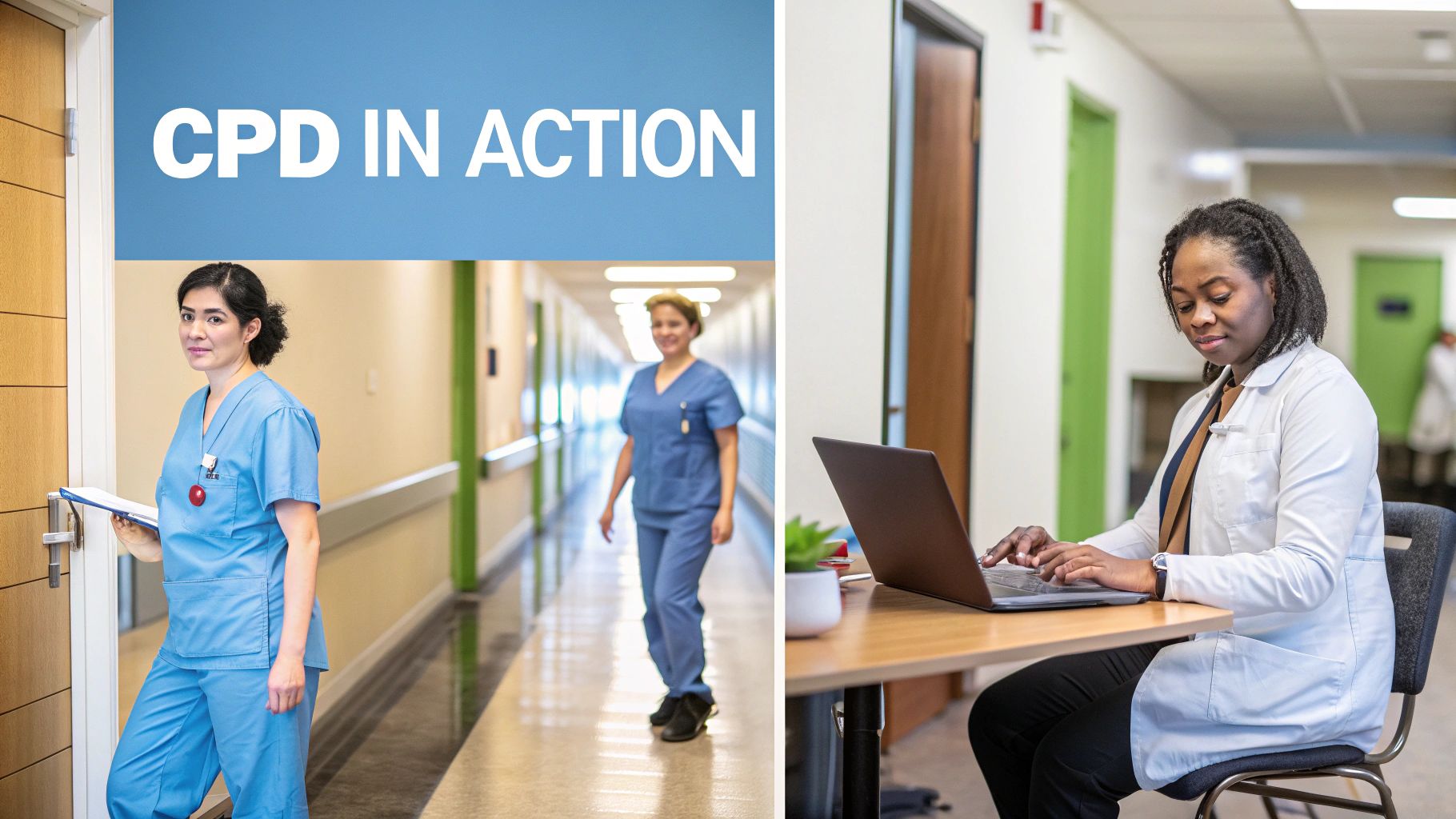
These kinds of activities give you invaluable experience and compelling stories to share in your university interviews. They prove that your interest in healthcare is more than just academic—it's a genuine commitment.
Examples for Different Career Paths
Every profession has its own landscape for CPD. The trick is to spot the opportunities that align with your goals. You just need to be a little creative and recognise that learning happens everywhere.
Here are a few concrete examples tailored to popular career routes:
- For Aspiring Social Workers: Reading a book on therapeutic communication or the impact of trauma is a powerful form of informal CPD. You could also follow leading social work academics or charities on social media to stay in the loop on policy changes and current debates.
- For Future Computer Scientists: The tech world moves at lightning speed, making informal CPD absolutely essential. Building a small personal project, like a simple website or a basic app, showcases practical skills. Getting involved in online coding challenges or contributing to an open-source project also proves you can problem-solve and work with others.
- For Aspiring Business Leaders: Listening to business-focused podcasts like "How I Built This" or "The Diary of a CEO" can offer incredible insights into strategy and entrepreneurship. Following major business news outlets and analysing a company’s annual report are other simple yet effective ways to build your commercial awareness.
For medical professionals, Continuous Medical Education (CME) is a vital form of CPD. The CME accreditation process is a fascinating area to explore, as it ensures high standards are maintained for ongoing training in such a demanding field.
Taking Ownership of Your Learning Journey
While many organisations provide CPD, its real power often comes down to personal ownership. When learning is just a top-down requirement, it can easily fail to make an impact. The teaching profession gives us a fascinating, and slightly cautionary, case study on this very point.
In England's schools, a staggering £1 billion is spent on teacher CPD each year. This covers everything from inset days to coaching and professional qualifications. But despite this huge investment, the return isn't always what you'd expect. A survey of over 1,000 teachers found that 1 in 4 had less than a single day of formal CPD in the last academic year. Even more concerning, a shocking 40% reported that their CPD didn't clearly help them do their job better.
This highlights a critical lesson for any professional: CPD is most powerful when you are in the driver's seat. Simply attending a mandated course is not enough. The real value comes from actively seeking out learning that addresses your specific needs and reflecting on how you will apply it.
This data shows that taking personal initiative is what transforms development from a box-ticking exercise into a genuine tool for growth. Whether you're aiming for a career in teaching, healthcare, or technology, the principle is the same. The most successful professionals are those who see their development as their own responsibility. By starting this habit now, you're building the foundation for a resilient and successful career long before you officially enter your chosen profession.
Your Top Questions About CPD Answered
Diving into the world of continuous professional development can feel a bit confusing, especially if you're planning a big career change or heading back into education. Let's clear up some of the most common questions so you can move forward with confidence.
Is CPD A Legal Requirement In The UK?
For a lot of regulated professions, the answer is a firm yes. While there’s no single UK law making CPD mandatory for every single worker, it’s an absolute must for keeping your licence to practise in critical fields like healthcare.
For instance, nurses and midwives have to follow the Nursing and Midwifery Council's (NMC) revalidation rules, which include a specific number of CPD hours. It's the same story for social workers and paramedics, who have similar duties under the Health and Care Professions Council (HCPC). Even in fields where it's not a strict requirement, employers see it as a mark of a true professional.
How Many CPD Hours Do I Need To Complete?
This really varies from one profession to another. Professional bodies set their own benchmarks—some government data analysts, for example, need to log 60-100 hours every year. Other sectors might ask for a certain number of hours spread over a two or three-year cycle.
The golden rule is to always check the specific guidelines for the career you're aiming for. If your profession doesn't have a formal target, aiming for around 30-35 hours of quality, relevant learning each year is a great way to stay sharp and competitive.
Does An Access to HE Diploma Count As CPD?
Absolutely! Completing an Access to Higher Education Diploma is a significant piece of formal CPD. It’s a huge statement about your commitment to your own growth and gives you the vital academic and subject-specific skills you'll need for university and your future career.
You should definitely log it in your CPD record. When you do, make sure to reflect on the skills you’ve developed—like critical analysis, research, and managing your time—and how they’ve set you up for success.
Can I Afford To Do CPD?
Yes, you can, because some of the most powerful CPD activities won't cost you a penny. While formal courses and qualifications can have a price tag, there's a huge amount of learning you can do for free. Think about it—all of these are effective and cost-free forms of CPD:
- Reading blogs or journals from leaders in your industry.
- Listening to expert podcasts on your commute.
- Watching documentaries relevant to your field.
- Shadowing a colleague or mentor for an afternoon.
- Joining a free professional webinar online.
What really matters is the learning outcome, not how much you spent. A good CPD plan should always have a healthy mix of low-cost and no-cost activities to make sure your development is something you can stick with.
At Access Courses Online, our accredited diplomas are designed to be a cornerstone of your CPD, giving you a direct and recognised route to university. Discover our range of courses today and take the first step towards your new career.