
Think of a top athlete watching game footage to see where they can improve. That's exactly what reflective practice in healthcare is all about. It’s a deliberate, structured way of looking back on your daily experiences to learn from them, sharpen your skills, and ultimately improve how you care for patients. It’s more than just a quick thought at the end of a shift; it’s a powerful tool for boosting safety, enhancing quality, and building your own resilience.
Understanding Reflective Practice in Healthcare

At its heart, reflective practice is about consciously hitting the pause button to really analyse an experience. Instead of just rushing from one task to the next, healthcare professionals use this method to break down what happened, figure out why it happened, and consider what could be done differently next time. This isn’t just having a chat about a difficult day; it’s a systematic and analytical process.
This approach turns every clinical encounter—good or bad—into a real learning opportunity. It pushes you to link the theory you’ve learned with what you’re actually doing on the ground, which sharpens your clinical judgement and leads to better patient outcomes. It’s so fundamental that it’s a mandatory part of professional standards for UK bodies like the Health and Care Professions Council (HCPC).
Moving Beyond Simple Thinking
It’s really important to get this clear: reflective practice isn't the same as just mulling over your day. We all do that. But while casual thinking is often unstructured and driven by emotion, structured reflection is purposeful, analytical, and designed to lead to real, actionable improvements.
The key difference is how intentional it is. Reflective practice empowers UK healthcare professionals to constantly evolve through learning—a core principle you'll see in many NHS resources. For the more than one million people working in the NHS, it’s a vital skill for thriving under constant pressure. If you’re studying on an Access to HE Diploma to get into nursing or another health profession, building this skill early gives you the confidence and competence that universities and future employers are desperate to see. You can find out more about how the NHS builds this into its culture on their official hub.
Reflective practice is about learning through experience to gain new insights for both self-awareness and professional practice. It prevents stagnation by turning retrospective analysis (reflection-on-action) into proactive strategies (reflection-for-action).
To make the difference crystal clear, let's put the two side-by-side.
Simple Reflection vs Structured Reflective Practice
This table breaks down the main differences between a casual think-through and a formal, structured approach to reflection. Getting your head around these distinctions is the first step to building a powerful habit for your healthcare career.
| Aspect | Simple Reflection | Structured Reflective Practice |
|---|---|---|
| Goal | Venting or casual thought about an event. | To learn, improve, and develop professional skills. |
| Process | Unstructured, often random and emotional. | Follows a specific model (e.g., Gibbs' Cycle) with clear steps. |
| Outcome | Temporary relief or unresolved thoughts. | A concrete action plan for future improvement. |
| Focus | Often centres on feelings and personal reactions. | Balances feelings with objective analysis and evidence. |
Seeing it laid out like this makes it obvious why one leads to real growth while the other often just goes around in circles. Structured reflection gives you a framework to turn experience into expertise.
Why Reflection Is a Cornerstone of Modern Healthcare
Knowing what reflective practice is one thing, but truly getting why it’s such an essential part of modern healthcare is another. This isn’t just an academic exercise or a box to tick for your portfolio. Its importance is deeply rooted in real-world events that have completely reshaped patient care standards here in the UK.
Think of reflection as your own personal quality control system. It gives you a structured, safe way to learn from everything that happens on a shift—the successes, the challenges, and even the near misses. In a high-stakes environment where every decision can impact a life, the ability to constantly learn and adapt isn't just a nice-to-have; it's absolutely critical.
From Landmark Report to Essential Practice
A pivotal moment that really cemented the role of reflective practice was the publication of the 2013 Francis Report. This exhaustive inquiry investigated the shocking failings in care at Stafford Hospital and sent tremors through the entire UK healthcare system. The report made it painfully clear how a culture that lacked openness, learning, and reflection had contributed to tragic outcomes for patients.
This wasn't about pointing fingers at individuals; it was about systemic failures. In response, the NHS and its regulatory bodies realised there was an urgent need to build a more conscious and self-aware culture across the entire workforce.
Reflective practice is now a non-negotiable part of professional development, mandated for health and care professionals by bodies like the Health and Care Professions Council (HCPC). Following the Francis Report, the NHS ramped up its efforts to embed these practices across its workforce of over 1.3 million staff. The report’s findings prompted the widespread adoption of structured reflection as a tool to deliver safer, higher-quality care.
Building Resilience and Enhancing Clinical Skills
Beyond improving patient safety, regular reflection is an incredibly powerful tool for your own professional growth and personal wellbeing. Let's be honest, healthcare is an emotionally and mentally demanding field. Being able to process difficult experiences, understand your own reactions, and develop coping strategies is vital for preventing burnout and building a long, sustainable career.
Reflection offers a confidential space to work through the pressures of the job. It helps you recognise what triggers your stress and gives you the tools to build the emotional resilience needed to thrive, not just survive.
Reflection is the bridge between experience and expertise. It transforms what you do into what you know, allowing you to turn challenging situations into opportunities for profound professional growth.
Developing strong clinical reasoning skills is also paramount, and reflective practice provides the perfect framework to sharpen this ability. When you systematically analyse your decisions after a complex case, you start connecting the dots between textbook theory and real-world application. This is how you sharpen your diagnostic and problem-solving skills.
This structured thinking leads to tangible benefits in your day-to-day work:
- Improved Patient Outcomes: By learning from every interaction, you continuously refine your approach, leading to better results for the people in your care.
- Stronger Team Communication: Reflecting on how you interact with colleagues helps you understand different perspectives and makes for much smoother collaboration.
- Increased Self-Awareness: Understanding your own strengths, weaknesses, and biases allows you to practise with greater confidence and integrity.
- Commitment to Lifelong Learning: Reflection is the engine of Continuous Professional Development (CPD). It turns your everyday work into a constant learning cycle. Check out our guide on understanding what continuous professional development is to learn more about this crucial career-long process.
Ultimately, reflection is what separates an experienced professional from an expert one. It’s the active ingredient that ensures your skills don’t just stagnate but grow sharper and more refined with every single year you spend in this rewarding field.
Key Reflective Practice Models You Will Use
Knowing you need to reflect is one thing, but how do you actually do it? The whole idea can feel a bit vague at first. That's where reflective models come in. Think of them less like rigid rules and more like helpful roadmaps for your thoughts. They give you a clear structure to follow, turning what can feel like a messy experience into a powerful learning opportunity.
These frameworks give you a series of prompts to guide you beyond simply describing what happened. They push you to dig deeper, explore your feelings and assumptions, and most importantly, come up with a solid plan for what you’ll do differently next time. Let’s walk through three of the most common models you’ll come across in your healthcare studies and career.
Gibbs' Reflective Cycle: The Detailed Debrief
One of the most popular frameworks in UK healthcare is Gibbs' Reflective Cycle (1988). Its six-stage circular design is brilliant because it really drives home the idea that learning is a continuous loop. Every experience, and the reflection that follows, feeds directly into how you’ll approach the next one.
It’s the perfect tool for doing a detailed breakdown of a specific, significant event – whether it was a positive one or a negative one.
Here are the six stages:
- Description: What happened? Just the objective facts here.
- Feelings: What were you thinking and feeling at the time? Don't be afraid to be honest with yourself.
- Evaluation: What was good and bad about the experience? What went well and what didn’t?
- Analysis: What sense can you make of it all? This is where you connect your experience back to theory or your professional knowledge.
- Conclusion: What else could you have done? Think about different options and how they might have changed the outcome.
- Action Plan: If this happened again, what would you do? This is the most important step, as it turns your insights into a concrete plan for the future.
Because it’s so thorough, Gibbs' Cycle is a fantastic choice for written university assignments or for unpacking complex clinical situations where lots of different factors were involved.
Kolb's Experiential Learning Cycle: The Learn-By-Doing Loop
Another cornerstone model you’ll see is Kolb's Experiential Learning Cycle (1984). While Gibbs helps you deconstruct a single event in detail, Kolb’s model is more about the big-picture process of how we learn from experience. It’s a four-stage loop that positions learning as an active, hands-on process.
You can think of it as the ultimate ‘learn-by-doing’ framework, which makes it ideal for reflecting on how you’re developing practical clinical skills.
The four stages are:
- Concrete Experience: You have an experience (you do something).
- Reflective Observation: You step back and reflect on that experience (you watch and review).
- Abstract Conceptualisation: You form new ideas or draw conclusions from your reflection (you think).
- Active Experimentation: You apply these new ideas to see what happens (you plan and try it out).
This cycle is perfect for situations like learning a new procedure on placement. You have a go, think about how it went, link it back to what you’ve been taught, and then plan how to improve your technique for the next time.
Driscoll's Model: The On-The-Go Checklist
For those moments when you need a quicker, more direct way to reflect, Driscoll's Model (2007) is incredibly handy. It’s built around three simple but powerful questions that cut right to the chase. It's the perfect tool for busy healthcare settings where you might only have a few minutes to gather your thoughts.
Its simplicity makes it really easy to remember and use on the spot.
The three core questions are:
What? (Describe the event) So What? (Analyse the event and why it matters) Now What? (Decide on actions for the future)
This model is excellent for daily ‘micro-reflections’ at the end of a shift or for quickly debriefing an incident with a mentor. It helps you build the habit of regular reflection without it feeling like a massive, time-consuming task.
Choosing the Right Reflective Model for Your Situation
So, which model should you pick? Honestly, the 'best' one is simply the one that fits your situation and what you need to get out of the reflection. There’s no single right answer, and you'll find that experienced practitioners often mix and match elements from different frameworks to suit their needs.
To help you get started, here’s a simple guide to choosing the most appropriate model for different scenarios you'll face during your training and beyond.
| Model | Best For | Key Feature |
|---|---|---|
| Gibbs' Reflective Cycle | A detailed, in-depth analysis of a complex or emotionally charged event. Ideal for university essays. | Its structured, six-stage process ensures a thorough and balanced reflection. |
| Kolb's Experiential Learning Cycle | Reflecting on the process of learning a new practical skill or procedure over time. | Focuses on the continuous loop of doing, observing, thinking, and planning. |
| Driscoll's 'What?' Model | Quick, immediate reflections in a busy clinical environment. Perfect for daily journaling or a quick debrief. | Its three simple questions make it easy to remember and apply on the go. |
Ultimately, the best way to get comfortable is to experiment with these different models to see what works for you. The goal is to make what is reflective practice in healthcare a natural, integrated part of your professional toolkit, turning every single experience into a valuable lesson learned.
A Step-by-Step Guide to Your First Reflective Essay
Moving from understanding reflective models to actually sitting down and writing your first reflective essay can feel like a big leap. This is where the theory hits the road, and it’s a core skill you’ll lean on throughout your healthcare education and your entire career. This guide will walk you through the process step-by-step, turning what might seem like a scary task into a manageable and incredibly powerful learning exercise.
To make this as practical as possible, we'll use a common clinical scenario. Imagine you're a student on placement and you've just had a difficult conversation with a patient’s anxious relative who felt they weren't getting enough information. We'll use Gibbs' Reflective Cycle as our framework, as its detailed, six-stage structure is perfect for university assignments.
This diagram gives you a quick visual of how different reflective models flow, showing the process for Gibbs', Kolb's, and Driscoll's frameworks.
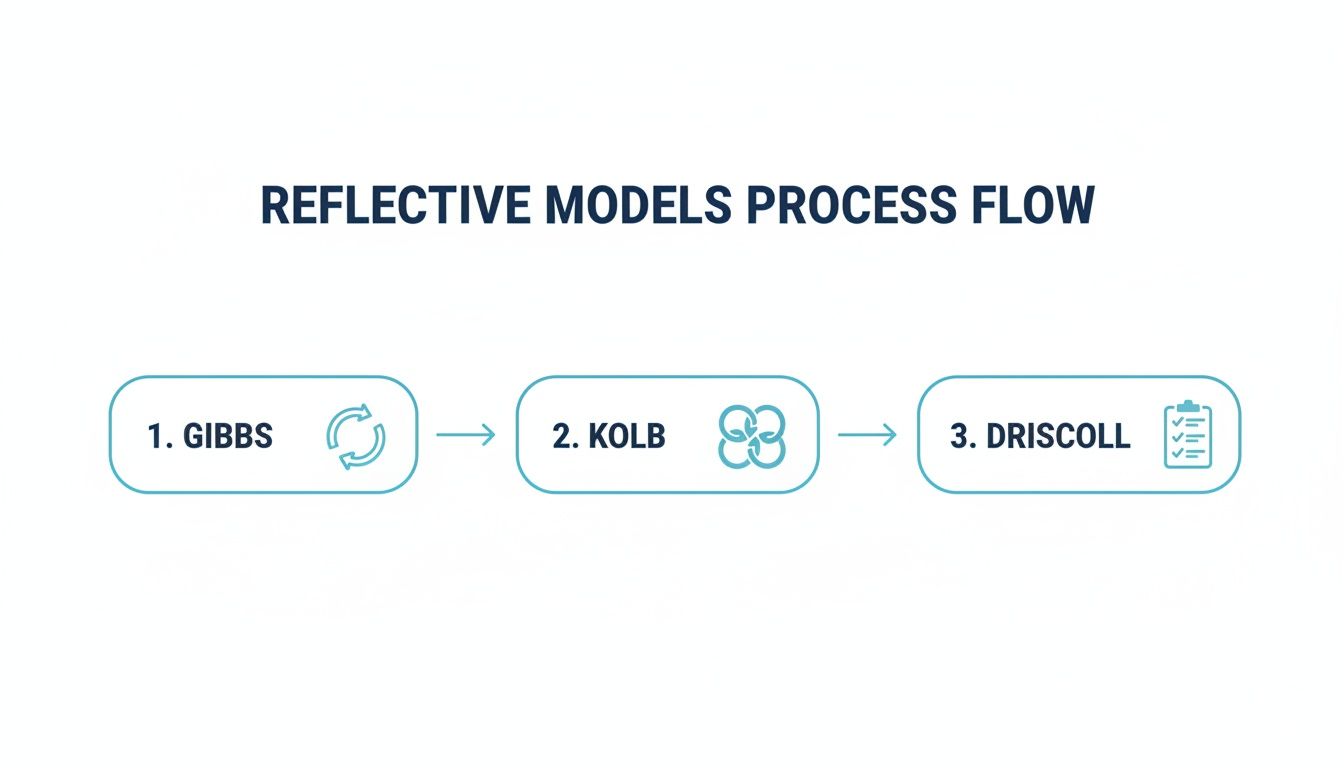
As you can see, each model offers a different path for reflection. Gibbs gives you a detailed cycle, while Driscoll provides a quick checklist, allowing you to pick the right tool for any situation you find yourself in.
Stage 1: Description – What Happened?
The first step is all about setting the scene with just the facts. Your goal here is to paint a clear, objective picture of the event without any judgement or analysis. Think of yourself as a reporter simply stating what occurred.
- Prompt: Describe the event in detail. Who was there? What did you do? What did others do?
- Sentence Starter: “During my afternoon shift on the ward, I was approached by the relative of a patient in bed 12. They expressed frustration about not knowing the plan for their family member’s care…”
Stage 2: Feelings – What Were You Thinking and Feeling?
Now it’s time to explore your own reactions, both emotional and cognitive. This stage is all about being honest with yourself. Acknowledging your feelings is crucial because they often drive your actions, and understanding this link is a huge part of developing self-awareness.
- Prompt: What were your feelings before, during, and after the incident? What thoughts were running through your head?
- Sentence Starter: “Initially, I felt defensive and a little overwhelmed, as the relative was visibly upset. I was worried about saying the wrong thing and making the situation worse…”
Stage 3: Evaluation – What Was Good and Bad?
Time to step back and assess the experience from a more neutral viewpoint. What parts of the interaction went well, and what parts were challenging or didn’t go as planned? This balanced evaluation is vital for a fair analysis.
- Prompt: What was positive about the experience? What was negative?
- Sentence Starter: “On the positive side, I remained calm and listened to their concerns without interrupting. However, a negative aspect was that I wasn’t immediately able to provide the clear information they needed, which increased their anxiety.”
Stage 4: Analysis – Making Sense of the Situation
This is the most critical stage of the whole cycle. Here, you connect your personal experience to your existing knowledge, theory, and professional standards. Why did things happen the way they did? What wider factors were at play?
You might bring in communication theories you've studied or the importance of patient-centred care. Perhaps you'll link the relative's anxiety to the immense stress of having a loved one in hospital. This is your chance to show deep, critical thinking.
- Prompt: What sense can you make of the situation now? What knowledge from your course helps you understand it?
- Sentence Starter: “Analysing the situation, it’s clear that the relative's frustration stemmed from a lack of communication. This aligns with the principles of person-centred care, which emphasise the need for clear and timely information for both patients and their families…”
A crucial element of reflective writing is maintaining professionalism and confidentiality. Always anonymise details—never use real names of patients, relatives, or colleagues. Refer to them by titles like "the patient," "my mentor," or "a doctor on the ward."
Stage 5: Conclusion – What Else Could You Have Done?
Based on your analysis, what could you have done differently? This isn't about blaming yourself. It’s about exploring alternative actions that might have led to a better outcome for everyone involved.
- Prompt: What did you learn from this? What skills do you need to develop?
- Sentence Starter: “In hindsight, I could have acknowledged their feelings more explicitly at the start by saying something like, ‘I can see this is very stressful for you.’ I also could have immediately sought out the registered nurse to help facilitate the conversation.”
Stage 6: Action Plan – What Will You Do Next Time?
Finally, you create a concrete plan for the future. This is the all-important step that turns your reflection into tangible professional development. Your action plan should be specific, realistic, and achievable.
- Prompt: If a similar situation arose again, what would you do? How will you prepare for it?
- Sentence Starter: “My action plan has three key points. First, I will review the trust’s policy on communicating with relatives. Second, I will ask my mentor to role-play difficult conversations with me. Third, in a similar future situation, I will immediately escalate the query to the nurse in charge to ensure accurate information is provided promptly.”
By following these structured steps, you can transform a challenging experience into a powerful learning opportunity. And that, right there, is the very essence of what is reflective practice in healthcare. For more detailed guidance and examples, check out our comprehensive guide on how to write a reflective essay for your healthcare course.
How Reflective Skills Strengthen Your University Application
Getting your head around the theory of reflective practice is one thing. But seeing how it can help you land a spot on a competitive healthcare degree course? That’s where it gets really interesting. Admissions tutors aren’t just scanning for good grades; they’re hunting for candidates who already have the core qualities of a great healthcare professional. Your ability to reflect is your secret weapon.
Showing this skill in your application, especially in your personal statement, sends a clear signal: you’re not just an aspiring student. You’re already thinking like a practitioner.
Proving You Have What It Takes
Admissions tutors for courses like Nursing, Midwifery, and Paramedic Science sift through thousands of applications. They have a sharp eye for spotting the people who have the essential non-academic traits needed to thrive in a demanding clinical setting.
Reflective practice is the perfect way to show them you’ve got those traits. By taking an experience from your life—whether from a job, volunteering, or even a personal challenge—and reflecting on it properly, you give them solid proof of your:
- Critical Thinking: You can show you don't just describe a situation, you can actually analyse it. You can pick apart what went well, what was tough, and most importantly, why.
- Self-Awareness: This demonstrates you can understand your own actions, feelings, and biases, and see how they affected what happened. It’s a huge sign of maturity.
- A Commitment to Lifelong Learning: Reflection is what drives professional development. By showing you can learn from your experiences, you’re proving you’re ready for a career that demands constant growth.
These three qualities are exactly what universities are looking for. They are the hallmarks of a resilient, adaptable, and effective healthcare professional in the making.
Showing you understand reflective practice tells an admissions tutor that you are ready for the academic and emotional demands of a healthcare degree. It proves you can turn experience into learning, a skill that will be vital from your first placement to your final day of practice.
The Access to HE Advantage
This is exactly why Access to HE Diplomas are designed the way they are. These courses are a bridge, built to help you turn your life and work experience into something universities value. The curriculum deliberately builds your reflective skills, teaching you how to analyse situations using frameworks like Gibbs' Cycle long before you ever set foot on a university campus.
By the time you sit down to write your application, you won't just be talking about reflection as a vague idea; you'll have actually done it, over and over again. This gives you a massive advantage, allowing you to explain why you’re right for the course with real depth and authenticity. To see how to bring these insights to life in your application, check out our guide on how to write a personal statement for practical tips.
Ultimately, showcasing your reflective skills is what moves your application from the "maybe" pile to the "must-interview" pile. It tells a powerful story about your potential—not just to pass the course, but to flourish as a compassionate and competent healthcare professional for years to come.
Making Reflection a Daily Habit for Success

To really get the most out of what is reflective practice in healthcare, it has to become more than just another box to tick for an essay. The real aim is to weave it into the fabric of your daily professional life, turning it into a powerful and sustainable habit. This isn't about adding another hour to an already packed day; it’s about finding small, consistent moments to pause, think, and learn.
Building this habit all starts with making it feel easy. Forget the pressure of a long, formal session every day. Instead, think in terms of “micro-reflections”—short, structured moments of thought that slot neatly into your routine. This way, the process feels manageable and becomes a go-to tool for managing stress and preventing burnout.
Overcoming the Time Barrier
The most common hurdle anyone faces is feeling like there simply isn't enough time. With staff shortages and immense pressure on the front line—a recent survey found that 35.3% of medical staff report feeling burnt out—adding another task can seem impossible. The secret is to reframe reflection not as an addition to your workflow, but as a part of it.
Here are a few practical, low-effort ways to get started:
- The Five-Minute Journal: Right at the end of your shift, take just five minutes to jot down your thoughts on three simple prompts based on Driscoll's model: What happened today? So what does this mean for me and my practice? Now what will I do differently?
- The Commute Debrief: Use your journey home to talk through a key event from the day. Just speaking your thoughts out loud can bring incredible clarity, no writing required.
- Peer Reflection: Grab a trusted colleague and schedule a quick ten-minute chat once a week to unpack a challenging situation. Sharing your experiences not only gives you a fresh perspective but also strengthens team bonds.
When building a reflective habit, it's not about how long you spend, but how consistent you are. A few focused minutes each day is far more powerful than a single hour-long session once a month.
Integrating Reflection into Your Routine
To make these actions stick, try anchoring them to habits you already have. For example, you could decide to do your five-minute journal entry as soon as you’ve finished your clinical notes, or make that peer reflection chat a regular part of your pre-shift coffee break.
Mindfulness is another brilliant technique. Simply taking 60 seconds to focus on your breathing before you walk into a patient's room can boost your awareness in the moment. This helps you notice more and react with greater intention—a perfect example of "reflection-in-action," or thinking on your feet.
By embedding these small, doable steps into your day, you build a reflective practice that isn't a burden but a vital support system. This proactive approach to learning and self-care is absolutely essential for building the resilience you'll need for a long and successful career in the demanding world of healthcare.
Common Questions About Reflective Practice
As you start getting to grips with what reflective practice looks like in healthcare, it's totally normal for questions to pop up. This isn't just about thinking back on your day; it’s a much deeper process, so it makes sense to wonder about the specifics. Let’s tackle some of the most common questions to clear things up and help you put these ideas into action with confidence.
Is Reflective Practice Just for Mistakes?
Not at all. While looking at what went wrong is a huge part of learning and keeping patients safe, it’s just as important to reflect on your wins.
When something goes well, taking the time to unpack why it was a success helps you recognise your strengths and figure out what you can do again. This builds up positive habits and boosts your confidence – two things that are absolutely essential for your growth in any healthcare role.
How Is Reflective Writing Different from a Diary?
This is a really important distinction. A personal diary is usually a place to record events and pour out your feelings, which is great for processing things on a personal level. Reflective writing, on the other hand, is a structured, analytical task with a clear professional goal.
Reflective writing uses a formal model (like Gibbs' or Driscoll's) to systematically break down an experience, link it back to professional theory or best practices, and create a solid action plan for next time. It’s about deep, critical learning, not just making a note of what happened.
The aim isn’t just to document your shift, but to pull out real, tangible lessons that will directly shape and improve how you care for patients in the future.
Do I Have to Share My Reflections with Others?
That really depends on the situation. If you’re at university or completing formal Continuous Professional Development (CPD), your written reflections will often be a required part of your assessment. In a clinical setting, group reflections are also common and incredibly valuable for team learning and making collaborative care even better.
However, a personal reflective journal is just for you. It’s your own safe space to be completely honest with yourself without any judgement. The real purpose of reflection is to learn from what you do; sharing it is just one of the ways to help that process along, always with the goal of improving, never of placing blame.
Ready to build the skills that universities and healthcare employers are looking for? Access Courses Online provides accredited Access to HE Diplomas that prepare you for success in Nursing, Midwifery, and other health professions. Start your journey today at https://accesscoursesonline.com.