

AccessCoursesOnline
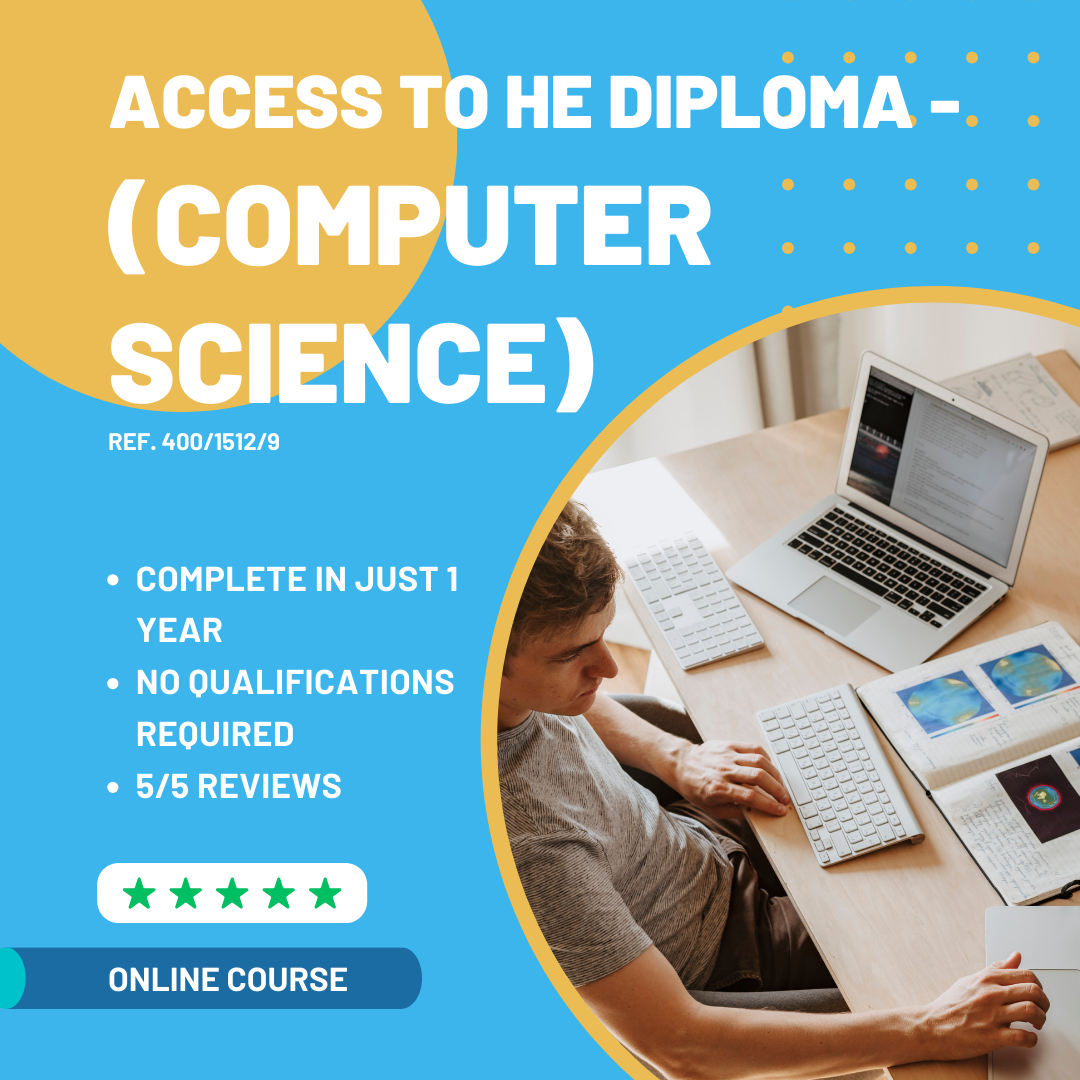
Access to Higher Education Diploma (Computer Science)
Access to Higher Education Diploma (Computer Science)
Couldn't load pickup availability
- Description
If you have a passion for technology, problem-solving, and innovation but lack the traditional qualifications to enter university, our Access to Higher Education Diploma (Computer Science) is the perfect route for you. This nationally recognised Level 3 qualification is designed to equip you with the technical knowledge, practical skills, and confidence required to take the next step in your computing career.
Why Choose This Course?
Our 100% online course is flexible and designed for adults balancing study with work and family commitments. Whether you’re interested in cybersecurity, data science, software development, or networking, this diploma will help you build foundational expertise and prepare you for higher education or employment in the tech industry.
-
Get on the fast track to university – Equivalent to A Levels, this course is accepted by many universities.
-
Develop essential computing skills – Covering programming, cybersecurity, data analysis, and web development.
-
Flexible learning at your own pace – Complete in as little as 9 months
-
No exams – assessment through coursework – Achieve your diploma through end-of-unit assignments.
Expert one-to-one tutor support – Get personalised guidance from experienced IT professionals.
Study Now, Pay Later
We offer Buy Now, Pay Later (12 months interest-free) payment plans, making high-quality education more accessible than ever. Plus, enrolling in an Access to HE course may help you reduce council tax payments (T&Cs apply).
Start Your Creative Journey Today
With Cambridge Online Education – established in 2002 – you’ll receive top-tier online education that prepares you for university and beyond. The diploma is accredited by AIM Qualifications and Assessment Group and regulated by the Quality Assurance Agency for Higher Education (QAA).
Course Outline
Course Outline
We don’t just teach you theory, we equip you with the practical skills, advanced mathematics, and academic readiness that university admissions teams and top tech employers actively look for.
Dive straight into the subjects driving today’s digital world. You will master the fundamentals of Programming and Relational Databases (SQL), while exploring cutting-edge specialisms like Cyber Security, Mobile Computing, and the Internet of Things (IoT). Get under the hood with Computer Architecture and learn how the industry works with Service Design and Operation.
A strong mathematics foundation is the secret weapon of every great computer scientist. We take the intimidation out of advanced mathematics, guiding you step-by-step through Algebraic Methods, Statistical Techniques, Trigonometry, and Calculus. You will arrive at university fully prepared for the quantitative rigor of a BSc program.
Going back to school is a big step, and we are here to support you. Alongside your tech subjects, you will build essential Academic Study Techniques and master professional Email communication. Because your success is about more than just grades, we also include dedicated modules on Mental Health & Wellbeing and Progressing to Higher Education to ensure you stay resilient, focused, and ready for your university application.
Do not let a lack of traditional qualifications hold you back. Turn your passion for problem-solving into a rewarding profession.
Modules
Modules
Skills for Learning & Core Units
- Academic Study Techniques (Ungraded) - Develop essential study skills to prepare for university.
- Progressing to Higher Education (Ungraded) - Guidance on taking the next step in your computing career.
- Email (Ungraded) - Master professional communication in a digital environment.
- Mental Health & Wellbeing (Ungraded) - Learn valuable strategies for maintaining positive mental health and resilience throughout your studies.
Mathematics for Computing
- Algebraic Methods - Strengthen mathematical skills for problem-solving in computing.
- Statistical Techniques - Learn essential data analysis and probability methods required for computer science applications.
- Trigonometry – Develop an understanding of geometric principles that are crucial for computer graphics and programming.
- Calculus – Master advanced mathematical concepts necessary for complex algorithm development and data science.
Computer Science Specialisms
- Cyber Security - Understand threats, vulnerabilities, and protection strategies.
- Cyber Security Business Compliance - Explore legal and ethical responsibilities in cyber security and how businesses can stay compliant with industry regulations.
- Relational Databases – Learn database design and management.
- Fundamentals of SQL– Develop essential SQL skills for managing and manipulating databases efficiently.
- Programming Principles – Gain an understanding of coding fundamentals and best practices in software development.
- Introduction to Computer Architecture – Learn about the inner workings of computers, including hardware components and data processing.
- Service Design and Operation – Learn the fundamentals of IT service management.
- Mobile Computing – Explore the architecture, design, and development of applications for mobile devices.
- The Internet of Things – Understand the expanding network of connected physical devices and how to capture, manage, and process data from them.
Enrolment Requirements
Enrolment Requirements
There are no formal entry requirements for students applying for the Cambridge Online Education Access to H.E. Diplomas. Tutors are nevertheless, required to ensure that learners admitted onto the Diploma possess the necessary skills and personal qualities to cope with the demands of the course.
Assessments
Assessments
All Access to HE Diplomas require the achievement of 60 credits. 45 of the 60 credits must be graded at Level 3 (pass, merit or distinction). Such credits will arise from the Academic Subject Content Modules. The remaining 15 credits are ungraded and can be achieved at either Level 2 or Level 3. Students may only be registered against units with a maximum combined total credit value of 60. In terms of the length of time required for a learner to complete their diploma, for all Access to HE Diplomas the notional learning hours are 600. Notional learning hours comprise all learning that may be relevant to the achievement of the learning outcomes including directed and private study, practical and project work, assignments and assessment time. The assessment methods used for each unit of your course will be detailed in the Programme Handbook. Your tutor will provide you with formative feedback and provisional grades. Your grades will be then evaluated by the Examination Board. Final grades will be released to students after the External Moderation Visit.
Qualification
Qualification
On successful completion of the course, you will receive a QAA recognised Access to Higher Education Diploma (Computer Science) at level 3 awarded by the Aim Qualifications and Assessment Group.
Aim Qualifications and Assessment Group are a national Awarding Organisation, regulated by the Quality Assurance Agency for Higher Education (QAA) and Qualifications Wales, to develop and award nationally recognised qualifications. Cambridge Online Education is a fully accredited education provider for this qualification
Careers
Careers
- Software Engineer / Developer
- Cyber Security Analyst / Engineer
- Data Scientist
- Data Analyst
- AI / Machine Learning Engineer
- Web Developer
- Mobile Application Developer
- DevOps Engineer
- Systems / Business Analyst
- IT Consultant
As different universities have different entry requirements, you are strongly advised to check these requirements with your chosen tertiary education provider. You can contact our career advisers for further guidance and support in that matter.
NB: Our flexible unit structure means your course can be tailored to meet specific university entry requirements - even if they differ between degrees. We’ll work with you to ensure you gain the right units to progress confidently onto your chosen university course. Speak to admissions today
Our Guarantees
-

Affordable Learning
We offer flexible payment plans to make learning more accessible and affordable. Spread the cost of your course over manageable monthly payments, so you can focus on achieving your goals without financial stress.
-
Application Support
We provide UCAS application support to help you navigate the university admissions process with confidence. From personal statement guidance to application tips, we’re here to support your journey to higher education.
-

Exam Free Learning
Our courses are completely exam free. Instead of exams, you'll complete assignments and coursework designed to develop your knowledge and skills in a supportive and flexible learning environment.
FAQ Computer Science
What HE progression routes are there with this course?
Given the broad-based nature of the course the HE progression route is varied including IT, Computer Science, Software Engineering, Games Development, Cyber Security etc.
What qualifications do you need to start this course?
None. Universities, however, will have their own entry requirements. Typically, GCSE (grade C and above) in English and Mathematics in addition to an AHE qualification.
What prior experience is needed?
No formal experience is needed. You should, however, have a keen interest in technology and a thirst to learn more. Furthermore, you should be thoroughly proficient with your chosen platform (Mac, Windows, Linux) – installing applications, managing files and folder, users and permissions etc. You should also be proficient with Office 365 including Word, One Drive and Teams.
Free Lesson - Coding Demo with Jon Evans

Meet your expert friendly tutor
