
Dreaming of a career in nursing but worried you don't have the usual qualifications? You're not alone. The great news is there's a path designed specifically for people just like you. The Access to Higher Education (HE) Diploma in Nursing is a one-year course that acts as a direct alternative to A-levels, paving the way for you to get into university.
Think of it as a purpose-built bridge, connecting your ambition directly to a nursing degree.
Your Direct Pathway Into a Nursing Career

It's a common myth that without A-levels, the door to a career in healthcare is firmly shut. The reality couldn't be more different. The Access to HE Diploma was created to swing that door wide open, offering a focused and fast-tracked route for motivated adults ready for a meaningful change.
This isn't just about ticking a box to get into uni. It’s a foundational programme that gets you ready—both academically and mentally—for the challenges and rewards of a nursing degree. It recognises that life experience brings invaluable qualities like maturity, empathy, and resilience, all of which are absolutely essential for a brilliant nurse.
A Qualification Built for Career Changers
The Access to HE Diploma is recognised and highly respected by universities all over the UK. It’s become a crucial pathway into the profession, especially with the ever-growing demand for qualified nurses.
As of March 2025, there were 853,707 registered nursing professionals in the UK, a figure that shows just how vital this workforce is. The Access to HE Diploma is key to meeting this need, providing a structured, one-year qualification that’s equivalent to three A-levels. It's how people with real-world experience can step up and join the front line of care.
More Than Just Nursing
Making a career change is a huge decision. While nursing is incredibly rewarding, it's wise to be certain it's the right move for you.
If you're still weighing things up, it can be helpful to explore other fulfilling career change opportunities. This will either confirm that nursing is your true calling or perhaps open your eyes to other possibilities you hadn't even considered.
This guide is here to walk you through every part of your journey to becoming a nurse. We'll cover everything you need to know, including:
- What the course covers and exactly how it prepares you for university-level study.
- The specific entry requirements and what you can do if you don't quite meet them.
- How to handle the UCAS application process with confidence.
- The different funding options available to make your studies affordable.
What the Access to Nursing Diploma Actually Involves
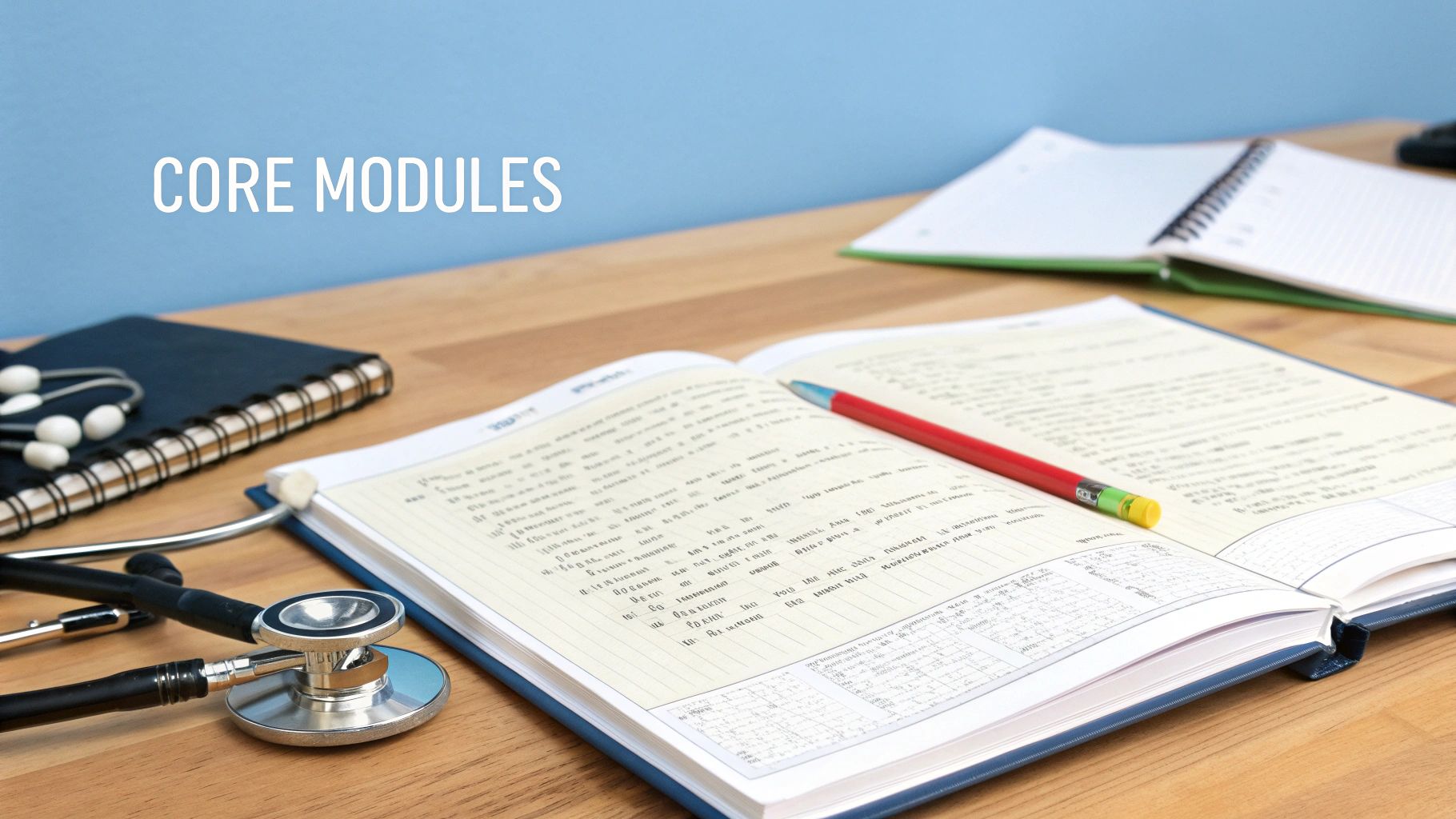
Stepping into an Access to Nursing course can feel like a big unknown, but it helps to think of it as a specialised training ground. The curriculum isn't just a random collection of subjects; it’s a carefully constructed programme designed to give you the exact knowledge and skills universities look for in their nursing applicants.
This diploma is your bridge to higher education. It’s been meticulously planned to ensure you arrive at your degree course not just qualified, but genuinely ready for the academic challenges ahead. You’ll be studying for a Level 3 qualification, which is equivalent to three A-levels, but every single module is directly relevant to your future in healthcare.
The Core Subjects You Will Study
While the exact curriculum can vary a little between providers, most Access to Nursing diplomas are built around a core of essential subjects. These form the scientific and social foundation that all your future nursing knowledge will be built on.
You can typically expect to cover a blend of the following:
- Human Biology: This is often the cornerstone of the course. You'll explore everything from cellular biology to the major organ systems like the cardiovascular, respiratory, and nervous systems. This isn’t about just memorising facts; it's about understanding how the human body works when it’s healthy and what goes wrong when disease strikes.
- Health Studies: This module zooms out from the individual to the wider community. You’ll investigate public health issues, the structure of the NHS, and the social factors that influence wellbeing. It helps you understand the world your future patients live in.
- Psychology & Sociology: Nursing is as much about people as it is about science. These subjects introduce you to human behaviour, mental health, and how society impacts individuals. You'll gain crucial insights that build empathy and massively improve your communication skills.
These subjects have been specifically chosen to prepare you for the diverse challenges of modern nursing. With adult nursing being the largest field at 632,082 professionals, followed by mental health and children's nursing, this broad foundation ensures you're ready for any specialisation you choose.
Here’s a quick breakdown of how these subjects directly prepare you for your degree:
Typical Core Modules in an Access to Nursing Diploma
| Module | What You Will Learn | Relevance to Nursing Degree |
|---|---|---|
| Human Biology/Anatomy | The structure and function of the human body, from cells to systems. | Essential for understanding patient health, disease processes, and treatments. |
| Health Studies | The NHS, public health policies, and social determinants of health. | Provides context for patient care and the healthcare system you'll work in. |
| Psychology | Theories of human behaviour, mental health, and cognitive processes. | Crucial for patient communication, empathy, and understanding mental health conditions. |
| Sociology | The impact of society, culture, and inequality on health. | Helps you provide culturally sensitive care and understand social barriers to health. |
| Academic Skills | Essay writing, research methods, and critical thinking. | The toolkit you'll need to succeed with university-level assignments and research. |
These modules work together to give you a complete picture, blending hard science with the human side of care.
Building Essential University-Level Skills
An access course to nursing does more than just teach you subject knowledge; it teaches you how to be a successful university student. This is a critical part of the course that sets you up for long-term success.
Many adult learners haven't been in a formal classroom for years, and this side of the course is designed to build academic confidence. It's all about sharpening the tools you'll need to thrive in your degree.
The goal is to transition you from whatever your previous experience has been—be it in an office, retail, or at home—into a capable and independent academic learner. You're not just learning facts; you're learning how to learn at a higher level.
Key skills development often includes:
- Academic Writing: Learning how to structure essays, write reports, and reference your sources correctly using systems like Harvard referencing.
- Research Skills: Developing the ability to find, evaluate, and synthesise information from academic journals and other credible sources.
- Critical Thinking: Moving beyond accepting information at face value to analysing evidence, forming arguments, and evaluating different perspectives.
- Time Management: Juggling multiple assignments and deadlines – a skill that is absolutely vital for surviving a demanding nursing degree.
As you dive into the curriculum, you'll find that mastering medical terminology is essential. It’s a practical skill that connects your biology modules with real-world clinical application. Your assessments will reflect this blend of knowledge and skill, typically involving coursework, essays, presentations, and practical reports rather than one big final exam. This continuous assessment model helps build your confidence and knowledge steadily throughout the year, preparing you perfectly for the demands of your future nursing degree.
Checking Your Eligibility and Entry Requirements
Let's tackle the first big question that pops into most people's heads: 'Can I actually get on an Access to Nursing course?' It's a perfectly normal thing to wonder, especially if you've been away from the classroom for a while.
The great news is that these courses are built from the ground up for people just like you. The entry requirements aren't there to trip you up; they're designed to make sure you have the right foundation to succeed, both on the Access course and when you get to university.
The Standard Entry Requirements
While you might find small differences between course providers, the core requirements are pretty consistent across the UK. Essentially, they want to see that you're ready for Level 3 study, which is the same level as A-Levels.
Here’s what you’ll almost certainly need:
- Age: You'll generally need to be 19 or older when you start the course. This is because the diploma is specifically designed as a pathway for adult learners returning to education.
- Previous Qualifications: This is the big one. Providers will almost always ask for GCSEs in English and Maths at a grade C/4 or above. A GCSE in Science (often Biology) is also a very common requirement, mainly because most universities ask for it for their nursing degrees.
Think of these GCSEs as the essential building blocks. They show you have the literacy, numeracy, and basic science knowledge needed to handle the workload of the Access course and, ultimately, the demands of being a nurse.
What If I Don’t Have the Right GCSEs?
Don't panic if you look at that list and realise you're missing a grade or two. This is not a roadblock; it's just a detour. Course providers are experts at helping adults who have all sorts of educational backgrounds.
If you don't have the required grades, you've got some brilliant options:
- GCSE Equivalency Courses: Many providers offer fast-track GCSE or IGCSE courses you can take before, or sometimes alongside, your Access diploma. They're designed to get you qualified quickly and efficiently.
- Functional Skills Level 2: Lots of universities accept Functional Skills Level 2 in Maths and English as a solid alternative to GCSEs. They’re often seen as more practical and can be a quicker route to meeting the entry criteria.
The most important thing to remember is that not having your GCSEs right now doesn’t rule you out. It just means there's an extra step in your plan. Good course providers will guide you through this, helping you get exactly what you need to move forward.
Before you commit, it's always a smart move to check the specific nursing degree entry requirements for the universities you're interested in. Doing this little bit of homework now ensures that the qualifications you're working towards will be accepted when it's time to apply through UCAS. It can save you a world of stress later on, and your course provider can usually give you great advice on this too.
Finding a Study Option That Fits Your Life
Deciding to chase your dream of becoming a nurse is a huge step, but it shouldn't mean pressing pause on the rest of your life. Thankfully, one of the biggest wins for adult learners is the sheer variety of study formats on offer. These courses are built specifically to work around real-world responsibilities like jobs, kids, and everything else life throws at you.
The path you take will come down to your personal circumstances and how you learn best. Can you clear your schedule and go all-in for a year, or do you need something that lets you chip away at your own pace? Figuring this out is the first step to creating a plan that you can actually stick with.
Full-Time vs Part-Time Study
The first big decision is usually about pace. There’s no right or wrong answer here, just what’s right for you.
- Full-Time (One Year): This is the fast track. It's an intense option, perfect if you want to get to university as quickly as possible and can commit a serious chunk of time each week. Think of it as a sprint – you'll cover all the material in about nine to twelve months, but it demands real focus and brilliant time management.
- Part-Time (Two Years): For anyone juggling a job or looking after a family, a part-time course is often a lifesaver. The workload is spread comfortably over two years, making the weekly commitment far more manageable. This is more of a marathon, giving you space to properly absorb the material without the constant pressure of tight deadlines.
Honestly, the key is to be realistic about the time you can give. Choosing the right pace is crucial for keeping your motivation high and avoiding burnout.
Online Learning vs In-Person College
Next up: where will you actually do your learning? The boom in online education has been a game-changer, offering a level of flexibility we could only have dreamed of a decade ago. That said, the traditional college campus still has a massive appeal for many people.
The most important thing is to find an environment where you feel supported enough to do your best work. Whether that’s in a lively classroom or the quiet of your own kitchen table, the right setting makes all the difference.
To help you decide, let's look at how the two formats stack up.
Comparing Study Formats: Online vs In-Person Learning
This table breaks down the key differences to help you figure out which learning style is the best match for your life.
| Feature | Online / Distance Learning | In-Person College |
|---|---|---|
| Flexibility | Study anytime, anywhere. You build learning around your schedule. | Fixed timetable with scheduled classes you have to attend on campus. |
| Pacing | Self-paced. You can speed up or slow down through topics as needed. | The pace is structured and set by the college and your tutor. |
| Support | One-to-one tutor support via email, phone calls, and video chats. | Face-to-face interaction with tutors and your fellow classmates. |
| Interaction | Connect with peers through online forums and dedicated student groups. | Spontaneous chats and group projects happen naturally in the classroom. |
| Discipline | Requires a high level of self-motivation and personal organisation. | The external structure and deadlines help keep you on track. |
There's no doubt that online learning gives you incredible freedom, which is a massive plus for parents or anyone working full-time. You can get a real feel for what it's like to study an access course online from home to see if that self-directed style clicks with you.
On the other hand, in-person learning provides a ready-made community and a solid routine, which is perfect for students who thrive on that kind of structure and social energy.
Ultimately, this choice is a personal one. By weighing up the pros and cons of full-time, part-time, online, and in-person options, you can pick a path that doesn't just get you to a nursing degree, but also respects the life you're living right now.
From Access Course to University Application
Finishing your Access course is a huge achievement and a real testament to your hard work. But it’s also the launchpad for the next exciting stage: applying to university. This step is handled through a UK-wide system called UCAS (the Universities and Colleges Admissions Service), and your Access to HE Diploma is your golden ticket.
Think of UCAS as the central hub for every university application. It’s where you’ll find nursing degree courses, fill out your details, and, fingers crossed, receive your offers. The whole thing can seem a bit daunting at first, but it’s a well-trodden path, and your course provider will be there to help you navigate it.
Cracking the UCAS Application
Your application is your moment to shine. It’s a chance to show off not just your new academic skills but also the brilliant life experience you bring to the table. The application is a mix of your personal details, your qualifications (including your predicted Access course grades), and the all-important personal statement.
A massive part of the process is choosing up to five university courses. This is where all that earlier research into different nursing specialisms—like adult, child, or mental health—really pays off. It's smart to be strategic here; choose a mix of universities with slightly different entry requirements to give yourself the best possible chance of getting offers.
Translating Your Grades into UCAS Points
One of the first questions Access students ask is, "How do my course grades actually get me into uni?" The answer is the UCAS Tariff point system. Universities use these points to set their entry requirements, and your Access course grades translate directly into them.
Your Access to HE Diploma is made up of 60 credits. 45 of these are graded at Pass, Merit, or Distinction. The number of credits you get at each grade adds up to your total UCAS Tariff points. So, the more Distinctions you earn, the higher your points total will be, opening up doors to universities with more competitive entry standards.
Think of it like this: each Distinction you earn is a powerful booster for your application. It’s a clear signal to admissions tutors that you are more than capable of high-level academic work and are ready for the challenges of a nursing degree.
Here’s a simple look at how your study choices lead to that final university application.
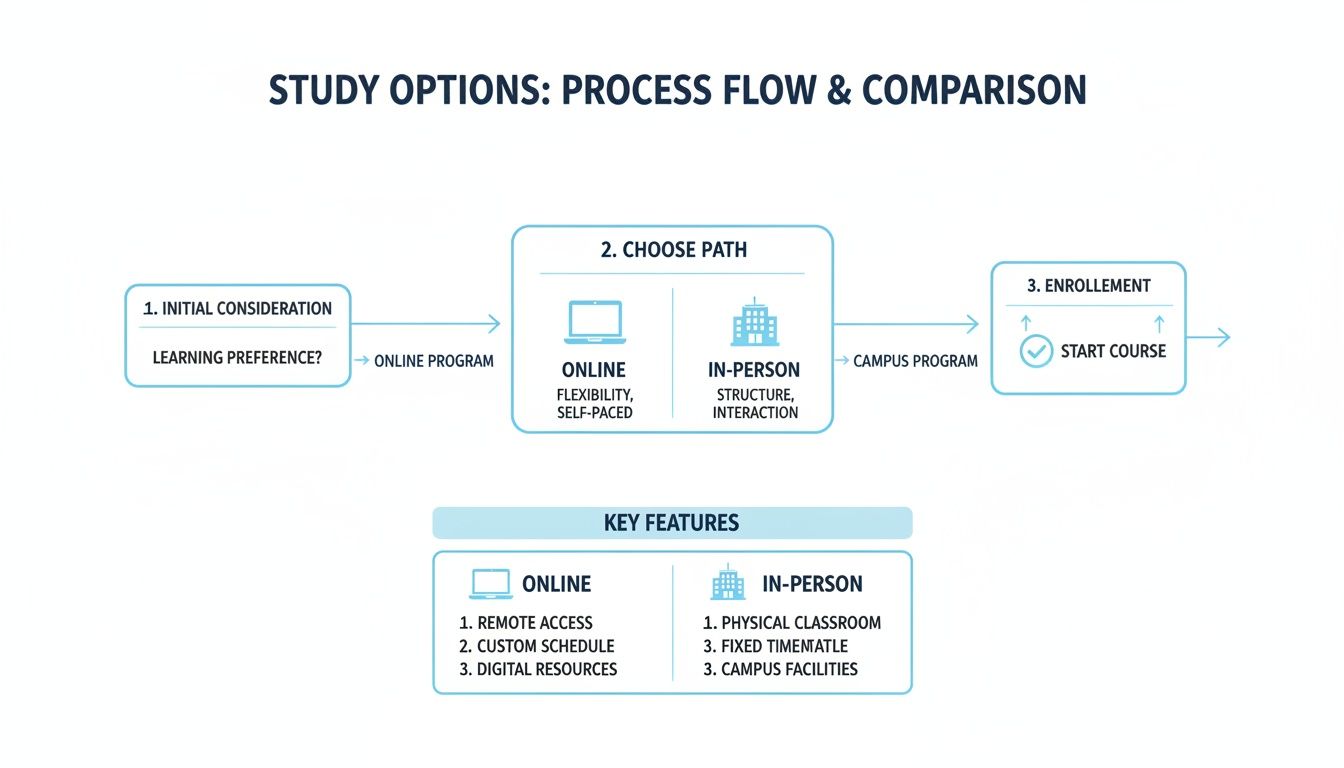
This shows that whether you study online or in a classroom, the end goal—a strong university application—is exactly the same.
Writing a Powerful Personal Statement
This is where you tell your story. Your personal statement is arguably the most critical part of your application. It’s a 4,000-character essay explaining why you want to become a nurse, what skills you have, and why you’d be a fantastic student. For adult learners, this is a golden opportunity.
You can draw on so much more than just your recent studies. You can talk about:
- Previous Career Experience: Ever worked in a customer-facing role? That’s communication and empathy right there.
- Life Experience: Have you cared for a family member or raised children? That shows responsibility, resilience, and compassion in spades.
- Your Access Course: Connect what you learned in modules like Human Biology or Psychology directly to the skills a nurse needs.
When you combine this rich life experience with the academic grounding from your access course to nursing, you create a compelling narrative that will make admissions tutors sit up and take notice. For a more detailed breakdown, check out our complete guide on how to apply to university after an access course. It walks you through the entire process, giving you the confidence to submit an application that truly reflects your potential.
How to Fund Your Access to Nursing Course
Let's talk about one of the biggest questions on everyone's mind when they think about returning to education: how do I pay for it? It's a valid concern, but the great news is that an Access to HE Diploma in Nursing is designed with adult learners in mind, and that includes the financial side of things. You don't have to let cost stand in the way of your dream career.
The main way people fund this course is through the Advanced Learner Loan. This is a government-backed student loan created specifically for learners aged 19 and over who are studying for a Level 3 qualification—which is exactly what an Access to HE Diploma is.
Think of it less like a traditional bank loan and more like a key that unlocks your future. It covers your course fees entirely, so you won’t have to find any money upfront. Even better, you only start making repayments once you're earning over a set salary, so you’re never under pressure before you're financially ready.
The Loan That Vanishes for Nurses
Now, here’s the best part—and it’s a big one. If you take out an Advanced Learner Loan to fund your Access to HE Diploma in Nursing, the government will completely write off the outstanding loan balance after you complete your nursing degree.
This isn’t a hidden detail; it’s a massive incentive created to get more people into vital roles like nursing. It means your Access course effectively becomes free, as long as you see your journey through and qualify as a nurse. This single policy has opened the door to a nursing degree for thousands of people who might have thought the first step was out of reach.
This loan write-off is a genuine game-changer. It means you can invest in your Access course with total confidence, knowing that once you finish your nursing degree, that initial debt simply disappears. It’s a direct investment from the government into you and your future in healthcare.
To be eligible for the loan, you typically need to be:
- Aged 19 or over on the first day of your course.
- Studying with an approved college or training provider in England.
- A UK national or have 'settled status'.
The application process is simple and isn't based on your income or credit history. It’s purely about giving you access to the education you need to get ahead.
Other Ways to Pay and Future Funding
While the Advanced Learner Loan is the most popular route, it’s not your only option. Many providers, including Access Courses Online, also offer flexible instalment plans. These plans let you spread the cost of the course over several months, often interest-free, which is a brilliant alternative if you'd rather pay as you go.
It’s also smart to look at the bigger picture. As soon as you complete your Access course and get your university place, a whole new world of funding becomes available. As a nursing student in England, you can apply for incredible support through the NHS Learning Support Fund (LSF).
This fund includes:
- A non-repayable training grant of at least £5,000 every year.
- Extra payments if you have children.
- Money to help with travel and accommodation costs for your clinical placements.
And this is on top of the standard student finance you can get for tuition fees and living costs. By understanding all these options, you can create a clear financial roadmap for your entire journey, from day one of your Access course right through to graduating as a registered nurse.
Frequently Asked Questions About Access to Nursing
Thinking about a new career always brings up a few questions. It’s completely normal. Here, we'll walk through some of the most common queries about the access course to nursing to give you the clarity you need to plan your next move with confidence.
Is the Diploma Accepted Everywhere?
In short, yes. The Access to HE Diploma is a nationally recognised qualification, created specifically to get you into university. It's accepted by the vast majority of UK universities for their nursing degrees.
However, and this is important, you still need to do your homework. Some universities might have specific grade requirements, asking for a certain number of credits at Merit or Distinction. Before you enrol on any course, always check the entry requirements on the websites of the universities you’re most interested in. A quick email to their admissions team can clear up any doubts.
Can I Work While I Study?
Absolutely. Many of our students work part-time while they complete their diploma. That's precisely why flexible online and part-time study options exist – to fit around your existing commitments.
But it’s important to be realistic about your time. A full-time, one-year course is intense. You'll typically need to set aside 15-20 hours of study each week, which makes holding down a full-time job extremely tough. If you need to work significant hours, a part-time course spread over two years is often a much more manageable and less stressful path.
The Bottom Line: Juggling work and study is totally possible. The secret is picking a study format that works with your life and financial needs. This way, you avoid burnout and can give the course your best shot.
What if I Don't Finish the Nursing Degree?
This is a really important financial point to get your head around, especially if you're using an Advanced Learner Loan. The loan is only written off after you successfully complete an eligible higher education course, like your nursing degree.
If you start your degree but don't finish it, you will have to repay the loan. The repayments work just like standard student loans, meaning you only start paying it back once you’re earning over a certain salary.
Do I Need Healthcare Experience First?
While it’s not always a strict requirement for getting onto an access course to nursing, having some healthcare experience is a massive advantage. We highly recommend it.
Why? Because getting some relevant volunteer or paid experience makes your future university application so much stronger. It proves you're genuinely committed and gives you real-world insights to talk about in your personal statement and interviews. Time spent in a care home, hospice, or as a healthcare assistant shows you understand what a caring role truly involves, making you a much more attractive candidate when you're competing for a place on a nursing degree.
Ready to take that next step towards your dream nursing career? At Access Courses Online, we provide flexible, fully accredited online courses designed to fit around your life. Discover our Access to HE Nursing Diploma and start your journey today.