
You may be working shifts, caring for children or supporting an older relative while wondering whether a healthcare career is still realistic. Perhaps you left school without the A-levels a university prospectus appears to demand, or your existing qualifications no longer match the direction you want to take. Access to higher education health science can provide a structured route forward, but the qualification is only one part of the decision. You also need to understand the academic workload, university admissions, clinical placements and the cost of staying on the pathway until professional registration.
Understanding the Access to Higher Education Health Science Pathway
Consider an adult learner who has spent years in retail and now wants to become a nurse. They may have the motivation, communication skills and practical maturity needed for patient care, but not the traditional subject combination required for a degree. An Access to Higher Education Diploma in Health Science is designed for precisely this kind of transition. It's a Level 3 qualification that prepares adults for higher education when A-levels aren't the most suitable or available route.
The diploma isn't a shortened nursing degree, and it doesn't qualify you to practise as a nurse, midwife or allied health professional. Instead, it develops the academic foundation you'll need to apply for a relevant university course. Admissions teams may consider an Access Diploma alongside the specific grade profile, GCSE requirements, interview performance and professional checks for the degree you've chosen.
A bridge, not a shortcut
A strong course typically combines health science with academic skills. You'll study subjects relevant to healthcare degrees, learn to interpret evidence and produce assessed work that demonstrates your readiness for university-level study. The qualification's purpose is to close an educational gap, not to remove the demands of higher education.
That distinction matters. A university can accept an Access Diploma in place of A-levels, but it may still require particular credits in biology, chemistry, mathematics or other units. Some nursing and allied health courses also set separate requirements for English, mathematics, health screening, interviews and professional suitability. Always compare the diploma's units with the entry criteria for each course on your shortlist.
Practical rule: Choose the university course first, then check whether the Access Diploma gives you the subjects and grades that course actually requires.
The route can also sit within a wider professional-development plan. If you're exploring roles beyond nursing, resources on allied health continuing education can help you understand how different health professions develop after initial study. That exploration is useful before committing to a pathway with substantial academic and clinical demands.
Why the route matters nationally
The link between health education and workforce need is particularly clear in nursing and midwifery. UK applications to nursing courses stayed between 61,800 and 67,400 annually from 2010 to 2016, then fell by 18% to 54,985 in 2017, the first year of a new student-funding model, according to the National Audit Office review of the NHS nursing workforce. In England, nursing applicants fell to 35,260 in 2018, a 12% year-on-year reduction and the lowest recorded level since 2009, while 22,200 applicants were accepted onto English nursing courses.
Those figures show why access routes matter, but they don't guarantee admission. They show sustained interest alongside limited progression opportunities. Your task is to turn that interest into evidence of scientific readiness, academic discipline and a realistic plan for the years that follow.
Core Modules and Academic Preparation
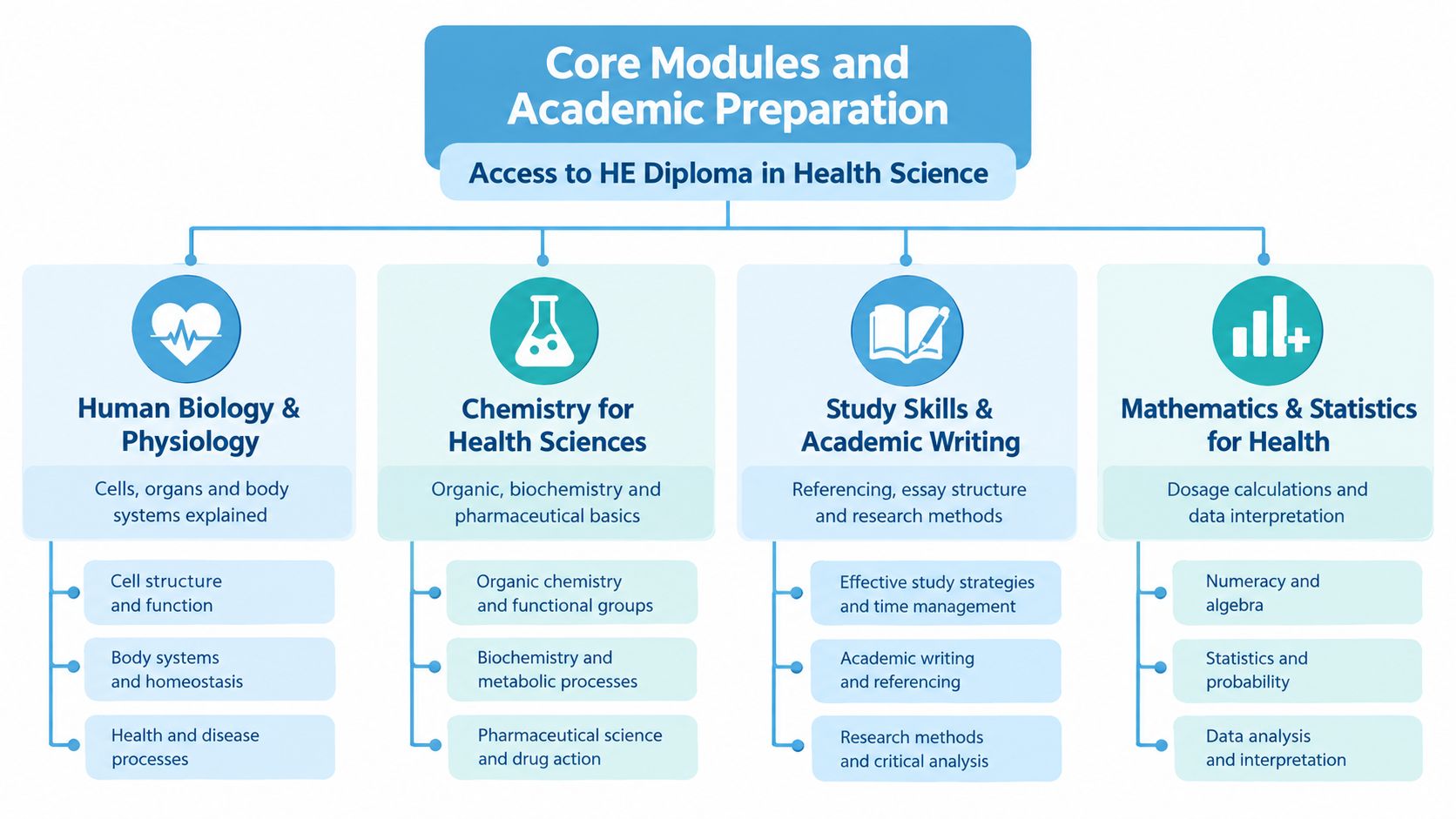
An Access Diploma should feel connected to the degree you intend to start. The precise unit titles vary between providers, but a health-science pathway commonly develops knowledge in human biology, anatomy and physiology, chemistry, academic writing, research and mathematics. Each area answers a question you'll meet at university: how the body works, how treatments affect it, how evidence is evaluated and how safe decisions are supported by accurate calculations.
Scientific foundations
Human biology and physiology may take you from cells and tissues to organs and integrated body systems. You might examine the cardiovascular, respiratory, nervous or endocrine systems, then connect structure with function. That connection is essential. A nursing student needs more than a list of anatomical terms. They need to understand how a change in one system can affect a patient's wider condition.
Chemistry for health sciences can seem less relevant if your goal is patient-facing care, but it supports understanding of medicines, fluid balance, metabolism and biochemical processes. You may encounter organic chemistry, basic biochemistry and pharmaceutical principles. The course doesn't expect you to become a laboratory chemist, but it does require careful reasoning and comfort with scientific language.
Mathematics has a practical purpose. Health professionals must work accurately with quantities, ratios, charts and clinical information. An Access course may use health-related examples to develop numerical confidence, but you'll still need to check the exact numeracy preparation expected by your intended university.
Academic preparation
Academic writing is not an optional add-on. You'll need to locate reliable sources, paraphrase without distorting meaning, reference consistently and build an argument rather than only describe a topic. Research methods introduce the logic behind evidence-based practice, including how questions are formed, how findings are interpreted and why the quality of a source matters.
A useful way to test course suitability is to ask how each unit maps to the first year of your intended degree:
| Access preparation | University relevance |
|---|---|
| Human biology and physiology | Understanding body systems, disease processes and patient assessment |
| Chemistry and biochemistry | Interpreting medicines, metabolism and physiological change |
| Research methods | Reading clinical evidence and supporting evidence-based practice |
| Academic writing | Producing essays, reports and reflective assignments |
| Mathematics and statistics | Interpreting data and completing health-related calculations |
The workload may be more demanding than an adult learner expects. You're rebuilding study habits while learning technical content, and you'll need to manage deadlines across several units. Treat early assignments as training for university, not as obstacles to get past. Feedback on structure, referencing and scientific explanation can prevent weaknesses from following you into a degree.
Assessment Methods and Flexible Online Study
Many adults hesitate because they picture a return to school dominated by high-stakes examinations. Access courses often use a broader assessment model, although the exact balance depends on the provider and unit. You may complete essays, written assignments, presentations, research tasks, practical reports or other forms of coursework that build a portfolio of evidence.
How continuous assessment works
A disciplined approach usually follows this sequence:
- Read the learning outcomes first. They tell you what the assessor expects you to know or demonstrate. Highlight command words such as analyse, evaluate, compare and explain.
- Complete formative work early. Draft paragraphs, quizzes or practice activities help identify gaps before you submit graded work.
- Gather and evaluate sources. Use your course materials, library resources and credible health information. Record references while researching rather than trying to reconstruct them at the end.
- Submit through the learning platform. Check file type, word count, declaration requirements and the deadline before uploading.
- Use feedback actively. Create a short improvement list and apply it to the next assignment. Repeating the same error wastes the value of tutor guidance.
This approach tests more than memory. Healthcare degrees require students to explain reasoning, interpret evidence and communicate clearly, so varied assessment can help you practise those behaviours before admission.
Making online study workable
Asynchronous learning lets you access materials at times that fit around employment or caring duties. Flexibility doesn't mean the course has no timetable. You still need protected study blocks, reliable internet access and a method for tracking deadlines. A weekly plan might reserve separate sessions for reading, notes, drafting and revision, rather than treating all study as one vague task.
Online learners also need purposeful contact with tutors. Look for clear feedback arrangements, accessible email or messaging channels and opportunities to ask questions about difficult science topics. Structured support matters because independent study can become isolating when an adult learner is already balancing work and family responsibilities.
For a closer explanation of how Access courses use coursework and whether examinations form part of the experience, read this guide to exams on Access courses. Use it to prepare questions for any provider you're considering, then confirm the current assessment pattern directly with that provider.
Navigating Clinical Placement Capacity and Progression
Being offered a university place is a major achievement, but it isn't the same as completing professional training. Nursing, midwifery and allied health degrees depend on supervised clinical education, and students need suitable placement opportunities to develop and demonstrate practice competence.
A 2026 interim report from Policy Connect identifies insufficient placement capacity as a constraint on expanding health-profession training, alongside funding problems, weak national coordination and a shrinking educator workforce. The report also highlights compounding barriers for learners outside London and the South East, as well as for students from lower socioeconomic backgrounds, ethnic-minority groups, and disabled or neurodivergent students. You can review the findings in the Policy Connect HealthEd interim report.
Admission doesn't answer every practical question
Universities may organise placements across hospitals, community services, care settings and other approved environments. The location and schedule can affect whether you can continue paid employment, arrange childcare or manage travel. A course that looks flexible in its teaching timetable may still require substantial availability for clinical learning.
Ask admissions teams and current students:
- Placement capacity: How does the university confirm that students can access the placements required for the programme?
- Travel expectations: Which areas are commonly used, and how far might students need to travel?
- Scheduling: Are placements arranged in blocks, regular shifts or another pattern?
- Caring responsibilities: What formal process exists for discussing childcare, disability or other constraints?
- Delays and changes: What happens if a placement is postponed, withdrawn or considered unsuitable?
- Support: Who handles concerns about supervision, safety, learning opportunities or travel hardship?
Don't assume that a university near your home will provide all placements nearby. Placement networks can extend across a region, and clinical service needs may influence allocation. Get practical answers before accepting an offer, especially if you're changing careers from a job with fixed hours.
The wider progression route is explained in this guide to online Access to Health Professions courses. The key question is not just whether you can gain entry. It's whether the complete route, including university teaching, clinical placement and registration requirements, can fit your life.
The Financial Reality for Mature Career Changers
The financial decision has two separate stages. First, you need to fund the Access Diploma while maintaining your household. Later, you'll need to manage degree-related costs, travel and the possibility of reduced earnings during clinical training. Treating the whole route as one affordable payment can hide the pressure that appears after university admission.
Compare the costs across the pathway
| Stage | Questions to answer |
|---|---|
| Access study | What is the total course cost, what funding may apply and how are payments scheduled? |
| University tuition | What fee will the degree charge, and what support is available under current rules? |
| Living costs | Can your household manage rent, food, utilities and other commitments if work hours fall? |
| Travel | How much time and money could regular travel to teaching or placements require? |
| Caring duties | Who will provide childcare or other support during compulsory attendance and placement periods? |
Some Access learners may be eligible for an Advanced Learner Loan, and the treatment of that loan can depend on progressing to an eligible higher education course and meeting the relevant conditions. Don't rely on a general statement that the loan will be written off. Check your personal eligibility, the course's status and the current rules with the official funding service or a qualified adviser.
The degree stage has its own financial reality. The Royal College of Nursing reported in November 2025 that mature students accepted onto nursing courses had fallen by 24% since 2021. It linked the decline to substantial debt and insufficient financial support for people who may have caring responsibilities, and noted that nursing students can face annual tuition fees of £9,250.
Build a survivable plan
Before enrolling, write a household budget that includes the unglamorous items. Add commuting, meals away from home, equipment, lost overtime, backup care and the cost of maintaining your current responsibilities. Then test the plan against a period when you can't accept extra shifts or when a placement is further away than expected.
A career change also requires an employment strategy. You may find job transition tips useful when explaining a return to education, transferring existing skills and preparing for interviews. Your previous work can support an application, but don't assume enthusiasm will replace evidence of financial planning.
For a more detailed discussion of funding questions affecting adult learners, consult this guide to student finance for mature students. Get written confirmation where possible, and keep a buffer for costs that prospectuses don't describe clearly.
Why Mature Learners Are Vital to the NHS Pipeline
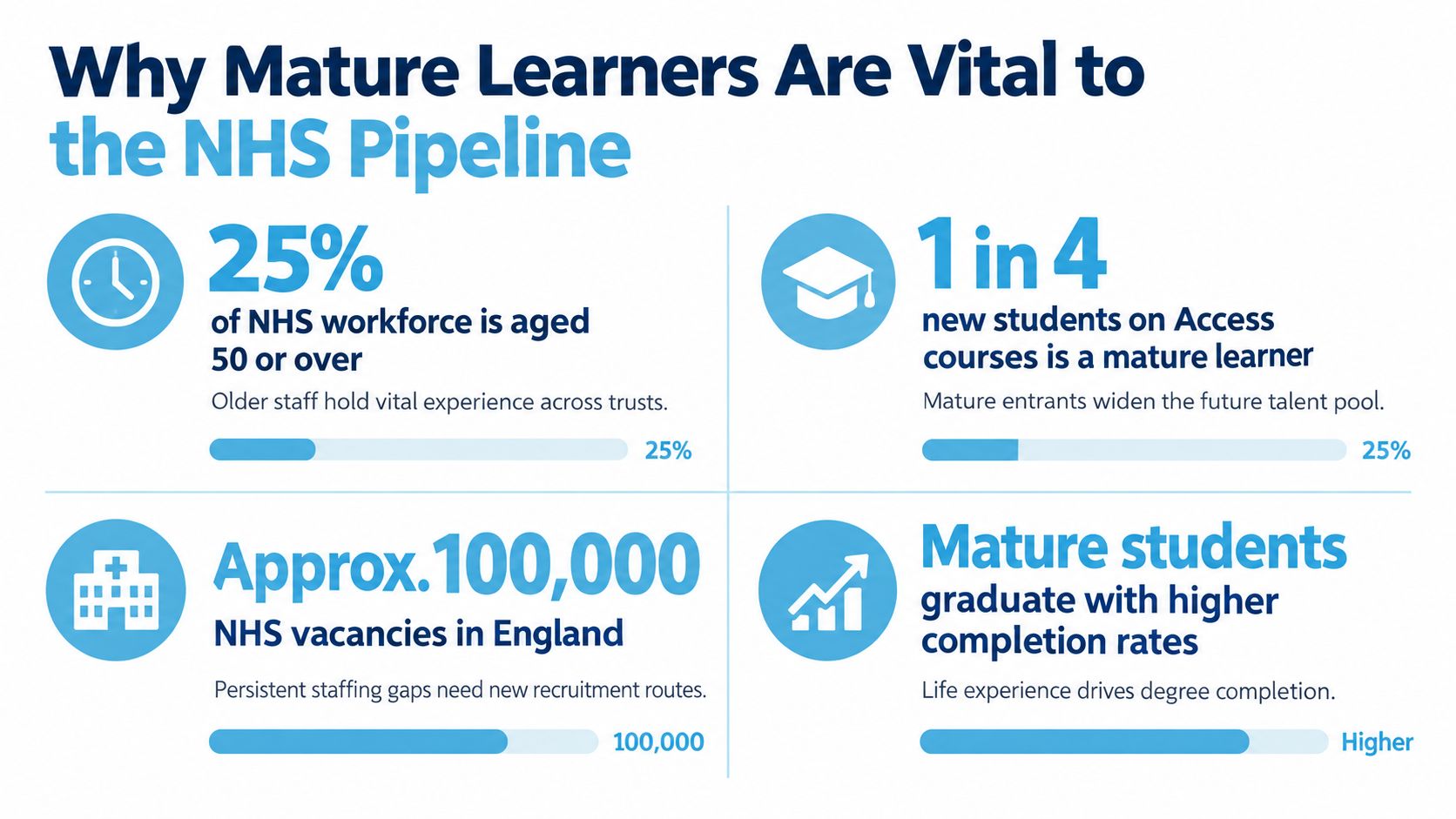
Adult applicants aren't an unusual exception in health education. UCAS identifies subjects allied to medicine, including nursing, among the most popular choices for applicants aged 21 and over. It also reports that 29% of nursing acceptances are from students aged over 30, while more than 70% of mature students aged over 31 accepted onto full-time degrees are female, as described in the UCAS analysis of mature students.
That matters because mature learners bring more than age to an application. They may have experience of customer service, administration, management, care, education or problem-solving under pressure. Those experiences don't replace scientific preparation, but they can strengthen communication, reflection and teamwork when the applicant explains them precisely.
A workforce route with real demand
Nursing education remains closely tied to NHS staffing needs. NHS England reported that new nursing students in England increased from 17,950 in 2019 to 22,490 in 2020, a 25% rise, and then to 23,490 in 2021, a further 4% increase, according to the Nuffield Trust analysis of the NHS workforce. The same source reported that 94% of nursing graduates were in work within six months of completing their degree, while NHS England identified more than 46,828 nursing, midwifery and health-visiting vacancies in England in October 2022.
Demand doesn't make the route easy. It makes preparation consequential. A mature learner who develops scientific confidence, understands professional expectations and plans around placement demands can approach the application with a more complete view of the job.
The strongest message is realistic rather than sentimental. You're not too old to start, but you do need to plan differently from a school-leaver. Flexible study can reduce the disruption of preparation, while your work and life experience can become an asset in interviews and practice.
Frequently Asked Questions About Starting Your Journey
Do I need GCSEs in English and mathematics?
Many universities and professional courses require evidence of English and mathematics at a specified level. Some providers can help adults work towards equivalent qualifications or Functional Skills, but the rules vary between the Access provider and the university. Check both sets of requirements before enrolling, and ask whether your existing qualifications are accepted.
Science requirements also differ. A general Access Diploma may not contain the biology or chemistry units required for a particular nursing, midwifery or allied health course. Send the university a list of the proposed Access units and ask for confirmation in writing.
When can I enrol?
Some online providers offer several start points or allow learners to begin at different times, while others organise fixed cohorts. Confirm the teaching calendar, assessment deadlines and expected completion date. Starting quickly is less important than choosing a schedule you can sustain alongside work and family commitments.
Ask for a taster activity if one is available. A short sample can reveal whether the learning platform is easy to use, whether the scientific language feels manageable and how much independent reading you'll need to do.
How can I study while working full time?
Begin with your real calendar, not an ideal week. Mark shifts, school runs, medical appointments and caring duties, then identify study blocks you can protect. If your timetable has no reliable space for reading and assignment work, discuss a slower pace or alternative start date before you commit.
Use a simple system: keep deadlines in a digital calendar, break each assignment into research and drafting tasks, and contact your tutor as soon as a problem appears. Ask how support is delivered, whether tutors respond by email or WhatsApp, and how feedback is provided. You may also need to automate routine job searches during a transition, and a job application automation tool can be one option to investigate while you manage study commitments.
What should I ask before paying?
Request the full course price, payment-plan terms, funding guidance, refund policy, assessment schedule and progression support in writing. Find out whether the provider is listed on the UK Government's Register of Learning Providers and whether the diploma is accepted by the universities you're targeting. Then compare the written information with the degree admissions pages, because an Access provider cannot guarantee that every university will accept every unit combination.
You should leave the conversation knowing what happens on the first day, how you submit work, who marks it, when you receive feedback and what support exists if your circumstances change. Those answers are more useful than a broad promise that the course is flexible.
Access Courses Online offers online Access to Higher Education Diploma routes for adults preparing for nursing, midwifery, health professions and other university pathways, with tutor guidance, funding information and flexible study arrangements. If you're ready to compare your target degree requirements with a practical preparation route, visit Access Courses Online and request information about the course, support and next steps.