
Thinking about a career in nursing but don't have A-levels? It can feel like you've hit a brick wall. But there's a fantastic route designed specifically for adult learners like you: the Access to Higher Education (HE) Diploma. This isn't just a backup plan; it's the UK's most effective and recognised pathway for people changing careers or returning to education.
Your Nursing Career Pathway Starts Here
For so many aspiring nurses, the traditional school-to-college-to-uni route just didn't happen. Life gets in the way, career priorities shift, or maybe you just didn't get the right qualifications the first time around. Whatever the reason, it can feel like the door to nursing is closed.
This is exactly where the Access to Higher Education in Nursing course comes in. Think of it less as an alternative to A-levels and more as a launchpad, specifically engineered to get you ready for the demands of a university nursing degree.
This diploma is so much more than a piece of paper. It’s a foundational experience that dives deep into the specific scientific knowledge and academic skills you’ll need to thrive. With the demand for skilled nurses higher than ever, this pathway is your direct line into a fulfilling and vital healthcare career.
A Pathway Built for Adult Learners
The Access to HE Diploma has been designed from the ground up with adults in mind. It recognises that you're not starting from scratch – you bring valuable life experience to the table, which is a huge asset in a caring profession. The course is structured to build your academic confidence and prepare you for the reality of university study.
Here’s why it works so well:
- Focused Curriculum: You won't waste time on irrelevant subjects. Modules are tailored to nursing, covering core topics like human biology, psychology, and professional healthcare practices.
- University Recognition: This is the big one. Over 90% of graduates go on to higher education. The diploma is widely accepted and respected by universities all over the UK.
- Flexible Study: Juggling life is tough. Online options mean you can fit your studies around your job, your family, and everything else you have going on.
Understanding the Context of Nursing Education
The world of access to higher education in nursing has seen its share of changes, especially when it comes to funding. For example, up until August 2017, English nursing students received an NHS bursary that covered tuition fees and living costs, making it a very accessible career.
While that specific funding model has changed, the commitment to opening up the profession hasn't. Pathways like the Access to HE Diploma are here to ensure that dedicated, passionate people always have a clear route into nursing. If you're curious about the history, you can discover more insights into how career change to nursing has evolved.
This guide will walk you through the entire process, from getting to grips with the course content to navigating your application and funding options. Whether you're making a massive career leap or stepping back into education after a long break, this diploma is your starting block.
What to Expect from Your Access to HE Nursing Diploma
Taking the leap into an Access to HE Nursing Diploma can feel like a big deal, especially if you’ve been out of the classroom for a while. The best way to think of it is as a focused 'boot camp' designed to get you ready for your nursing degree. It’s an intense but incredibly rewarding experience that builds the exact foundation you need to succeed.
This isn’t just about memorising facts; it's about learning how to learn at a university level. The diploma is carefully put together to make sure you don’t just get into your chosen nursing programme, but that you thrive from your very first lecture.
A Curriculum Built for Future Nurses
Unlike A-levels, which can feel a bit scattered, the Access to HE Nursing curriculum is laser-focused. Every single module has been chosen to give you a complete picture of patient care, preparing you for the real world of modern healthcare.
The course is built around a credit system that universities understand and respect. To earn your diploma, you’ll need to complete a total of 60 credits.
- 45 Graded Credits: This is the core of your academic work. These credits are graded at Pass, Merit, or Distinction and cover key subjects like biology, health studies, and psychology. Universities will look at how many distinctions and merits you achieve when they make you an offer.
- 15 Ungraded Credits: These modules are all about building essential academic skills—think research, referencing, and essay writing. They might be ungraded, but they're mandatory and absolutely vital for giving you the confidence to handle degree-level assignments.
This structure gives universities a clear, detailed snapshot of what you're capable of academically.
The Access to HE Diploma does more than just tick the boxes for university entry. It’s designed to develop the critical thinking, analysis, and reflection skills that are the heart and soul of a brilliant, compassionate nurse.
Core Subjects You Will Study
While the exact modules might vary slightly depending on where you study, the goal is always the same: to give you a 360-degree view of what influences a person’s health and wellbeing. You won't just study the human body; you'll explore the human experience.
This approach teaches you that a patient is always more than their diagnosis. You’ll learn to see the whole person, a skill that is fundamental to providing outstanding care. You can expect to get stuck into subjects like:
- Human Biology and Physiology: This is the scientific backbone of everything you'll learn. You’ll explore it all, from cells to major organ systems, giving you the essential anatomy and physiology knowledge you'll need in a clinical setting.
- Psychology: Understanding the mind is just as important as understanding the body. This module looks at topics like human development, stress, and the psychological impact of illness on patients and their loved ones.
- Sociology of Health: This subject opens your eyes to how social factors like class, background, and even where someone lives can affect their health. It helps you understand the bigger picture of a patient's life and the health inequalities that exist in our society.
- Professional Healthcare Practices: Here, you'll learn about the nuts and bolts of the job. This includes the structure of the NHS, the responsibilities of a registered nurse, and the professional codes of conduct, including the famous '6 Cs' of nursing (Care, Compassion, Competence, Communication, Courage, and Commitment).
This mix of science, social science, and professional studies provides a strong, well-rounded education. It’s this comprehensive knowledge base that makes an access to higher education in nursing diploma so effective and so highly regarded by university admissions tutors across the UK.
Comparing Your Pathways into Nursing
Deciding how to start your nursing career is a big deal. Think of it like planning a trip—there are several routes to get to the same destination, and each one has its own pace, scenery, and challenges. To make sure there’s clear access to higher education in nursing for everyone, the UK has a few different pathways you can take.
This section is your roadmap. We’re going to compare the three main routes: the Access to HE Diploma, traditional A-levels, and the Nursing Degree Apprenticeship. Once you understand the differences, you can pick the one that best fits your life, learning style, and career goals.
This flowchart helps you see the first big decision point, depending on the qualifications you already have.
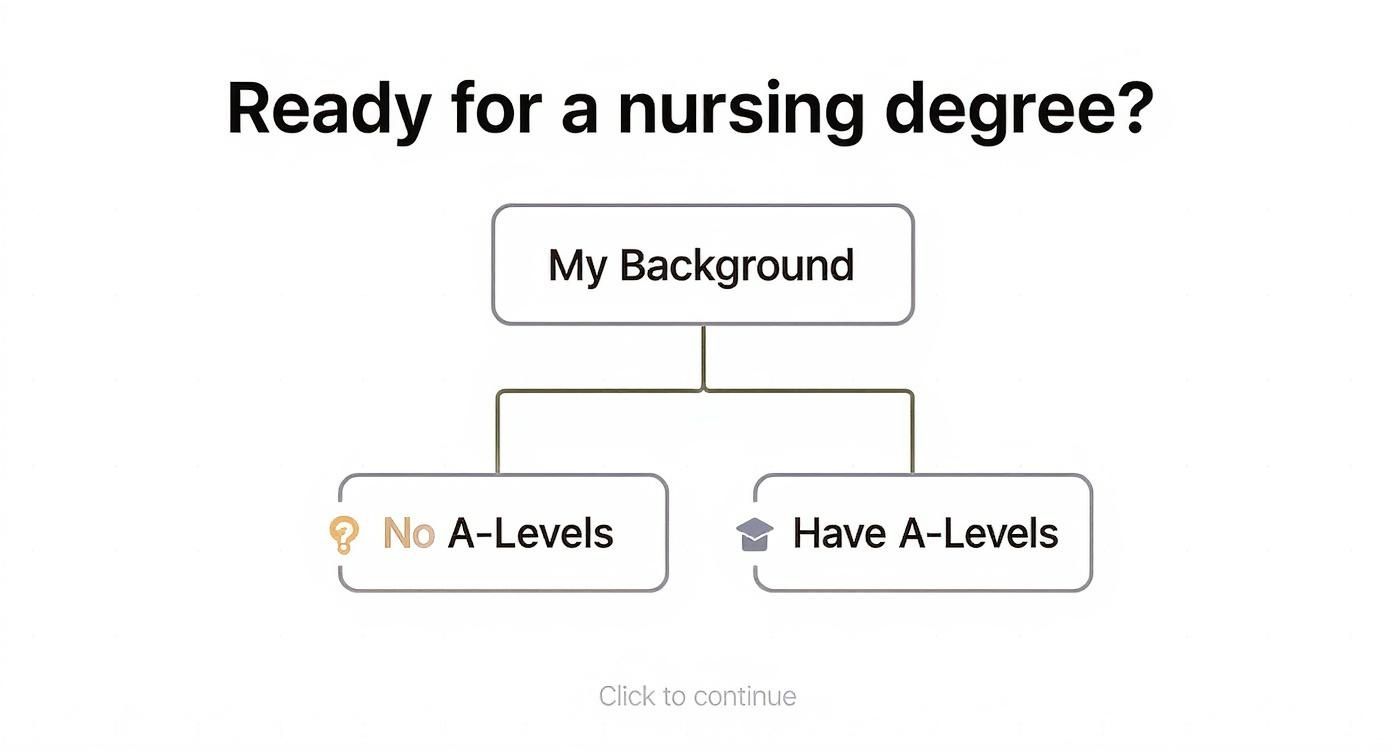
As you can see, not having A-levels isn't a dead end. It’s just a different starting point on your journey into nursing.
To make things even clearer, let's break down the key features of each pathway side-by-side.
Comparing Entry Pathways to a Nursing Degree
| Feature | Access to HE Diploma | A-Levels (Traditional Route) | Nursing Degree Apprenticeship |
|---|---|---|---|
| Typical Student | Adults (19+), career changers, those returning to education. | School leavers (16-18) following the standard academic path. | Individuals of any age who prefer hands-on, work-based learning. |
| Duration | 1 year (intensive, full-time study, often online). | 2 years (full-time study at a college or sixth form). | Around 4 years (combining part-time study with full-time work). |
| Focus | Highly focused on subjects directly relevant to nursing and healthcare. | Broader academic scope, covering 3-4 different subjects. | Vocationally focused, blending academic theory with on-the-job practice. |
| Cost & Funding | Self-funded, often via an Advanced Learner Loan (written off on degree completion). | Typically government-funded for under-19s. | No tuition fees for the apprentice; paid for by the employer. |
| Key Advantage | The fastest, most direct route to university for adults without A-levels. | A well-established and universally recognised route for school leavers. | Earn a salary while you study and graduate debt-free. |
| Main Challenge | Requires intense self-discipline and commitment to complete in one year. | A longer time commitment that’s less practical for many adult learners. | Securing a paid apprenticeship position is highly competitive. |
Each of these pathways is a valid route into a rewarding career. The best one for you really comes down to your personal circumstances, how you learn best, and what your financial situation looks like.
The Access to HE Diploma: The Focused Fast-Track
Think of the Access to HE Diploma as an express train that takes you straight to university. It’s been specifically created for adult learners who are ready to dive into an intensive, one-year course that gives them all the knowledge and academic skills they need for a nursing degree.
Its biggest advantage is its speed and focus. Every single module is directly relevant to nursing, so you aren’t spending time on subjects you don’t need. This makes it the perfect choice for career changers or anyone returning to education who wants to get onto a degree programme without any delay.
- Best for: Adults aged 19+ who need a recognised university entry qualification and want to get there within a year.
- Learning Style: A blend of academic theory and practical skills development, often available online for maximum flexibility.
- Time Commitment: Typically one academic year of full-time study. It’s intense, but incredibly efficient.
A-Levels: The Traditional Scenic Route
A-levels are the conventional pathway, a bit like a well-trodden scenic route that school leavers usually take over two years. They are a perfectly good way to get into a nursing degree, but they tend to be less common for mature students because of the longer time commitment and broader range of subjects.
If you already have A-levels in relevant subjects like Biology, you’re in a great position. But for an adult starting from scratch, spending two years on A-levels can feel like a much less direct path compared to the purpose-built Access to HE Diploma.
- Best for: School leavers or those who have the time for a two-year course covering a wider academic scope.
- Learning Style: Mainly classroom-based, exam-focused learning in a sixth form or further education college.
- Time Commitment: A full two years of study, usually requiring you to be there in person.
The Nursing Degree Apprenticeship: The Earn-While-You-Learn Model
The Nursing Degree Apprenticeship is a completely different approach. It’s like learning to drive a car by actually getting behind the wheel from day one, with an instructor right there with you. This route combines full-time work in a healthcare setting with part-time university study, and your employer covers your tuition fees.
This is a fantastic option for people who thrive in a practical, hands-on environment and need to earn a salary while they study. The only catch is that these apprenticeships are extremely competitive. You have to secure a job as an apprentice with a healthcare employer, like an NHS Trust, before you can start.
"Apprenticeships offer a fantastic, debt-free route into the profession, but they are jobs first and foremost. Securing one requires a strong application and a successful interview, as you are competing for a paid position."
- Best for: Individuals who prefer vocational, on-the-job training and can secure a competitive apprenticeship position.
- Learning Style: Primarily work-based learning integrated with academic study, leading to a full nursing degree.
- Time Commitment: Longer than a traditional degree, typically taking around four years to complete.
To get a complete picture of what universities are looking for, it’s worth checking out our detailed guide on nursing degree entry requirements. It breaks down exactly what each pathway means for your application.
Navigating the Application and Entry Process
Once you've got a handle on your different pathway options, the next practical step is the application itself. It can feel like a big hurdle, but if you break it down into stages, it's a lot more manageable. Think of it as a two-part journey: first, you'll secure your place on an Access to HE course, and then, you'll use that as your launchpad to apply for your nursing degree at university.
This section is all about the practical side of getting started. We'll walk you through what you need and how to build an application that really shows off your potential to become a fantastic nurse.
Securing Your Spot on an Access Course
Your first move is to enrol on an Access to HE Diploma with a college or an online provider. The entry requirements for these courses are usually quite flexible because they're specifically designed for people who don't have traditional qualifications. But there's one key thing you need to be aware of right from the start.
To get into a university nursing degree, you'll almost always need GCSEs in English and Maths at grade 4/C or above. This isn't a rule set by the Access course provider, but by the universities themselves.
Plenty of aspiring nurses discover they need to retake one or both of these. The good news is that most providers, including Access Courses Online, offer integrated GCSE or Functional Skills Level 2 courses. This means you can study for these essential qualifications at the same time as your main diploma, making sure all your bases are covered when it's time to apply to uni.
Understanding the University Application (UCAS)
Once you're enrolled and studying, your next big milestone will be your university application, which all goes through the Universities and Colleges Admissions Service (UCAS). Your tutors will give you tons of support with this, but the single most important part—the bit you have total control over—is your personal statement.
This is your moment to shine and show the admissions tutors who you are beyond the grades. It's where your life experience transforms from a simple backstory into your biggest strength.
Your personal statement isn't just a list of your achievements. It's a carefully crafted story that connects your personal journey, your values, and your experiences to the core principles of the nursing profession.
Crafting a Standout Personal Statement
A common mistake people make is just saying they're a caring or compassionate person. You need to do more than that—you need to show it with real-world examples. Think about times you've supported a family member, volunteered in your community, or dealt with a tricky situation at work. How did you communicate? What did you learn from it?
Writing a compelling personal statement is a massive part of your application. It’s well worth looking at some examples of powerful personal statements to see how others have successfully told their story.
To give your statement real structure and impact, try framing your experiences around the ‘6 Cs of Nursing’. This framework is at the heart of the NHS Constitution, and it's exactly what university tutors are looking for.
- Care: Describe a time you provided practical or emotional support to someone.
- Compassion: How have you shown empathy and understanding for what someone else was going through?
- Competence: Talk about a skill you've developed, whether at work or at home, that proves you are reliable and capable.
- Communication: Give an example of when you had to listen carefully or explain something clearly to sort out a problem.
- Courage: When have you stood up for what's right, or faced a challenging situation head-on?
- Commitment: Show your dedication. This could be through finishing a tough project, juggling different responsibilities, or simply your commitment to starting this course.
By weaving these themes into your personal story, you build a powerful narrative. You’re no longer just saying you have what it takes to be a nurse; you’re proving it with evidence from your own life. This is what makes an application impossible to ignore and turns your experience into a successful university offer.
Funding Your Journey to Becoming a Nurse
Let's talk about one of the biggest worries for anyone thinking about a career change: the cost. Concerns about course fees and how you'll manage financially can feel like a huge barrier, but they don't have to be. For aspiring nurses, there's a fantastic support system in place to make your education affordable.
We’ll walk through the funding available for your Access to HE course and what you can expect when you get to university.
The Advanced Learner Loan
The first tool you need to know about is the Advanced Learner Loan. This is a government-backed loan designed specifically to cover the tuition fees for qualifications like the Access to HE Diploma. The great thing is, it isn't based on your income, and there's no credit check involved. It takes the immediate financial pressure off, so you can focus on your studies.
But for future nurses, this loan comes with an incredible, game-changing feature.
The Loan Write-Off: A Game Changer for Nursing Students
This is probably the single most important piece of funding information you'll read. If you use an Advanced Learner Loan for your Access to HE Diploma in Nursing and then successfully complete a nursing degree at university, the government will completely write off your loan.
That’s right. Your Access to HE Diploma essentially becomes free. The loan you took out to get your qualification simply disappears once you graduate with your nursing degree.
This isn't a loophole; it's a deliberate policy to encourage more people like you to join the nursing profession. It makes that first, crucial step of getting qualified for university completely accessible. If you want to dive into the specifics, you can learn more about how Access to HE funding works.
Financial Support During Your University Degree
Once you’ve nailed your Access course and have your university place confirmed, a whole new level of financial support opens up. The pressures on students are real; research from the Royal College of Nursing highlighted that student attrition rates have hit around 21%, often due to financial strain.
To help tackle this, a support package is available specifically for healthcare students. It’s made up of a few key parts:
- Tuition Fee Loan: This covers your university tuition fees in full. You won't pay a penny upfront. Repayments only begin once you've graduated and are earning over a certain amount.
- Maintenance Loan: This is for your day-to-day living costs—think rent, food, and travel. How much you get depends on things like your household income and where you’re studying.
The NHS Learning Support Fund
On top of the standard student loans, if you're studying in England, you can also apply for the NHS Learning Support Fund (LSF). This is extra money to support you during your degree that you do not have to pay back.
The LSF includes several fantastic elements:
- Training Grant: A straightforward payment of £5,000 for each year of your course.
- Parental Support: An extra £2,000 a year if you have at least one dependent child.
- Travel and Dual Accommodation Expenses: You can claim back extra costs you face when travelling to your clinical placements.
- Exceptional Support Fund: For students facing serious financial difficulty, a grant of up to £3,000 per year is available.
When you put it all together—the loan write-off for your Access course, combined with the comprehensive loans and grants at university—the path to becoming a nurse is clearer and more financially supported than ever.
Essential Study Skills for Mature Students
Stepping back into education after a few years away can feel like a massive leap, especially when you’re already juggling work, family, and a million other things. But here’s the thing: as a mature student, your life experience and sheer determination are your superpowers. The academic side of things might just need a little dusting off. This section is all about giving you the tools to find your rhythm and build unstoppable momentum.
It’s not just about squeezing in study time; it’s about making that time truly count. Many of our students find that the old study habits from their school days just don't cut it anymore. The key is to work smarter, not harder, by using strategies built for focus and efficiency in a busy life.

Mastering Time Management
Let’s be honest, your schedule is probably already bursting at the seams. Great time management isn't about magically finding extra hours in the day—it’s about being intentional with the ones you have. A simple first step is to treat your study sessions like non-negotiable appointments in your calendar.
For those with really demanding schedules, exploring effective time blocking techniques can be a total game-changer. This method is all about dedicating specific chunks of time to a single task, which is brilliant for shutting out distractions and really getting into a state of deep focus.
Another fantastic method that our students swear by is the Pomodoro Technique. It sounds fancy, but it's incredibly simple:
- Pick a task: Decide exactly what you’re going to work on.
- Set a timer: Work, completely focused, for a 25-minute burst.
- Take a short break: Step away for 5 minutes to reset.
- Repeat: After four of these cycles, take a proper break of 15-30 minutes.
This technique is brilliant for preventing burnout and keeping your mind fresh, making it so much easier to absorb complex new information.
Rebuilding Academic Confidence
It's completely normal to feel a bit wobbly when you first start. You might be worried about writing essays or getting referencing right, but remember, the course is designed to teach you these skills from scratch. No one expects you to be an expert on day one.
One of the most powerful things you can do is connect with your peers. Try forming a small study group with other mature students on your course. You’ll quickly find out you’re not alone in your concerns, and you can lean on each other through the trickier assignments. Explaining a concept to someone else is also one of the best ways to lock it into your own memory.
"Your life experience is not separate from your education; it is the foundation upon which you will build your new skills. Embrace the perspective you bring—it’s what will make you an exceptional, empathetic nurse."
Finally, don’t be afraid to use the support systems that are there for you. Your tutors genuinely want you to succeed. If you're stuck on a topic, ask for help. If you want feedback on a draft essay, just ask. Being proactive about seeking support is a sign of strength and a key habit of every successful student. Following these tips will help ensure your access to higher education in nursing is a journey where you truly thrive.
Your Questions Answered
Starting a new career journey naturally comes with a few questions. It’s completely normal to want to get all the details straight before you dive in. Here, we've gathered some of the most common queries we hear about the Access to HE Diploma for nursing, giving you the clear, straightforward answers you need to feel confident about your next move.
Is There an Age Limit for an Access to HE Course?
Absolutely not. This is one of the best things about the Access to HE Diploma – it was created specifically for adult learners, so there’s no upper age limit.
While you generally need to be 19 or older to start, these courses are perfect for anyone ready to pursue nursing, whether you're 25, 45, or even older. In this field, your life experience isn't a barrier; it's a huge asset.
Do All Universities Accept Access to HE Diplomas for Nursing?
Yes, they do. The Access to HE Diploma is a nationally recognised qualification designed as a direct route to university. It’s widely accepted by universities across the UK for nursing, midwifery, and a whole range of other healthcare degrees.
It’s always smart to double-check the specific entry requirements for the universities you have your eye on, but you can rest assured that this diploma is a standard, respected pathway for adults wanting to get into higher education in nursing.
The Access to HE Diploma isn't just an 'alternative' to A-levels. For thousands of adult learners, it's the established and preferred qualification that universities actively recruit from every single year.
How Intensive Is the Course and Can I Work Part-Time?
There’s no sugar-coating it – the course is intensive. It’s designed to get you university-ready in just one academic year, which means covering a lot of ground to prepare you for degree-level study. This definitely requires a serious time commitment.
That said, many students successfully manage to work part-time while they study. Most colleges and course providers will advise you to keep your work hours manageable, just to make sure you have enough time for classes, assignments, and the independent study that’s crucial for success.
What if I Don't Have My GCSEs in Maths and English?
This is a really common situation, so please don’t let it put you off. It’s true that almost all university nursing programmes require a grade 4/C or higher in both GCSE Maths and English.
The great news is that most Access to HE providers have a solution. They often offer integrated GCSE or Functional Skills Level 2 courses that you can study right alongside your diploma. This means you can tick all the boxes for your university application without any extra delays.
Ready to take the next step towards your nursing career? Access Courses Online offers flexible, accredited online diplomas designed to fit your life. Explore our courses and get personalised advice today.
Find your path to university at https://accesscoursesonline.com.