
Thinking about a career change into nursing is a huge step, but one that can lead to a stable, in-demand, and genuinely purposeful profession. It’s a decision that’s about so much more than a new job title; it’s about finding work that truly matters and making a real difference in people's lives.
Is a Career Change to Nursing Right for You?
The idea of moving into nursing often comes from a desire for a career with more heart. But what does it really take to thrive? Forget the stereotypes for a moment. Modern nursing demands a unique blend of skills and a seriously resilient mindset. It’s not just about caring – it's about sharp critical thinking, emotional strength, and unwavering empathy, often all at the same time.
Before you take another step, it's time for some honest self-reflection. This is your chance to square your personal motivations with the day-to-day realities of the job.
Assessing Your Core Strengths and Motivations
A successful career change to nursing always starts with a bit of soul-searching. Ask yourself, what’s pulling you towards this field? Is it the deep-seated desire to help people, the search for job security, or the intellectual puzzle of medicine? All are valid reasons, but your "why" is what will get you through the tough shifts and emotionally challenging moments.
Think about the core attributes that nurses rely on every single day:
- Resilience: Can you handle long hours, physically demanding tasks, and emotionally draining situations without hitting a wall?
- Critical Thinking: Are you able to size up a complex situation quickly, make sound judgements under pressure, and solve problems on the fly?
- Empathy and Communication: Can you connect with patients from all walks of life, listen with intent, and explain complex information with clarity and compassion?
- Teamwork: Nursing is a team sport. You’ll be working shoulder-to-shoulder with doctors, therapists, and other healthcare professionals to give patients the best possible care.
A common myth is that you need a science-heavy background to even consider nursing. While the academic side is important, universities are increasingly recognising the immense value of life experience. Skills from other careers – like project management, client relations, and conflict resolution – are highly transferable and sought after.
Finding Your Fit in a Diverse Profession
Nursing isn't a one-size-fits-all career path. The field is incredibly diverse, with specialisms that cater to all kinds of different personalities and strengths. Taking some time to explore these options can really help you pinpoint where your unique skills would shine.
For instance, if you’re calm under pressure and thrive in a fast-paced environment, you might be a natural fit for Adult Nursing in an A&E department. Or, if you have endless patience and a passion for advocacy, you could excel in Learning Disability Nursing.
Other major specialisms include:
- Children's Nursing: Working with children and their families, which calls for specialised communication skills and often a playful approach.
- Mental Health Nursing: Supporting individuals with mental health conditions, requiring deep empathy and powerful therapeutic communication skills.
Your previous career can be a massive asset here. A former teacher might have the perfect patience for paediatric nursing, while someone from a corporate background could have the organisational skills to step into a leadership role down the line. Many people find their age and experience are advantages, not hurdles. In fact, you can explore how Access to HE Diplomas are ideal for career changers in their 30s, 40s, and beyond. It’s all about finding that sweet spot where your past experience and future passion come together.
Mapping Your Pathway into Nursing
So, you’ve decided to make the switch to nursing. That’s a huge and exciting decision, but now comes the big question: how exactly do you get there? The good news is the UK has several well-trodden paths into the profession, each designed for people at different stages of life, with varying academic backgrounds and financial situations. There's no single 'best' route—it’s all about finding the one that fits you.
And if you're feeling like you might be starting this a bit later in life, you're in great company. A career change to nursing is incredibly common, especially for adults looking for work that truly matters.
In fact, according to the Nursing and Midwifery Council, of the 32,163 new UK professionals who joined the register in the 12 months leading up to March 2025, over half were aged 31 or above. With a record 853,707 professionals on the register, it's clear the profession is thriving with experienced individuals like you. You can dive deeper into the numbers in the NMC's full annual report.
Before you even look at courses, it helps to do a quick gut-check on the core qualities needed for the job. This infographic is a great visual reminder of what makes a brilliant nurse.
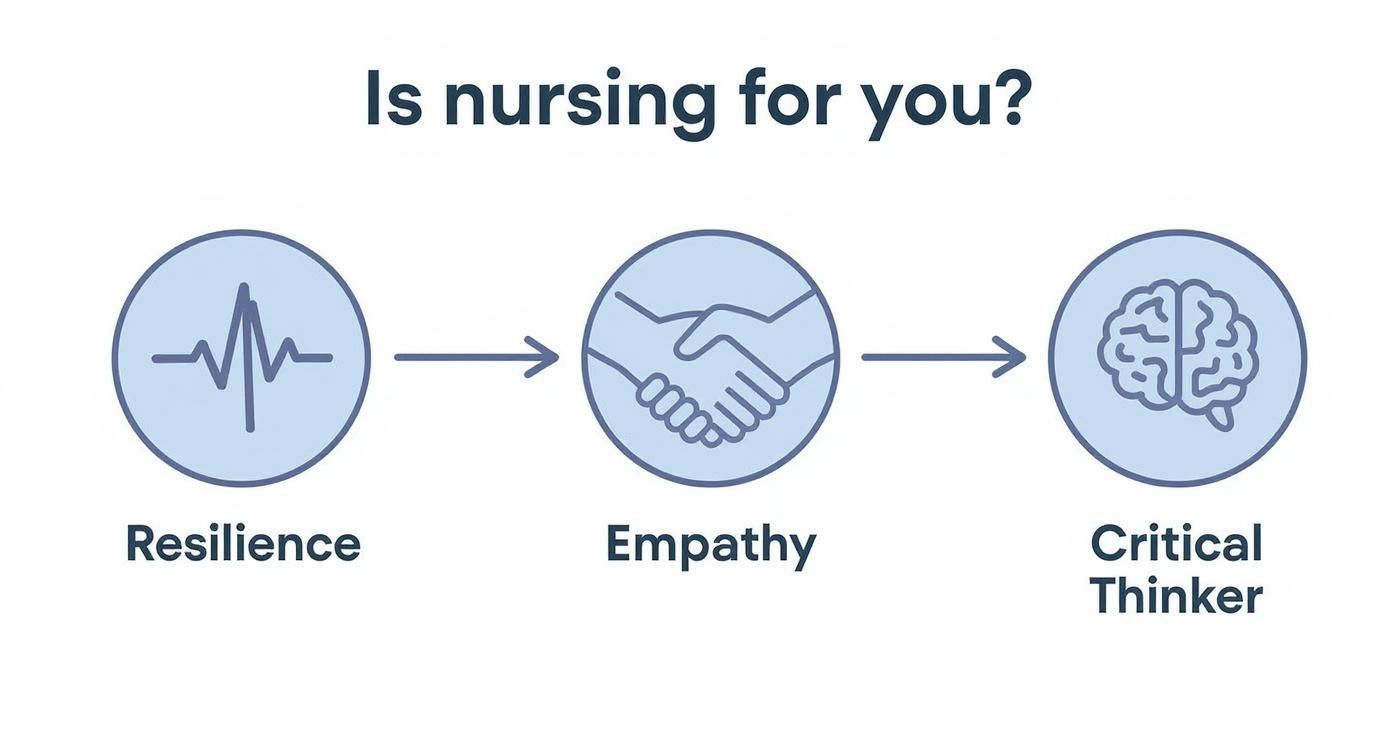
As you can see, it’s that unique blend of resilience, empathy, and sharp thinking that forms the bedrock of nursing. Knowing this can help steer you towards the pathway that plays to your strengths.
The Traditional Undergraduate Degree
This is the route most people think of first: the full-time, three-year BSc (Hons) Nursing degree. It’s the standard path for anyone who doesn't already have a degree. You'll split your time roughly 50/50 between university lectures and hands-on clinical placements.
This option is perfect if you’re starting your higher education journey from the ground up. It gives you plenty of time to build your skills and confidence across a wide range of healthcare settings without feeling rushed.
The Accelerated Postgraduate Route
Already have a bachelor's degree in another subject? Then the postgraduate route is a seriously efficient way to qualify. These courses, usually a Postgraduate Diploma (PGDip) or a Master's (MSc), squeeze the nursing curriculum into an intensive two-year programme.
Be warned, this path is fast and demanding. It’s designed for people who can use their existing academic skills to hit the ground running. It’s a hugely popular choice for career changers who want to get into the workforce as quickly as possible, but that also means competition for places is fierce.
A Quick Tip: Don't write off your previous degree, even if it feels completely unrelated. A background in psychology, sociology, or even business gives you a unique perspective on patient care and communication that universities really value.
The Nursing Degree Apprenticeship
One of the newest and most popular options is the Nursing Degree Apprenticeship. This route completely flips the traditional model on its head. You get to work in a healthcare setting—often starting as a healthcare assistant—while studying for your nursing degree part-time.
And the best bit? You earn a salary while you train, and your employer pays your tuition fees.
This pathway usually takes about four years and is a fantastic choice if you simply can't afford to stop working. The hands-on, learn-as-you-go approach is perfect for many adult learners, as you’re applying what you learn in the classroom to real-life situations from day one.
To make things a bit clearer, here’s a table comparing the main entry routes side-by-side.
Comparing UK Nursing Entry Routes for Career Changers
This table gives you a quick snapshot of the main pathways into nursing, helping you compare the duration, typical entry requirements, and the kind of person each route is best suited for.
| Pathway | Typical Duration | Common Entry Requirements | Ideal For |
|---|---|---|---|
| BSc (Hons) Nursing | 3 Years (full-time) | A-Levels, BTEC, or an Access to HE Diploma, plus GCSEs | Individuals without a prior degree seeking a comprehensive foundation. |
| PGDip/MSc Nursing | 2 Years (full-time) | An existing bachelor's degree (usually 2:2 or higher) and healthcare experience | Graduates from other fields who want the fastest route to qualification. |
| Degree Apprenticeship | 4 Years (approx.) | Employer sponsorship, relevant Level 3 qualifications, and GCSEs | People who need to earn a salary while studying and prefer hands-on learning. |
Ultimately, choosing your path is a balancing act between your timeline, your finances, and how you prefer to learn. The traditional degree offers depth, the postgraduate course offers speed, and the apprenticeship offers a practical, debt-free alternative. By thinking carefully about what works for your life, you can confidently take the first step in your career change to nursing.
Meeting Entry Requirements as an Adult Learner

The idea of university entry requirements can feel a bit overwhelming, especially if it’s been years since you last sat in a classroom. For many people dreaming of a career change to nursing, academic qualifications seem like the biggest hurdle.
But here’s the good news: the system is actually designed to welcome adult learners. Universities absolutely recognise that your journey and experience are massive assets.
They understand that mature students bring a different kind of wealth to the table. Life and work have already equipped you with skills that can’t be taught in a lecture hall—resilience, managing your time, and the ability to connect with people from all walks of life. These are the very qualities that make an exceptional nurse.
And let's be honest, the need for skilled nurses is huge. With over 60,000 NHS nursing vacancies in England alone, there's a real drive to attract dedicated people from all backgrounds. This has led to more flexible entry routes and a much greater appreciation for the skills career-changers bring.
Tackling the Essential Qualifications
So, let's break down what you actually need. Pretty much every nursing degree in the UK will ask for GCSEs (or an equivalent) in English and Maths, usually at grade C/4 or above. If you don't have these, don't panic. You’ve got a few straightforward options.
Many local colleges offer evening or part-time GCSE courses, which are great for fitting around your current commitments. Another popular—and often faster—route is completing Functional Skills Level 2 qualifications. These are widely accepted by universities as GCSE equivalents and are designed to teach practical, real-world skills.
The Access to HE Diploma: Your University Passport
For anyone without A-Levels, the Access to Higher Education Diploma (Nursing) is your most direct path to a degree. This qualification is created specifically for adult learners like you, preparing you academically and building your confidence for university life. It usually takes just one year.
The curriculum is tailored to give you the exact knowledge you'll need, covering modules like:
- Human Biology
- Psychology
- Sociology
- Professional Healthcare Practice
- Health and Wellbeing
An Access to HE Diploma isn't just about memorising facts; it's about learning how to learn again. It teaches you academic writing, research skills, and critical thinking, making sure you're not just qualified but fully prepared to hit the ground running from day one of your nursing degree.
Completing this diploma shows admissions tutors that you are serious, committed, and ready for the challenges of a nursing course. Many providers offer this course fully online, giving you the flexibility you need to juggle study with work and family. For a deeper dive into what universities are looking for, check out these specific nursing degree entry requirements.
Leveraging Your Life and Work Experience
Never, ever underestimate the power of your professional background. The skills you've spent years developing in a completely different industry are incredibly valuable in a healthcare setting. When you write your personal statement, this is where you get to shine.
Think about your past roles and reframe your experience through a healthcare lens.
- Customer Service or Retail? You have deep experience in communication, conflict resolution, and handling tough situations with empathy.
- Office Admin or Management? You're a pro at organisation, time management, prioritisation, and teamwork.
- Parenting or Caring for a Relative? You have first-hand experience with compassion, advocacy, and managing complex emotional and practical needs.
Universities aren't just looking for academic stars; they want compassionate, resilient, and well-rounded people. Your journey, with all its unique twists and turns, makes you a stronger candidate. Frame it with confidence.
Crafting a Standout University Application
This is your moment. Your application is where you connect the dots between the career you've had and the nursing career you’re striving for. For anyone making a career change to nursing, the UCAS process isn't about fitting into a neat box; it's about selling your unique story and proving that your life experience has perfectly prepared you for this.
Admissions tutors aren't just scanning for academic potential. They’re looking for the human qualities that make an exceptional nurse—resilience, empathy, and a genuine understanding of the profession. This is exactly where your non-traditional journey becomes your greatest asset.
Writing a Compelling Personal Statement
The personal statement is the beating heart of your UCAS application. It's your one shot to show the person behind the qualifications. Instead of just listing what you’ve done, your goal is to tell a compelling story that links your experiences directly to nursing.
A common pitfall is simply saying you want to "help people." You need to dig much deeper than that. The key is to show, not just tell. A great way to structure your examples is using the STAR method (Situation, Task, Action, Result).
Think about it this way. A former retail manager could frame their experience like this:
"During a difficult de-escalation with an upset customer (Situation), my goal was to understand their frustration and find a solution (Task). By actively listening and showing empathy for their perspective (Action), I not only resolved the issue but also retained them as a loyal customer (Result). This taught me that compassion is the key to managing challenging situations—a skill I'm eager to apply in patient advocacy."
See how that turns a customer service role into a powerful demonstration of skills vital for nursing? Rummage through your own career history for moments where you showed:
- Communication: How did you navigate a tricky conversation or break down a complex idea for someone?
- Teamwork: When did you pull together with others to hit a goal, especially when the pressure was on?
- Problem-Solving: Describe a time you had to think on your feet to sort out an unexpected mess.
- Empathy: When did you genuinely connect with someone’s emotional state to give them better support?
Securing Strong References
Getting references when you’ve been out of a classroom for a while can feel daunting, but it's totally manageable. Don't stress if you can't track down an old university lecturer—universities are completely used to this scenario with mature applicants.
Your best bet is often a recent employer, especially a line manager. They can speak directly to your work ethic, reliability, and all those fantastic transferable skills like time management and professionalism. When you ask them, give them a quick rundown of the nursing course and mention the key qualities you'd love for them to highlight. It helps them write a reference that’s far more relevant and impactful.
And if you’ve recently completed an Access to HE Diploma, your course tutor is the perfect academic referee. They can comment directly on your readiness for the demands of degree-level study.
Preparing for University Interviews
An interview invitation means the university already sees your potential. Your job now is to bring that application to life. For career changers, nursing interviews often mix questions about your motivations with practical, scenario-based challenges.
Be ready to answer common questions with genuine confidence:
- Why nursing, and why now? Link your decision to specific moments or experiences in your life or career that cemented your choice.
- What do you understand about the 6 Cs of nursing? This shows you've done your homework. Be prepared to talk about Care, Compassion, Competence, Communication, Courage, and Commitment.
- How would you handle a difficult patient? Pull from your past experiences to show how you manage stress and conflict with empathy.
Some universities use Multiple Mini Interviews (MMIs), where you'll rotate through several short, scenario-based stations. These are designed to test your critical thinking and ethical judgement on the spot. You might be asked, for example, how you'd handle a disagreement with a senior colleague over patient care.
The goal isn't always to find the one "right" answer. It’s to see your reasoning process—how you think through a problem logically and compassionately. Reflect on your journey, practise telling your story, and let your unique experience shine.
Funding Your Studies and Managing Finances

Let's talk about the money. For anyone thinking about a career change to nursing, financial worries are often the biggest hurdle, especially if you already have a mortgage or family to support. But here's the good news: the UK has several funding options designed to make this big life change feel much more manageable.
Figuring out how to pay for your studies is a massive step in this journey. The financial support for nursing students has seen some big shifts over the years. UCAS data showed a 24% drop in nursing applicants between 2016 and 2023, which was heavily linked to the nursing bursary being removed in 2017.
Luckily, things are looking up. Financial support was partially brought back in 2020, and the number of students accepting places on nursing degrees is now on the rise again. This means dedicated support is out there – you just need to know where to find it.
Student Finance for Your Nursing Degree
For most people going down the traditional or postgraduate nursing degree route, the first port of call will be Student Finance England (or its equivalent in your part of the UK). This is the standard government loan system for higher education.
It’s usually split into two main parts:
- Tuition Fee Loan: This covers your course fees in full and gets paid straight to your university. You won't have to find a penny for fees upfront.
- Maintenance Loan: This is for living costs – think rent, food, and bills. How much you get depends on your household income and where you’ll be living and studying.
Don't let the word "loan" scare you. You only start repaying it once you've graduated and are earning over a certain amount. The repayments are just a small, fixed percentage of your earnings, not a huge chunk of your salary.
For a really detailed breakdown of what’s available, it’s worth checking out a full guide on student finance for mature students.
The NHS Learning Support Fund
Here’s where it gets even better. On top of the standard student loans, nursing students in England can also get the NHS Learning Support Fund (LSF). This is a package of grants, which means you don’t have to pay it back. Ever.
The LSF includes a few key bits of funding:
- Training Grant: A straight payment of £5,000 for each academic year.
- Parental Support: An extra £2,000 a year if you have at least one dependent child.
- Travel and Accommodation Expenses: You can claim back extra costs you rack up travelling to and from your clinical placements.
- Exceptional Support Fund: A grant of up to £3,000 a year for students who find themselves in severe financial difficulty.
This fund can be a real game-changer. It provides a financial cushion that often means you can cut down on part-time work and really focus on your demanding course and placements.
The Earn-While-You-Learn Apprenticeship Route
If taking on any student debt is a complete non-starter for you, then the Nursing Degree Apprenticeship is a fantastic alternative. With this option, you’re employed by a healthcare provider from day one, earning a salary while you train. Your employer also covers all of your university tuition fees.
You’ll usually work in a role like a Healthcare Assistant and be given time off to attend your university lectures and seminars. It takes a bit longer – typically around four years – but it offers incredible financial stability. As you weigh up your options, it's also smart to get clued up on how to handle student debt if you go down the loan route. There are some great resources that explain how to manage student loans to help you plan ahead.
Common Questions About Changing Careers to Nursing
Making the leap into nursing naturally brings up a lot of practical questions. You've done the soul-searching and have a rough idea of your path, but now it's time to get into the nitty-gritty. Let's tackle some of the most common queries we hear from adult learners who are right where you are now.
How Can I Get Healthcare Experience Before Applying?
This is a big one, and honestly, it’s non-negotiable for a strong application. It shows universities you're serious and gives you a real-world glimpse into what you're signing up for.
Your best bet is to look for paid roles like a Healthcare Assistant (HCA) or a support worker. These jobs throw you right onto the front line, giving you the kind of direct patient experience that application tutors love to see.
Volunteering is another fantastic route. Get in touch with your local NHS Trust's volunteer services department—they often have opportunities ranging from chatting with patients on a ward to helping out at mealtimes. You could also look into organisations like St John Ambulance or the Royal Voluntary Service. Even a non-clinical role, like a hospital porter, offers an incredible insight into the daily rhythm of a healthcare setting.
Can I Study Nursing Part-Time in the UK?
The short answer is yes, but it’s complicated. Part-time nursing degrees exist, but they are far less common than full-time options and typically stretch over five to six years. The real challenge is the mandatory placement hours, which often have to be done in full-time blocks, making it a real juggling act if you have other commitments.
A more practical choice for many is the Nursing Degree Apprenticeship. This route is built from the ground up to blend paid work with part-time study, offering a much more integrated and financially manageable way to qualify. The best advice is to check directly with your chosen universities on UCAS to see exactly what flexible study options they offer.
Don't assume "part-time" means fewer hours each week. In nursing, it usually just means the course is spread over more years. The placement requirements are just as intense, so make sure you understand how they're structured before you commit.
What Is a Realistic Timeline from Application to Qualification?
Knowing the timeline is key to planning your life around this massive (and exciting!) change. Here’s how it usually breaks down:
- UCAS Application: The main deadline for a September start is typically in January.
- Interviews: These usually run from January through to April.
- Preparatory Course (if needed): If you need an Access to HE Diploma, you'll need to factor in one full academic year before your degree even begins.
- The Degree Itself: A standard BSc takes three years, while an accelerated postgraduate course is two.
All in, from the day you start an Access course to the day you qualify as a registered nurse, you should realistically plan for a three-to-four-year commitment. An apprenticeship pathway is usually about four years from start to finish.
I Have a Degree in an Unrelated Subject—Do I Have to Start Over?
Absolutely not! In fact, your previous degree gives you a major advantage. If you have a bachelor's degree (usually a 2:2 or higher), you're the perfect candidate for an accelerated Postgraduate Diploma (PGDip) or Master's (MSc) in Nursing. These are intense, two-year courses designed specifically to build on the academic skills you've already mastered.
This is the fastest graduate entry route into nursing. You’ll still need your Maths and English GCSEs and some relevant healthcare experience, but you get to skip starting a three-year undergraduate degree from scratch. Just be aware that these courses are fiercely competitive, so you’ll need a standout application that clearly connects the skills from your previous career to nursing.
Once you've finished your studies and are ready to hit the job market, a polished CV is crucial. You can find detailed advice on putting one together with these best nursing resume tips to make sure your experience truly shines.
At Access Courses Online, we specialise in helping adults just like you get the qualifications needed to kickstart their university journey. Our flexible, accredited online courses are designed to fit around your life, providing the perfect stepping stone to your new career in nursing.