
Think of an Access to Higher Education online course as your personal bridge, connecting where you are now directly to the university degree you've always wanted. It's a nationally recognised qualification designed specifically for adults who are ready to get back into education but don't have the traditional A-levels. It's a flexible, online pathway that gives you the exact academic tools you need to succeed.
What Are Access to Higher Education Online Courses?

Simply put, an Access to Higher Education (HE) Diploma is a Level 3 qualification, which is the same level as three A-levels. Universities all over the UK really value these diplomas because they’re built from the ground up to prepare adult learners for the unique challenges of degree-level study.
Unlike A-levels, which can cover a wide range of subjects, an Access to HE Diploma is laser-focused on a specific degree path, whether that’s Nursing, Business, or Computer Science. This means you’ll be studying modules that are directly relevant to your future degree, so you'll walk onto campus already equipped with a solid base of knowledge and the right academic skills.
You'll get hands-on experience with the essentials: learning how to research properly, structure a compelling academic essay, and reference your work correctly. These are the skills that make all the difference when you're at university.
Who Are These Courses For?
Access to HE online courses are built with the adult learner in mind. They’re a perfect fit if you've been out of the classroom for a few years and are looking to kickstart a new career or climb higher in your current one. The main people who benefit are:
- Career Changers: Professionals who are ready for a complete change of direction, like someone moving from a retail job into midwifery.
- Aspiring Students Without A-levels: Individuals who didn't follow the traditional academic route after school but now have the drive to earn a degree.
- Parents and Carers: Anyone needing a flexible study schedule that can fit neatly around family life and other responsibilities.
To get a real feel for how these courses work, it helps to understand the concept of distance learning education. This flexible model is what gives you the freedom to study without being tied to a campus schedule.
The real power of an Access to HE Diploma lies in its ability to unlock potential. It acknowledges that valuable skills are gained through life and work experience, providing a formal structure to translate that experience into academic readiness.
The Growing Appeal of Online Study
The demand for flexible learning has absolutely soared, making access to higher education online courses more popular than ever. The COVID-19 pandemic certainly sped this up, showing everyone the real-world benefits of being able to study from home.
Recent figures show that by 2025, around 21% of the UK population had been involved in some kind of online education. This boom is all down to the incredible flexibility that lets you balance your studies with your job and personal life—a total game-changer for adult students.
How Online Access to HE Courses Are Structured and Assessed
Starting an access to higher education online course can feel a bit like learning to read a new map. Getting your head around the structure and how you’ll be assessed is the key to navigating your journey to university with confidence. Unlike a traditional classroom, the online format is built for real life – letting you fit your studies around your commitments, not the other way around.
At the heart of every Access to HE Diploma is a clear, consistent framework. Think of it as a solid blueprint for building your academic future. Every single course is made up of 60 credits, which is the total value that universities across the country recognise. This structure guarantees that no matter where you study, your qualification meets a national standard.
But not all credits are created equal. They’re split into two different types, and each plays a vital role in getting you ready for university. This smart system lets admissions tutors see not just that you've done the work, but how well you’ve grasped the skills needed for a degree.
Understanding the 60-Credit Framework
That 60-credit structure is your roadmap to the finish line. It’s broken down into smaller, manageable chunks called units or modules, each tackling a specific topic. Imagine each one as a building block; by the end, you’ll have built a complete foundation of knowledge.
Out of the 60 credits, 45 are ‘graded’. These are the core academic units directly linked to your chosen career path – think Biology for a Nursing diploma or Law for a Social Science one. On these, you’ll be awarded a Pass, Merit, or Distinction. Universities really focus on these grades and often make offers based on how many distinctions you achieve.
The other 15 credits are ‘ungraded’. These typically cover essential study skills like academic writing, research, and referencing. For these, you simply need to pass them to earn the credits.
This dual system has a very clear purpose:
- Graded Units (45 credits): These showcase your academic talent and deep understanding of your chosen subject.
- Ungraded Units (15 credits): These confirm you’ve got the practical skills to handle university-level assignments.
This credit-based structure gives university admissions tutors a transparent and reliable way to gauge your readiness. They can instantly see your performance in relevant subjects and your skill in core academic tasks, making it easy for them to assess your application.
How Your Knowledge Is Assessed
One of the best things about online Access to HE courses is how you’re assessed. Forget the stress of a single, three-hour exam that decides your entire future. Instead, you're assessed continuously through coursework you submit as you go.
This approach just makes sense for adult learners. It lets you focus on one assignment at a time, apply what you've learned in a meaningful way, and get regular feedback from your tutor. This helps you build momentum and confidence as you move through the course. The aim is to measure your understanding, not just your memory.
Common ways you'll be assessed include:
- Essays and Written Reports: The classic way to test your ability to research a topic, build a solid argument, and communicate your ideas clearly.
- Case Study Analyses: You’ll get a real-world scenario to break down, helping you apply theory to a practical situation.
- Presentations: Often submitted as a recorded video or a slide deck with notes, this shows you can pull information together and present it effectively.
- Academic Posters: A great way to present research findings visually and concisely – a skill you'll definitely use at uni.
This mix of assessments ensures you develop a truly well-rounded set of academic skills. By the time you finish, you won’t just have a qualification; you’ll have a whole portfolio of work that proves you’re ready for whatever university throws at you. It’s this practical approach that helps students who complete access to higher education online courses adapt so well to degree-level study.
Exploring Pathways to Your Future Career
Choosing an access to higher education online course is the first big step towards a new career, but it’s the specific pathway you select that really maps out your future. This isn't just about ticking a box to get a qualification; it's about drawing a straight line from where you are now to your dream profession.
Think of each diploma as a specialist toolkit. If you want to become a nurse, your kit needs to be full of things like human biology and psychology. Aiming for a career in business? Then you'll need marketing principles and financial know-how. The diploma you choose makes sure you turn up to university with the right tools already in your belt, ready to start building on a solid foundation.
This focused approach is what makes these courses so powerful. You're not just studying to get into university; you're actively preparing for the real-world challenges and opportunities of your chosen field from day one.
From Course Modules to University Degrees
So, how does a set of online modules actually turn into a university place and, down the line, a professional career? It’s a very deliberate progression, where every unit you study has a clear purpose. Each one is a stepping stone to the next stage of your journey.
Let's say you enrol on the Access to HE Diploma (Nursing). Your learning will be built around core scientific principles and the realities of healthcare practice.
You’d typically study modules like:
- Human Anatomy and Physiology: This gives you the fundamental biological knowledge that every single healthcare degree is built on.
- Psychology and Sociology of Health: Here, you'll explore how social factors and mental wellbeing affect a patient's health – a vital concept in modern nursing.
- Professional Skills for Healthcare: This unit gets down to the practical skills of communication, ethics, and patient care that are essential for the job.
By getting to grips with these subjects, you’re doing more than just earning credits. You’re building the exact academic profile that university admissions tutors for BSc (Hons) Nursing or Midwifery degrees are looking for. You’re proving you can handle both the scientific rigour and the compassionate understanding the role demands.
Charting Your Course to Professional Success
This same principle works across a huge range of professions. The sheer variety of access to higher education online courses available means there's a clear, structured path to almost any graduate career you can think of. The key is simply to match your long-term goal with the right diploma.
Take another popular route: the Access to HE Diploma (Business and Management). This pathway gets you ready for degrees in fields like marketing, finance, or human resources.
The real value of a specialised diploma is its direct relevance. It cuts through the noise and focuses your learning on what truly matters for your future career. This makes your university application stronger and your transition into degree-level study so much smoother.
This course would likely include units on business law, marketing fundamentals, and economic principles. Finishing it successfully opens doors to degrees like a BA (Hons) in Business Management or a BSc in Marketing. From there, you're on track for professional roles like Marketing Manager, Financial Analyst, or HR Business Partner. Every step is a logical and connected part of your career plan.
To help you see how it all connects, we’ve put together a table showing how common diplomas line up with university degrees and potential careers.
Common Access to HE Pathways and Potential University Degrees
This table matches popular online Access to HE Diplomas with the university degrees they prepare you for, helping you visualise your educational journey.
| Access to HE Diploma Pathway | Typical University Degrees | Potential Career Fields |
|---|---|---|
| Health and Social Care | BSc Social Work, BA Health and Social Care | Social Worker, Community Support Officer |
| Science | BSc Biology, BSc Chemistry, BSc Forensic Science | Laboratory Technician, Research Scientist |
| Computer Science & IT | BSc Computer Science, BSc Software Engineering | Software Developer, IT Project Manager |
| Education | BA (Hons) Primary Education with QTS | Primary School Teacher, Education Consultant |
This direct alignment takes the mystery out of returning to education. You can see exactly how the work you put in today will pay off in the professional world tomorrow. Your online course becomes more than just study; it becomes the first, and most important, investment in your future.
How to Verify Your Course Is Fully Accredited
Before you put your time and money into an access to higher education online course, you need to be absolutely sure it’s the real deal. Accreditation isn't just some fancy sticker they put on a website; it’s your guarantee that the diploma you earn will be recognised and respected by universities right across the UK.
Think of it as the official quality mark for your education. It confirms that your course has been properly checked against strict national standards. Without it, you could spend a whole year working your socks off only to end up with a qualification that universities simply won’t accept. That would be a heartbreaking end to your degree aspirations.
The Role of the QAA
The first and most important name you need to get familiar with is the Quality Assurance Agency for Higher Education (QAA). The QAA is the independent body that keeps an eye on the standards and quality of UK higher education. In short, they are the guardians of the Access to HE Diploma.
Any legitimate Access to HE Diploma, whether you study it online or in a classroom, must be licenced by the QAA. This is completely non-negotiable. When you’re browsing a course provider’s website, you should easily spot the official QAA logo. If you can't find it anywhere, that’s a massive red flag.
Identifying the Awarding Organisation
Now, the QAA doesn't actually award the diplomas themselves. Instead, they authorise specific organisations, known as Awarding Organisations (AOs), to develop, approve, and ultimately award the Access to HE Diplomas. These are the bodies that make sure the course content is up to scratch and meets the right standards.
You'll come across several AOs in the UK. Some of the most common ones you'll see for online courses include:
- OCN London: A really well-established organisation that creates courses for a massive range of sectors.
- Ascentis: A national awarding body with a strong focus on creating clear, straightforward pathways to university.
- Open College Network West Midlands: Another key player in developing and validating Access to HE Diplomas.
A legitimate provider will always be transparent about its Awarding Organisation. They should clearly state which AO validates their diplomas. If this information is hidden or unclear, you should proceed with extreme caution.
Your final diploma certificate will actually come from the Awarding Organisation, not the college or online provider you study with. Checking this relationship is a crucial step. If you're ever in doubt, you can usually head over to the AO’s own website and look for a list of their approved centres. It’s a simple check that gives you peace of mind, knowing your qualification will be nationally recognised.
For a deeper dive, you can learn more about whether online access courses are recognised in our detailed guide.
Your Accreditation Checklist
To protect yourself and make sure you're choosing a high-quality, valid course, just follow these simple steps. This little checklist will help you confidently sort the genuine providers from those offering qualifications that aren't worth the paper they're printed on.
- Look for the QAA Logo: First things first, check the provider’s website for the official licenced Access to HE logo. If it’s not there, that’s a serious warning sign.
- Identify the Awarding Organisation: Find out which AO validates the course. You want to see names like OCN, Ascentis, or Open College Network.
- Confirm with the AO: If you have any doubts at all, visit the Awarding Organisation’s website. Many of them have a searchable list of approved course providers you can check.
- Check for Transparency: A trustworthy provider will be upfront and proud about their accreditation. They'll want to show you who they work with.
By taking a few moments to follow these steps, you can be confident that all your hard work will lead to a valuable diploma that opens doors to your future, rather than closing them.
Navigating Funding and Financial Support
Thinking about returning to education is a huge step, but the thought of the cost can often feel like a massive hurdle. Let’s clear up one of the biggest myths right away: you don't need to have all the money upfront to start an access to higher education online course. The truth is, there are financial support systems in place designed to make this journey affordable and a lot less stressful.
For most students in England, the main route to funding is the Advanced Learner Loan. This isn’t like a typical bank loan; it’s backed by the government, isn't based on your income, and doesn’t involve a credit check. It’s built to cover your course fees, taking that immediate financial weight off your shoulders so you can focus on what really matters – your studies.
Unlocking the Advanced Learner Loan
You can think of the Advanced Learner Loan as the key that opens the door to your education, without you needing to pay anything at the start. It’s a pretty straightforward system run by Student Finance England, and the rules for who can get it are simple for most UK residents.
Generally, you just need to be:
- Aged 19 or over on the first day of your course.
- Living in the UK when your course begins, and have lived in the UK, Channel Islands, or Isle of Man for the last three years.
- Studying with an approved provider for a valid Level 3 qualification, which an Access to HE Diploma is.
The application is all done online and is separate from your course enrolment. It's designed to be painless, and the money goes directly to your course provider, so you never even have to handle it yourself.
But the most powerful part of the Advanced Learner Loan is what happens after you finish your Access to HE Diploma. It's a little-known detail that essentially makes the course free for most students who continue on to university.
The 'Write-Off' Rule Explained
This is the part that makes the Advanced Learner Loan such a game-changer. Once you pass your Access to HE Diploma and then go on to complete a higher education course (like a university degree), Student Finance England will completely write off your outstanding Advanced Learner Loan balance.
Yes, you read that right. If you use the loan for your Access course and then finish your degree, you won’t have to pay a penny of it back. The loan is simply cancelled. This policy exists to encourage adults just like you to get back into education and bridge the gap to university without worrying about piling up two sets of debt. It’s an incredible incentive.
When looking into financial help for your studies, it's also worth exploring all your options, including things like grants for student loans.
Exploring Other Financial Avenues
While the Advanced Learner Loan is the most popular way to fund a course, it's not the only way. Providers of access to higher education online courses know that everyone's financial situation is different, and they often offer other ways to manage the cost.
Here are a couple of other options you might find:
- Interest-Free Payment Plans: Many online colleges let you spread the cost of your course over a fixed period, like 12 months, with simple direct debit payments. This is a great choice if you’d rather self-fund without taking on a loan.
- Bursaries and Scholarships: These are less common for Access courses, but it's always worth asking. Some providers or charitable trusts might have small grants available for students in specific situations.
Getting your head around the funding is a crucial first step. For a much deeper dive into the details, you might find our ultimate guide to Access to Higher Education funding really helpful. By exploring all these paths, you can turn your dream of returning to education into a financial reality.
Your Step-By-Step Enrolment and University Application Plan
Getting from choosing your access to higher education online course to holding a university offer can feel like a massive task, especially if it’s been a while since you were last in a classroom. But don’t worry. The trick is to break it all down into a simple, manageable plan.
Think of this as your personal roadmap to success. By tackling one stage at a time, you’ll build momentum and confidence, keeping you on the right track from your very first enquiry all the way to your first day on campus.
Step 1 Research and Select Your Provider
First things first, you need to find the right online provider and the perfect course for your future ambitions. Not all colleges are created equal, so your best bet is to focus on those with a proven track record of helping adult learners just like you succeed.
Look for a provider that is completely open about its accreditation with the QAA and its specific Awarding Organisation. It’s also a great idea to check for genuine student testimonials and success stories – they offer real insight into what the learning experience and tutor support are actually like. Most importantly, make sure they offer the exact diploma pathway you need for the university degree you’re aiming for.
Step 2 Confirm University Entry Requirements
Before you even think about enrolling, it’s vital to do a bit of reverse-engineering. Pinpoint a few universities you’d love to attend and look up the specific entry requirements for your chosen degree. Most will tell you exactly what they expect from Access to HE Diploma students.
Universities will often be very clear about the number of credits you need at Distinction and Merit. For instance, a competitive nursing degree might ask for 45 credits at Level 3, with 30 at Distinction and 15 at Merit. Knowing this target from day one gives your studies a clear purpose and helps you stay focused.
This infographic shows just how straightforward it can be to fund your course with an Advanced Learner Loan, from the initial application right through to having the loan written off when you finish your degree.
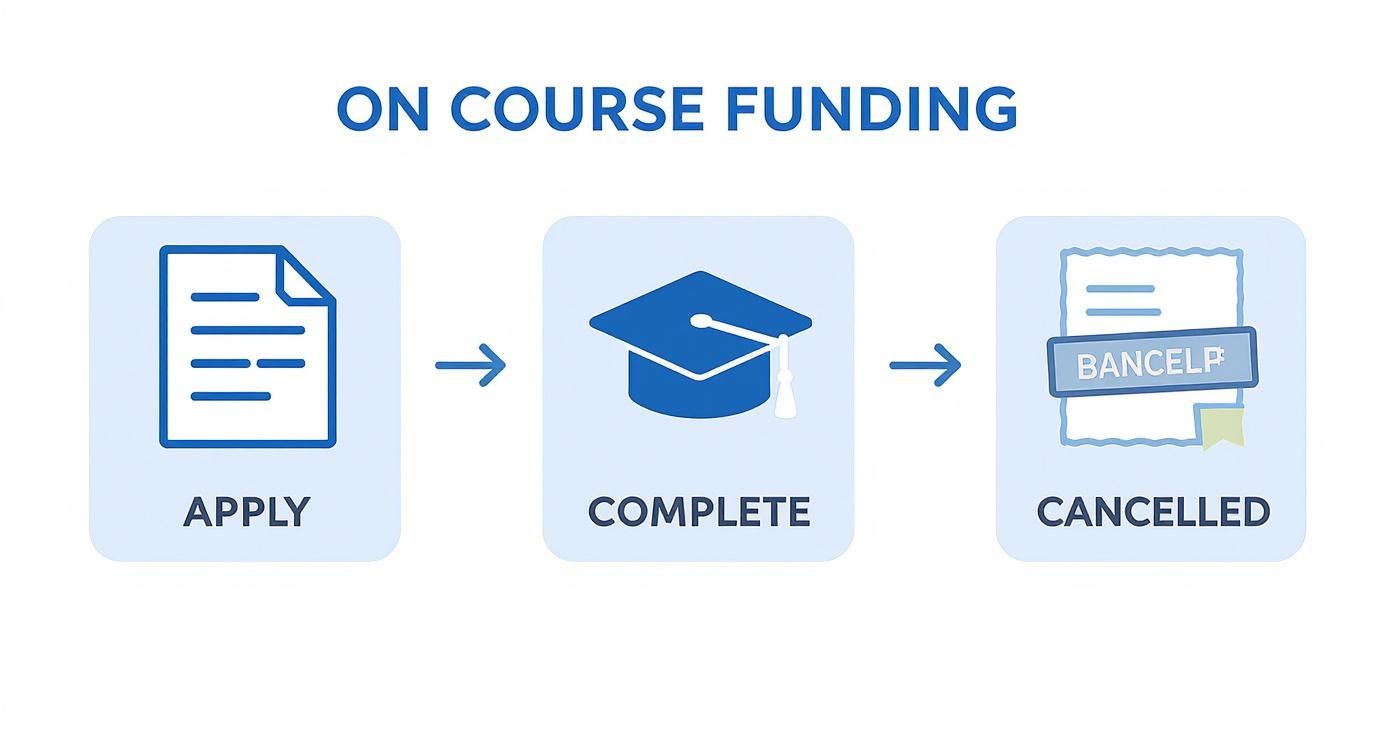
As you can see, the loan is completely cancelled after you finish your higher education course, which essentially makes your Access diploma free. It’s a brilliant system.
Step 3 Complete Your Online Enrolment
Once you’ve picked a provider and double-checked the entry requirements, the enrolment process is usually refreshingly simple. Most online colleges have a straightforward application form on their website. You'll typically just need to provide some basic personal details and perhaps answer a few questions about your goals.
This is also the point where you’ll sort out your funding. If you’re using an Advanced Learner Loan, you’ll complete that application through the Student Finance England portal. If you're self-funding, you’ll set up your payment plan directly with the college.
Step 4 Apply to University Through UCAS
Here’s a great tip: you can start your UCAS (Universities and Colleges Admissions Service) application while you’re still studying for your diploma. Your online course tutor is your best friend here. They'll give you the "buzzword" needed to link your application to the college and, crucially, write your academic reference.
Without a doubt, your personal statement is the most important part of the whole UCAS application. This is your moment to shine and tell your story.
For adult learners, the personal statement is a powerful tool. Use it to showcase how your life and work experience have prepared you for university. Your maturity, resilience, and real-world skills are massive assets that set you apart from younger applicants.
Explain why you’re so passionate about your chosen subject and connect it to your personal journey and future career goals. To help you nail this vital step, check out our guide on how to apply to university after an Access course. A well-written statement can truly make all the difference.
Common Questions About Access to HE Online Courses
Jumping into any new course is a big decision, and it’s only natural to have a few questions. When it comes to Access to Higher Education online courses, we find that most people are curious about the same things: how much time it takes, how it fits into a busy life, and what it’s actually worth in the real world.
Let’s get right to it and tackle some of the most common queries we hear.
One of the first things people ask is about the time commitment. How many hours a week will you really need to study? While it varies, most providers suggest setting aside around 10 to 15 hours per week. This pace should see you comfortably finish the course in the typical nine months to a year. The best part about studying online? You get to decide exactly when and where those hours happen.
This freedom is a massive reason why online study has become so popular. In fact, recent data shows that more than two in five online learners pick their course based on how well it slots into their existing life schedules. It’s clear that flexible education is becoming essential for adults juggling work, family, and other commitments.
Will Employers Respect My Online Diploma?
This is a big one, and the answer is a resounding 'yes'. An accredited Access to HE Diploma is a nationally recognised Level 3 qualification, putting it on par with three A-levels. It doesn't matter if you earned it online or in a classroom; it's validated by the same official bodies, like the QAA.
Employers are less concerned about how you studied and more interested in what you can do. These courses are fantastic for demonstrating skills they actively look for, such as:
- Time management and self-discipline – proven by the very fact you’ve managed your own learning.
- Digital literacy and confidence using online tools.
- Strong research and writing skills, which you’ll sharpen with every assignment.
What really matters to universities and employers is the accreditation behind the qualification. They know you've met the same high academic standard as any student on a physical campus.
Another frequent question is about what you need to get started. Do you need a full set of GCSEs? For most Access to HE courses, the answer is no. They’re built for adults who might have taken a non-traditional path. Just keep in mind that the university degree you're aiming for will almost certainly require GCSEs in English and Maths at a grade C/4 or above.
Here at Access Courses Online, we provide clear, accredited pathways to university that are designed for the realities of adult life. Explore our range of courses today and take the first step towards the career you’ve always wanted.