

You've checked your email during a lunch break, between school runs, or after a shift, and there it is: a message saying you've been admitted to university. The relief arrives first. Then the questions follow. Does “admitted” mean your place is guaranteed? Do you still need to finish your Access to HE Diploma? What happens if your results aren't quite what you expected?
Adult applicants often face a more complicated route than school-leavers. You may be applying with work experience, an Access qualification, GCSE resits, or a mixture of older certificates. You may also need to use Clearing, balance an offer with family responsibilities, or make decisions long after the standard application window.
The good news is that UK higher education admits large numbers of students each year. In the 2025 UCAS cycle, 759,830 people applied and 577,725 were accepted onto UK undergraduate programmes, an overall acceptance rate of 76%, according to the UCAS end-of-cycle briefing. This guide explains what admission means, how offers work, why the Access to HE Diploma can be a practical route for adults, and how Clearing can keep your plans alive when the first outcome isn't the one you hoped for.
What Being Admitted to University Really Means
Maya opens her email during a work break. After years of considering Nursing, completing an Access course around family responsibilities, and submitting her UCAS application, she sees that the university has made a decision. UCAS Hub shows an offer, and the excitement is immediate.
The careful reading comes next. Her place depends on achieving the required Access grades and completing a particular science unit. She has not reached the final stage of admission yet. She has received an offer that can become a confirmed place after she meets those conditions.
Being admitted to university can describe several stages. It may mean receiving an offer, satisfying its requirements, having the university confirm your place, or completing enrolment. These stages are connected, but they are not interchangeable. The wording in UCAS Hub shows which stage you have reached and what action remains.
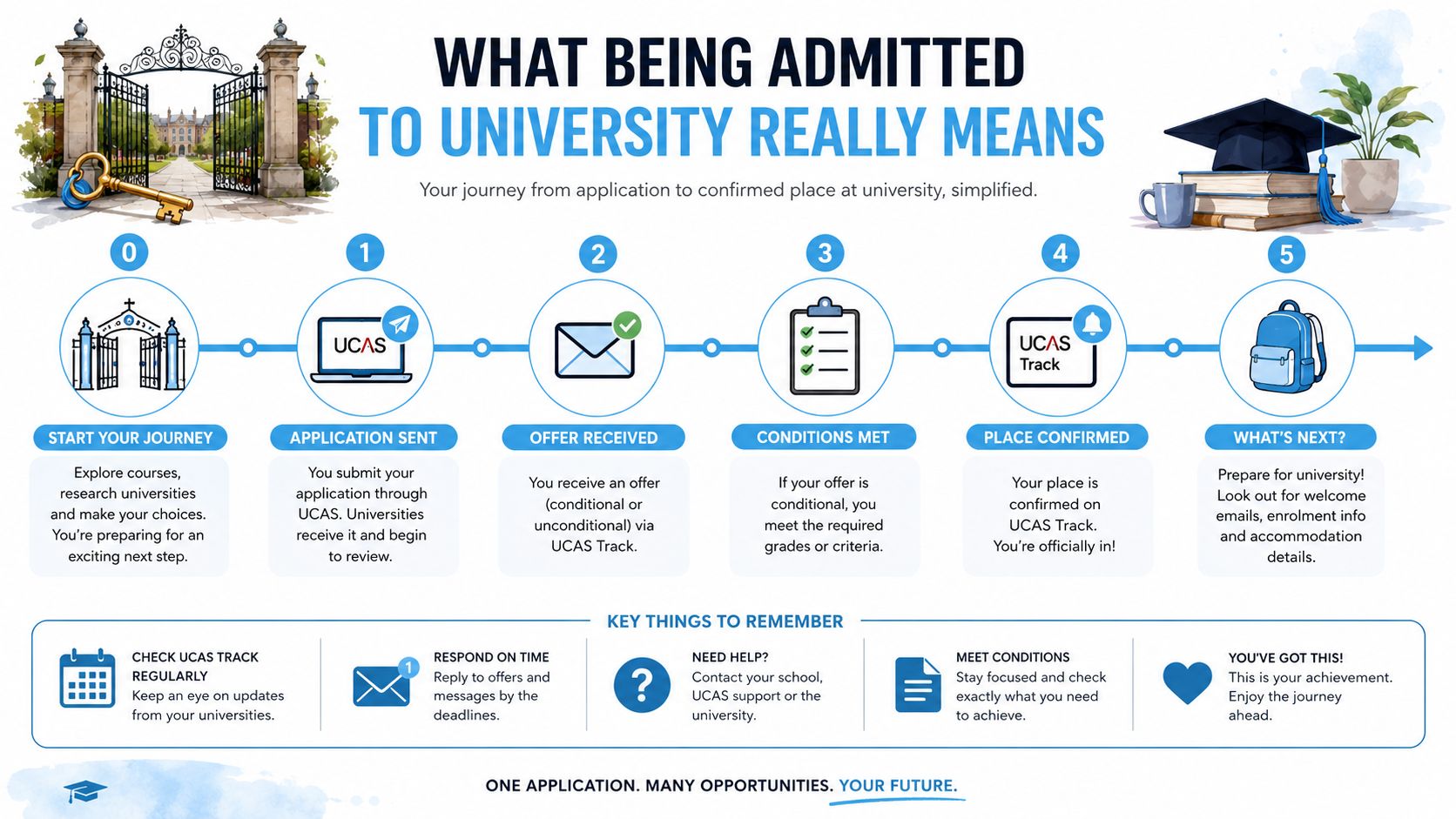
The four questions behind the email
An adult applicant needs practical answers before treating an admissions message as a finished result:
- What type of offer have I received? A conditional offer lists requirements you still need to meet. An unconditional offer confirms the academic place without those conditions, although administrative tasks may remain.
- When will my place become confirmed? The answer depends on your qualification results, outstanding documents, and the university's confirmation process.
- Can I improve my chances before a decision? A focused personal statement, relevant experience, a useful academic reference, and preparation for an interview or portfolio can strengthen an application.
- What happens if the offer does not become a place? Clearing and direct contact with universities may provide another route. This can matter to mature applicants who apply late, change direction, or need a course that fits work and family commitments.
The wider system is active, but broad acceptance figures cannot promise an individual outcome. Competitive courses may have stricter requirements, and an Access to HE applicant still needs to meet the exact conditions attached to the chosen course. The route may involve a standard application, Clearing, or another late-cycle option, particularly for adults whose qualifications and responsibilities do not follow the usual school-leaver timetable.
Read the conditions, not just the congratulations. The offer wording tells you whether you must achieve grades, submit evidence, pass checks, or complete another requirement before the university confirms your place.
Conditional, Unconditional, and Withdrawn Offers Explained
A UCAS offer can look reassuring while still leaving work to complete. For an adult applicant balancing study, employment, or family responsibilities, the wording matters because it tells you what must happen before a university confirms your place.
A conditional offer works like an agreement subject to final checks. The university is prepared to admit you if you meet specified academic or administrative requirements. An unconditional offer confirms the academic place without those conditions, but enrolment, identification, funding arrangements, or professional checks may still be outstanding.
A withdrawn offer means the university has removed its offer. The reason may relate to administration, missing information, or the application itself. Check your UCAS status and contact the university directly rather than relying on another applicant's experience.
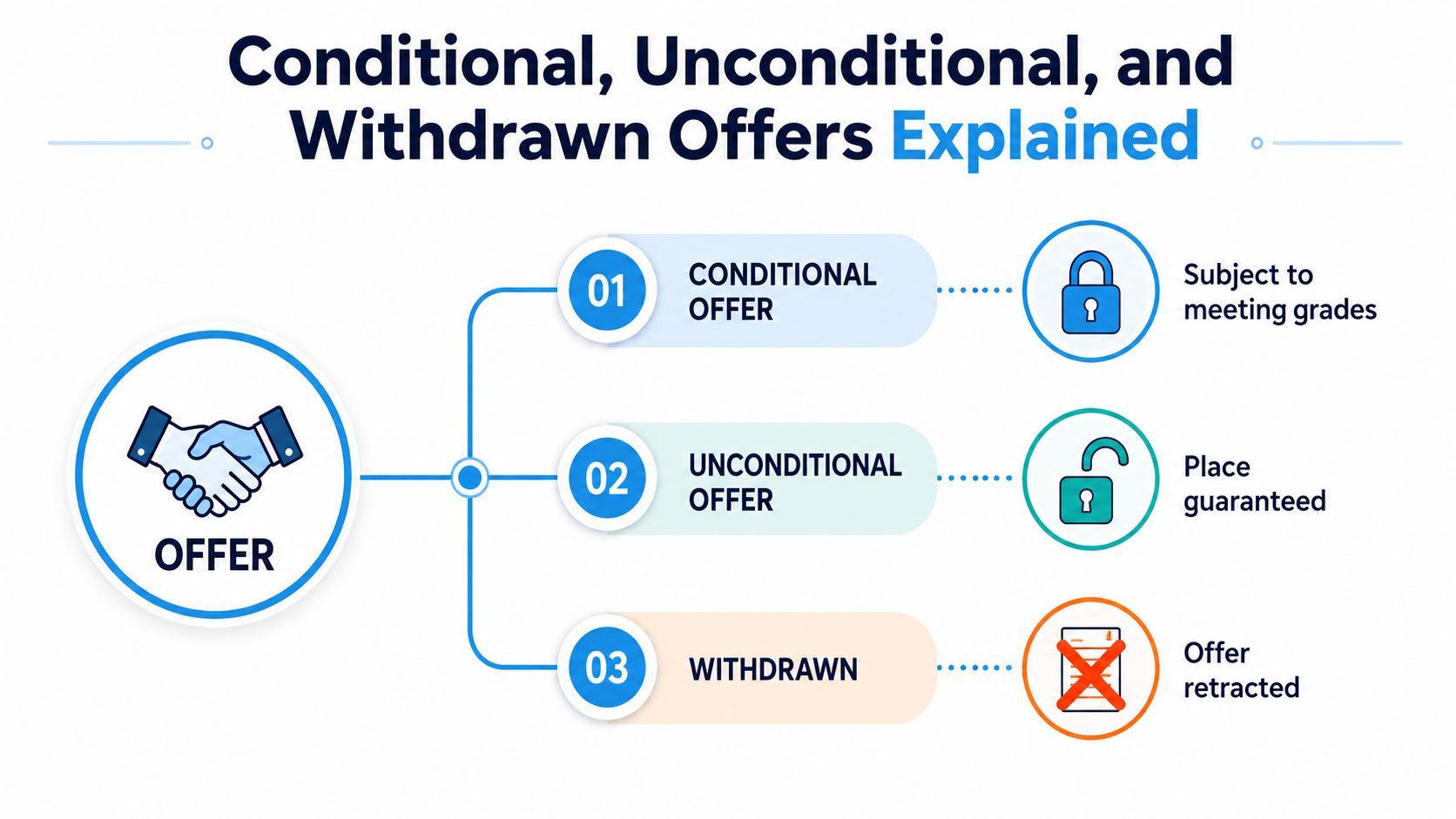
What conditions can include
Universities can attach conditions to qualifications you are completing or evidence you must provide. Common examples include:
- Access to HE Diploma results: You may need specified credits at specified grades, not merely a pass in the full Diploma.
- GCSE or Functional Skills requirements: Nursing, teaching, health, and other regulated or professional courses may require evidence in English, mathematics, or science.
- English language evidence: The university may request formal proof of language ability.
- Reference or document checks: Admissions staff may need clarification from your referee or proof of previous study.
- Health, safeguarding, or placement checks: Professional courses can require clearance before enrolment or before you begin a placement.
Read the exact wording. If you cannot tell whether a requirement applies to the whole Diploma or to particular units, ask admissions before making assumptions.
A practical UCAS timeline
Adult applicants do not always follow the school-leaver timetable. You may apply while studying an Access course, submit an application earlier to allow time for review, or need a later route after a change in work or family circumstances. A typical UCAS journey includes:
- Autumn application: You submit your application, personal statement, reference, and course choices.
- January consideration point: Applications submitted by the equal consideration deadline are normally reviewed within the main cycle.
- Spring decisions: Universities issue offers, rejections, or invitations to discuss an application.
- Results and confirmation: Your results are checked against the conditions attached to the offer.
- Late-cycle options: If no confirmed place is available, Clearing may provide another way to find a suitable course.
Your own sequence may differ. The key distinction is between an offer and a confirmed place. An offer shows that the university is willing to admit you under stated terms. Confirmation follows when those terms have been met and the institution records the place.
If UCAS terminology still feels unfamiliar, this short guide to UCAS and the adult application process explains the application route in accessible language.
For a visual explanation of how admissions decisions work, watch the following overview:
The Access to HE Diploma as a Route to Admission
Adults without traditional sixth-form qualifications have several possible routes into university. A-Levels are subject-based qualifications with a long-established role in undergraduate entry. BTECs can provide vocational and academic preparation, particularly where the target course accepts the relevant subject. Functional Skills or GCSE resits can help you meet individual English, mathematics, or science requirements, but they may not provide the full academic preparation needed for degree study.
The Access to HE Diploma is designed differently. It's an adult-focused qualification that combines subject content with academic skills such as research, referencing, written communication, and independent study. That makes it particularly relevant if you're returning to education after a long gap and need both an entry credential and a structured transition into university-level work.
Official data shows that 23,290 Access to HE students entered higher education in 2021-22, while 22,630 applicants were accepted for September 2021 entry, according to the Access to HE key statistics. The same dataset recorded 40,855 applicants in the cycle. Those figures show that Access is routinely connected to real university admissions, although your outcome still depends on course requirements, grades, application timing, and the relationship between your provider and your chosen universities.
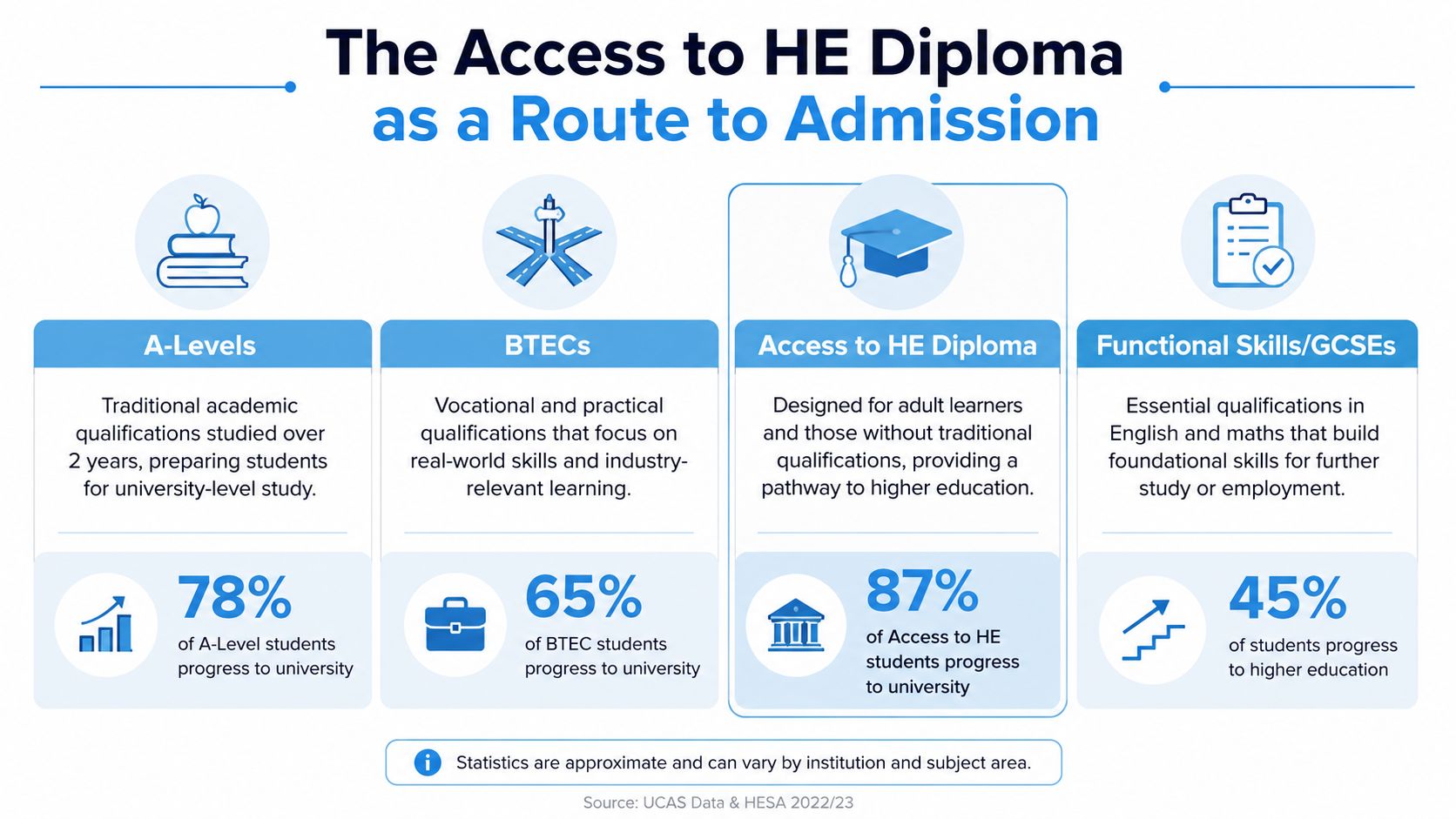
Progression depends on the provider
Official analysis found that 62% of Access course students progressed to a degree programme within four years, with 47% entering degree-level study within one year and a further 15% entering in years two to four, as reported by the Office for Students analysis. The same analysis found substantial variation between providers, so the qualification title alone shouldn't decide your choice.
Ask each provider:
- Does the diploma match my degree subject? A Nursing application needs different preparation from Computer Science or Social Science.
- Which universities regularly accept this diploma? Check the exact course page, not only the university's general admissions page.
- What grades and units will I need? A course may specify distinctions, merits, or particular subject modules.
- What support is available? Find out how tutors help with references, applications, study skills, and interview preparation.
- How flexible is the delivery? Online study can suit adults with work or caring responsibilities, but you'll still need a realistic weekly study routine.
The best route is the one that matches your target degree and circumstances. An adult who already has strong A-Level results may not need an Access Diploma. Someone without recent qualifications may find that Access offers a clearer bridge than collecting isolated certificates.
If you're comparing routes, this guide to the Access to HE Diploma explains how the qualification is used for university progression.
Strengthening Your Application as an Adult Learner
Your age isn't the weakness in your application. The risk is leaving your experience unexplained. Admissions tutors need to see how your work, responsibilities, previous study, and career decisions connect to the degree you're applying for.
Turn experience into evidence
A personal statement should explain why this subject, why now, and why you're prepared. Avoid listing every job you've held. Select experiences that demonstrate skills or motivation relevant to the course.
For a mature Nursing applicant, “I've always wanted to help people” is too broad. A stronger approach would explain how supporting a relative, working in a care setting, or volunteering exposed you to communication, dignity, teamwork, and the realities of healthcare. The applicant should then connect those experiences to the academic demands of Nursing and identify the areas they still need to develop.
A Computer Science career-switcher might describe solving workflow problems in a current job, teaching themselves a programming language, or building a small project. The key is not to claim professional expertise. It's to show curiosity, persistence, problem-solving, and a clear understanding of what studying Computer Science involves.
Admissions tutors don't need a perfect life story. They need a convincing academic reason for your next step.
A reference from an Access tutor can add useful evidence about your current study habits, written work, attendance, response to feedback, and readiness for degree-level learning. An employer can describe reliability and professional conduct, but a generic character reference won't replace subject-specific academic insight.
Prepare for selection beyond the form
Healthcare and teaching courses may assess communication, judgement, motivation, safeguarding awareness, or professional values. A portfolio-based course may ask you to explain your creative or technical decisions. Treat the invitation as an opportunity to demonstrate preparation, not as a test of whether you already know everything.
Use this study-session checklist:
- Personal statement: Link each major example to the degree.
- Reference: Ask your tutor or referee what evidence they can provide.
- Experience: Write down what you learned, not only what you did.
- Interview: Practise answering questions aloud, then listen for vague answers.
- Portfolio: Label your work and explain the process behind it.
- Course research: Read the modules, placement information, and entry requirements.
Applicants targeting highly selective healthcare degrees may also benefit from specialist preparation, such as Ace Med Boards admissions guidance, alongside the requirements published by each university. For help with the written part of the application, use this guide to writing a personal statement.
Clearing, Adjustment, and Late-Cycle Entry
A mature applicant may reach results day without a confirmed university place because work, family responsibilities, delayed decisions, or changing circumstances have altered the plan. Clearing provides a formal route between applicants in that position and universities with vacancies. It can therefore matter greatly to adults who are applying outside the pattern assumed for an 18-year-old school-leaver.
HEPI reported that 9,390 UK mature students were accepted through direct Clearing in 2024, an increase of 7.4% on 2023 and 22.7% on 2022, in its analysis of demand for higher education. These figures do not guarantee an offer for every adult applicant. They do show that missing the main cycle does not close every route into higher education.
How to act when results don't go to plan
Check your UCAS status first, then read every message from your universities. You may already have a place, or a university may reconsider your application if your results differ from its stated conditions.
If no place is confirmed, work through this sequence:
- Make a shortlist: Find courses with suitable content, realistic entry requirements, a workable location, and manageable placement arrangements.
- Prepare your details: Keep your UCAS personal ID, qualification results, Access units and grades, GCSE or Functional Skills results, and employment history ready.
- Call admissions: Ask whether the course accepts Clearing applications. Explain your qualification route, including your Access to HE Diploma, clearly.
- Ask precise questions: Confirm the course title, start date, attendance pattern, placement expectations, and any conditions still outstanding.
- Record the response: Note the adviser's name, requested documents, and the deadline for accepting an offer.
- Follow up promptly: Send evidence through the university's stated process and check UCAS Hub for the formal update. If you need a refresher on the system, review this guide to UCAS and how the application process works.
Your phone call can be simple: “Hello, I'm applying through Clearing for your [course name]. I have an Access to HE Diploma in [subject], and my results are [brief summary]. Could you tell me whether you're considering mature applicants and what evidence you need?”
Adjustment follows a different route. It may let an applicant who has exceeded the conditions of their firm choice explore a course with higher entry requirements. Keep your existing place secure while you check the process with UCAS and the university. Ask what changes, whether the alternative course has vacancies, and how accepting another option would affect your current offer.
From Offer Accepted to First Day on Campus
Receiving an offer is the start of a practical period, not the end of your application. Once you've compared the course content, teaching pattern, travel, placements, and support available, reply through UCAS Hub. Your firm choice is your preferred option, while an insurance choice can provide another route if you don't meet the firm conditions.
Then work through the administrative tasks in the order the university gives you:
- Complete enrolment: Upload identity documents, confirm your details, and respond to requests from admissions.
- Apply for Student Finance: Submit the relevant funding application as early as possible and check whether your course has additional placement or travel costs.
- Arrange Disabled Students' Allowance: If you have a disability, long-term health condition, mental health condition, or specific learning difficulty, ask Student Finance and the university support team what evidence is needed.
- Contact the mature-student team: Ask about induction, study skills, childcare information, commuting, and academic support.
- Review preparation materials: Read any summer work, online modules, reading lists, or equipment guidance before teaching begins.
A manageable eight-week countdown
Weeks one and two: Accept your offer, check conditions, begin funding applications, and tell your employer or family about key dates.
Weeks three and four: Complete university forms, investigate travel and childcare, and contact support services if you'll need adjustments.
Weeks five and six: Review academic materials, practise note-taking, refresh relevant subject knowledge, and plan realistic study time around work.
Weeks seven and eight: Confirm your timetable, travel route, technology, stationery, and first-day arrangements. Keep copies of important emails in one folder.
Adult learners often worry that university expects them to abandon their existing life. It doesn't, although a degree will require protected study time and honest conversations with the people who depend on you. Planning those arrangements before the first lecture is more useful than hoping the timetable will somehow solve everything.
Frequently Asked Questions for Adult Applicants
Can I be admitted to university without GCSEs?
Possibly. Universities set their own requirements, and some adult applicants use Functional Skills, GCSE resits, or an Access to HE Diploma to meet academic and subject conditions. Check the exact course page, especially for English, mathematics, and science requirements. The qualification discussion above explains how an Access route can combine preparation with progression.
What can I do if I apply late?
Contact universities directly and check Clearing rather than assuming the cycle is closed. Mature applicants may use direct Clearing, and the route can be suitable when your circumstances or qualification results changed after the main application period. Have your results, UCAS details, and course questions ready before you call.
How can I balance university with work and family?
Start with the timetable, placement expectations, travel, and independent study demands. Speak to the mature-student team before enrolment, create fixed study periods, and arrange childcare or work changes around compulsory teaching. Flexibility helps, but it doesn't remove the need for a consistent routine.
What if I receive no offers after results day?
Check your UCAS status, contact your original choices, and build a focused Clearing shortlist. Ask admissions teams whether they'll consider your qualification profile and whether alternative courses or start dates are available. Stay polite and specific on the phone, then follow every document request quickly.
The UK 18-year-old application rate was 40.6% in 2025, while the number of UK 18-year-olds applying by the January deadline reached 323,360, according to UCAS application data. Adult applicants don't need to copy the school-leaver journey. They need to understand the routes available and choose the next practical step.
Access Courses Online offers accredited online Access to HE Diploma courses for adults preparing for degrees including Nursing, Midwifery, Health Professions, Computer Science, Science, Social Science, and Business. If you need a flexible route that fits around work or family commitments, visit Access Courses Online to review course options and request guidance on your university application.