

If you’re thinking about going to university in the UK, there’s one name you’ll see everywhere: UCAS. So, what is it? Put simply, UCAS (the Universities and Colleges Admissions Service) is the single, centralised system you’ll use to apply for almost every full-time undergraduate degree course. It’s the one front door for your entire higher education journey.
Your Master Key to University Applications
Imagine trying to apply to several universities at once. You could spend ages filling out separate, lengthy application forms for each one, typing out the same information over and over again. It would be a nightmare.
Or, you could use a master key to unlock all those doors in one go. That’s exactly what UCAS is. It takes what could be an incredibly complicated and repetitive process and makes it simple.
Instead of trying to keep track of dozens of different deadlines and requirements, you just complete one application. That single submission is then sent out to all the universities you've chosen, saving you a huge amount of time and stress. It’s the central hub for undergraduate applications across the UK, covering courses in England, Wales, Northern Ireland, and Scotland.
To give you a better idea of its role, let’s break down what UCAS actually does for you.
UCAS at a Glance Key Functions
This table quickly sums up the main ways UCAS helps you on your path to university.
| Function | What It Means for You |
|---|---|
| Central Application Hub | You fill out just one application for up to five different courses. |
| Offer Management | This is where you’ll see your offers from universities and make your final choice. |
| Clearing & Extra | If things don’t go as planned, UCAS provides a safety net to help you find a spot. |
| Information & Guidance | It’s a huge resource for researching courses and getting application advice. |
| Tariff Points System | It provides a standardised way for universities to compare different qualifications. |
Essentially, UCAS streamlines the entire journey, from that first application to accepting your final offer.
Core Functions of UCAS
At its heart, the system performs three critical functions that will shape your application from start to finish. Getting your head around these is the first step towards a confident application.
- Processing Applications: UCAS gathers all your essential information—your personal details, qualifications, course choices, personal statement, and reference—and sends it to your chosen universities in a standard format they all understand.
- Managing Offers: Once universities have reviewed your application, they send their decisions back through UCAS. You then use the UCAS Hub to see your offers, accept them, or decline them. This is where you’ll select your main 'firm' choice and a backup 'insurance' choice.
- Providing Second Chances: If your results aren't what you hoped for, or if you change your mind, UCAS doesn’t leave you stranded. It provides structured routes like Clearing and Extra, which act as a safety net to help you find an alternative course or university place.
The real value of UCAS is its ability to create a level playing field. It ensures every applicant, whether you're fresh out of college or a mature student returning to education, follows the same clear process and is assessed fairly.
Ultimately, getting to grips with UCAS is your first practical step towards higher education. For many, especially those who’ve been out of the classroom for a while, this journey starts with a qualification like an Access to Higher Education Diploma, which is designed specifically to get you into university. It’s also important to know what support is available once you get there, such as navigating college disability accommodations.
Your Step-by-Step Guide to the UCAS Application
Looking at the UCAS application for the first time can feel a little overwhelming, but it’s really just a series of manageable steps. Think of each section as a building block, helping you create a complete picture of who you are and why you’re ready for university. The whole thing is handled through the UCAS Hub, which becomes your personal dashboard for the entire journey.
It all kicks off when you create an account on the UCAS Hub. This is where you’ll build, manage, and keep an eye on your application from start to finish. Once you’re in, you’ll work through a few different sections, filling in your details one piece at a time.
Building Your Application Section by Section
Your application is essentially your professional profile for universities. You’ll be asked to complete several parts, and each one has a specific job to do:
- Personal Details: This is the easy bit – your name, address, residency status, and other straightforward information.
- Course Choices: Here’s where you can list up to five different courses. They can all be at one university or spread out across several.
- Education History: You’ll need to list all your qualifications, like GCSEs, A-Levels, or your Access to HE Diploma. Accuracy is key here, so double-check everything.
- Employment History: If you’ve got any paid work experience, this is the place to add it. This part is gold for mature students, as it’s a chance to show off real-world skills and responsibility.
This diagram gives a great overview of how these first steps fit into the bigger picture of applying, managing your offers, and finally, securing your spot.
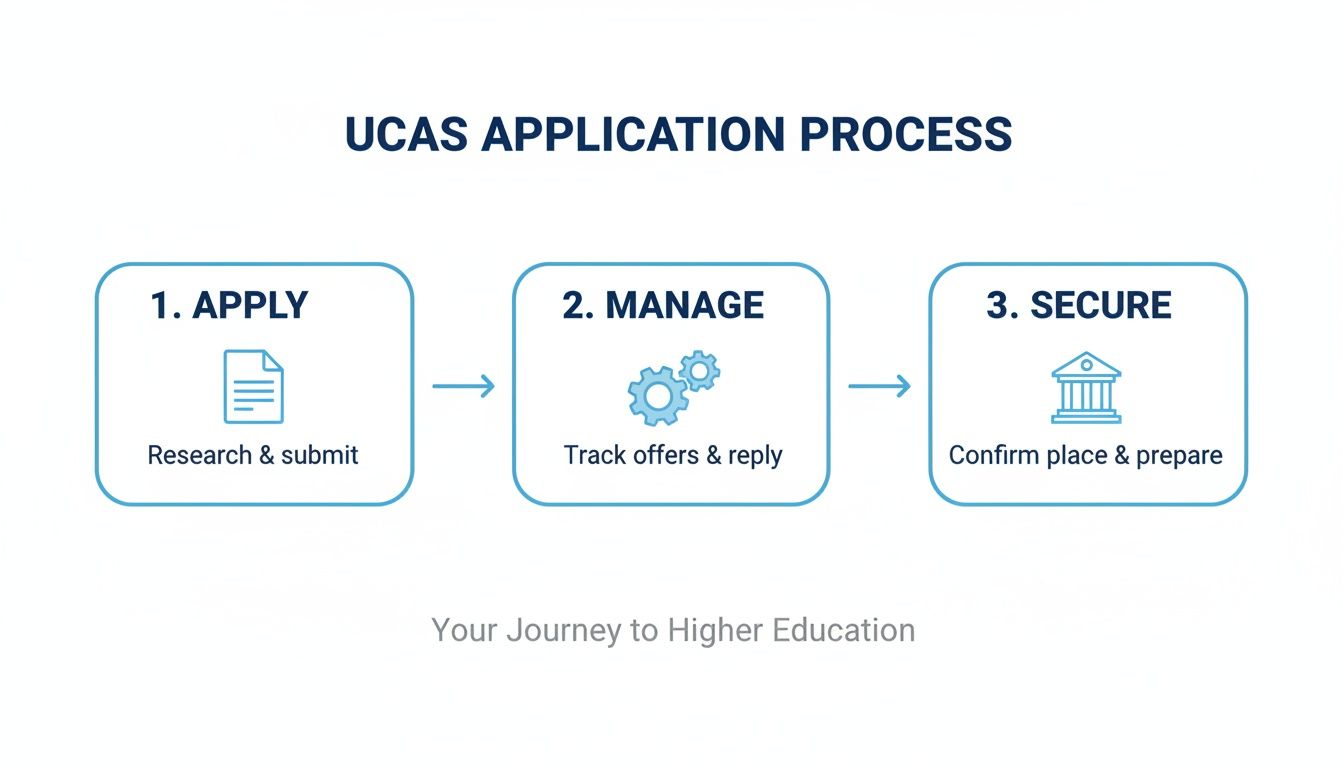
As you can see, getting the application submitted is just the beginning. The next stage is all about managing the offers that come rolling in.
Crafting Your Personal Statement
This is your moment to shine. The personal statement is, without a doubt, the most important part of your application. It’s a 4,000-character (or 47-line) piece where you get to tell universities exactly why you want to study their course. It’s your opportunity to go beyond just grades.
If you’re coming back to education, this is where you can connect your life experiences to your academic ambitions. You can talk about the skills you’ve picked up from work, volunteering, or even raising a family. An Access to HE Diploma, for instance, gives you a huge amount to write about – from specific modules that ignited your interest to the new study skills you’ve mastered.
Feeling a bit stuck? Don't worry, we've got you covered. You can learn more about how to write a compelling personal statement in our dedicated guide.
Your personal statement is your voice in the application process. It’s the one place you can directly communicate your passion, motivation, and suitability for the course, making a memorable impression on admissions tutors.
Securing a Strong Reference
The final piece of the puzzle is your reference. This is a written recommendation from someone who knows you well in an academic or professional capacity, like a tutor or a recent boss. They’ll be asked to comment on your character, work ethic, and your potential to do well at university.
Choose your referee wisely. You need someone who can speak positively about your commitment and abilities. For our students on an Access to HE Diploma, your course tutor is the perfect choice. They can provide a detailed, supportive reference that directly links what you’re studying now to your university goals.
Once all these sections are filled out and you’re happy with them, you’re ready to hit submit
Mapping Your Timeline with Key UCAS Deadlines

The whole UCAS process runs on a pretty clear annual cycle, and getting your head around the key dates is the secret to a stress-free application. Let’s be honest, missing a deadline can throw a real spanner in the works. It’s vital to see the timeline as your roadmap, helping you stay organised while juggling your studies, work, and family life.
Think of the UCAS calendar less like a series of scary hurdles and more like milestones on a map. Each one gets you a step closer to your goal. The most important thing is figuring out which deadlines apply to you, because they aren’t the same for everyone.
The Early Application Deadline
First things first, there’s a special deadline for a small group of highly competitive courses. If you’re dreaming of studying at the universities of Oxford or Cambridge, or applying for most courses in medicine, veterinary medicine/science, and dentistry, your deadline is much earlier than everyone else’s—typically around the 15th of October.
This early date gives these universities extra time to sort through complex applications that often involve interviews or admissions tests. For these specific courses, hitting that October deadline is non-negotiable.
The Main January Deadline
For the vast majority of undergraduate courses, the big UCAS deadline lands in late January. The exact day can shift a little each year, but it’s usually the last Wednesday of the month. This is the date most applicants, including our Access to HE Diploma students, need to circle in their calendars.
This is what’s known as the ‘equal consideration’ deadline. In simple terms, it means universities have to give the same amount of attention to every application that arrives by this date. While some courses might still accept applications later on, many popular ones will fill up fast, making this the most important date in the UCAS cycle for most people.
Understanding the 'why' behind each deadline is as important as knowing the 'what'. The October and January dates are structured to create a fair and manageable system for both applicants and universities, ensuring every application gets the consideration it deserves.
To help you visualise the journey from start to finish, here is a simplified look at how a typical UCAS year plays out.
Typical UCAS Application Timeline
| Time of Year | Key Action or Deadline |
|---|---|
| September | UCAS applications officially open for the following year's entry. |
| Mid-October | The deadline hits for Oxbridge, medicine, dentistry, and vet science. |
| Late January | The main deadline for the majority of all other undergraduate courses. |
| February–May | Universities review applications and start sending out their offers. |
| June | Your deadline to reply to offers (if you received them all by mid-May). |
Knowing these key dates helps you plan your personal statement without a last-minute panic and gives your chosen referee plenty of notice to write you a glowing reference. A little bit of planning goes a long way, especially when you're just getting to grips with what UCAS is all about.
Decoding University Offers and Making Your Choice
After you’ve hit ‘submit’ on your application, the waiting game begins. Before you know it, decisions from universities will start trickling into your UCAS Hub. It’s an incredibly exciting time, but it’s also when you need to put your strategic hat on and think carefully about your future.
The first step is getting to grips with the different types of offers you might receive. Understanding what they mean is essential to making a choice you feel confident about.
Conditional vs. Unconditional Offers
Most people will get a conditional offer. Think of it as the university saying, "We'd love to have you, but first, you need to meet a few conditions." These are almost always tied to the final grades you get in your current course, like your Access to HE Diploma.
For example, an offer might ask you to achieve a certain number of credits at Merit or Distinction. It gives you a clear and concrete target to aim for as you finish your studies.
On the other hand, you might get an unconditional offer. This is the golden ticket – it means you've already met all the requirements, and your place on the course is guaranteed. They're fantastic to receive but are much less common, especially for students who are still completing their qualifications.
Here’s a quick look at the two:
- Conditional Offer: The most common type. You get a place as long as you achieve specific grades or UCAS Tariff points.
- Unconditional Offer: Your place is confirmed, with no more academic hoops to jump through.
It’s so important to read the small print on every offer. Knowing exactly what each university is asking for will help you figure out which options are realistic and match up with the grades you’re expecting to get.
Receiving your offers is a huge milestone in your UCAS journey. It’s not just about getting in; it's about choosing the right path forward based on your goals and a realistic sense of what you can achieve.
Choosing Your Firm and Insurance Options
Once all the decisions are in from your chosen universities, it's time to make two massive choices: your firm choice and your insurance choice. This is where your strategy really comes into play.
Your firm choice is your number one pick—the course and university you have your heart set on. If you meet the conditions of this offer on results day, that’s where you’ll be heading. It should be your ambitious, but still achievable, top choice.
Your insurance choice is your backup plan. It’s your safety net, just in case things don't go exactly as planned. This offer should have lower entry requirements than your firm choice. That way, if you narrowly miss the grades for your first pick, you might still meet the conditions for your insurance option, securing you a spot at university without the stress of going through Clearing. It’s a smart move that prepares you for any outcome.
Finding Your Place Through Clearing and UCAS Extra

Sometimes, no matter how carefully you plan, things don't quite go as you hoped on results day. It’s a moment that can feel incredibly stressful, but it's important to remember it’s not the end of the road. UCAS has some powerful systems in place to give you a second chance. These aren’t just last resorts; they are genuine, dynamic routes to finding the right course for you.
One of the most well-known pathways is UCAS Clearing, which usually opens in July and runs right through to October. Think of it as a marketplace where universities advertise any course places they still have available. It’s a fantastic opportunity if you didn’t quite meet the conditions of your offers, if you applied after the main deadline, or even if you’ve simply had a change of heart about your original choices.
This process is becoming more and more vital. Projections show a massive rise in UK university applicants—potentially hitting 1 million by 2030—which means competition is getting fiercer. Understanding every single route available, including Clearing, is crucial for securing a place, especially for adult learners taking a non-traditional path into education. You can read more about these UCAS applicant projections to see why these second-chance options matter so much.
What Is UCAS Extra?
Before Clearing even kicks off, there's another option called UCAS Extra. This service runs from late February to early July and is specifically designed for anyone who has used all five of their choices but isn't holding any offers.
Instead of having to wait for Clearing to open, Extra lets you apply for one more course at a time, giving you another shot at securing a spot. Once you’ve landed a place through either of these routes, the next step is all about practical planning. You'll need to think about where you’re going to live, and it’s always a good idea to search for student accommodation early to get the best pick of what's available near your new university.
Clearing and Extra are not signs of failure. They are strategic tools that put you back in control of your future, providing multiple pathways to achieve your goal of attending university, even when your journey takes an unexpected turn.
How to Prepare for Clearing
If you find yourself heading into Clearing on results day, the key is to stay prepared and act quickly. Here’s a simple plan to follow:
- Stay Calm and Research: Jump onto the UCAS search tool to find courses with vacancies that catch your eye. Make a shortlist of potential universities and courses to focus your efforts.
- Make the Call: Get on the phone with the universities directly. Make sure you have your UCAS ID, your Clearing number, and all your qualification details ready to discuss your situation with the admissions team.
- Get an Informal Offer: If the university is interested, they’ll often give you an informal, verbal offer over the phone.
- Add Your Choice: Once you have an offer you’re happy with and want to accept, you can officially add it as your Clearing choice in your UCAS Hub.
Understanding UCAS Tariff Points with an Access to HE Diploma
If you're studying an Access to HE Diploma, you’ve probably heard the term ‘UCAS Tariff points’ thrown around and wondered what it all means for you. It’s actually quite simple: think of the Tariff as a big conversion system that turns all sorts of qualifications, from A-Levels to BTECs, into a single numerical score. This makes it easier for universities to compare applicants who've taken different paths.
Your Access to HE Diploma is built from 60 credits. The crucial part is that 45 of these are graded as either Pass, Merit, or Distinction. Each of these grades has its own point value, and they all add up to give you a final Tariff score.
How Your Credits Translate into Points
It's a straightforward system: the better your grade on a module, the more points you get. Understanding this helps you see exactly how every piece of hard work you put into your assignments directly boosts your university application. While many universities will make you an offer based on a specific credit profile (like, "achieve 45 credits at Merit"), knowing your points total is still incredibly useful.
Here’s a quick look at how it breaks down:
- Distinction: Worth the most points
- Merit: Worth a moderate number of points
- Pass: Worth the fewest points
For example, if you earned 15 credits at Distinction and 30 at Merit, that would add up to 120 UCAS points. You can easily figure out your potential score using our handy UCAS points calculator for Access to HE Diplomas. It's a great way to set clear goals for yourself.
Even though not all universities use Tariff points for Access to HE offers, getting your head around the system is empowering. It gives you a standardised way to measure your achievements and helps you make the most of the search tools on the UCAS website.
This standardised route is especially important for mature learners. UCAS data often shows how qualifications like the Access to HE Diploma create clear pathways into competitive degrees, like those in Health Professions. It's a fantastic way to bridge the gap for anyone returning to education. You can dig into more in-depth UK higher education statistics on the UCAS data hub to see the trends for yourself.
Your UCAS Questions, Answered
Going through the UCAS system can feel like learning a new language, especially if you’ve been away from education for a while. It’s completely normal to have questions. This final section tackles some of the most common ones we hear, giving you clear, straightforward answers to help you feel ready for the journey ahead.
Can I Apply to University Without A-Levels?
Yes, absolutely! This is probably the biggest worry for mature students, but universities are actively looking for people with different qualifications and valuable life experience. An Access to Higher Education Diploma is one of the most respected and popular ways to get there, as it’s designed specifically to prepare adults like you for degree-level study.
In fact, many universities value the commitment and skills shown by completing an Access to HE course so much that they’ll make you an offer based on those results alone. Your work history and other qualifications also add real weight to your application, showing you’re more than ready for what’s next.
How Much Does the UCAS Application Cost?
There's a small fee you pay directly to UCAS when you're ready to hit 'submit'. The cost just depends on how many choices you're applying for. For 2025 entry, the fee for a single choice is £28.50, and if you want to apply for multiple courses (up to five), it’s the same price of £28.50.
This one-off payment covers your entire application for that year, including handy services like UCAS Extra and Clearing if you end up needing them. It's a small admin cost that unlocks a huge, centralised system, making things much simpler than applying and paying fees to each university separately.
Think of the UCAS fee as an investment in efficiency. For a small cost, you gain access to a standardised system that manages your applications, offers, and potential second chances all in one place.
What if I Change My Mind About a Course Choice?
You do have a bit of wiggle room, but timing is everything. Before you’ve paid and sent off your application, you can chop and change your choices as much as you like. Once it’s submitted, things get a little tighter.
You get a 14-day window after submitting to swap a choice, but only if that university or college hasn't already made a decision on your application. If you miss that window, you’d have to withdraw and start over, or just wait to see which offers come through. And if you don't get any offers, you can always use UCAS Extra to apply somewhere new.
At Access Courses Online, our tutors provide dedicated support to guide you through every single stage of your UCAS application. We want you to feel clear and confident from the moment you start. If you’re ready to take that next step towards university, why not explore our range of accredited Access to HE Diplomas today?