

Feeling like you’re stuck at a crossroads, held back by a missing qualification? It’s a familiar story. An adult GCSE maths qualification is often that one non-negotiable key that unlocks the door to university courses and brand-new career paths. The thought of returning to study can feel a bit overwhelming, but the good news is that it's more accessible than ever, with flexible options designed for adults juggling the demands of everyday life.
Why Adult GCSE Maths Is Your Key to Higher Education
Picture this: you've finally decided on a career that truly excites you—maybe nursing, engineering, or business—only to hit a wall. A single requirement you missed back in school is blocking your path. This happens to so many adults, but it’s a hurdle you can absolutely clear. Nailing a GCSE Maths qualification is about so much more than just ticking a box; it's the solid first step that turns higher education from a distant dream into a realistic goal.
For most universities in the UK, a Grade 4 (what used to be a C) or higher in GCSE Maths is a standard entry requirement, not just for degree programmes but also, crucially, for Access to HE Diplomas. Without it, your application might not even get a second look, no matter how much life experience or passion you bring to the table.
You Are Not Alone on This Journey
If you're thinking about diving back into your studies, you’re in good company. You’re part of a growing and successful movement of adult learners. The number of adults taking resits has shot up, with recent figures showing a 16 percentage point increase in post-16 entries for GCSE English and Maths in just one year.
And here’s the encouraging part: while younger resit students see a pass rate of around 15.3%, older learners aged 20 and above have a much higher success rate of 34%. It just goes to show that maturity and motivation make a massive difference. These numbers prove that the pathways designed for adults are providing a vital second chance for people to move forward.
This trend is making the whole experience of returning to education feel normal. Online courses, designed with complete flexibility in mind, let you fit your studies around work and family, removing the old barriers of rigid timetables and having to be in a physical classroom.
Taking the step to gain your adult GCSE maths qualification isn't about going backwards; it's about building a solid foundation to propel yourself forwards into the future you want.
To get the most out of your qualification, it’s really helpful to start by thinking about your long-term ambitions. Learning the art of setting life goals can give you the clarity and drive you need to see your studies all the way through to a university degree and beyond. This isn't just about passing one exam; it's about making a strategic investment in your future career.
Choosing Your Path: GCSE Maths vs Functional Skills
So, you've decided it's time to get that maths qualification you need for university. That's a huge step! But you'll quickly find two main options cropping up: GCSE Maths and Functional Skills Level 2 Maths. They can seem pretty similar at first glance, but picking the right one is absolutely crucial for where you want to go next.
Choosing the wrong one could mean wasting precious time and money on a qualification that your dream university course won't accept. Let's make sure that doesn't happen.
Think of it like learning a language. GCSE Maths is like studying literature and grammar. It gives you a really deep, theoretical understanding of mathematical ideas. You’ll cover a wide range of topics, from abstract algebra to complex geometry, which is exactly why universities see it as the gold standard. It proves you can handle rigorous academic work.
Functional Skills, on the other hand, is like learning conversational fluency. It’s all about practical, real-world maths. The questions are based on situations you'd actually face, like working out percentages for your household budget, calculating measurements for a DIY project, or making sense of a utility bill.
What Do Universities Prefer?
This is the big question for anyone aiming for a degree. For the vast majority of university courses and Access to HE Diplomas, a GCSE in Maths at Grade 4 (the old 'C' grade) or above is non-negotiable. This is especially true if you're aiming for competitive fields or regulated professions.
If your heart is set on studying any of the following, you will almost certainly need a full GCSE Maths qualification:
- Nursing and Midwifery: Every UK university offering these degrees will ask for a GCSE pass.
- Science and Engineering: These fields are built on the strong theoretical foundation that GCSE Maths provides.
- Teaching: A GCSE in Maths is a fundamental requirement to get into the teaching profession.
- Social Sciences and Business: Most reputable courses will list GCSE Maths as a core entry requirement.
While Functional Skills Level 2 is officially recognised as equivalent to a GCSE Grade 4, many universities simply don't accept it as a direct replacement for degree programmes. Its main purpose is to unlock doors to vocational training, apprenticeships, or some Access to HE Diplomas that might have more flexible entry criteria. But you should always check with your target university first.
This handy decision tree shows you a simple way to think about which qualification best suits your goals.
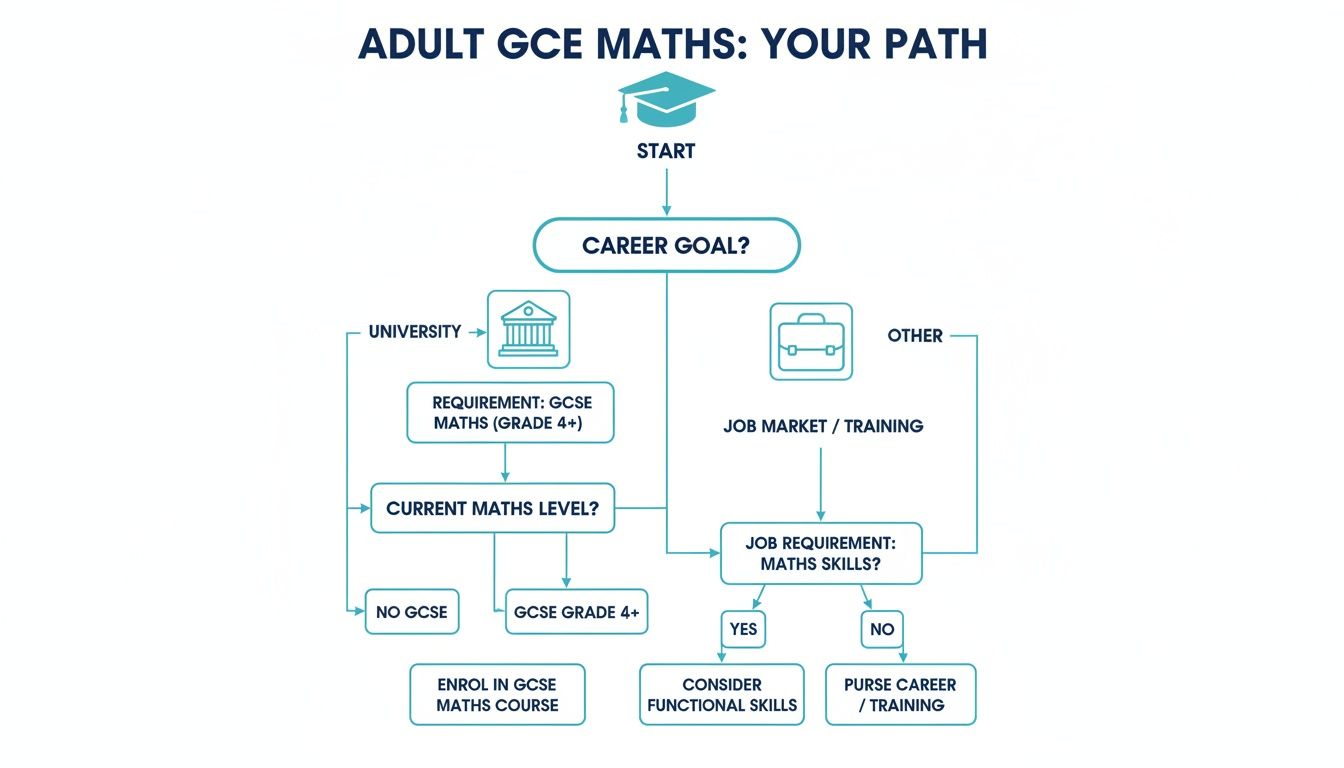
As the flowchart makes clear, if university is your definite goal, the GCSE route is the safest and most widely accepted path.
Key Differences At a Glance
To help you decide which qualification fits your learning style and goals, let's break down the practical differences. Getting your head around these distinctions will help you make a properly informed choice on your adult learning journey.
GCSE Maths vs Functional Skills At a Glance
| Feature | GCSE Maths | Functional Skills Level 2 Maths |
|---|---|---|
| Content Focus | Broad and theoretical, covering number, algebra, geometry, ratio, proportion, and statistics. | Practical and applied, focusing on real-world problem-solving using number, measure, and data. |
| Assessment | Typically three final exams (two with a calculator, one without). No coursework. | One or two exams, often with a calculator and non-calculator section, focused on scenario-based tasks. |
| Grading System | Graded on a 9–1 scale, with Grade 4/5 being the standard 'pass' needed for university. | A simple Pass/Fail system. There are no grades. |
| University Access | The 'gold standard' accepted by virtually all UK universities for degree-level entry. | Accepted by some universities for specific courses or Access Diplomas, but acceptance is not guaranteed. |
For most adult learners planning to use an Access to HE Diploma as their route to university, securing a GCSE Maths qualification is the safest and most direct strategy. It simply removes any doubt about meeting entry requirements.
Ultimately, while both qualifications are valuable, they serve very different purposes. If you just want to build everyday numeracy skills for work or personal life, Functional Skills is an excellent choice.
But if your sights are firmly set on a university degree, investing your time and effort in achieving an adult GCSE maths qualification is the most secure path to success. You can learn more in our detailed guide on Functional Skills Level 2 Maths and see how it compares.
Navigating the Adult GCSE Maths Exam Process
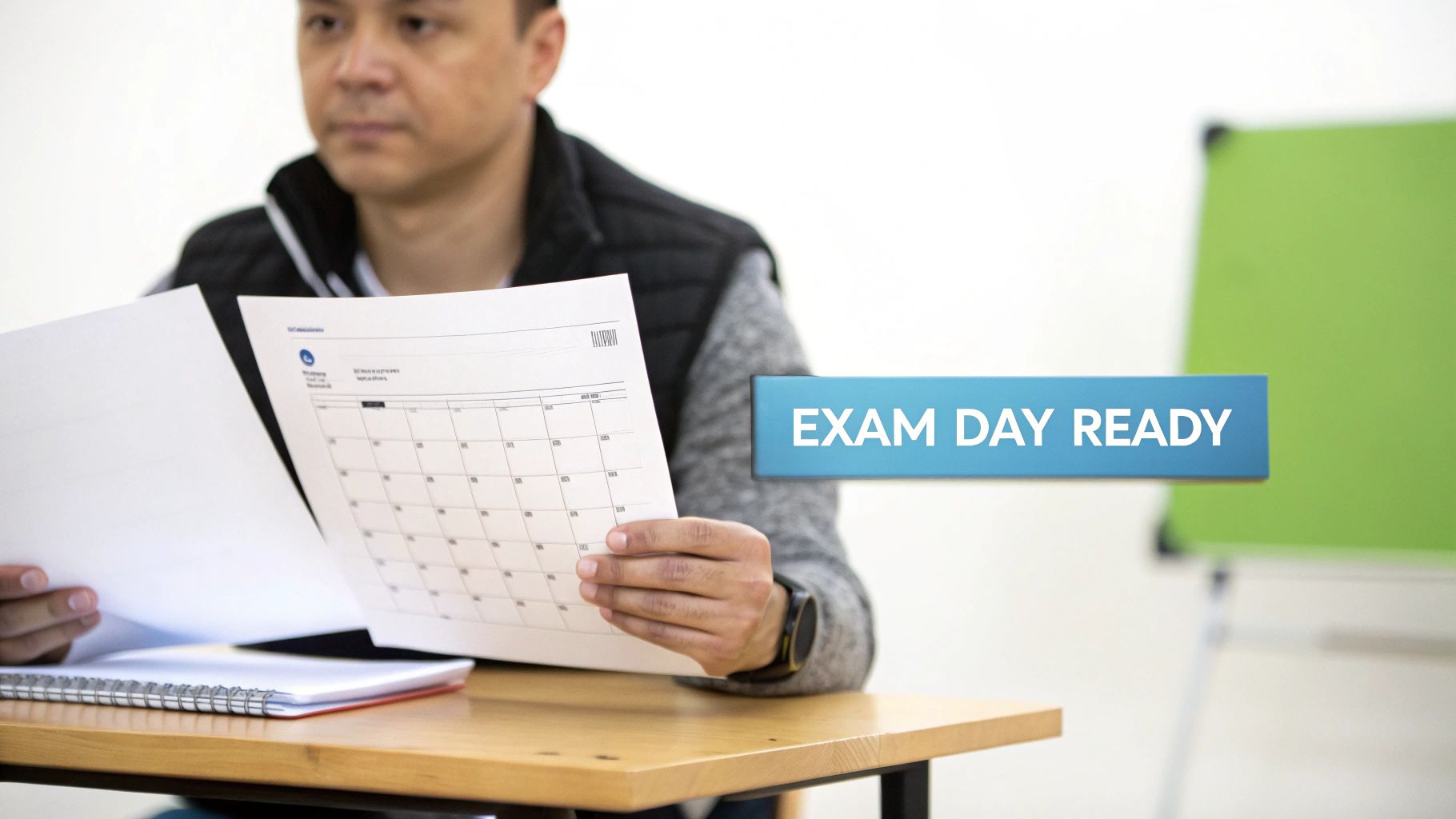
For many adult learners, sorting out the actual exams can feel like the biggest hurdle of all. But don't worry – you're not alone. Thousands of people successfully navigate this process as private candidates every single year. With a clear, step-by-step plan, you can get the logistics sorted and focus on what really matters: your studies.
Think of it a bit like booking a holiday. You need to find your destination (the exam centre), check the dates (the exam timetable), and buy your ticket (pay the exam fees). When you break it down into smaller, manageable tasks, it all becomes a lot less intimidating.
Finding Your Local Exam Centre
First things first, you need to find a school or college that's happy to host you as a private candidate. Not all of them do, so it’s really important to start your search early – ideally in the autumn before the summer exam season kicks off.
The best place to start is the websites of the major UK exam boards, like AQA, Pearson Edexcel, and OCR. They all have tools to help you find approved centres in your area.
- AQA: Has a handy search tool for centres that accept private candidates.
- Pearson Edexcel: Offers a similar directory to help you find local schools and colleges.
- OCR: Keeps its own list of available centres right across the country.
Once you’ve got a shortlist of potential places, it’s time to get in touch. Whether you call or email, just be clear and direct. Explain that you're an adult learner studying for your adult GCSE maths qualification and you want to register as a private candidate. They'll let you know if they have space and walk you through their specific registration process and deadlines.
Make sure you ask about their fees upfront. These can vary a lot from one centre to another, often ranging from £100 to over £200. This fee usually covers the exam board's charge plus the centre's own admin costs.
Choosing the Right Tier: Foundation or Higher
One of the biggest decisions you'll make is whether to sit the Foundation or Higher tier paper. This choice directly affects the grades you can achieve, which is a massive deal if you're aiming for university.
The two tiers are designed for different levels of mathematical ability and offer a different range of grades.
Foundation Tier:
- Covers grades 1 to 5.
- The content is more straightforward, focusing on the core concepts of maths.
- This is the safest bet if you need to lock in a Grade 4 or 5 (what used to be a C/B) for a university place.
Higher Tier:
- Covers grades 4 to 9.
- This paper gets into more complex and abstract topics in algebra, geometry, and problem-solving.
- Here's the catch: if you don't score enough marks for a Grade 4, you'll get a 'U' for unclassified – which means you won't pass at all.
For most adult learners whose main goal is hitting that standard university requirement of a Grade 4 or 5, the Foundation tier is the most strategic choice. It gives you a clear and achievable path to the grade you need, without the high-stakes risk of the Higher paper. By focusing your energy on mastering the Foundation syllabus, you'll build confidence and give yourself the best possible shot at success.
Building a Study Plan That Fits Your Life

Most study advice seems to be written for teenagers with endless free time. That’s rarely the reality when you’re an adult. Juggling a job, family, and everything else life throws at you means you need a study plan that’s realistic and sustainable, not just ambitious. For adult GCSE maths, the secret isn't finding huge, empty blocks of time—it's about making the most of the small pockets you already have.
It's time to ditch the "all or nothing" mindset. Instead of trying (and often failing) to carve out a marathon three-hour study session on a Sunday, think smaller. Focusing on shorter, more frequent opportunities is not only more manageable but also far more effective for actually remembering what you’ve learned.
Master Your Time with Smart Techniques
Trying to force yourself to concentrate for hours on end is a fast track to burnout. A much smarter approach is to work with your brain's natural rhythm, not against it. One of the best tools for this is the Pomodoro Technique. It's a surprisingly simple method that breaks your study time into focused bursts.
Here’s how it works:
- Pick one task to focus on (like practising algebra equations).
- Set a timer for 25 minutes and work on that single task without any distractions. No phone, no email, just maths.
- When the timer pings, take a 5-minute break. Get up, stretch, grab a coffee, or just step away from your desk.
- After four of these "Pomodoros," take a longer break of around 15-30 minutes.
This technique keeps you focused, stops you from feeling overwhelmed, and makes even the most daunting topics feel approachable. It’s all about consistency, not cramming.
Weaving learning into your daily routine is another game-changer. Your commute can become a moving classroom with study apps on your phone. Even a 15-minute break at work is long enough to review a key concept. By fitting in these micro-sessions, you keep the material fresh in your mind without having to completely overhaul your schedule.
Breaking Down the GCSE Maths Syllabus
At first glance, the GCSE Maths syllabus can look pretty intimidating. But when you realise it's just a collection of smaller, more manageable topics, it becomes a lot less scary. The curriculum is organised into a few core areas.
These are the main pillars you’ll need to get to grips with:
- Number: This is your foundation. It covers everything from fractions and percentages to standard form and surds.
- Algebra: Here, you'll learn to work with expressions, solve equations, and get your head around sequences and graphs.
- Ratio, Proportion, and Rates of Change: This is the practical side of maths, including things like scale drawings, currency conversions, and direct proportion.
- Geometry and Measures: Get ready for angles, shapes, trigonometry (think Pythagoras and SOHCAHTOA), and calculating area and volume.
- Statistics and Probability: This involves learning how to interpret data from charts and calculate the likelihood of different outcomes.
Your first step should be figuring out where you stand. A great way to do this is by tackling a practice paper early on. Your results will act as a personal roadmap, highlighting which topics need the most attention. Prioritise the areas where you dropped the most marks and build your plan around strengthening those weaknesses first.
The journey of an adult learner is unique. While statistics show only 15.3% of 17-19 year-olds pass their maths resits, the pass rate for learners aged 20 and above climbs to 34%. This really shows how motivation and mature study habits can make a huge difference to your success.
The Power of Consistent Practice and Support
Success in adult GCSE maths comes from regular, consistent practice—not from last-minute cramming sessions a week before the exam. Aim to do a little bit of maths every day, even if it’s just for 20 minutes. This daily effort builds momentum and embeds concepts in your long-term memory. To make your study sessions even more effective, try using the spaced repetition study method, a scientifically proven way to boost retention.
This is where a structured online course really comes into its own. Instead of trying to piece together a curriculum from random YouTube videos, a good course provides a clear, logical path through the syllabus. It gives you access to expert tutors to answer your questions and a library of practice materials designed for the exam. Having that structure removes the guesswork and lets you focus your energy purely on learning.
Ultimately, your study plan is a personal tool designed to fit your life. By combining smart techniques with a structured course, you can create a sustainable schedule that builds your confidence and leads you straight to that all-important pass grade. For more practical advice, check out our guide on creating a study schedule that actually works.
Finding Funding and Support for Your Studies
Let's be honest, the thought of paying for a course can be a big hurdle. But worries about cost should never be the thing that stops you from chasing your goals. Think of studying for your adult GCSE maths qualification as an investment in yourself, and luckily, it’s one you often don’t have to make alone.
There’s a surprising amount of financial help and personal support out there, all designed to help adult learners like you get across the finish line. Knowing where to look is half the battle.
Exploring Your Financial Options
The biggest helping hand for adult learners in England is the Adult Education Budget (AEB). It’s a government scheme set up specifically to help people gain the qualifications they need to get a job or move up in their careers. For many, this means you could get your GCSE Maths course fully funded.
Whether you’re eligible depends on a few things, like your age and what qualifications you already have. As a general rule, if you’re 19 or over and don't already have a Grade 4 (what used to be a C) in GCSE Maths, you’ve got a very good chance of studying for free at a local college.
But government funding isn’t the only path. Plenty of people find other ways to make it work:
- Employer Sponsorship: It’s always worth a chat with your boss. Gaining a key qualification like GCSE Maths makes you more valuable to them, too! Many employers are happy to invest in their staff’s development.
- Flexible Payment Plans: We get it – life has costs. Most online course providers offer interest-free payment plans that let you spread the cost of your course over several months, making it much easier to budget for.
The Importance of a Strong Support Network
Money matters, but having the right people in your corner is just as important. Studying as an adult comes with its own unique set of challenges, and a good support system can be the difference between powering through a tough week and giving up.
A great online course is more than just a folder of learning materials; it’s a connection to a dedicated support system.
Support isn't just about getting answers to tricky maths problems. It's about having a team that genuinely believes in you and understands the juggling act of adult learning. That encouragement is often what carries you through.
When you’re choosing a course, look for one that gives you access to experienced tutors for one-to-one guidance. These are the people who can break down complex topics and give you that little boost of encouragement just when you need it.
On top of that, many online platforms have buzzing student communities. These forums are brilliant for connecting with other people who are in exactly the same boat. Sharing revision tips, celebrating small wins, or just knowing you’re not the only one burning the midnight oil can be incredibly powerful. By pairing financial help with a solid support network, you’re creating the perfect environment to focus on what matters: smashing your adult GCSE maths journey.
From GCSE Maths to Your University Degree
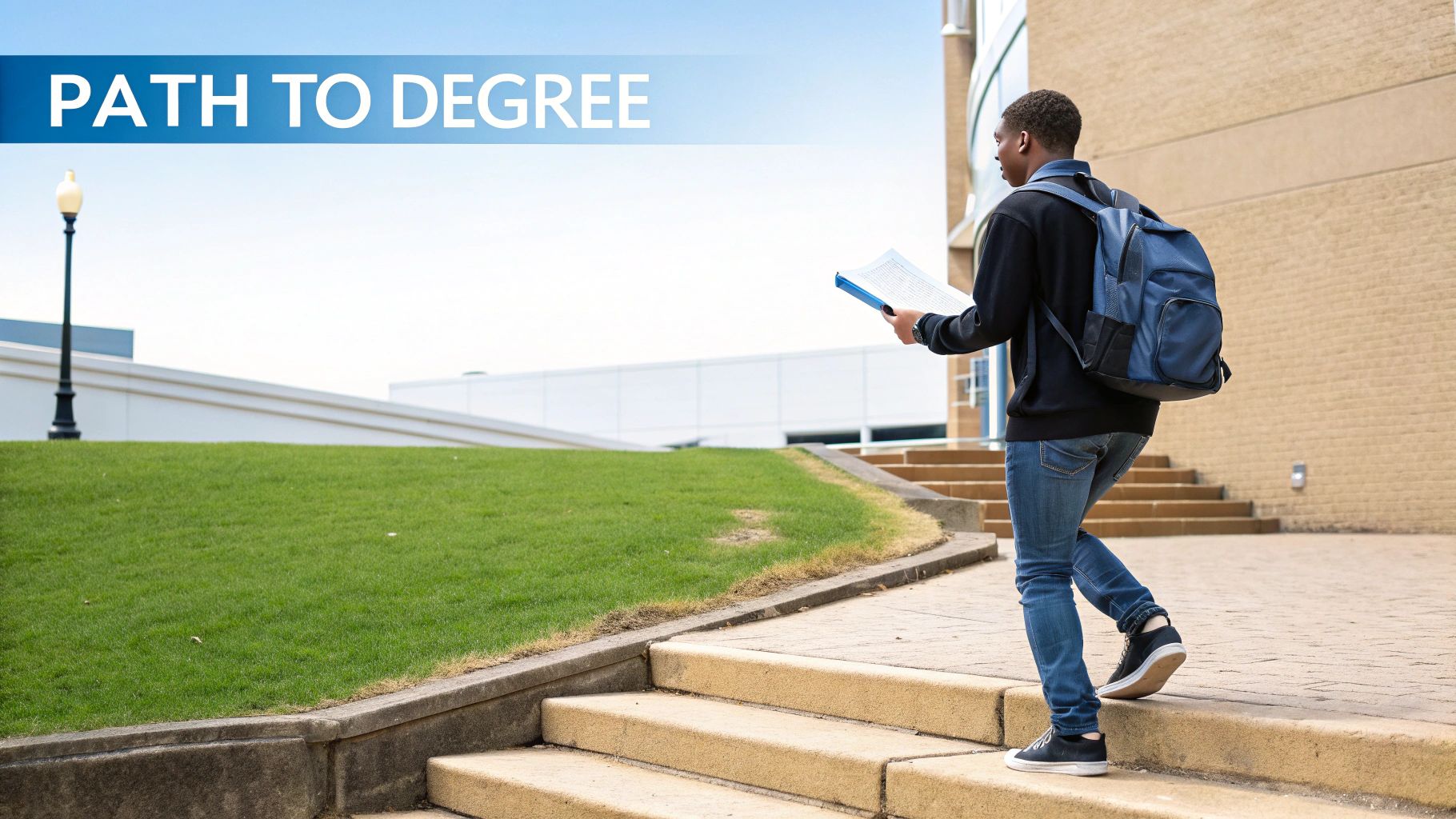
This is where all your hard work finally pays off. Nailing your adult GCSE maths qualification isn’t just about ticking a box; it’s about unlocking the next chapter of your life. Think of it as the master key that opens the door to higher education, especially if you don't have A-Levels.
This one achievement paves the way for the most popular university route for adult learners: the Access to Higher Education Diploma. These diplomas are specifically built to bridge the gap between where you are now and a university degree, getting you fully prepared for undergraduate study.
Your Seamless Progression Plan
Imagine a clear, direct path from today to your first day as a university student. That’s precisely what this route offers. Once you have your GCSE Maths certificate in hand, you can move straight onto an Access to HE Diploma in the field that genuinely excites you.
This smooth transition is a game-changer for adults who need to get qualified without putting their lives on hold. A typical journey looks a bit like this:
- Enrol and complete your GCSE Maths course online, fitting your studies around your existing commitments.
- Achieve your Grade 4 or higher, securing that essential university entry requirement.
- Immediately enrol on an Access to HE Diploma in a subject you’re passionate about, like Nursing, Social Science, or Computing.
- Complete your diploma and use it to apply to universities all over the UK for your chosen degree.
This structured pathway removes the uncertainty that so often holds adults back. It turns a distant dream of earning a degree into a clear, step-by-step journey with achievable milestones.
The numbers really back up the success of dedicated adult learners. While general GCSE results show a 67.1% pass rate for Grade 4 and above, the figures for adults tell a more inspiring story. Adults aged 20 and over achieve a 34% pass rate in maths—that's more than double the rate for younger resit students. It proves that mature learners, often using flexible online courses, have the focus and drive to succeed.
This isn't just a theory; it’s a reality for thousands of people every year. Many learners start in the exact same position you're in now and are currently studying for their dream careers at university. This is a well-trodden path designed to help you succeed. You can find out more about how to get into university without A-Levels in our dedicated guide.
Answering Your Top Questions About Adult GCSE Maths
Deciding to go back to education is a huge step, and it’s completely normal to have a few questions swirling around. You're probably feeling a mix of excitement and maybe a little bit of apprehension. We get it. To help put your mind at ease, here are some straight-talking answers to the questions we hear most often.
How Long Does It All Take?
This is the big one, isn't it? The honest answer is that it really depends on you and your life. Unlike being back at school with a rigid timetable, online courses are built around your schedule. Most of our adult learners find that they feel ready for their exams within nine to twelve months.
But that's just an average. If you can carve out more time each week or you find some of the topics are coming back to you easily, you could be ready much faster. The real secret isn't speed, it's consistency. A little bit of focused study a few times a week is always going to be more powerful than a frantic cramming session on a Sunday night.
Are Online GCSE Maths Courses Actually Respected?
Yes, one hundred percent. When it comes to the qualification itself, universities and employers don't distinguish between how you studied for it. Whether you were in a college classroom or at your kitchen table, you sit the very same official exam papers from awarding bodies like AQA or Pearson Edexcel.
What truly matters is the final certificate with your grade on it. How you chose to prepare for that exam is your business, and online learning is a proven and respected route for thousands of adults every single year.
Can I Get Into University With An Online GCSE?
Definitely. For many adults, this is the entire reason they take the qualification in the first place! Getting a Grade 4 or higher in GCSE Maths is a standard entry requirement for the vast majority of Access to HE Diplomas and university degrees across the UK.
Think of it as the key that unlocks the door to your future. Nailing that pass is often the first critical step on your journey into higher education, opening up degree courses in nursing, business, engineering, and so much more.
What Happens If I Don't Pass The First Time?
Failing an exam feels rubbish, there's no sugar-coating it. But it is never the end of the road. It’s just a bump in it. It’s a setback, not a reflection of your potential. You can absolutely resit your GCSE Maths exams, and you'd be surprised how many adult learners find they smash it the second time around.
You'll go into your resit with real-life exam experience, a much better understanding of the process, and a crystal-clear idea of which topics you need to focus on. It sets you up perfectly for success on your next try.
Ready to take that first step towards university and a new career? At Access Courses Online, we specialise in accredited, flexible courses designed to fit around your life. Explore our GCSE and Access to HE Diplomas today.