

You've got the brief open in one tab, a mug going cold in the other, and a half-finished draft that still doesn't feel like it's answering the question. Maybe you're trying to fit study around a shift pattern, a school run, or both, and the main problem isn't effort, it's that the assignment still feels hidden behind the wording. Good assignment guidance should make the task visible before you write a word.
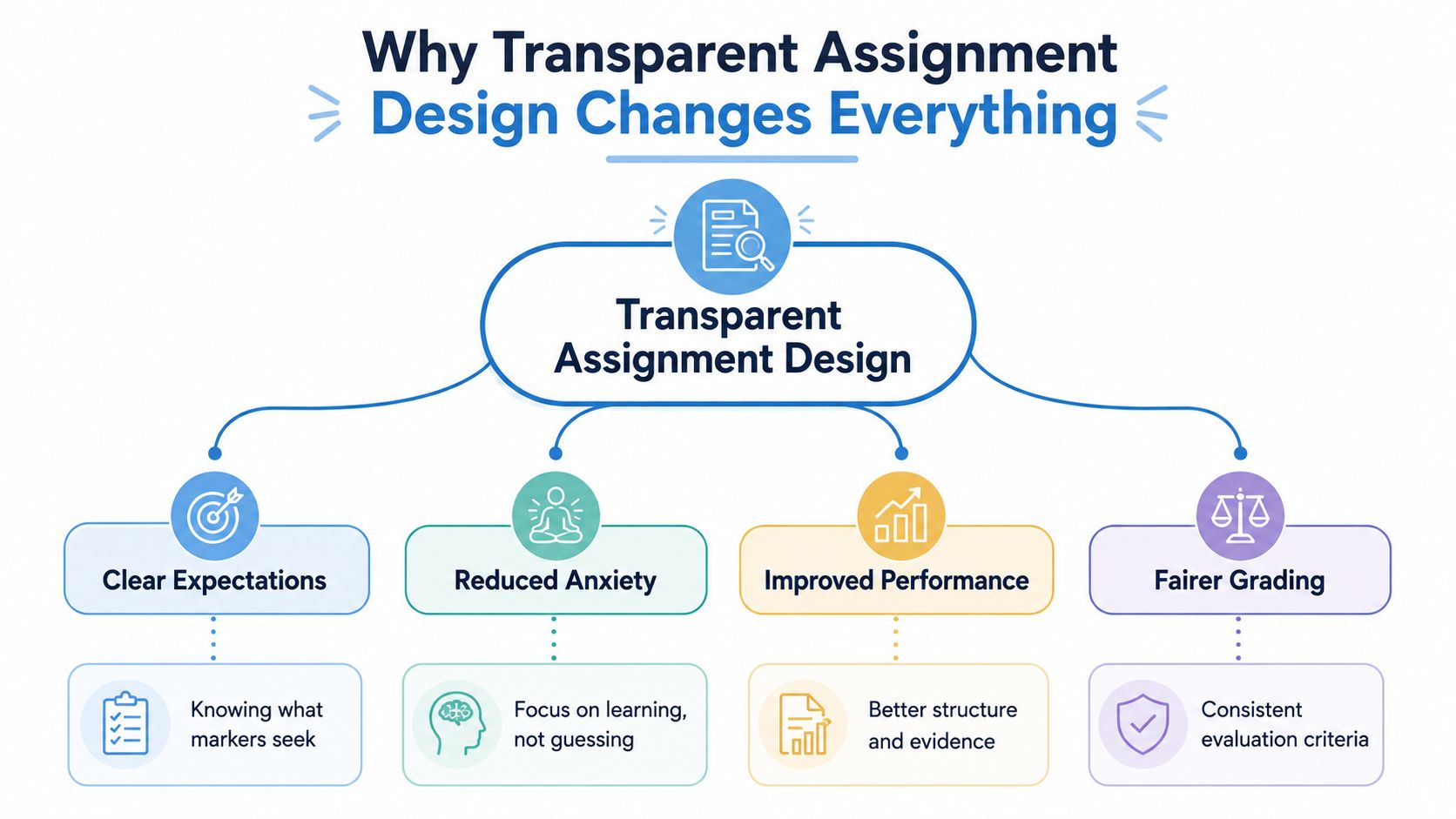
Why Transparent Assignment Design Changes Everything
Adult learners often lose marks because they're guessing what the marker wants, not because they lack ability. That's why transparent assignment design matters so much in Access to HE work, it turns a vague brief into three visible parts, the purpose, the task, and the criteria. Once you can see those three things clearly, you stop writing into the dark.
Read the brief as three separate messages
The purpose tells you why the assignment exists. The task tells you what you must do, usually through verbs like explain, evaluate, compare, or justify. The criteria tell you how the work will be judged, which is where hidden expectations usually live.
A brief for a Nursing Access unit might say, “Evaluate the impact of communication on patient care.” That sounds broad, but the actual work starts when you split it up. The purpose is to show you understand communication in health settings, the task is to evaluate, not describe, and the criteria will usually expect evidence, examples, and judgement.
Practical rule: if you can't point to the purpose, task, and criteria in the brief, you're not ready to draft yet.
A useful way to decode a brief is to make a one-page assignment map. Write the verb first, then list the constraints, such as word count, number of sources, or required format. Then add the marking clues, which are often tucked into phrases like “use examples” or “show analysis.”
This approach matches the logic behind clear assignment design and learning outcomes, which you can see in teaching guidance on learning outcomes and in useful explanations of understanding teaching models. It's the same reason transparent briefs work better than generic “good writing” advice, they show students what success looks like.
A Five-Checkpoint Planning Workflow
Adult learners need a workflow that respects limited time. A brief gets much easier when you stop treating it like one huge task and break it into checkpoints that can fit around work, family, and tired evenings. The sequence below works well because it moves from understanding to evidence, then to drafting, then to revision.
Start with a rewritten prompt
First, rewrite the prompt in your own words. If the brief says, “Evaluate the role of small businesses in the UK economy,” your version might be, “I need to judge how small businesses contribute, where they help, and what limits there are.”
That simple rewrite stops you drifting into description. It also helps you spot the exact scope, which matters on Access modules where one word in the verb can change the whole task.
Build a source shortlist before you write
Next, gather only the sources you need. If the assignment asks for recent evidence on a Business or Health topic, don't hoard links, choose the most relevant ones and make notes on what each source can support.
A common trap is researching endlessly because writing feels risky. Better to decide, “I need three strong sources for this paragraph, not ten random tabs.” That gives you enough evidence without wasting time.
Draft an outline, then test it
Use a one-page outline with headings or paragraph topics. Then test one rough paragraph against the rubric. If the paragraph only describes a source, the rubric usually tells you that you need more analysis, comparison, or judgement.
Revise substance before polish
The final checkpoint is revision for meaning, not just spelling. If a paragraph repeats the source instead of answering the brief, rewrite the sentence that comes after the evidence so it explains what the evidence means.
If your notes are tidy but your answer is unclear, the problem isn't grammar, it's structure.
A practical weekly plan helps here. Block two or three short study sessions in your calendar, not because productivity is magical, but because small sessions make it easier to finish one checkpoint before the next begins. The five-step method in this assignment planning guide fits that rhythm well, especially if you're balancing study with everything else.
Harvard vs APA for Access to HE Assignments
Referencing causes panic because it looks technical, but most mistakes come from mixing systems or rushing the final list. On Access to HE courses, you're most likely to meet Harvard on Business and Social Science pathways and APA on Health and Science pathways, so the first job is always to check the brief. If the unit guide names a style, follow that exact style, not the one you used last term.
Harvard and APA side by side
| Feature | Harvard | APA |
|---|---|---|
| In-text citation | Author and date in brackets | Author and date in brackets |
| Page number for a direct quote | Usually required | Required |
| Reference list order | Alphabetical by author surname | Alphabetical by author surname |
| Capitalisation in reference list | Sentence-style or course-specific variants | Sentence-style for article titles |
| Typical Access use | Business, Social Science | Health, Science |
A quick example makes the difference easier to see. In Harvard, a paraphrase might look like (Smith, 2022), and a direct quote usually needs the page number. In APA, a paraphrase also uses author and date, but the formatting of the reference list and quoted material follows APA conventions exactly.
The biggest errors I see are missing dates, inconsistent capitalisation, and no page number for a direct quote. A five-minute reference audit before submission catches most of them. Check every in-text citation against the reference list, then scan for one source that's been cited in the text but never listed at the end.
For a clean overview of citation basics, the guide to what referencing is is useful because it keeps the focus on matching your in-text citations to your final list rather than memorising isolated rules.
Structuring Essays and Reports That Flow
A clear structure is like a route map for the marker. They should be able to follow your thinking without having to guess where each point is going. Adult learners often either plan every sentence in advance or start writing before the shape is clear, and both can leave the final piece feeling hard to follow.
Essays need a route, not just paragraphs
An essay still works best with introduction, main body, and conclusion, but the key difference comes from how each paragraph leads to the next. Each main point should finish with a sentence that points forward, so the reader does not feel dropped from one idea into another.
A simple pattern is point, evidence, explanation, link. If you are writing about nursing communication, one paragraph might focus on listening skills, the next on documentation, and the next on how communication affects patient safety. The linking sentence is what keeps that sequence moving, like stepping stones across a stream. If you are still getting the shape of the argument clear, an essay plan template can help you place each point before you start drafting in full sentences.
Reports need labelled sections
Reports are more explicit. A common Access format is introduction, findings, discussion, conclusion, and recommendations. That format suits factual topics because it separates what you found from what you think it means.
If you are writing a Business report on customer service, findings can present the evidence, discussion can interpret it, and recommendations can turn that analysis into action. That keeps the report from turning into one long block of blended opinion and summary.
For messy notes, a structure tool can help you create structure while ideas are messy without forcing your thoughts into a false order too early. A good essay plan template also helps you decide where each point belongs before you start drafting in full sentences.
Word count matters here too. Keep the conclusion brief and judgmental, not sprawling. If the conclusion starts becoming a second main body, the structure needs tightening.
Writing With Evidence the UK Way
UK academic writing usually expects you to do more than list facts. You need to give a clear answer, state the relevant evidence, explain what it means, and note limits where they matter. That pattern appears in UK statistical communication guidance and in university teaching, because the goal is interpretation, not repetition. It's also why writers are told to be precise about the population, sample size, and method when using data in an assignment.
Answer first, then evidence, then meaning
A strong paragraph starts with your judgement. If a Science brief asks you to interpret a small dataset on patient waiting times, don't begin by describing the table row by row. Start with the point you want the reader to understand, then bring in the evidence that supports it, then explain what the numbers suggest.
That order helps the marker see that you're making a decision, not just collecting information. It also matches the plain-language principle used in government-style statistical writing, where main messages come first and numbers are kept in context.
Practical rule: if a paragraph ends with a statistic and no explanation, it's unfinished.
Choose evidence that can actually do a job
Credible sources usually have a date, an author, and enough context to judge how the information was produced. If a source doesn't show where the data came from, or if the sample is unclear, it's harder to use confidently in an assignment.
The common mistake is over-summarising. Students often repeat what the source says, then move on, but the brief usually wants a conclusion about what that source means for the question being asked. A note to yourself like “So what does this tell me?” can save a lot of marks.

Turning Tutor Feedback Into Better Marks
Feedback is one of the few free resources that changes results. The problem is that many adults read it once, feel frustrated, and leave it in the folder. Better marks come when you treat feedback like working instructions, not a verdict on your ability.
Separate the type of comment
A note about analysis is different from a note about presentation. If a tutor writes that your work is descriptive, that usually means your paragraphs are reporting information but not explaining its significance. If the comment is about spelling or formatting, that's a smaller fix, and it shouldn't distract you from the bigger issue.
Turn each comment into an action. For “analysis is descriptive,” the revision action might be, “After each source, add one sentence that says what the evidence implies for the brief.” That's concrete enough to use straight away.
Keep one feedback log across the diploma
A simple log helps you spot repeating patterns. Write the assignment title, the main comments, the correction you made, and any wording you want to reuse next time. Over time, that log becomes a map of your own habits, which is far more useful than guessing where you usually lose marks.
Useful follow-up questions are short and specific. You can ask, “Do you want more evidence in the middle paragraph?” or “Should I compare two sources here, or just explain one in more depth?” Those are better than asking, “How do I improve my assignment?” because they give the tutor something clear to answer.
Common Pitfalls and How to Dodge Them
Most Access to HE mistakes are predictable, which is good news. If you know where learners usually slip, you can fix the problem before it costs marks. The fastest wins often come from boring habits, not dramatic rewrites.
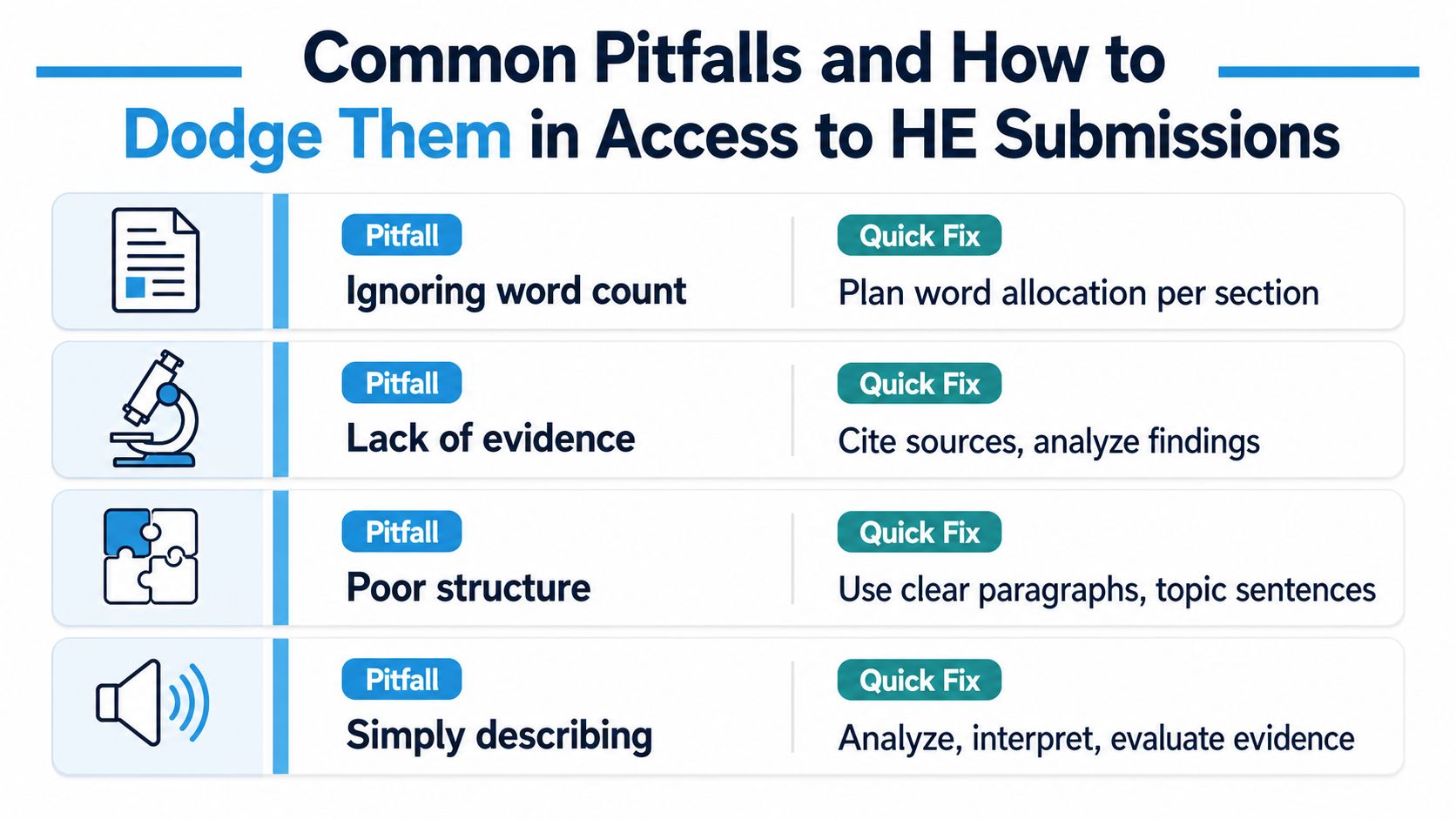
The mistakes that keep coming back
- Ignoring word count. Plan how many words each section gets, then leave room for the conclusion.
- Lack of evidence. Cite sources, then explain what they show.
- Poor structure. Use topic sentences so each paragraph has one clear job.
- Describing only. Add judgement, comparison, or implication after the facts.
- Last-minute submission. Finish early enough to read the work once with fresh eyes.
- Skipping the final proofread. Read the submission in the portal format, not only in Word.
- Missing backup copies. Save your draft in at least two places.
- Overlooking inclusive submission options. If your pathway allows audio, diagrams, or annotations, check whether they suit the brief better than a long essay.
A clean habit beats a heroic rush. The final proofread often catches the tiny errors that make a polished assignment look unfinished, and that last check is usually where confidence starts to match the quality of the content.
If you want more practical support with Access to HE study, Access Courses Online offers flexible routes that fit around work and family, along with guidance that helps you understand briefs, structure your answers, and stay on track. If you're ready to turn confusing assignment guidance into a repeatable routine, visit the site and look at the Access to HE options that match your next step.